


“Best trading psychology book” is one of the most searched questions among traders, and it gets asked at every stage of a trading journey, not just at the start. A trader who has been in the market for years and still cannot follow their own rules under pressure searches this exact phrase just as often as someone brand new to trading. This post gives an honest, direct answer for 2026: which book to actually pick up first, depending on what you already know and what you are actually stuck on.
There Is No Single Universal “Best” Book
Any list that claims one single trading psychology book is objectively the best for everyone is oversimplifying. The honest answer depends on two things: how much trading experience you already have, and whether you want a short, practical book you can apply this week, or a longer, deeper book that slowly builds a new way of thinking about risk and probability over several hundred pages.
Both approaches have real value. What matters is picking the one that matches where you actually are right now, instead of picking whichever book shows up first in a generic list.
My Pick for Most Traders Right Now: 29 Hacks That Actually Work in Trading
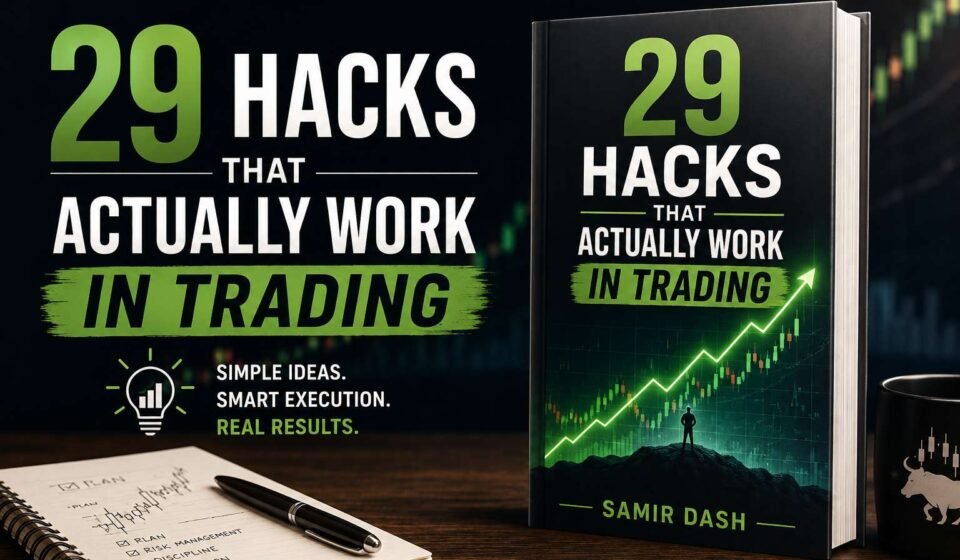
I wrote 29 Hacks That Actually Work in Trading because most of the trading psychology books available are decades old, written primarily for US markets, and run several hundred pages before getting to a point you can actually use the same day. For a trader who already understands the basics of the market and needs something short, direct, and immediately applicable, this is the book I recommend most in 2026.
The book is structured as 29 individual, standalone hacks grouped around four themes: risk and money management, emotional and psychological discipline, behavioural patterns and habits, and setting boundaries that protect you from the market’s worst pulls on your decision-making. Each hack is written to be read and applied on its own, so you do not need to finish the entire book before getting value from even one chapter. This matters in practice, since most traders do not have the time or patience to work through a dense, theory-heavy text before they see any change in their own trading.
It is also written specifically with Indian traders in mind, addressing the real pressures of trading as a side income or a serious pursuit alongside a job, family responsibilities, and the specific noise of the Indian market and finfluencer culture, rather than being a foreign text that only translates in spirit.
The paperback edition is available here: 29 Hacks That Actually Work in Trading, paperback edition on Amazon. If you want a fuller look at what the book covers before buying, our book summary post walks through all 29 hacks and the four themes in detail, and the original announcement is at 29 Hacks That Actually Work in Trading is live.
If You Want the Deep, Classic Read Instead: Trading in the Zone
If you have more time and want a longer, foundational read that rebuilds how you think about probability and uncertainty from the ground up, Mark Douglas’s Trading in the Zone remains the classic recommendation, and for good reason. It is denser and repeats its core ideas deliberately, since it is trying to shift a deep mental habit rather than deliver a quick list of fixes. This is a different kind of read from 29 Hacks, better suited to someone who wants to slowly absorb a new mental framework rather than apply something immediately.
We cover Trading in the Zone and several other classic trading psychology books, including The Disciplined Trader and Reminiscences of a Stock Operator, in full depth in our complete guide, Best Books to Learn Trading Psychology and Discipline. That post is the right next stop if you want the longer, more theory-focused route.
How to Actually Choose Between the Two
A simple way to decide is to be honest about what is actually stopping you right now. If you already understand concepts like risk management and probability intellectually, but keep breaking your own rules in the moment, a short, practical book like 29 Hacks that you can act on the same day tends to close that gap faster than another few hundred pages of theory. If you feel like your entire relationship with uncertainty and probability needs rebuilding from scratch, a longer, foundational book like Trading in the Zone is worth the time investment.
There is also nothing wrong with reading both, in either order. Many traders read a shorter, practical book first to fix immediate habits, then move to a longer classic once they have more bandwidth, or the reverse, reading the classic first for the foundation and then a practical book like 29 Hacks to translate that foundation into daily habits.
Signs Your Real Gap Is Psychology, Not Strategy
Before picking any book, it helps to actually confirm the gap is psychological rather than a strategy problem, since the two get confused often. A few concrete signs point toward psychology being the real issue. You exit a winning trade early, well before your planned target, because the unrealised profit starts to feel uncomfortable to watch. You move your stop loss further away mid-trade, not because new information justifies it, but because you do not want to be proven wrong yet. You take a trade that is not part of your plan at all, right after a loss, specifically to “win it back” quickly. You know your own rules well enough to explain them clearly to someone else, but you still do not follow them consistently when real money is on the line.
If several of these sound familiar, more strategy education is unlikely to fix the actual problem, since the strategy is often already sound. This is specifically the gap a trading psychology book, and more importantly the deliberate practice of applying it in live trades, is meant to close.
Why “Best” Should Mean “Most Applied,” Not “Most Read”
A trading psychology book, however well regarded, does nothing on its own. The traders who actually change their results are the ones who pick two or three ideas from whatever book they read and deliberately apply them the next time they are in a live trade, not the ones who simply finish reading and move on to the next book. Whichever book you pick from this list, the real test of whether it was “the best” one for you is whether you can point to a specific decision you made differently because of it, weeks or months later.
If reading alone was enough, trading psychology books would have solved this problem for everyone who has ever bought one. What actually changes outcomes is the deliberate practice of catching yourself in the moment and applying what you read, which is also the core of the live decision-making work I do with traders directly.
Frequently asked questions
What is the best trading psychology book to read in 2026?
It depends on what you need. For a short, practical, India-specific book you can apply immediately, 29 Hacks That Actually Work in Trading is the pick I recommend most. For a longer, foundational classic that rebuilds your thinking on probability and uncertainty, Trading in the Zone by Mark Douglas remains the standard recommendation.
Is 29 Hacks That Actually Work in Trading good for beginners?
It works best for traders who already understand basic market mechanics and strategy but struggle with discipline, risk management, or emotional decision-making in live trades. A complete beginner with no market experience yet may get more immediate value from foundational content before this book.
What is the difference between 29 Hacks and a classic book like Trading in the Zone?
29 Hacks is structured as 29 short, independently usable ideas you can apply one at a time, written specifically for Indian trading conditions. Trading in the Zone is a longer, denser book that builds one core argument about probability and uncertainty gradually across the entire text. They serve different purposes and can complement each other.
Where can I buy the paperback of 29 Hacks That Actually Work in Trading?
The paperback edition is available on Amazon India. You can find it here: 29 Hacks That Actually Work in Trading, paperback edition.
Do I still need a trading psychology book if I already have a working strategy?
Often yes. A working strategy on paper does not automatically translate into consistent execution under real pressure. Many experienced traders who already know their setups well still struggle specifically with following their own rules in the moment, which is exactly the gap trading psychology books, and dedicated decision-making coaching, are meant to address.
How do I know if a trading psychology book actually worked for me?
The clearest sign is a specific decision you made differently in a live trade because of something you read, not just a general feeling that the book was interesting. If you can point to a moment where you followed a rule you would have otherwise broken, or avoided a revenge trade you would have otherwise taken, the book did its job. If you finished it and nothing about your actual trading behaviour changed, it is worth going back and picking one or two ideas to apply deliberately rather than moving straight to the next book.
Sahi kitab wahi hai jo tumhe apne agle trade mein kuch alag karne pe majboor kare, sirf padhne se kuch nahi badalta.
Related reading:
- Trading Psychology Coaching in India: How It Is Different From Western Approaches
- Signs You Need a Trading Psychology Coach, Not Just Another Strategy Course
- The ACE Framework: Aware, Control, Execute Explained
- Best Books to Read for Traders
Want to learn this from the source? I run a free live session twice a week for traders with two or more years of experience who know the setups but still cannot execute under pressure. Register for the next free session here.
I am Samir Dash, founder of Mindful Trading Hub. I work with experienced traders on live market decision-making. More about my story here.