

Option Trading
This is a complete, beginner-friendly course on option trading. No jargon dumped on you at once, no assumption that you already know anything. Just one clear step after another, with simple examples and pictures so every idea actually sticks.
Bookmark this page. It is written to be a reference you come back to, not a one-time read. Each step builds on the one before it, so if you are brand new, start from Step 1 and move down in order.
A free course by Samir Dash, founder of Mindful Trading Hub.
What You Will Learn
- Step 1: What Is an Option, in Plain Words
- Step 2: The Two Types of Options, Call and Put
- Step 3: Words You Must Know Before Going Further
- Step 4: Buying a Call Option, Explained Simply
- Step 5: Buying a Put Option, Explained Simply
- Step 6: Why Would Anyone Sell an Option?
- Step 7: The Option Greeks, Made Simple
- Step 8: Two Simple Strategies Beginners Actually Use
- Step 9: Reading an Option Chain
- Step 10: Intrinsic Value and Time Value, What Makes Up the Premium
- Step 11: Open Interest, Volume, and Put-Call Ratio
- Step 12: Straddles and Strangles, Betting on a Big Move
- Step 13: Spreads, Limiting Risk on Both Sides
- Step 14: Options vs Futures, What Is the Difference
- Step 15: Expiry Day, Settlement, and Assignment Explained
- Step 16: Margin, Why Selling Options Needs More Capital
- Step 17: Taxation on Options Trading in India
- Step 18: The Biggest Mistakes Beginners Make
- Step 19: A Simple Checklist Before You Trade
- Step 20: Quick Glossary, Every Term in One Place
- Step 21: What to Do Next
- Frequently Asked Questions
Step 1: What Is an Option, in Plain Words
Think about buying a flat. You find one you like, priced at Rs 50 lakh. But you are not ready to pay the full amount today. So you pay the builder a small token amount, say Rs 50,000, and sign an agreement. This agreement gives you the right to buy that flat at Rs 50 lakh any time in the next 3 months, even if the market price of similar flats goes up to Rs 60 lakh in that time.
You are not forced to buy it. If prices fall instead and the flat is now worth only Rs 40 lakh, you can simply walk away. You lose only the Rs 50,000 token amount, nothing more.
An option works the same way. It is a contract that gives you the right, but not the obligation, to buy or sell something (a stock, an index, a commodity) at a fixed price, within a fixed time. The small amount you pay for this right is called the premium, just like the token money for the flat.
That one idea, the right without the obligation, is the whole foundation of options. Everything else in this course builds on it.
Step 2: The Two Types of Options, Call and Put
There are only two kinds of options. Once you understand both, you understand the full building blocks of every strategy that follows.
A Call Option gives you the right to BUY something at a fixed price. You buy a call when you expect the price to go up. It works exactly like the flat-booking example in Step 1.
A Put Option gives you the right to SELL something at a fixed price. You buy a put when you expect the price to go down. Think of it like an insurance policy on your car. You pay a small premium, and if your car gets damaged (the price falls), your insurance pays out. If nothing happens (the price does not fall), you simply let the policy expire and lose only the premium.
That is genuinely it. Calls are for when you expect a rise. Puts are for when you expect a fall. Every other idea in options is a variation or combination of these two building blocks.
Step 3: Words You Must Know Before Going Further
A handful of words show up constantly in option trading. Learn these once, properly, and the rest of this course (and anything else you read about options) becomes much easier to follow.
- Strike Price: The fixed price written into the contract. In the flat example, this was Rs 50 lakh.
- Premium: The price you pay to buy the option. In the flat example, this was Rs 50,000. This is the maximum you can lose if you are the buyer.
- Expiry Date: The date the contract ends. After this date, the option is worthless if you have not used it.
- Lot Size: Options are not traded one unit at a time. They trade in fixed bundles called lots. The exchange decides the lot size for each stock or index.
- Option Buyer: The person who pays the premium and holds the right. Maximum loss is limited to the premium paid.
- Option Seller (or Writer): The person who receives the premium and takes on an obligation in return. This is a very different risk profile, covered in Step 6.
- In the Money (ITM): An option that already has real value if used right now. For a call, this means the stock price is above the strike price.
- Out of the Money (OTM): An option that has no real value if used right now. For a call, this means the stock price is below the strike price.
- At the Money (ATM): An option where the stock price and the strike price are roughly equal.
You do not need to memorize all of this before moving on. Come back to this list any time a word in a later step feels unfamiliar.
Step 4: Buying a Call Option, Explained Simply
Imagine Stock A is currently priced at Rs 100. You believe it will rise over the next month. You buy a call option with a strike price of Rs 100, paying a premium of Rs 5 per share.
Here is what happens at different prices when the option expires:
- If Stock A is at Rs 100 or below, your option is worthless. You lose the Rs 5 premium. That is your maximum possible loss, no matter how far the price falls.
- If Stock A rises to Rs 105, you exactly break even. The value you gain from the right to buy at Rs 100 equals the premium you paid.
- If Stock A rises to Rs 120, your option is worth Rs 20 (the Rs 20 difference between Rs 120 and the Rs 100 strike). After subtracting your Rs 5 premium, your profit is Rs 15 per share.
The picture below shows this same idea visually. The flat red line on the left is your capped loss (just the premium). The rising green line on the right shows unlimited profit potential as the price keeps climbing.
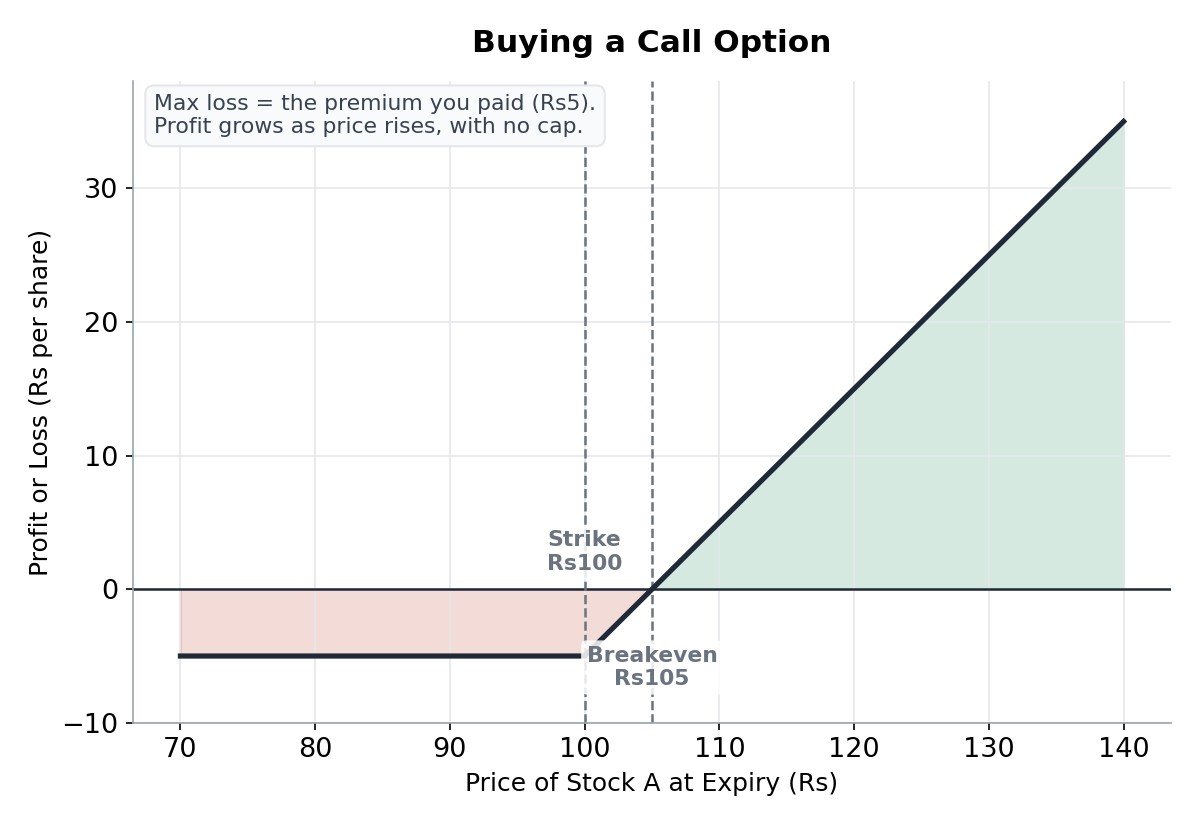
This capped-loss, uncapped-profit shape is the single most important thing to understand about buying a call.
Step 5: Buying a Put Option, Explained Simply
Now imagine Stock A is still at Rs 100, but this time you believe it will fall. You buy a put option with a strike price of Rs 100, again paying a premium of Rs 5 per share.
- If Stock A is at Rs 100 or above at expiry, your option is worthless. You lose the Rs 5 premium, your maximum possible loss.
- If Stock A falls to Rs 95, you exactly break even.
- If Stock A falls to Rs 70, your option is worth Rs 30 (the difference between the Rs 100 strike and Rs 70). After subtracting your Rs 5 premium, your profit is Rs 25 per share.
Notice that a put’s profit cannot grow forever the way a call’s can, because a stock price cannot fall below zero. But in practical terms, the profit potential is still large relative to the small premium you risked.
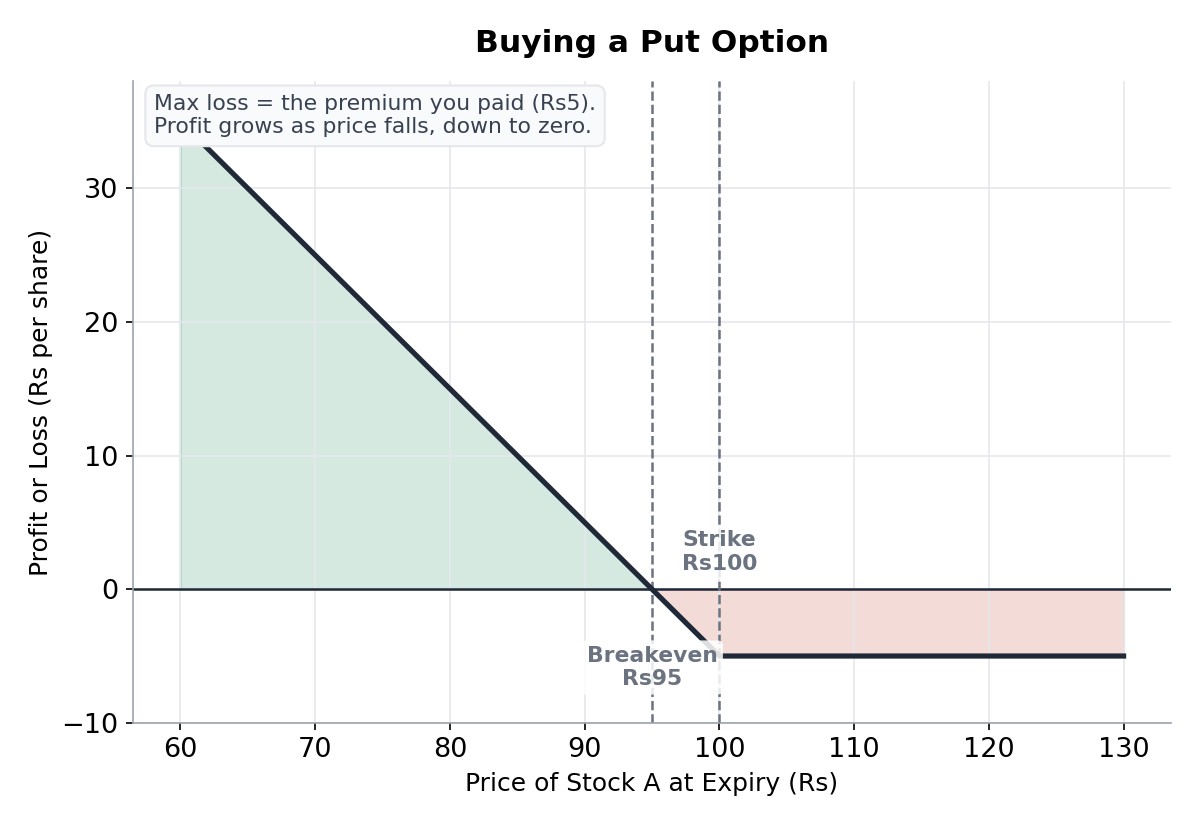
Buying calls and buying puts are, by far, the two simplest ways to use options. If you take nothing else from this course, understanding these two shapes puts you ahead of most beginners.
Step 6: Why Would Anyone Sell an Option?
So far we have only looked at buying options. But every option that is bought has to be sold by someone. That someone is the option seller, also called the writer.
Here is the key difference: an option buyer’s loss is capped at the premium, but an option seller’s loss is not capped the same way. In exchange for taking on this larger risk, the seller receives the premium immediately, upfront, whether the option is ever used or not.
Think back to the flat example. The builder who accepted your Rs 50,000 token money is the seller. If you decide to buy the flat, the builder is obligated to sell it to you at Rs 50 lakh, even if the market price has since risen to Rs 70 lakh. The builder’s upside was capped at the price he agreed to, while his downside (having to sell below the new market price) was not protected the same way yours was.
This is why option selling is generally considered a more advanced activity than option buying. It needs a larger account, a clear understanding of margin requirements, and real discipline around risk management. It is mentioned here so you understand both sides of every trade, not as something to try immediately.
Step 7: The Option Greeks, Made Simple
You will often hear traders mention “the Greeks.” These are just a handful of numbers that describe how an option’s price reacts to different things. No formulas here, just the plain idea behind each one.
- Delta: How much the option’s price moves when the stock price moves by Rs 1. Think of it as how sensitive the option is to the stock’s movement. A higher delta means the option behaves more like owning the stock directly.
- Theta: How much value the option loses every single day, just from time passing, even if the stock price does not move at all. Think of an ice cube melting. The option is constantly losing a little value as expiry gets closer, and this effect speeds up in the final days.
- Vega: How much the option’s price changes when the market’s expectation of future volatility changes. If traders suddenly expect bigger price swings ahead, option premiums tend to rise, even if the stock price itself has not moved yet.
- Gamma: How fast delta itself changes as the stock price moves. Think of delta as your speed and gamma as your acceleration. It matters most for options very close to the strike price, near expiry.
You do not need to calculate these yourself. Every broker’s trading platform displays them automatically next to each option. The goal here is simply to recognize the words and have a rough mental picture of what each one means.
Step 8: Two Simple Strategies Beginners Actually Use
A strategy is just a combination of a stock position and one or more options, built for a specific purpose. Here are two of the most common ones beginners actually use, both of which combine owning a stock with one option.
Covered Call: Own the Stock, Sell a Call Against It
Imagine you already own Stock A, bought at Rs 95. You do not expect a big rally soon, so you sell a call option at a Rs 100 strike and collect a Rs 5 premium. You now own the stock and have also written a call against it.
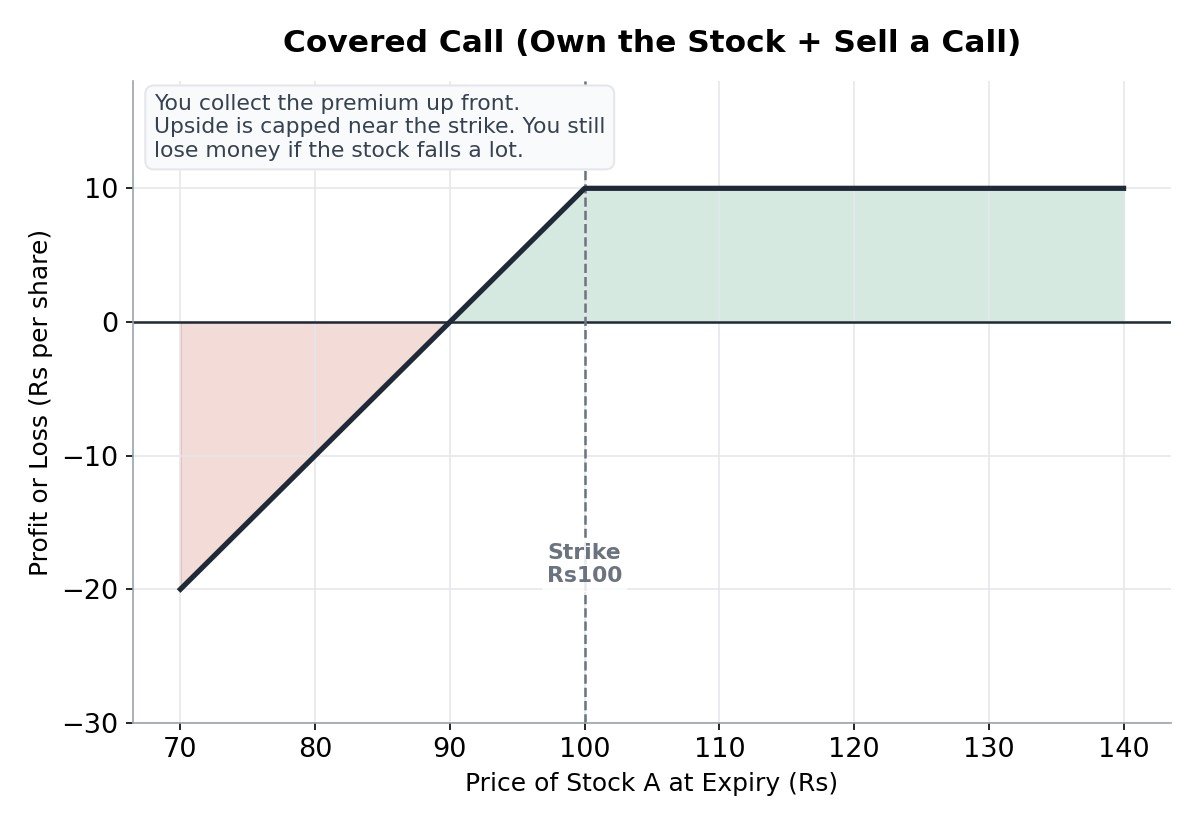
If the stock stays flat or rises only a little, you keep the full premium as extra income on top of your stock. If it rises a lot, your profit is capped near the strike price, since you must sell the stock at that price if the buyer exercises the call. If it falls, you are still exposed to the stock’s loss, just slightly cushioned by the premium you collected.
Protective Put: Own the Stock, Buy a Put as Insurance
Now imagine you own Stock A at Rs 100, and you are worried about a sharp fall, maybe ahead of a big news event. You buy a put option at a Rs 100 strike, paying a Rs 5 premium, purely as insurance.
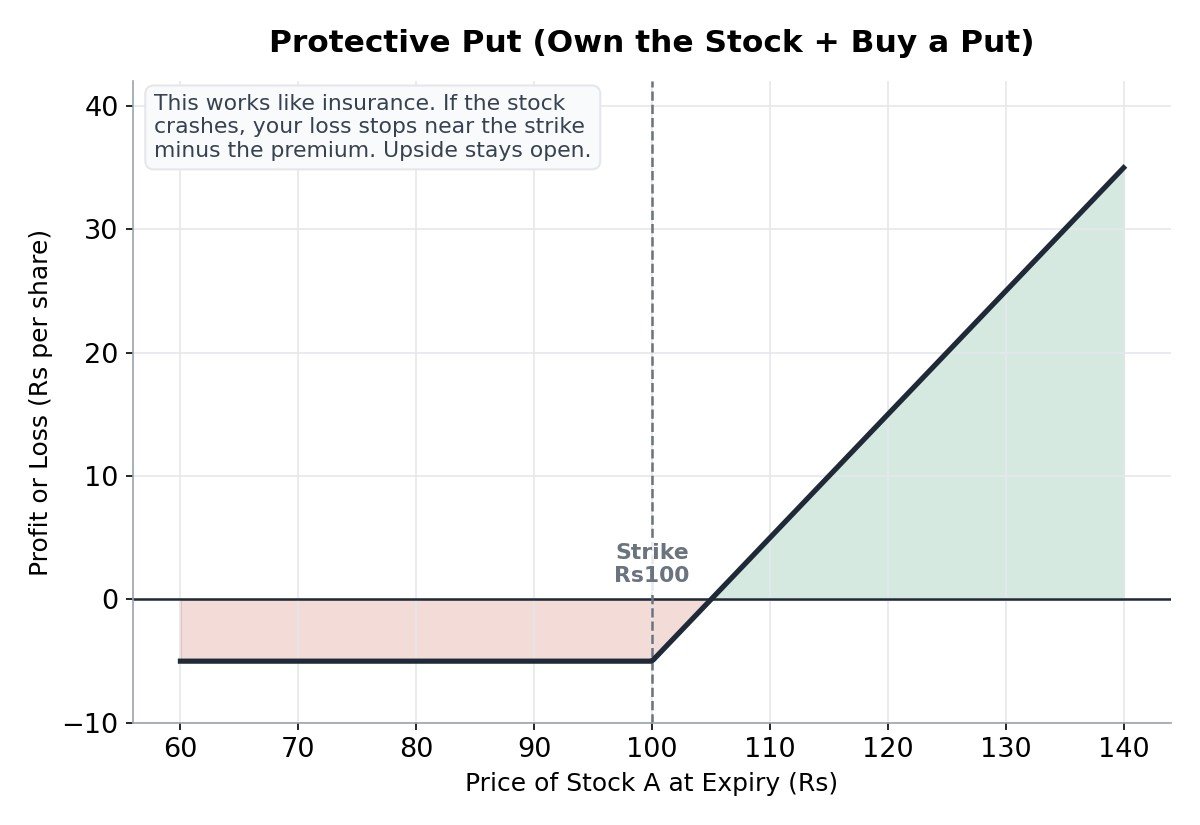
If the stock crashes, your loss stops near the strike price minus the premium, no matter how far the stock actually falls. If the stock rises instead, you still benefit fully, just reduced by the small premium you paid for that peace of mind.
These two strategies are a natural next step after you understand simple buying, because they show how stocks and options combine to change your risk, not just your profit.
Step 9: Reading an Option Chain
An option chain is simply a table listing every available strike price for a stock, side by side, along with each one’s premium. Here is a simplified example for a hypothetical Stock A, currently trading at Rs 100.
| Strike Price | Call Premium | Call Status | Put Premium | Put Status |
|---|---|---|---|---|
| Rs 90 | Rs 12 | In the Money | Rs 2 | Out of the Money |
| Rs 95 | Rs 8 | In the Money | Rs 3 | Out of the Money |
| Rs 100 | Rs 5 | At the Money | Rs 5 | At the Money |
| Rs 105 | Rs 3 | Out of the Money | Rs 8 | In the Money |
| Rs 110 | Rs 2 | Out of the Money | Rs 12 | In the Money |
A few patterns to notice here, which hold true for almost every option chain you will ever look at:
- As the strike price rises, call premiums fall and put premiums rise. This makes sense: a call that lets you buy cheaper (a low strike) is worth more, while a put that lets you sell higher (a high strike) is worth more.
- In the Money options always cost more than Out of the Money options at the same distance from the current price, because they already carry real, usable value.
- The At the Money strike (closest to the current stock price) usually has the highest trading activity, since it carries the most uncertainty about whether it will finish in profit or not.
Step 10: Intrinsic Value and Time Value, What Makes Up the Premium
Every option premium is actually made of two separate parts added together. Once you can split a premium into these two pieces in your head, a lot of confusing price behavior starts making sense.
Intrinsic Value is the real, usable value the option has right now, if you used it this very second. For a call, this is the stock price minus the strike price (if positive, otherwise zero). For a put, it is the strike price minus the stock price (if positive, otherwise zero).
Time Value is everything else in the premium. It is the extra amount buyers are willing to pay for the chance that the option becomes more valuable before expiry. More time left and higher expected volatility both increase time value.
Take Stock A at Rs 100, with a Rs 100 strike call trading at a Rs 7 premium. Since the stock price exactly equals the strike, intrinsic value is zero. The entire Rs 7 premium is time value, pure hope and possibility priced into the option.
Now take Stock A at Rs 110, with that same Rs 100 strike call now trading at a Rs 13 premium. Intrinsic value is Rs 10 (the Rs 110 stock price minus the Rs 100 strike). The remaining Rs 3 is time value.
One rule to remember: time value shrinks every single day and becomes exactly zero on the expiry date. Only intrinsic value survives to expiry. This is the mechanical reason behind the theta decay described in Step 7.
Step 11: Open Interest, Volume, and Put-Call Ratio
Your broker’s option chain usually shows two extra numbers next to every strike: Open Interest and Volume. Both are commonly searched terms, and both tell you something different.
- Volume is how many contracts of that specific option traded today. It resets to zero every single day.
- Open Interest (OI) is how many contracts of that option are currently open (bought or sold and not yet closed), across all days. It only changes when a new contract is created or an existing one is closed, not on every trade.
Rising OI alongside rising price usually means new money is confidently entering in that direction (traders call this a “long buildup”). Rising OI alongside falling price usually means new money is betting against it (“short buildup”). Falling OI alongside rising price often means people who had bet against the move are exiting (“short covering”). These four combinations are a simple starting framework, not a guaranteed signal, since OI data reflects what already happened, not what will happen next.
Put-Call Ratio (PCR) is simply the total put OI divided by the total call OI, for a stock or index on a given day. A high PCR (lots of put activity relative to calls) is often read as a sign of fear or hedging in the market. A low PCR is often read as a sign of confidence or greed. Many traders watch extreme PCR readings as a possible sign of an overcrowded, one-sided market, though it should never be used alone to decide a trade.
Step 12: Straddles and Strangles, Betting on a Big Move
Every strategy covered so far needed you to pick a direction, up or down. A straddle and a strangle are different. They let you bet that a big move is coming, without needing to guess which way it goes.
Long Straddle: Buy a Call and a Put at the Same Strike
Imagine Stock A is at Rs 100, and a big announcement is expected soon that could send it sharply in either direction. You buy a Rs 100 strike call for Rs 5 and a Rs 100 strike put for Rs 5, spending Rs 10 total.
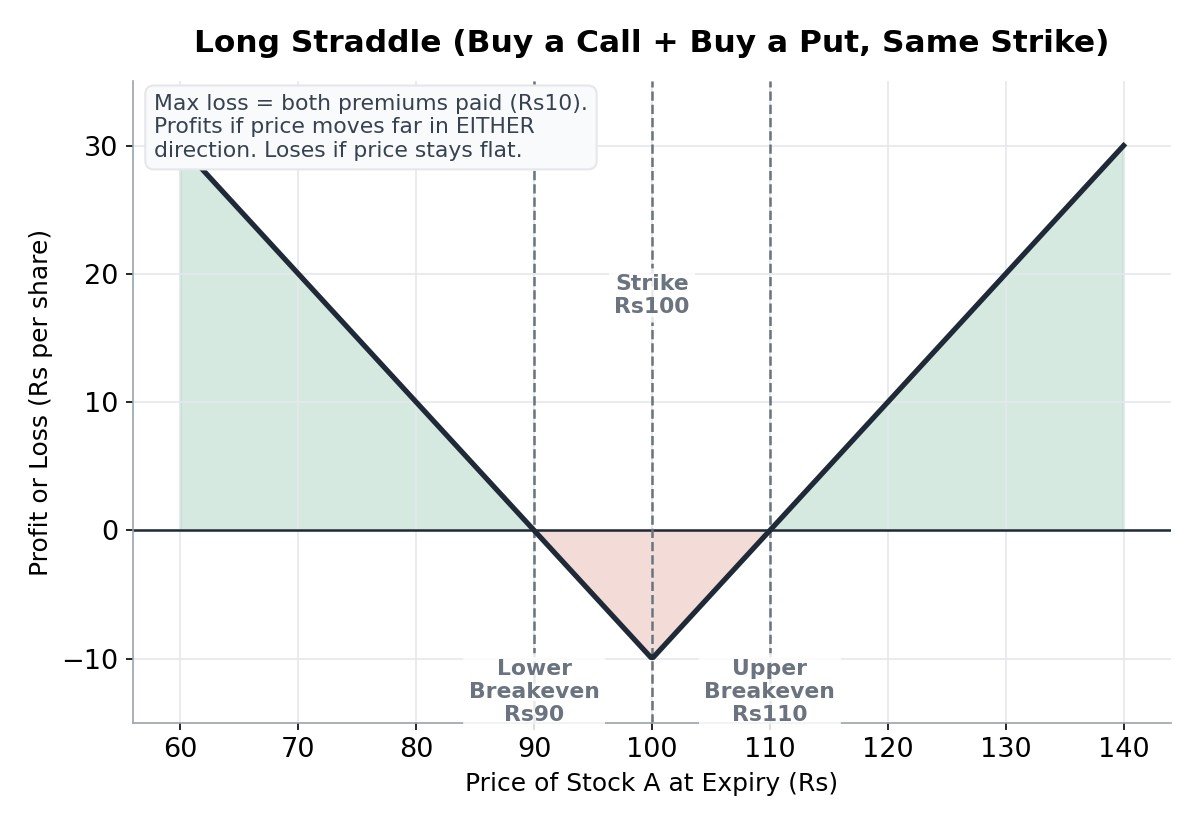
If the stock makes a big move in either direction, past Rs 90 on the downside or past Rs 110 on the upside, you profit, because one side of your position grows faster than the other side loses. If the stock stays roughly flat near Rs 100, both options lose value to time decay and you lose money, up to your full Rs 10 premium.
A strangle works the same basic idea, but you buy a call and a put at two different, further-apart strikes instead of the same one. This usually costs less than a straddle, but needs an even bigger move to turn profitable, since both strikes start further from the current price.
Step 13: Spreads, Limiting Risk on Both Sides
A spread means buying one option and selling another option of the same type, on the same stock, at a different strike. The purpose is almost always the same: give up some profit potential in exchange for a lower cost and a clearly capped loss on both sides.
Bull Call Spread: Buy a Lower Strike Call, Sell a Higher Strike Call
You expect Stock A, currently at Rs 100, to rise, but only moderately. You buy a Rs 100 strike call for Rs 6, and sell a Rs 110 strike call for Rs 2, so your net cost is only Rs 4, instead of the full Rs 6 a plain call would cost.
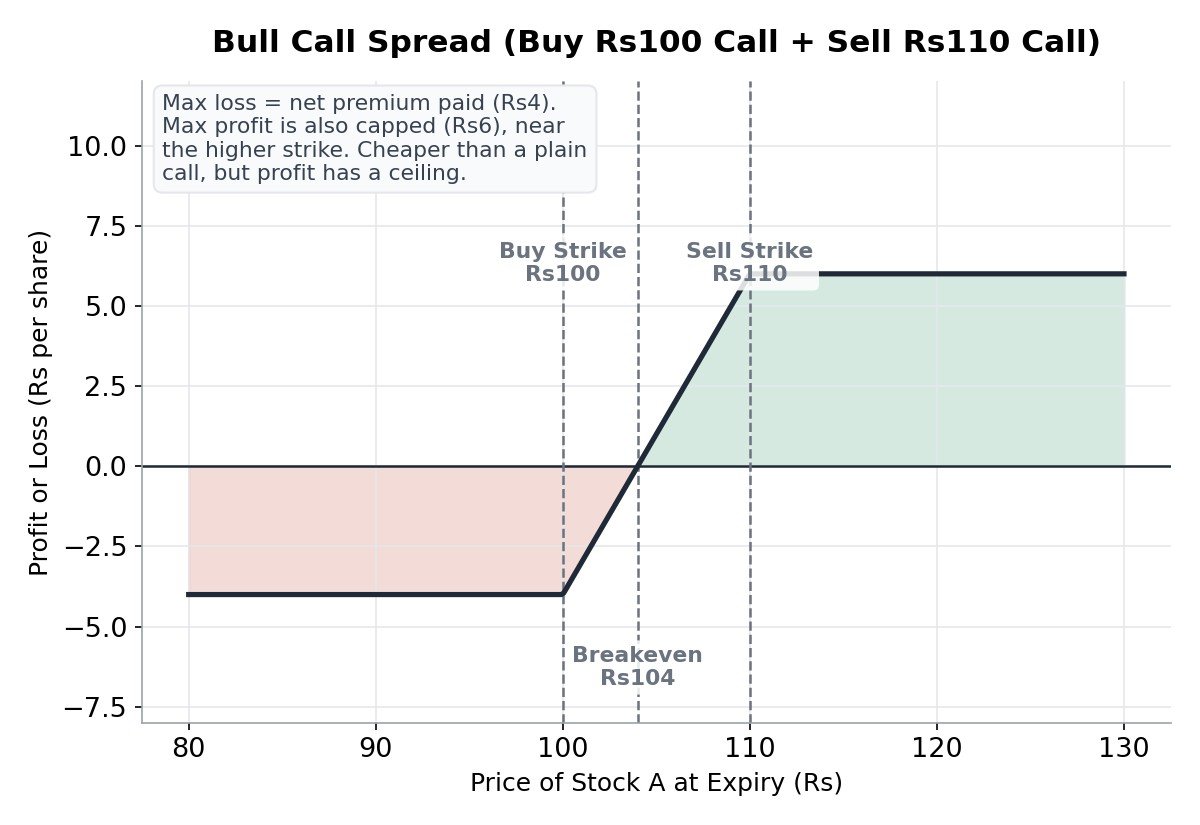
Your maximum loss is the Rs 4 net premium, if the stock stays at or below Rs 100. Your maximum profit is capped at Rs 6 (the Rs 10 gap between strikes, minus the Rs 4 you paid), reached once the stock is at or above Rs 110. You traded away unlimited upside for a cheaper, more defined-risk position.
Bear Put Spread: The Same Idea, for a Moderate Fall
This mirrors the bull call spread exactly, but using puts, for a trader expecting a moderate fall. You buy a higher strike put and sell a lower strike put, again capping both your cost and your maximum profit.
Iron Condor: Betting the Price Stays Inside a Range
An iron condor combines a bear call spread and a bull put spread on the same stock, built to profit if the price stays inside a defined range through expiry, which is the opposite goal of a straddle. It collects premium upfront, with a capped maximum profit (the premium collected) and a capped maximum loss on either side if the price breaks out of the range. It is generally considered a more advanced strategy, since it manages four separate option legs at once.
The common thread across every spread: more legs means more complexity to track, but also a more precisely defined risk, known in advance, before you ever place the trade.
Step 14: Options vs Futures, What Is the Difference
Beginners often confuse these two, since both are derivative contracts trading on the same exchange. The difference is actually simple once stated plainly.
- A futures contract is an obligation. Both the buyer and the seller are required to complete the transaction at the agreed price on expiry, whether the price moved in their favor or not.
- An option is a right, not an obligation, for the buyer specifically. The buyer can simply walk away and lose only the premium, as covered in Step 1. The option seller does carry an obligation, similar to a futures position, which is why selling options is treated as higher risk in Step 6.
Because of this, buying a future has unlimited profit potential and unlimited loss potential in both directions, with no premium paid upfront, only margin. Buying an option has unlimited profit potential (for a call) but a loss capped at the premium, which is why many beginners find options a more forgiving way to first express a market view with real money.
Step 15: Expiry Day, Settlement, and Assignment Explained
A few mechanical details around expiry trip up a lot of beginners the first time they actually hold a position until the end.
- Weekly vs Monthly Expiry: Many popular index options have both a weekly expiry (every week) and a monthly expiry (the last one of the month). Stock options in India typically only have monthly expiry. Weekly options see faster time decay since there is less time left to begin with.
- European vs American Style: A European-style option can only be exercised on the expiry date itself, not before. An American-style option can be exercised any day up to expiry. Index options in India are European-style; stock options are typically American-style. This is a naming convention only, it has nothing to do with geography.
- Cash Settlement vs Physical Settlement: Cash settlement means profit or loss is simply credited or debited in rupees, no shares change hands. Physical settlement means actual shares are delivered or received. Index options are always cash settled, since you cannot physically deliver “the index.” Many stock options in India are physically settled if they expire In the Money, which catches beginners off guard when shares unexpectedly show up in their account.
- Assignment is what happens to an option seller when a buyer exercises an In the Money option against them. The seller does not get a choice in the moment. This is the real-world version of the obligation described in Step 6.
- India VIX is a number published by the exchange that reflects the market’s current expectation of volatility over the next 30 days. A rising India VIX generally pushes option premiums higher across the board (this connects back to Vega in Step 7), even before any actual price move happens.
Step 16: Margin, Why Selling Options Needs More Capital
When you buy an option, you simply pay the premium upfront, nothing more is required. Selling an option is structured completely differently, because your broker needs security against the larger, uncapped risk you are taking on, as covered in Step 6.
This security deposit is called margin, and it is usually calculated using a system called SPAN margin (plus an additional exposure margin on top), which estimates the worst reasonable loss your position could face in a single day and blocks that much of your capital. Margin requirements change with volatility: calmer markets need less margin, turbulent markets need more, sometimes with very little warning.
The exact margin amount for any specific stock or index changes regularly and is always shown live by your broker before you place a selling trade. The number itself is not something to memorize, the important habit is to always check it, and never sell an option without knowing exactly how much capital gets blocked and what your true maximum loss could be.
Step 17: Taxation on Options Trading in India
This is one of the most searched questions by anyone starting options, and it deserves a clear, honest answer rather than a specific number that will likely be outdated by the time you read this.
In India, profit or loss from trading options (part of what is called F&O, Futures and Options) is generally treated as business income, not capital gains, regardless of how often you trade. This means it gets added to your other income and taxed according to the income tax slab rates that apply to you, and it also generally requires maintaining proper books of accounts once your trading activity crosses certain limits, with a tax audit required beyond certain turnover levels.
Because exact slab rates, turnover limits, and audit thresholds are set by the government and do genuinely change from year to year in the Union Budget, this course deliberately does not state specific numbers here, stating one today would likely mislead you a year or two from now. What stays true regardless of the year: keep clean records of every trade, and talk to a qualified Chartered Accountant who handles F&O traders specifically, before you file your return. This is not optional advice, it is the single most common regret experienced traders mention about their first year of trading.
Step 18: The Biggest Mistakes Beginners Make
- Buying far Out of the Money options because they are cheap. A cheap premium often means a low probability of ever becoming profitable. Cheap is not the same as good value.
- Ignoring time decay (theta). An option can lose value every single day even if your view on direction turns out to be correct, simply because time is running out.
- Treating option buying like a lottery ticket. Buying a tiny, cheap option hoping for a huge payout is gambling, not trading. A real plan has a reason behind every strike and expiry chosen.
- Not understanding margin before selling options. Option selling can require a large margin and carries risk that is not capped the way buying is. Never sell an option without fully understanding what you could lose.
- No exit plan before entering the trade. Decide your target and your maximum acceptable loss before you place the trade, not after you are already watching the price move against you.
- Over-trading because options feel fast and exciting. The speed of options can make it tempting to take trade after trade. More trades is not the same as a better result.
Step 19: A Simple Checklist Before You Trade
Save this list, bookmark it, or share it with a friend who is learning alongside you. Go through it before every single option trade.
- Do I clearly understand whether I am buying or selling this option?
- Do I know my exact maximum possible loss on this trade?
- Have I chosen the strike and expiry for a real reason, not just because the premium looked cheap?
- Do I understand how time decay will affect this specific position as days pass?
- Have I decided my exit plan, both target and stop loss, before entering?
- Am I using money I can genuinely afford to lose, without it affecting my other financial responsibilities?
- Am I taking this trade from a calm, clear state of mind, not from excitement, fear, or boredom?
Step 20: Quick Glossary, Every Term in One Place
A fast reference for every term used across this course. Bookmark this page and jump here any time a word slips your memory, instead of hunting back through each step.
- Strike Price: The fixed price written into the option contract.
- Premium: The price paid to buy an option, maximum loss for a buyer.
- Expiry: The date the contract ends.
- Lot Size: The fixed bundle size an option trades in.
- ITM / OTM / ATM: In the Money, Out of the Money, At the Money, describing whether an option has real value right now.
- Intrinsic Value: The real, usable value an option has right now.
- Time Value: The part of the premium above intrinsic value, reflecting time left and expected volatility.
- Delta, Theta, Vega, Gamma: The Greeks, describing how an option’s price reacts to the stock price, time, volatility, and delta’s own rate of change.
- Open Interest (OI): The number of contracts currently open.
- Volume: The number of contracts traded today.
- Put-Call Ratio (PCR): Total put OI divided by total call OI, a rough sentiment gauge.
- Straddle / Strangle: Buying a call and a put together, betting on a big move in either direction.
- Spread (Bull Call, Bear Put, Iron Condor): Combining a bought and a sold option to cap both cost and profit.
- Assignment: What happens to a seller when a buyer exercises an option against them.
- Margin: The capital a broker blocks from a seller, as security against a larger potential loss.
- SPAN Margin: The standard system exchanges use to calculate that required margin.
- Cash Settlement / Physical Settlement: Whether expiry pays out in rupees, or in actual shares.
- European / American Style: Whether an option can only be exercised on expiry day, or any day up to it.
- India VIX: An index reflecting the market’s current expectation of volatility.
Step 21: What to Do Next
Understanding option mechanics is one half of the picture. The other half, the one most courses skip entirely, is the decision-making that happens once real money and real emotion are involved. Knowing exactly how a covered call works on paper is very different from calmly holding that position when the stock suddenly gaps against you.
That second half is what Samir Dash’s ACE framework (Aware, Control, Execute) at Mindful Trading Hub focuses on specifically, for traders who already understand the mechanics but still struggle to execute consistently under pressure.
Frequently Asked Questions
Can I lose more money than I pay for an option?
If you are buying an option (a call or a put), your maximum possible loss is exactly the premium you paid, nothing more. If you are selling (writing) an option, your risk is structured very differently and can be significantly larger, which is why selling is generally considered a more advanced activity, covered in Step 6.
Do I need a large amount of money to start learning options?
Learning the mechanics costs nothing. This course itself is free. Actually placing trades requires real capital, and how much depends on the lot size of the stock or index you choose and your broker’s specific margin requirements.
What happens if I do nothing and just let my option expire?
If your option has no value at expiry (it is Out of the Money), it simply expires worthless and you lose the premium you paid, exactly like letting an insurance policy lapse unused. If it has value (it is In the Money), most brokers will automatically settle it for you, but always confirm your specific broker’s process.
Is option trading the same as gambling?
The instruments themselves are not gambling. How they are used can become gambling, specifically when trades are taken without a plan, without understanding the risk, or purely chasing excitement, as covered in Step 10. The same tool can be used as a structured, risk-aware decision or as a reckless bet. The difference is entirely in how you use it.
Should I start by buying options or selling them?
Most beginners start with buying, specifically because the maximum loss is clearly capped at the premium paid, which makes the risk easier to understand and manage while you are still learning. Selling options involves a different risk profile and is generally better approached only after you have a solid grasp of the mechanics covered in this course.
What is Open Interest and why do traders watch it so closely?
Open Interest is the total number of option contracts currently open, not yet closed out. Traders watch how it changes alongside price to get a rough sense of whether new money is entering confidently or exiting, as explained in Step 11. It is a supporting clue, not a standalone signal.
What is the difference between options and futures?
A future is an obligation for both sides to complete the trade at expiry. An option gives the buyer a right, not an obligation, capping the buyer’s loss at the premium paid. Step 14 covers this difference in full.
Will I actually receive shares when my option expires?
It depends on what you are trading and whether your position finishes In the Money. Index options always settle in cash. Many stock options in India settle physically if In the Money at expiry, meaning shares can be delivered or required. Step 15 covers this in detail, and your broker’s platform will always show you the exact settlement type before expiry.
How is profit from options trading taxed in India?
It is generally treated as business income, taxed at your applicable income tax slab rate, with recordkeeping and audit requirements once your activity crosses certain limits. Exact thresholds change with each year’s Budget, so Step 17 deliberately avoids stating specific numbers and recommends a Chartered Accountant who handles F&O traders.
Is this investment advice?
No. Samir Dash is not SEBI-registered, and nothing in this course is a stock tip, investment recommendation, or promise of returns. Every example in this course uses a hypothetical “Stock A” with made-up numbers, purely to explain how option mechanics work. This content is for educational purposes only. Please read the Disclaimer before acting on anything you read here.
Related Reading on This Site
If you want to go deeper on specific ideas from this course, Samir Dash has written these on blog.samirdash.in:
- Delta in Options Explained
- Theta in Options Explained
- Implied Volatility Explained
- ITM, ATM, and OTM Options Explained
- Strike Price Selection Explained
Continue Your Learning Path
You understand options. Here is what most readers explore next.
- Swing Trading: hold positions for days to weeks instead of hours.
- Intraday Trading: open and close every position within the same day.
- Trading Psychology: the inner game every strategy eventually runs into.
You can also see every course on this site, in order, and pick your own path.
Want to trade with more clarity and less emotional reactivity? Samir Dash’s ACE framework (Aware, Control, Execute) helps traders build the decision-making discipline that technical analysis alone can’t teach. Learn more at Mindful Trading Hub.