

Intraday Trading
This is a complete, beginner-friendly course on intraday trading, the fast-paced style where every position opens and closes within the same single day. We start from the very first idea and build all the way up to the real cost pressures and psychological demands this style places on a trader.
This is a full course, not a short article, so it does not rush, and it does not oversell how easy or exciting this style is. Bookmark this page and come back to it any time a concept feels unclear.
A free course by Samir Dash, founder of Mindful Trading Hub.
What You Will Learn
- Step 1: What Is Intraday Trading, in Plain Words
- Step 2: Intraday vs Swing vs Investing, a Quick Recap
- Step 3: What You Need to Start Intraday Trading
- Step 4: Margin and Leverage in Intraday Trading
- Step 5: Timeframes Used in Intraday Trading
- Step 6: The Market Open, the First 15 to 30 Minutes
- Step 7: The Opening Range Breakout Strategy
- Step 8: VWAP and How Intraday Traders Use It
- Step 9: Scalping vs Momentum Trading
- Step 10: Gap Up and Gap Down Trading at Open
- Step 11: Candlestick and Chart Patterns on Intraday Charts
- Step 12: Setting Tight Stop Losses for Intraday Trades
- Step 13: Position Sizing for Higher Frequency Risk
- Step 14: The Square Off Rule, Why Intraday Positions Must Close Same Day
- Step 15: Brokerage and Costs Eating Into Intraday Profits
- Step 16: The Psychological Pressure of Intraday Trading
- Step 17: Building a Pre-Market Routine
- Step 18: Common Mistakes in Intraday Trading
- Step 19: A Simple Checklist Before an Intraday Trade
- Step 20: Quick Glossary, Every Term in One Place
- Step 21: What to Do Next
- Frequently Asked Questions
Step 1: What Is Intraday Trading, in Plain Words
Imagine renting a bicycle for exactly one day and returning it before the shop closes that same evening, never keeping it overnight. Intraday trading works the same way: every position you open must be closed before the market shuts for the day, no exceptions.
Intraday trading, sometimes called day trading, means buying and selling within the same single trading session, aiming to profit from price movement that happens purely during market hours. No position is carried overnight, which removes the gap risk covered in this site’s Swing Trading course, but replaces it with a faster pace and far less time to think through each decision.
Step 2: Intraday vs Swing vs Investing, a Quick Recap
This site’s Swing Trading course covers positions held for days to weeks, and this site’s Trading Foundation course touches on long term investing, held for months or years. Intraday trading sits at the opposite, fastest end of this spectrum, with every single position opening and closing on the very same day.
This difference is not just about speed, it changes almost everything: the timeframes you watch, the stop loss distances you use, the costs you pay relative to your profit, and the mental and emotional demands placed on you, each covered in the steps ahead.
Step 3: What You Need to Start Intraday Trading
Beyond the Demat and trading account covered in this site’s Trading Foundation course, intraday trading has a few extra practical requirements. A stable, fast internet connection matters far more here than in swing trading, since delays of even a few seconds can meaningfully affect your entry or exit price.
You also need real, dedicated time during market hours, since intraday trading generally cannot be done properly alongside a demanding full time job the way swing trading can, a genuinely important, honest consideration before committing to this style.
Step 4: Margin and Leverage in Intraday Trading
Most Indian brokers offer significantly higher leverage for intraday positions than for positions you intend to hold overnight, often placed under an order type called MIS (Margin Intraday Square-off). This lets you control a larger position with less of your own capital, exactly the leverage idea covered in this site’s Forex Trading course, but it carries the exact same core warning: leverage multiplies both your potential profit and your potential loss by the same amount, and intraday’s faster pace gives you less time to react if a leveraged position moves against you quickly.
Step 5: Timeframes Used in Intraday Trading
Intraday traders typically work on much smaller timeframes than swing traders, commonly 1 minute, 5 minute, or 15 minute charts, since the entire trade needs to play out within a single session.
Even so, many experienced intraday traders still check a daily chart briefly before the session starts, purely for broader trend context, exactly the multiple timeframe analysis habit covered in this site’s Price Action Trading course, rather than trading the small timeframe in complete isolation.
Step 6: The Market Open, the First 15 to 30 Minutes
The first 15 to 30 minutes after the market opens are typically the most active and often the most unpredictable part of the entire trading day, as overnight news, pre-market sentiment, and early orders all collide at once.
Many intraday traders deliberately wait and simply observe during this opening window rather than rushing into a trade immediately, giving the market a short amount of time to establish its early direction and the opening range covered in Step 7, instead of reacting to the very first, often noisy, few minutes.
Step 7: The Opening Range Breakout Strategy
This is one of the most widely used intraday strategies, built directly on the idea from Step 6.
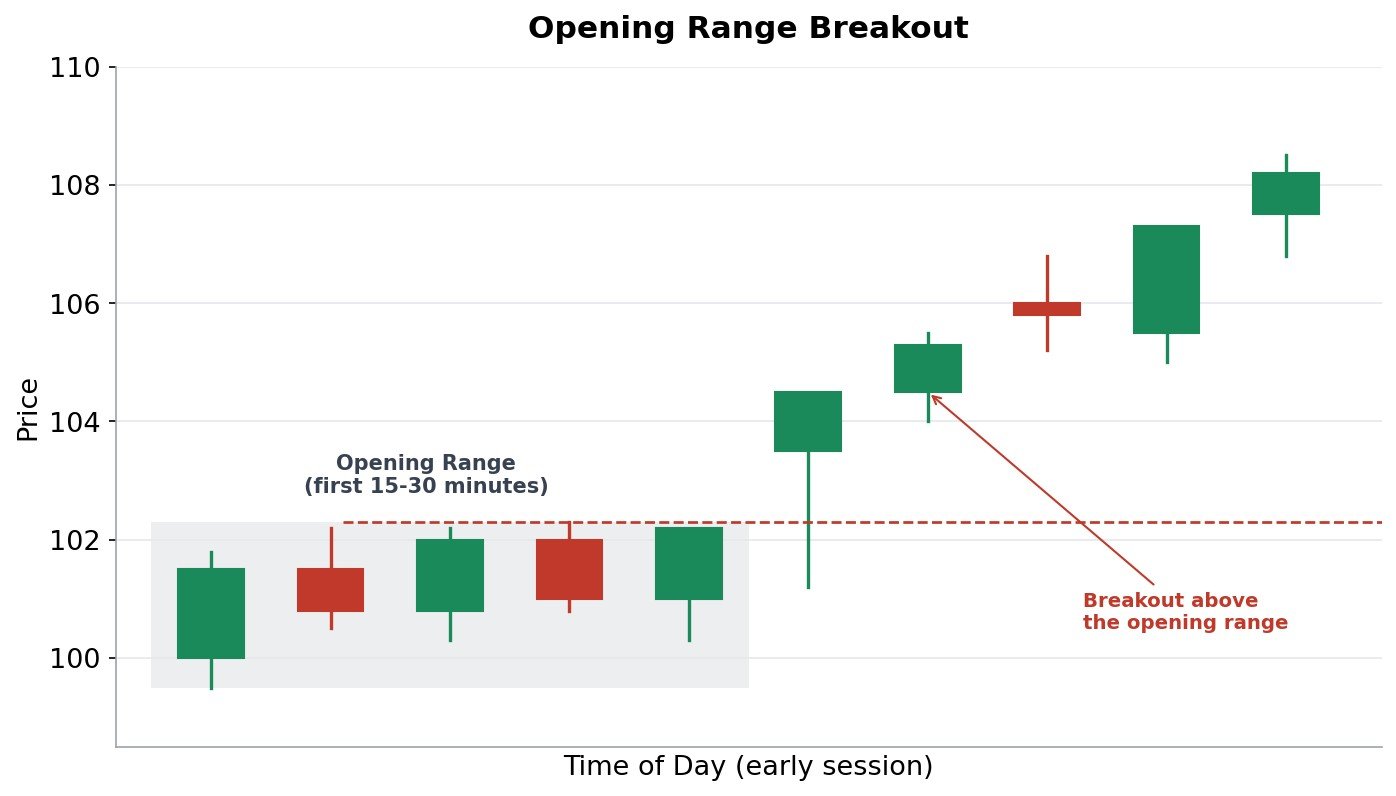
The opening range is simply the highest and lowest price reached during the first 15 to 30 minutes of trading, as shown in the picture. Many intraday traders watch for price to break firmly above the opening range’s high (or below its low) as a signal that the day’s real directional move may be starting, applying the same breakout and fakeout ideas covered in this site’s Price Action Trading course directly to this specific, well known intraday setup.
Step 8: VWAP and How Intraday Traders Use It
VWAP, short for Volume Weighted Average Price, is one of the most widely used intraday indicators, recalculated fresh every single trading day.
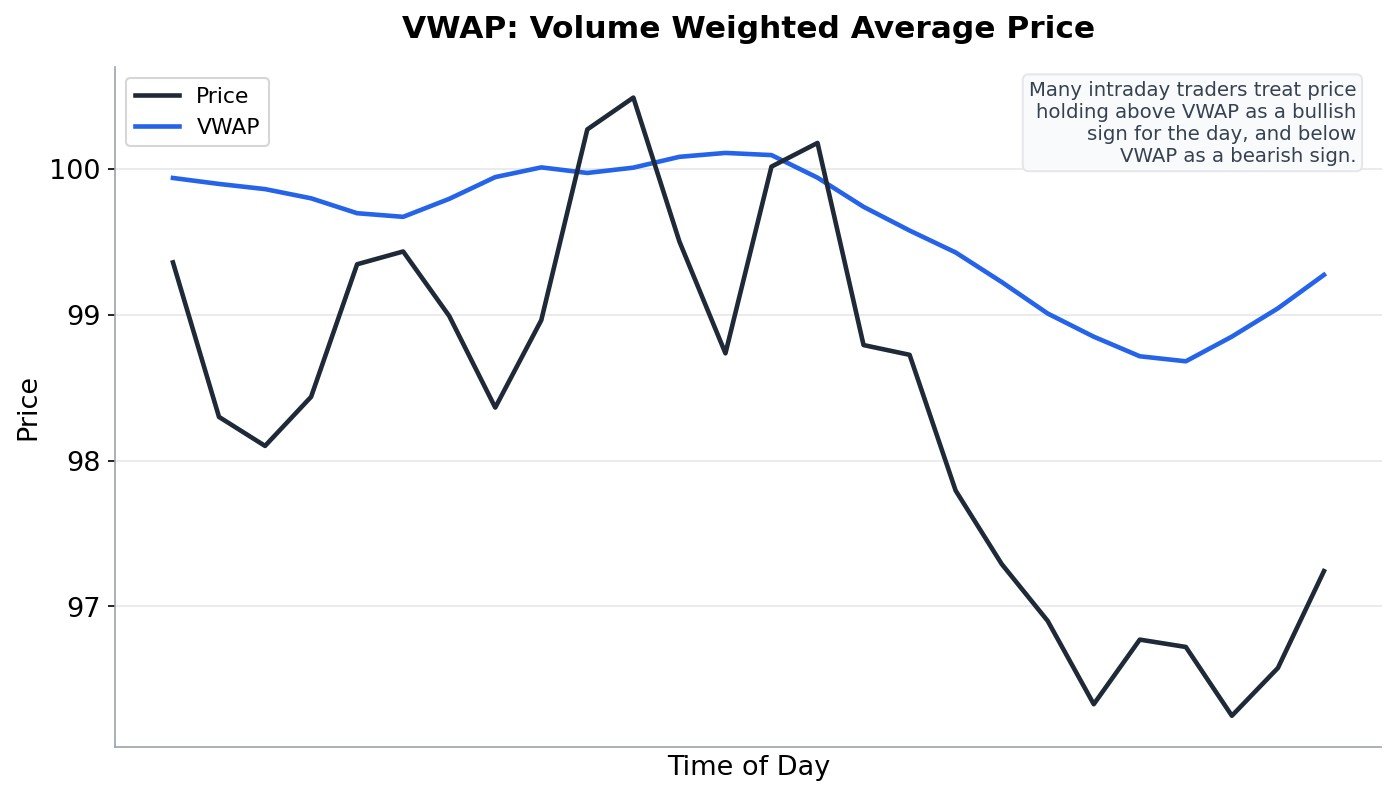
Unlike a simple moving average, VWAP weights each price by how much volume traded there, giving a truer sense of the average price real money actually traded at during the day, not just the average of the price line itself. Many intraday traders treat price holding above VWAP as a sign the day is leaning bullish, and price holding below VWAP as a sign it is leaning bearish, and large institutional traders specifically use VWAP to judge whether their own large orders are being filled at a fair average price.
Step 9: Scalping vs Momentum Trading
Within intraday trading itself, two broad styles are common, differing mainly in how long a single trade is held.
- Scalping: Taking many very short trades throughout the session, often holding a position for just seconds to a few minutes, aiming to capture small, repeated price movements. This generally needs very tight spreads, low costs per trade, and intense, sustained focus.
- Momentum Trading: Holding a position for a larger portion of the session, often tens of minutes to a few hours, riding a stronger, more sustained intraday move rather than many small ones.
Scalping in particular is especially exposed to the cost drag covered in Step 15, since its profit per trade is often small relative to brokerage and other fixed costs.
Step 10: Gap Up and Gap Down Trading at Open
A stock can open the day significantly higher (a gap up) or lower (a gap down) than its previous close, usually because of overnight news, a similar idea to the gap concept covered in this site’s Price Action Trading and Swing Trading courses, except an intraday trader experiences it live, right at the market open.
Some intraday traders specifically look to trade in the direction of a strong gap, expecting the move to continue. Others look for a “gap fill” instead, betting price will retrace back toward the prior close. Neither approach is universally correct, and gaps are generally considered a higher risk, faster moving setup than the opening range breakout from Step 7, given how little time there often is to react calmly.
Step 11: Candlestick and Chart Patterns on Intraday Charts
Every pattern covered in this site’s Candlestick Patterns and Chart Patterns courses applies directly to intraday charts, the mechanics do not change on a smaller timeframe. What does change is how quickly these patterns form and resolve, often within minutes instead of days, which demands faster, calmer pattern recognition under real time pressure.
Step 12: Setting Tight Stop Losses for Intraday Trades
Because intraday trades unfold over minutes or hours rather than days, stop losses are typically placed much closer to the entry price than in swing trading, often just beyond the opening range, a recent swing low or high, or a key intraday level like VWAP.
A tighter stop loss is not automatically “safer,” it simply reflects the shorter time horizon and faster pace of this style, and it generally needs a correspondingly tighter, more realistic target too, connecting directly to the risk and reward thinking covered throughout this site’s other courses.
Step 13: Position Sizing for Higher Frequency Risk
The same position sizing formula used throughout this site, risk amount divided by risk per share, applies here too. But because intraday trading often involves many more trades per week than swing trading, it is worth tracking your total risk exposure across an entire trading day or week, not just one trade in isolation, since a string of several losing trades in the same session can add up quickly.
Many intraday traders set a maximum daily loss limit in advance, a fixed amount or percentage of their account beyond which they stop trading for the rest of the day entirely, regardless of how confident the next setup looks, a discipline this site’s Trading Behaviour course covers in more depth.
Step 14: The Square Off Rule, Why Intraday Positions Must Close Same Day
Intraday positions, typically placed using an MIS order type as mentioned in Step 4, must be closed before the market closes for the day. If you do not manually close the position yourself, most brokers will automatically square it off at a set time shortly before market close, sometimes at a less favorable price than you would have chosen yourself.
This is an important mechanical detail to genuinely understand before placing your first intraday trade, since forgetting about an open position near the end of the day can result in an unexpected, broker-forced exit.
Step 15: Brokerage and Costs Eating Into Intraday Profits
Because intraday trading often involves many more trades than swing trading or investing, the real cost of trading, brokerage, exchange charges, taxes, and slippage, matters enormously, and is one of the most underestimated risks for beginners.
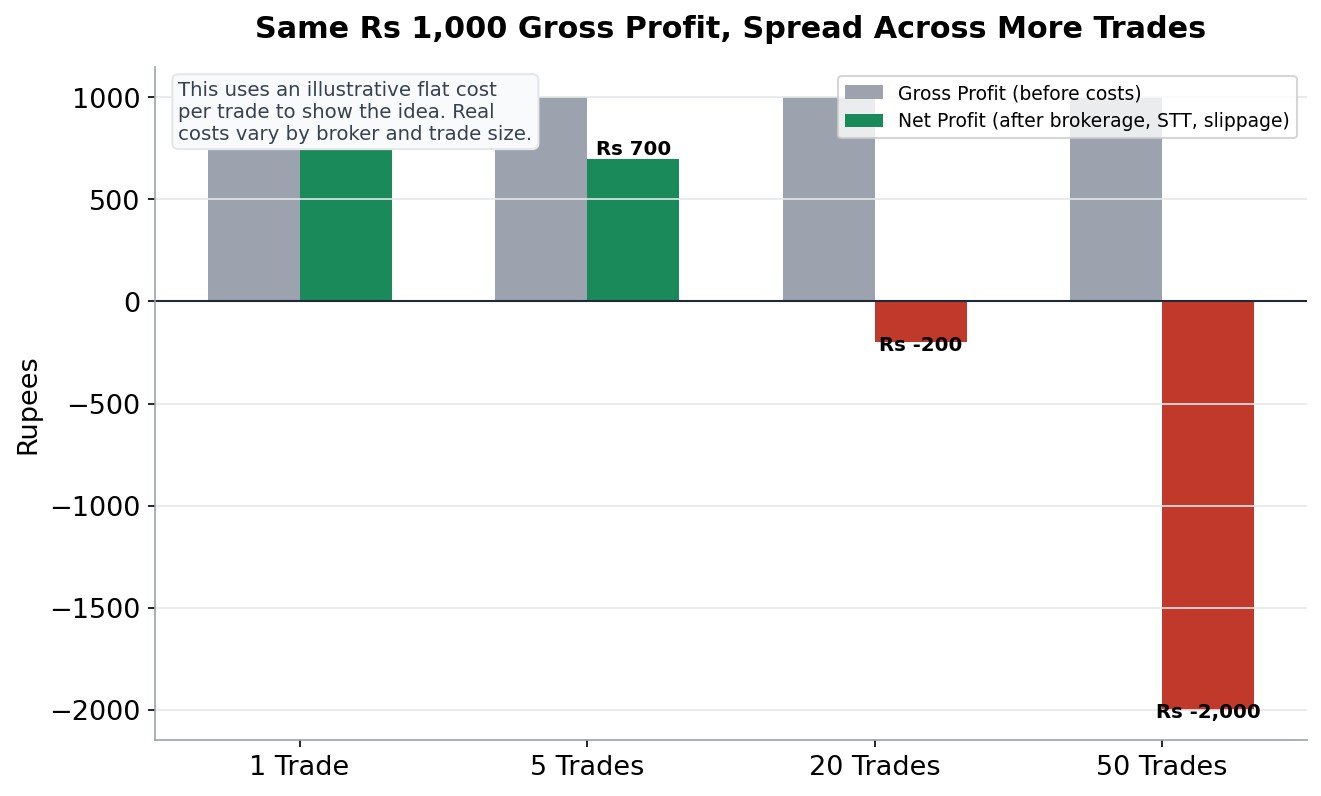
As shown in the illustrative picture above, the same total gross profit can look very different once realistic trading costs are factored in across a handful of trades versus dozens of them. This is exactly why many experienced intraday traders care deeply about trade frequency and cost efficiency, not just whether individual trades are “winners,” since a high win rate with a high trade count and high relative costs can still result in a net loss overall.
Step 16: The Psychological Pressure of Intraday Trading
Intraday trading compresses decision-making into a much shorter window than swing trading or investing, which means less time to think calmly and more opportunities, across a single session, to let fear or impatience drive a decision rather than a clear plan.
This is precisely why this site’s Trading Psychology and Trading Behaviour courses matter so much for anyone seriously pursuing this style, since the fast pace of intraday trading tends to expose weaknesses in discipline and emotional control far more quickly and more often than slower styles do.
Step 17: Building a Pre-Market Routine
Because intraday decisions must be made quickly once the market opens, many experienced intraday traders do their real thinking before the market opens, not during it. A typical pre-market routine includes checking overnight news and any gap ups or gap downs (Step 10), reviewing the prior day’s key levels, and deciding in advance which setups from Steps 7 through 11 they are actually looking for that day.
Walking into the trading session with a clear, pre-decided plan, rather than deciding what to look for only after the opening bell, meaningfully reduces the chance of reacting impulsively to the market’s often chaotic opening minutes.
Step 18: Common Mistakes in Intraday Trading
- Trading immediately at the open without waiting to see the opening range form, as covered in Step 6.
- Overtrading, taking far more trades than a clear plan calls for, which directly worsens the cost drag shown in Step 15.
- Using maximum leverage without understanding MIS mechanics, as covered in Step 4.
- Forgetting about an open position near the end of the day, risking a forced, unfavorable square off, as explained in Step 14.
- Revenge trading after a loss, taking an unplanned trade purely to “win back” a loss within the same session, a specific behavior pattern covered in this site’s Trading Psychology course.
- Trying intraday trading without real, dedicated time available during market hours, as honestly flagged in Step 3.
Step 19: A Simple Checklist Before an Intraday Trade
Save this list, bookmark it, or share it with a friend who is learning alongside you.
- Have I let the opening range fully form before considering a trade, rather than reacting to the first few minutes?
- Is this setup one of the specific patterns I planned for in my pre-market routine, from Step 17?
- Do I know exactly where my stop loss goes, and does my target realistically justify the risk?
- Have I checked my total risk taken so far today against my maximum daily loss limit?
- Am I factoring in brokerage and other real costs when judging whether this trade is actually worth taking?
- Am I trading from a calm, planned state of mind, not chasing a loss from an earlier trade today?
- Do I have the real, dedicated time available right now to manage this trade properly until it closes?
Step 20: Quick Glossary, Every Term in One Place
A fast reference for every term used across this course. Bookmark this page and jump here any time a word slips your memory.
- Intraday Trading / Day Trading: Opening and closing a position within the same single trading session.
- MIS Order: Margin Intraday Square-off, an order type offering higher leverage for same-day positions.
- Opening Range: The highest and lowest price reached during the first 15 to 30 minutes of the session.
- Opening Range Breakout: A strategy entering as price moves firmly past the opening range’s high or low.
- VWAP: Volume Weighted Average Price, the average price for the day weighted by how much volume traded there.
- Scalping: Taking many very short trades, often held for seconds to a few minutes.
- Momentum Trading: Holding an intraday position for a larger portion of the session to ride a stronger move.
- Gap Up / Gap Down: Opening significantly higher or lower than the previous day’s close.
- Square Off: Closing an open position, required for every intraday position before market close.
- Maximum Daily Loss Limit: A pre-decided amount beyond which a trader stops trading for the rest of the day.
Step 21: What to Do Next
Every candlestick and chart pattern from this site’s Candlestick Patterns and Chart Patterns courses applies directly to the fast moving charts covered here, so building real fluency there pays off especially quickly in intraday trading. If the pace and daily time demands here feel too intense, this site’s Swing Trading course covers a related but noticeably slower, more schedule-friendly style.
But given how much faster intraday trading moves, the decision-making half of trading matters here more than almost anywhere else. Samir Dash’s ACE framework (Aware, Control, Execute) at Mindful Trading Hub, and this site’s dedicated Trading Psychology and Trading Behaviour courses, focus specifically on that half, for traders who understand the setups but still struggle to execute calmly under real time pressure.
Frequently Asked Questions
How much money do I need to start intraday trading?
There is no fixed minimum, but given the real costs covered in Step 15, very small accounts can find it especially difficult to trade profitably after brokerage and other charges are factored in, so a realistic, honest assessment of cost drag relative to your account size matters a lot here.
Is intraday trading more profitable than swing trading?
Neither style is inherently more profitable, they carry different risks and demand different things from a trader. Intraday trading avoids overnight gap risk but adds significant cost drag (Step 15) and intense psychological pressure (Step 16); swing trading avoids much of that pressure but adds overnight and weekend gap risk instead.
Can I do intraday trading part time alongside a job?
This is genuinely difficult, since intraday trading needs real, focused attention during market hours, as honestly explained in Step 3. Many traders balancing a job find swing trading, covered in this site’s dedicated course, a more realistic fit.
What happens if I forget to close my intraday position?
Your broker will typically square it off automatically shortly before market close, sometimes at a less favorable price than you would have chosen yourself, as explained in Step 14. It is always better to manage your own exit deliberately.
Is this investment advice?
No. Samir Dash is not SEBI-registered, and nothing in this course is a stock recommendation or promise of returns. This content is for educational purposes only. Please read the Disclaimer before acting on anything you read here.
Related Reading on This Site
If you want to go deeper on specific ideas from this course, Samir Dash has written these on blog.samirdash.in:
- What Is Intraday Trading? Meaning, Rules and How It Works
- VWAP: The Indicator Institutions Actually Use
- The Opening Range: Why the First 15 Minutes Matter
- Pivot Points Explained: How Intraday Traders Use Them
- Day Trading vs Swing Trading: Which One Fits You?
Continue Your Learning Path
You have a trading style now. Make sure the mind behind it is ready too.
- Swing Trading: compare the slower style, same ideas, a lot more room to breathe.
- Trading Psychology: the single biggest reason good setups still fail.
You can also see every course on this site, in order, and pick your own path.
Want to trade with more clarity and less emotional reactivity? Samir Dash’s ACE framework (Aware, Control, Execute) helps traders build the decision-making discipline that chart reading alone can’t teach. Learn more at Mindful Trading Hub.