

Swing Trading
This is a complete, beginner-friendly course on swing trading, the style of trading that sits between fast-moving intraday trading and slow, long term investing. We start from the very first idea and build all the way up to managing several swing positions at once and reviewing your own results properly.
This is a full course, not a short article, so it does not rush. Bookmark this page and come back to it any time a concept feels unclear while you are reading or practicing.
A free course by Samir Dash, founder of Mindful Trading Hub.
What You Will Learn
- Step 1: What Is Swing Trading, in Plain Words
- Step 2: Swing Trading vs Day Trading vs Long Term Investing
- Step 3: Why Swing Trading Appeals to People With a Full Time Job
- Step 4: What You Need to Start Swing Trading
- Step 5: Timeframes Used in Swing Trading
- Step 6: Spotting a Swing Trading Opportunity, Trend Plus Pullback
- Step 7: Swing Trading Entry Techniques
- Step 8: Setting Stop Loss and Targets for a Swing Trade
- Step 9: Position Sizing and Risk Per Swing Trade
- Step 10: Chart Patterns Worth Watching for Swing Trades
- Step 11: Using Multiple Timeframe Analysis in Swing Trading
- Step 12: Overnight and Weekend Risk, Gaps
- Step 13: Swing Trading in Different Market Conditions
- Step 14: Fundamental Catalysts That Matter for Swing Trades
- Step 15: Building a Swing Trading Watchlist
- Step 16: Managing Several Swing Positions at Once
- Step 17: Keeping a Swing Trading Journal
- Step 18: Common Mistakes in Swing Trading
- Step 19: A Simple Checklist Before a Swing Trade
- Step 20: Quick Glossary, Every Term in One Place
- Step 21: What to Do Next
- Frequently Asked Questions
Step 1: What Is Swing Trading, in Plain Words
Imagine catching a wave while surfing. You do not need to be in the water every single second of the day, you wait for a good wave to form, ride it for a while, and get out once it fades. Swing trading works the same way with price moves.
Swing trading means holding a position for more than one day, typically somewhere between a few days and a few weeks, aiming to capture a meaningful “swing” in price. It sits between intraday trading, which closes every position the same day, and long term investing, which can hold a position for years. A swing trader is not trying to catch an entire multi-month trend, nor a tiny five minute wiggle, just one solid, identifiable move at a time.
Step 2: Swing Trading vs Day Trading vs Long Term Investing
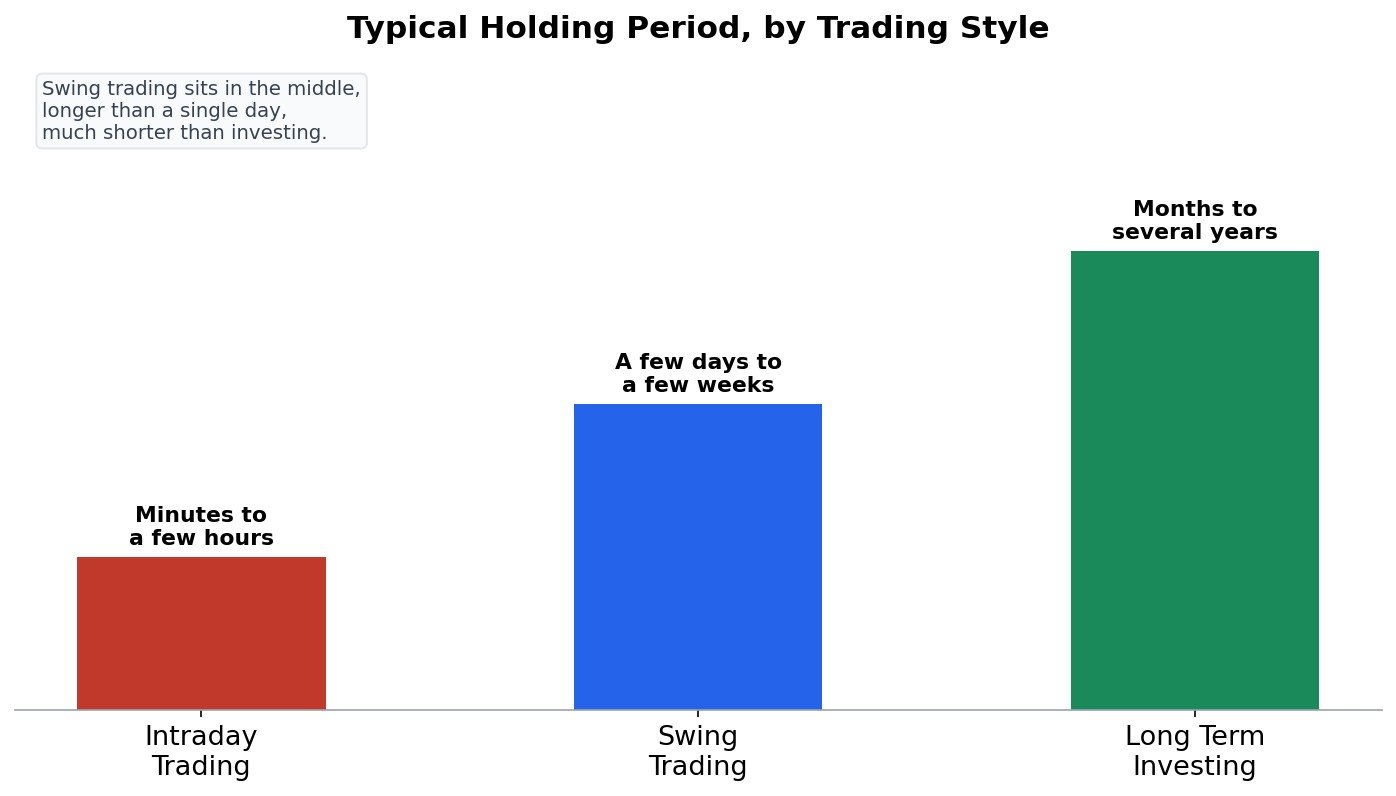
This site’s Intraday Trading course covers positions that open and close within the same single day. This site’s Trading Foundation course touches on long term investing, holding for months or years based mainly on a business’s underlying quality. Swing trading sits deliberately in between, long enough to let a real price move develop, short enough that you are not committed for months at a time. Each style needs a different amount of daily attention, a different mindset, and often a different personality fit, which Step 3 explains further.
Step 3: Why Swing Trading Appeals to People With a Full Time Job
Intraday trading generally requires watching the screen closely during market hours, which is simply not realistic for someone working a regular job. Swing trading solves this by not needing constant attention.
A swing trader typically does their real analysis once a day, often in the evening after the market closes, places or adjusts orders, including the stop loss and target levels from Step 8, and then does not need to watch the screen throughout the trading day. This is precisely why swing trading is one of the most practical trading styles for people balancing trading alongside other full time responsibilities.
Step 4: What You Need to Start Swing Trading
Swing trading does not require any special, expensive tools beyond what this site’s Trading Foundation course already covers: a Demat and trading account with a registered broker, and a charting platform that shows daily and weekly candlestick charts clearly.
Unlike intraday trading, swing trading does not need an extremely fast internet connection or lightning quick order execution, since you are not reacting to second-by-second price changes. What it does need is patience, a clear plan written down before you enter a trade, and the discipline to check in once a day rather than constantly, a habit covered further in Step 17.
Step 5: Timeframes Used in Swing Trading
Swing traders typically do their main analysis on the daily chart, where each candle represents one full trading day, since this timeframe filters out a lot of the noisy, short term wiggles that make intraday charts harder to read calmly.
Many swing traders also check the weekly chart for bigger picture trend context, exactly the multiple timeframe analysis idea covered in this site’s Price Action Trading course, then use a 4 hour or 1 hour chart only to fine-tune the exact entry price once they have already decided to take a trade on the daily chart.
Step 6: Spotting a Swing Trading Opportunity, Trend Plus Pullback
The single most common swing trading setup combines two ideas directly from this site’s Price Action Trading course: an established trend, and a pullback within it.
First, identify a clear uptrend or downtrend using the higher highs and higher lows (or lower highs and lower lows) structure covered in that course. Then, instead of chasing the trend at a fresh high or low, wait patiently for price to pull back toward a prior support level, a demand or supply zone, or a moving average, before looking for signs that the pullback is ending and the original trend is resuming. This single idea, trend plus pullback, is responsible for a large share of all swing trades taken by experienced traders.
Step 7: Swing Trading Entry Techniques
A few specific entry techniques are especially common in swing trading, building directly on the candlestick and price action skills covered elsewhere on this site.
- Moving Average Pullback Entry: Entering as price pulls back to touch a moving average acting as dynamic support in an uptrend (or resistance in a downtrend), then shows a reversal candle, such as a hammer, from this site’s Candlestick Patterns course.
- Breakout Entry: Entering once price confirms a breakout past a well tested resistance level or a chart pattern’s neckline, from this site’s Chart Patterns course, ideally on noticeably higher volume.
- Support or Resistance Bounce Entry: Entering as price reaches a well tested support or resistance zone and shows a clear reversal signal right at that level.
None of these techniques is reserved only for swing trading, the same ideas apply across timeframes, but they tend to fit especially naturally into a daily-chart, once-a-day swing trading routine.
Step 8: Setting Stop Loss and Targets for a Swing Trade
Because a swing trade stays open overnight and across weekends, its stop loss needs to account for more potential movement than a typical intraday stop, exactly the overnight gap risk covered fully in Step 12.
A common approach: place the stop loss just beyond the nearest structural level that would prove the trade idea wrong, such as just below the support or moving average used for the pullback entry in Step 7, giving the trade reasonable room to breathe across several days without being stopped out by normal daily noise. Targets are often set using the measured move technique from this site’s Chart Patterns course, or simply at the next meaningful resistance or support level ahead.
Step 9: Position Sizing and Risk Per Swing Trade
The same position sizing formula covered in this site’s Option Trading and Forex Trading courses applies directly here: your risk amount (a fixed percentage of your account) divided by your risk per share (the distance between your entry and your stop loss) tells you exactly how many shares to trade.
Because a swing trade’s stop loss is often placed further away than an intraday stop, to allow for the overnight risk in Step 12, this usually means trading a smaller quantity of shares for the same rupee risk amount, compared to a tighter intraday stop. This is a normal, expected tradeoff of the style, not a mistake.
Step 10: Chart Patterns Worth Watching for Swing Trades
Because swing trading operates on daily and weekly charts, the larger chart patterns covered in this site’s dedicated Chart Patterns course are especially relevant, since they take real time to form and are easiest to see clearly on these slower timeframes. Cup and handle patterns, flags and pennants following a strong move, and clean triangle breakouts are all commonly used swing trading setups, each with the measured-move target technique from that course applying directly.
Step 11: Using Multiple Timeframe Analysis in Swing Trading
A disciplined swing trader typically checks three layers before entering a trade: the weekly chart for the broadest trend context, the daily chart for the actual setup and entry signal, and sometimes a 4 hour or 1 hour chart purely to fine-tune the entry price once the daily setup is already confirmed.
Skipping the weekly context is a common beginner mistake, since a daily chart setup that looks clean on its own can still be fighting against a much bigger trend one timeframe higher, exactly the lesson covered in this site’s Price Action Trading course.
Step 12: Overnight and Weekend Risk, Gaps
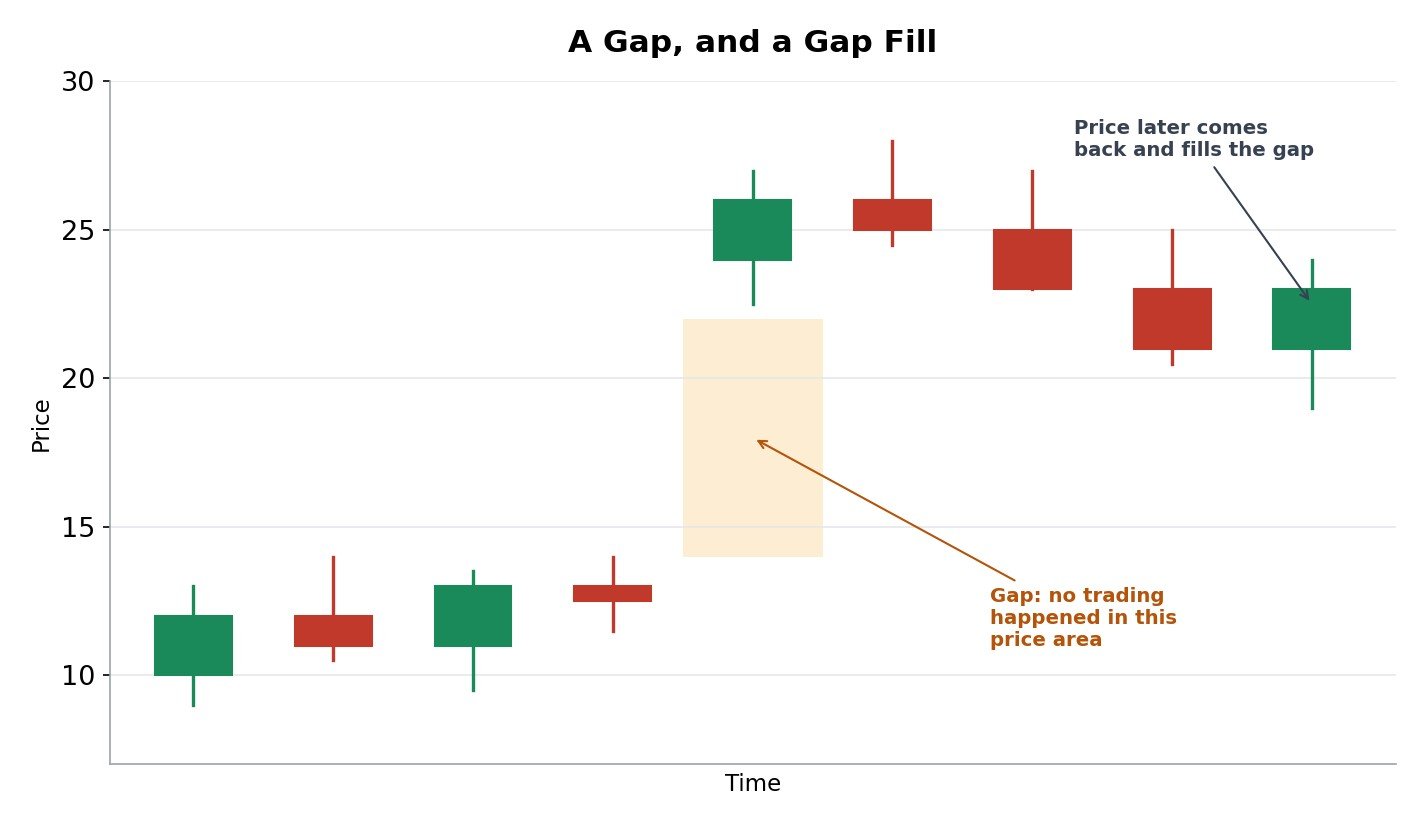
Because a swing position stays open while the market is closed, news or events happening overnight or over a weekend can cause the next day’s opening price to “gap,” jumping sharply higher or lower with no trading happening in between, exactly as shown in this picture from this site’s Price Action Trading course. A stop loss order cannot protect you from a gap the way it protects you during normal trading hours, since there is no price action to trigger it until the market reopens, sometimes already well past your intended stop level.
This risk cannot be fully eliminated in swing trading, only managed, mainly through the position sizing discipline in Step 9 and by being aware of major scheduled events (like earnings, covered in Step 14) that could cause a position to gap against you.
Step 13: Swing Trading in Different Market Conditions
Swing trading setups built around a clear trend, like the pullback entry in Step 6, work best in genuinely trending markets. In a choppy, range-bound market, the same approach can produce more false signals, since there is no strong trend to actually resume after a pullback.
Recognizing which condition the market is actually in, trending or ranging, using the structure and range ideas from this site’s Price Action Trading course, before deciding which setup to apply, is one of the most valuable judgment calls a swing trader develops over time.
Step 14: Fundamental Catalysts That Matter for Swing Trades
Because a swing position is held for days or weeks, it is far more exposed to scheduled company and economic events than a same-day intraday trade. Quarterly earnings announcements, in particular, can cause a sharp overnight gap, as explained in Step 12, regardless of how clean the technical setup looked beforehand.
Many swing traders specifically check a company’s upcoming earnings date before entering or holding a position through it, and some deliberately avoid holding a full position directly into an earnings announcement, preferring to reduce or close the position beforehand given the unpredictable, often outsized price reaction these events can cause.
Step 15: Building a Swing Trading Watchlist
Rather than scanning the entire market every single day, most swing traders maintain a focused watchlist of stocks they follow closely and understand well, checking this shorter list regularly for the setups covered in Step 7, instead of searching the whole market fresh each time.
A useful watchlist is usually built around stocks with reasonable daily trading volume (so positions can be entered and exited without excessive slippage), a clear, readable trend on the daily chart, and, ideally, companies or sectors the trader has taken the time to understand reasonably well.
Step 16: Managing Several Swing Positions at Once
Because swing trades stay open for days or weeks, it is common to hold several positions at the same time, unlike intraday trading where positions typically close before the next one opens. This introduces a risk management consideration beyond any single trade: total combined risk across all open positions.
A useful habit is capping your total risk across all open swing positions at once, not just risk per individual trade, so that several positions moving against you at the same time cannot cause a loss far larger than you intended. Checking whether open positions are in related sectors or correlated stocks, a similar idea to the currency correlation concept in this site’s Forex Trading course, is also worth doing before adding a new position.
Step 17: Keeping a Swing Trading Journal
Because swing trades play out over several days, it is easy to lose track of your original reasoning by the time a trade actually closes. A trading journal, recording your setup, entry reason, stop loss, target, and eventual outcome for every trade, lets you review honestly afterward whether your actual process matched your plan.
A regular review of your journal, weekly or monthly, often reveals patterns an individual trade never would, such as consistently exiting winning trades too early, or a specific setup type that genuinely works better for you than others.
Step 18: Common Mistakes in Swing Trading
- Setting a stop loss too tight for a multi-day hold, getting stopped out by normal daily noise rather than a real change in the trade’s validity.
- Ignoring the weekly chart’s bigger trend before entering based only on the daily chart, as warned in Step 11.
- Holding a full position directly into an earnings announcement without deliberately deciding to accept that specific risk, as covered in Step 14.
- Checking open positions excessively throughout the day, undermining the very reason swing trading fits a busy schedule in the first place.
- Adding too many correlated positions at once without tracking total combined risk, as explained in Step 16.
- Abandoning the original plan mid-trade out of impatience, rather than letting the stop loss or target do its job.
Step 19: A Simple Checklist Before a Swing Trade
Save this list, bookmark it, or share it with a friend who is learning alongside you.
- Have I checked the weekly chart for the bigger trend context, not just the daily chart?
- Is this setup a trend plus pullback, a confirmed breakout, or a tested support or resistance bounce, not just a random entry?
- Do I know exactly where my stop loss goes, accounting for overnight gap risk?
- Have I calculated my position size from my account risk and this specific stop distance?
- Is there an earnings announcement or major scheduled event coming up during this trade’s expected holding period?
- Does this new position push my total combined risk across all open swing trades too high?
- Have I written down my plan so I am not tempted to abandon it mid-trade out of impatience?
Step 20: Quick Glossary, Every Term in One Place
A fast reference for every term used across this course. Bookmark this page and jump here any time a word slips your memory.
- Swing Trading: Holding a position for roughly a few days to a few weeks, aiming to capture one identifiable price move.
- Pullback: A short term move against the main trend, before the main trend potentially resumes.
- Moving Average Pullback Entry: Entering as price touches a moving average acting as dynamic support or resistance.
- Gap: A price jump between one candle’s close and the next candle’s open, with no trading in between.
- Watchlist: A focused, regularly checked list of stocks a trader follows closely.
- Total Combined Risk: The sum of risk across every open position at the same time, not just one trade alone.
- Earnings Announcement: A company’s scheduled quarterly results release, which can cause a sharp price gap.
- Trading Journal: A record of every trade, kept to honestly review what is working and what is not.
Step 21: What to Do Next
Swing trading leans heavily on the pattern reading skills from this site’s Candlestick Patterns, Chart Patterns, and Price Action Trading courses, so those are a natural place to build real depth. If your schedule allows closer attention to the market, this site’s Intraday Trading course covers a faster paced style built on similar foundations.
But reading charts well is still only one half of becoming a consistent trader. The other half is the decision-making that happens once real money and real patience are tested over several days at a time. Samir Dash’s ACE framework (Aware, Control, Execute) at Mindful Trading Hub, and this site’s dedicated Trading Psychology and Trading Behaviour courses, focus specifically on that second half, for traders who understand the setups but still struggle to execute consistently under pressure.
Frequently Asked Questions
How much time does swing trading actually take each day?
Much less than intraday trading. Many swing traders spend perhaps 30 minutes to an hour once a day, often in the evening, reviewing charts and managing orders, rather than watching the screen throughout market hours, as explained in Step 3.
Is swing trading safer than intraday trading?
Neither style is inherently “safer,” they carry different types of risk. Swing trading avoids the intense, rapid pace of intraday trading, but introduces overnight and weekend gap risk instead, as covered fully in Step 12.
How many stocks should I watch at once for swing trading?
There is no fixed number, but most swing traders find a focused watchlist, often somewhere between a handful and a few dozen stocks they know well, more manageable than trying to scan the entire market fresh every day, as explained in Step 15.
Can I swing trade with a small amount of capital?
Yes, the position sizing math in Step 9 works at any account size, though very small accounts may need to trade fewer shares or focus on lower priced stocks to keep risk amounts reasonable.
Is this investment advice?
No. Samir Dash is not SEBI-registered, and nothing in this course is a stock recommendation or promise of returns. This content is for educational purposes only. Please read the Disclaimer before acting on anything you read here.
Related Reading on This Site
If you want to go deeper on specific ideas from this course, Samir Dash has written these on blog.samirdash.in:
- Day Trading vs Swing Trading: Which One Fits You?
- Scalping vs Swing Trading: What Technical Analysis Changes
- Positional Trading Explained: A Beginner’s Guide
- Intraday vs Positional Trading Psychology
Continue Your Learning Path
You have a trading style now. Make sure the mind behind it is ready too.
- Intraday Trading: compare the faster style, same ideas, a much tighter timeframe.
- Trading Psychology: the single biggest reason good setups still fail.
You can also see every course on this site, in order, and pick your own path.
Want to trade with more clarity and less emotional reactivity? Samir Dash’s ACE framework (Aware, Control, Execute) helps traders build the decision-making discipline that chart reading alone can’t teach. Learn more at Mindful Trading Hub.