

Trading Behaviour
This is a complete, beginner-friendly course on trading behaviour, the observable habits and actions that quietly shape your real results, separate from the feelings covered in this site’s dedicated Trading Psychology course. Two traders can feel the exact same fear or greed, yet behave very differently once it is time to actually click the button.
This is a full course, not a short article, so it does not rush. Bookmark this page and come back to it any time you notice a habit creeping back in that you thought you had already fixed.
A free course by Samir Dash, founder of Mindful Trading Hub.
What You Will Learn
- Step 1: What Is Trading Behaviour, and How It Differs From Psychology
- Step 2: The Behaviour Gap, Why Real Results Lag the Strategy Itself
- Step 3: Overtrading, Recognizing It and Why It Happens
- Step 4: Chasing the Market, Entering Too Late After a Move
- Step 5: Averaging Down Into a Losing Position
- Step 6: Moving Your Stop Loss Further Away
- Step 7: Position Size Creep After a Win
- Step 8: Inconsistent Position Sizing, Random Bet Sizing
- Step 9: Jumping Between Strategies Too Often
- Step 10: Ignoring Your Own Trading Plan
- Step 11: Trading Without a Plan at All
- Step 12: The Habit of Overchecking Open Positions
- Step 13: Building Consistent Pre-Trade Routines
- Step 14: Building Consistent Post-Trade Routines
- Step 15: Tracking Your Own Behaviour With a Trading Journal
- Step 16: How to Build New, Better Trading Habits
- Step 17: Accountability Systems, Trading With a Community or Mentor
- Step 18: Common Behavioural Mistakes Beginners Make
- Step 19: A Simple Checklist to Audit Your Own Trading Behaviour
- Step 20: Quick Glossary, Every Term in One Place
- Step 21: What to Do Next
- Frequently Asked Questions
Step 1: What Is Trading Behaviour, and How It Differs From Psychology
Imagine two traders who both feel the exact same wave of fear after a loss. One sits on their hands, waits calmly, and takes the next trade only when a real setup appears. The other immediately opens a bigger position to “win it back.” Both felt the same emotion. Only one acted on it.
This site’s Trading Psychology course covers the internal side, what you feel and why. This course covers trading behaviour, the external, observable side, the actual habits, routines, and patterns of action that follow from those feelings. You can read both courses in either order, but they work best read together, since behaviour is usually where psychology actually shows up in your account.
Step 2: The Behaviour Gap, Why Real Results Lag the Strategy Itself
A well tested strategy with a real, demonstrated edge can still produce disappointing real world results, not because the strategy stopped working, but because the person using it did not consistently follow it.
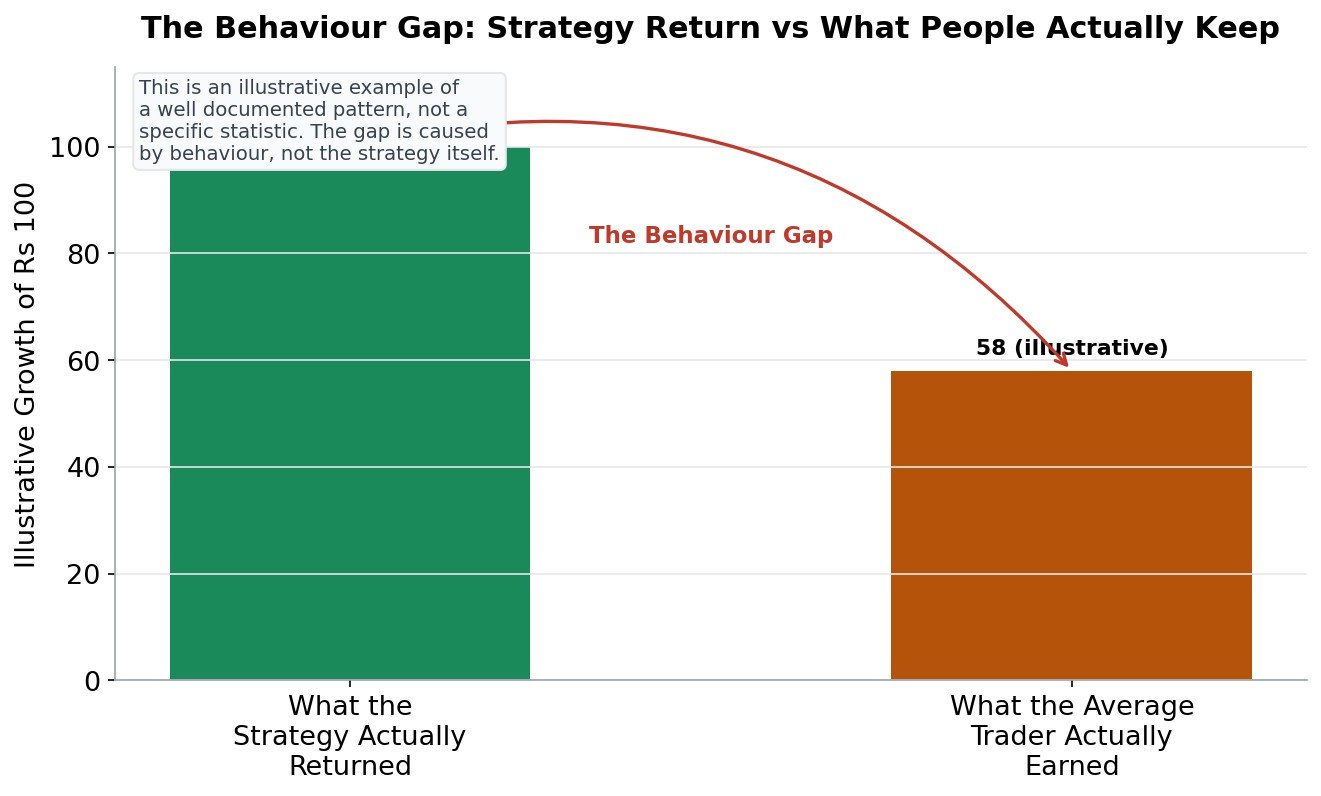
This gap, often called the behaviour gap, is caused entirely by the habits covered throughout this course: skipping trades out of fear, chasing trades out of excitement, abandoning a plan mid-trade, or inconsistent position sizing, all of which quietly erode a strategy’s real, demonstrated performance. The picture above is illustrative, not a specific statistic, but the underlying pattern it represents is real and widely recognized: the strategy is rarely the main problem, the behaviour around it usually is.
Step 3: Overtrading, Recognizing It and Why It Happens
Overtrading means taking more trades, or larger trades, than your actual plan calls for. It often comes from boredom during a quiet market, the urge to “stay busy,” or a loss triggering an immediate desire for a new trade to replace it.
A simple, practical test: if you cannot clearly state which specific setup from your plan justified a trade, before you entered it, there is a real chance it was overtrading rather than a planned decision. This connects directly to the cost drag covered in this site’s Intraday Trading course, where more trades than necessary quietly eats into real profit through brokerage and other costs, even before behaviour is factored in at all.
Step 4: Chasing the Market, Entering Too Late After a Move
Chasing means entering a trade after a big portion of the move has already happened, usually driven by the FOMO feeling covered in this site’s Trading Psychology course. Behaviorally, chasing shows up as a pattern: repeatedly entering trades well after your actual planned entry point, then wondering why your results do not match a backtested strategy’s numbers.
A useful habit to interrupt chasing: if your planned entry price has already passed, treat the trade as missed and wait for the next valid setup, rather than entering late at a worse price with a worse risk to reward ratio than you originally planned for.
Step 5: Averaging Down Into a Losing Position
Averaging down means adding to a losing position to lower your average entry price, hoping the trade turns around. This is a specific, well known trading behaviour, and it is worth distinguishing a planned, deliberate version of it from an emotional one.
A planned scale-in, decided before the trade with clear rules, position sizing, and a maximum add-on limit, is a legitimate, deliberate technique some traders use. Averaging down purely because a losing position feels uncomfortable, without any pre-decided plan, directly connects to the sunk cost fallacy covered in this site’s Trading Psychology course, and tends to turn one manageable loss into a much larger one.
Step 6: Moving Your Stop Loss Further Away
This is one of the most common and most damaging trading behaviours: moving a stop loss further away from the entry price once a trade starts moving against you, instead of accepting the original, planned loss.
This behaviour directly undoes the entire purpose of a stop loss, turning a small, planned loss into a potentially much larger, unplanned one. A useful, concrete rule: a stop loss can be moved to reduce risk (such as to breakeven once a trade moves favorably, covered in this site’s Price Action Trading course) but should never be moved to increase risk once a trade is already open.
Step 7: Position Size Creep After a Win
Position size creep means gradually increasing your position size after a string of wins, often without consciously deciding to, simply because confidence has grown.
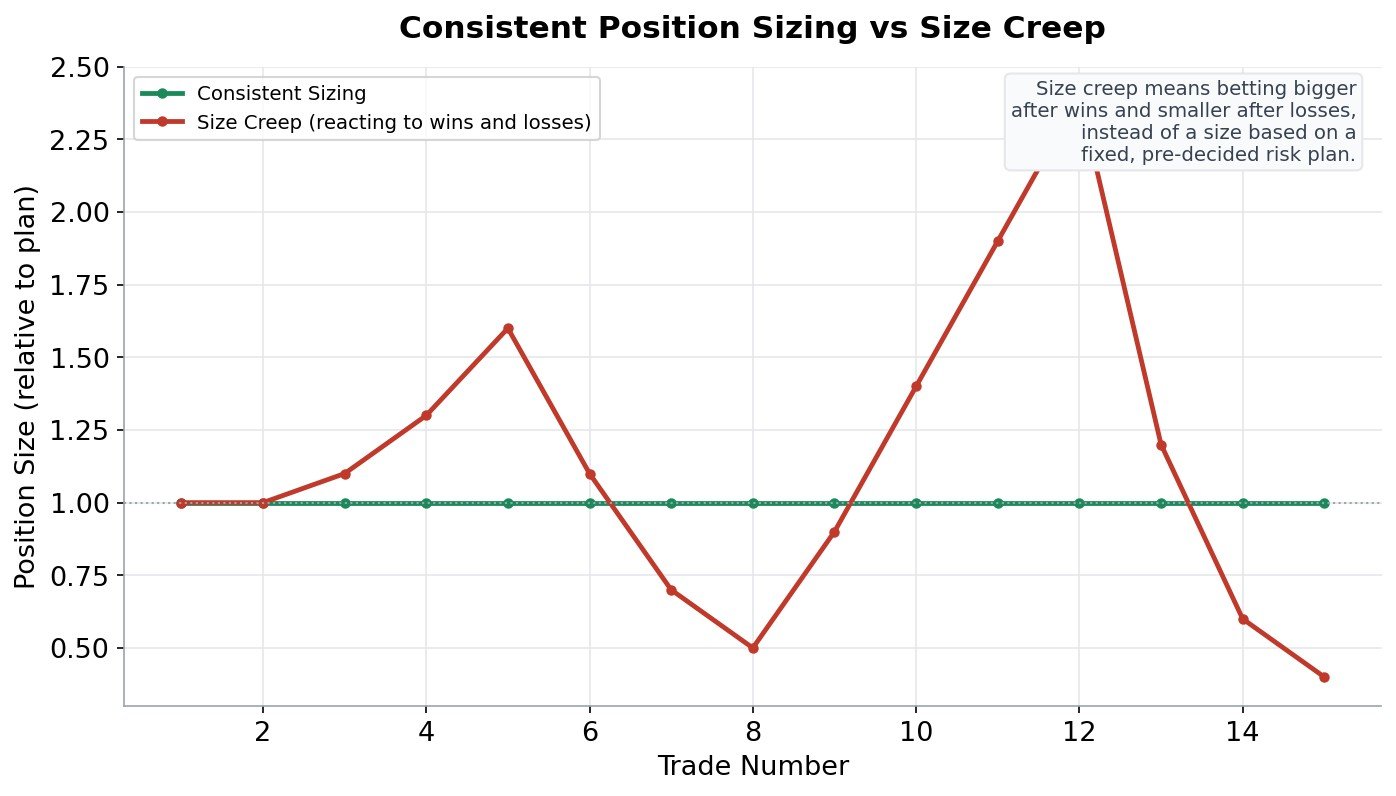
As shown in the picture, consistent position sizing stays steady, based on a fixed risk plan, regardless of recent results. Size creep instead swings with recent wins and losses, often growing largest right before a normal, expected losing trade finally arrives, exactly when the position is at its biggest. This directly connects to the overconfidence bias covered in this site’s Trading Psychology course.
Step 8: Inconsistent Position Sizing, Random Bet Sizing
Separate from size creep specifically tied to a winning or losing streak, some traders simply size positions inconsistently in general, larger on trades that “feel” more confident, smaller on trades that feel less certain, without any actual formula behind the decision.
The position sizing math covered throughout this site’s other courses, risk amount divided by risk per share, exists specifically to remove this inconsistency, replacing a feeling-based decision with a calculated one, so that every trade carries a deliberately chosen, consistent amount of real risk.
Step 9: Jumping Between Strategies Too Often
Switching strategies after every losing streak, chasing whichever approach performed best most recently, is a common behavioural trap. This often prevents any single strategy from ever being given a real, fair, statistically meaningful sample of trades before being abandoned.
A more disciplined approach: decide in advance, before starting with a strategy, roughly how many trades constitute a fair test of it, and commit to that sample size before judging whether the strategy, rather than your execution of it, is actually the problem.
Step 10: Ignoring Your Own Trading Plan
This is a subtly different behaviour from not having a plan at all, covered next in Step 11. Ignoring your plan means you do have a written plan, but you quietly do not follow it, entering trades it does not call for, or skipping trades it does call for, usually without consciously deciding to deviate.
A trading journal, covered in Step 15, is the most direct tool for catching this pattern, since it forces an honest, after the fact comparison between what your plan said and what you actually did.
Step 11: Trading Without a Plan at All
This is the more foundational version of the problem: entering trades based purely on a feeling or a tip, with no predefined entry criteria, stop loss, or target decided in advance at all.
Every strategy course on this site, Price Action Trading, Candlestick Patterns, Chart Patterns, Swing Trading, Intraday Trading, Forex Trading, Option Trading, and Crypto Trading, gives you the raw material to build a real plan. The behavioural discipline covered in this course is what actually turns that raw material into consistent, repeatable action, rather than good ideas that never quite turn into a real, followed process.
Step 12: The Habit of Overchecking Open Positions
Constantly refreshing an open position’s price, far more often than is actually useful for managing the trade, is a widespread behaviour that tends to increase anxiety and the temptation to deviate from a plan, without adding any real value to the trade itself.
A useful habit, particularly for swing trades covered in this site’s Swing Trading course, is deciding in advance how often you actually need to check a position, once a day is often genuinely sufficient for a multi-day swing trade, rather than checking constantly out of habit or anxiety.
Step 13: Building Consistent Pre-Trade Routines
A consistent pre-trade routine, reviewing your plan, your checklist, and your current state of mind before placing any trade, is one of the most effective behavioural defenses against nearly every mistake covered earlier in this course.
This mirrors the pre-market routine covered in this site’s Intraday Trading course, but applies to any trading style: a short, repeatable sequence of steps performed before every single trade, turning discipline into a habit rather than something you have to consciously remember and enforce every single time.
Step 14: Building Consistent Post-Trade Routines
What you do immediately after a trade closes matters just as much as what happens before it. A consistent post-trade routine, recording the result in your journal, briefly reviewing whether your plan was actually followed, and consciously taking a short pause before considering the next trade, interrupts several of the behaviours covered earlier, especially the overtrading from Step 3 and the revenge trading pattern covered in this site’s Trading Psychology course.
Step 15: Tracking Your Own Behaviour With a Trading Journal
A trading journal, covered throughout this site mainly for reviewing strategy performance, is equally valuable for tracking behaviour specifically. Recording not just the trade’s result, but whether your actual entry, stop loss, and position size matched your plan, builds an honest, factual record of your own behavioural patterns over time.
Many traders are genuinely surprised, once they review this record honestly, at how often a specific behaviour, like moving a stop loss or sizing inconsistently, shows up across their trades, a pattern that is nearly impossible to see clearly without a written record to look back on.
Step 16: How to Build New, Better Trading Habits
Behaviour change works best through small, specific, repeatable adjustments, not a single, sweeping resolution to “be more disciplined.” Pick one specific behaviour from this course that your journal (Step 15) shows is genuinely a problem for you, build one small, concrete rule to address it directly, and track your adherence to that one rule specifically for a meaningful stretch of trades before adding another.
This focused, one-habit-at-a-time approach tends to produce far more durable change than trying to fix every behavioural issue at once, which usually results in fixing none of them consistently.
Step 17: Accountability Systems, Trading With a Community or Mentor
Behaviour is often easier to see in someone else’s trading than in your own, and sharing your plan and results with a trading community, an accountability partner, or a mentor adds a layer of external accountability that a private journal alone cannot fully provide.
This does not mean copying anyone else’s trades, it means having someone, or some group, who can honestly point out a behavioural pattern you may be too close to your own trading to notice clearly yourself.
Step 18: Common Behavioural Mistakes Beginners Make
- Taking trades to stay busy rather than because a real setup from the plan is present, the overtrading covered in Step 3.
- Entering late after a move has already happened, the chasing behaviour covered in Step 4.
- Moving a stop loss further away mid-trade, as warned clearly in Step 6.
- Letting position size swing with recent results instead of staying consistent with a fixed risk plan, covered in Step 7 and Step 8.
- Abandoning a strategy before giving it a fair, statistically meaningful sample, as covered in Step 9.
- Having a plan but quietly not following it, the specific gap covered in Step 10.
- Never writing down a plan at all, the more foundational issue covered in Step 11.
Step 19: A Simple Checklist to Audit Your Own Trading Behaviour
Save this list, bookmark it, or share it with a friend who is learning alongside you. Run through it periodically, reviewing your actual recent trades, not just before a new one.
- Looking at my last 10 to 20 trades, did each one match a real setup from my plan, or were some taken out of boredom or impatience?
- Did I move any stop losses further away once a trade moved against me?
- Was my position size reasonably consistent across these trades, or did it swing noticeably after wins and losses?
- Did I abandon any strategy before giving it a fair, meaningful sample of trades?
- Does my actual trading match what my written plan says, or have I been quietly deviating from it?
- Am I checking open positions more often than actually useful for managing them?
- Have I picked one specific behaviour to work on next, rather than trying to fix everything at once?
Step 20: Quick Glossary, Every Term in One Place
A fast reference for every term used across this course. Bookmark this page and jump here any time a word slips your memory.
- Trading Behaviour: The observable habits and actions a trader takes, separate from the internal feelings covered in trading psychology.
- Behaviour Gap: The gap between what a strategy actually returns and what a trader actually keeps, caused by behaviour rather than the strategy itself.
- Overtrading: Taking more trades, or larger trades, than an actual plan calls for.
- Chasing: Entering a trade after a significant portion of the move has already happened.
- Averaging Down: Adding to a losing position to lower the average entry price.
- Position Size Creep: Gradually increasing position size after a string of wins, without a deliberate decision.
- Pre-Trade Routine / Post-Trade Routine: A consistent sequence of steps performed before and after every trade.
- Trading Journal: A record of every trade, used here to track real behaviour against a written plan.
- Accountability System: A community, partner, or mentor who provides outside perspective on your trading behaviour.
Step 21: What to Do Next
This course works best alongside this site’s Trading Psychology course, which covers the internal, emotional roots that these external behaviours usually come from. Every strategy course on this site gives you the raw material for a real trading plan, but behaviour is what actually determines whether that plan gets followed consistently, trade after trade.
Samir Dash’s ACE framework (Aware, Control, Execute) at Mindful Trading Hub brings both the psychological and behavioural halves together into one structured approach, for traders who already understand the mechanics covered across this site but still find their actual results lagging behind what their strategy should be capable of.
Frequently Asked Questions
How is trading behaviour different from trading psychology?
Trading psychology, covered in this site’s dedicated course, is about internal states, what you feel and why. Trading behaviour, covered in this course, is about the external, observable actions and habits that follow from those feelings, as explained in Step 1.
What is the single most damaging trading behaviour?
There is no universal answer, but moving a stop loss further away mid-trade (Step 6) is one of the most widely cited, since it directly undoes a trade’s entire planned risk, turning one small, accepted loss into a potentially much larger, unplanned one.
How do I actually change a behaviour I know is a problem?
Step 16 covers this directly: pick one specific behaviour, build one small, concrete rule to address it, and track your adherence to that single rule for a meaningful stretch of trades before adding another, rather than trying to fix everything at once.
Is a trading journal really necessary to fix my behaviour?
It is one of the most effective tools available, since most behavioural patterns are genuinely difficult to see clearly without a written, honest record to review afterward, as explained in Step 15.
Is this investment advice?
No. Samir Dash is not SEBI-registered, and nothing in this course is a trading recommendation or promise of returns. This content is for educational purposes only. Please read the Disclaimer before acting on anything you read here.
Related Reading on This Site
If you want to go deeper on specific ideas from this course, Samir Dash has written these on blog.samirdash.in:
- Overtrading: The Habit That Quietly Empties Accounts
- How to Stop Overtrading: 7 Rules That Actually Work
- How to Keep a Trading Journal That Changes Your Behaviour
- The Habit Loop: Why You Keep Repeating the Same Trading Mistake
- Decision Journaling for Traders Explained
Continue Your Learning Path
You have now covered the whole library, from the first candle to your own habits.
- Trading Psychology: if you have not read it yet, this is the other half of this course.
- Trading Foundation: back to the very start, to refresh the basics or share it with someone new.
You can also see every course on this site, in order, and pick your own path.
Want to close the gap between what you know and what you actually do? Samir Dash’s ACE framework (Aware, Control, Execute) at Mindful Trading Hub helps traders build the consistent behaviour that knowledge alone can’t teach. Learn more at Mindful Trading Hub.