

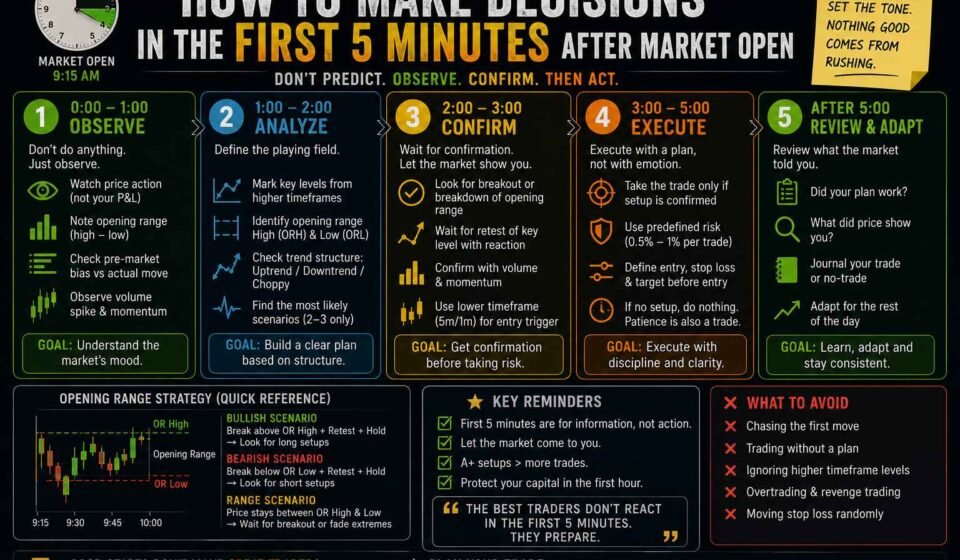

The first five minutes after the market opens, 9:15 to 9:20am for Indian equity markets, produce some of the most misleading prices you will see all day. They also produce some of the strongest urges to act. That combination is exactly why this window causes so much damage.
This post is about what actually happens in those five minutes, why your brain treats them as more important than they are, and a specific rule set for the window.
Why the first five minutes are structurally different
Overnight news, global cues, and the previous day’s positioning all collide in the first few minutes of trading. Orders that built up overnight get executed at once. This creates two effects that do not exist later in the day.
- Wider spreads and faster price swings. A move that looks like a breakout at 9:16am can fully reverse by 9:25am, simply because the initial imbalance of overnight orders gets absorbed.
- False signals on indicators that assume steady volume. Many indicators, especially anything based on average volume or average range, are calibrated on a full trading day. In the first five minutes, volume is unusually high relative to a normal five-minute window, which can make an ordinary move look like an extraordinary one.
None of this means nothing real happens in those five minutes. It means the signal-to-noise ratio is worse than at almost any other point in the session, which changes how much weight a decision made in that window should carry.
Why your brain treats this window as urgent
The first few minutes of the session carry a psychological weight that has nothing to do with their actual reliability.
“If I don’t get in now, I’ll miss the whole move.”
That thought shows up because the overnight wait has built anticipation, and the first candle feels like the answer finally arriving. It is not the answer. It is one data point out of hundreds the day will produce, arriving at the moment you are least equipped to judge it calmly, because you have been waiting for it since the previous close.
This is the Aware stage of the ACE framework in its most literal form. Before reacting to the first candle, the useful question is not “what is the market doing,” it is “what condition am I in right now, coming into this candle.” Anticipation built up overnight is not neutral. It pushes toward action, regardless of what the actual setup looks like.
What actually happens to traders who act fast in this window
Three patterns show up consistently among traders who make entries inside the first five minutes without a specific rule for that window.
- Chasing the gap. Price gaps up, the trader buys immediately assuming continuation, and the gap fills within the first fifteen minutes, stopping them out on a move that had nothing to do with their actual setup.
- Oversizing on false confidence. The fast move feels like conviction, so the position is sized larger than a normal entry, right in the window with the least reliable prices of the day.
- Whipsaw exhaustion. Two or three quick entries and exits inside the first ten minutes, each one technically valid on a fast chart, cumulatively cost more in slippage and small losses than a single well-timed trade later in the session.
A rule set for the first five minutes
- No new entries before 9:20am, as a default rule. Not because nothing valid can happen before then, but because the reliability of what happens before then is low enough that the rule saves more money than it costs in missed moves.
- If your strategy specifically trades the opening range, define the range with a fixed time, for example the first 15 minutes, and only act on a break of that defined range, not on the first candle alone.
- Half size for any entry taken before 9:30am, even if your rule technically allows it. The reduced reliability of the window justifies reduced size, independent of how confident the setup looks.
- Write the one-line Aware check before market open, not after the first candle prints. Once the first candle is on the screen, the anticipation has already converted into pressure to act.
These rules cost you some trades that would have worked. That is the correct tradeoff. A rule that only ever helps and never costs anything is not actually constraining behavior, and this window specifically needs constraint.
What to do instead of trading in those five minutes
The five minutes are not empty time, they are observation time. Use them to note the actual opening range, the direction and strength of the gap relative to the previous close, and whether volume looks unusually high or unusually thin compared to a typical open. This information feeds directly into decisions made from 9:20am onward, which is when the same setups become meaningfully more reliable simply because the overnight order imbalance has had time to clear.
How this connects to the rest of your trading day
The first five minutes are not an isolated event. How you handle them sets the emotional tone for everything that follows. A trader who chases a false move at 9:17am and gets stopped out within ten minutes often carries that loss into the next decision, arriving at 9:30am already a step behind, already trying to recover something, rather than starting the real trading day fresh.
This is why the rule for this window matters beyond the five minutes themselves. A clean, rule-based open, even a quiet one with no trade taken, sets up a calmer state for the rest of the session. A messy open, chasing noise and getting stopped out, often produces a worse version of the trader for the following hour, which compounds the actual cost of those five minutes well beyond the initial loss.
What experienced traders do differently in this window
Traders who have been through enough sessions to trust this pattern usually develop a specific habit: they use the first five minutes purely as information gathering, writing down the gap size, the direction, and the initial volume, without any pressure to act on it. By 9:20am, they already have a clearer picture of the day’s character, trending or choppy, high volume or thin, than a trader who jumped in at 9:16am chasing the first candle.
This is a learned patience, not a natural one. Almost every trader starts out feeling the pull to act immediately at the open. What changes with experience is not the pull itself, which tends to stay fairly constant, but the willingness to let a written rule override it consistently, session after session, until it becomes closer to automatic.
Frequently asked questions
Does this apply to every market, or just Indian equities?
The specific 9:15 to 9:20am window is India-specific, but the underlying mechanism, overnight orders clearing and creating unreliable early prices, applies to the open of most markets. The exact number of minutes to wait can be adjusted, but some wait rule is worth having regardless of market.
What if my strategy is specifically built to trade the opening range breakout?
Opening range strategies can work, but they should define the range with a fixed time window and trade the break of that range, not the first single candle. The difference is subtle but matters: a defined range respects the noise in the first few minutes instead of reacting to the first tick.
Isn’t waiting five minutes just a way to miss the best moves of the day?
Occasionally, yes. But the moves missed by waiting are outweighed, across enough trading days, by the false starts and whipsaws avoided. This is a probability trade-off, not a claim that every early move is fake.
How do I stop myself from acting on impulse in that window if I know the rule?
Write the rule down before market open, not as a mental note but as a physical or digital note visible during the session. Impulse control is far more reliable against a rule you can see than against a rule you are trying to remember under pressure.
Does the same caution apply to the last five minutes of the session?
It is a related but different problem, covered in Decision Fatigue: Why Your Worst Trades Happen Late in the Day. The open is unreliable because of noise. The close is risky for a different reason, tied to accumulated decision fatigue across the day.
What if I trade a strategy that has historically performed best right at the open?
Some strategies genuinely do have an edge concentrated in the first few minutes, particularly around scheduled news or economic data releases. If your own tracked data shows this clearly, over a large enough sample, that is different from an assumption or a hopeful feeling about the open. Even then, a smaller size and a specific, narrower rule for that window tends to outperform trading it the same way as the rest of the day.
The real point
The first five minutes feel like the most important part of the day because they arrive first and carry the weight of overnight anticipation. They are usually the least reliable five minutes of the day. Treating them that way, on paper, before the market opens, is what keeps that mismatch from costing you money.
The market does not reward better predictions. It rewards better decisions, and the best decision in the first five minutes is often simply to wait.
Subah ki jaldi, sham ka pachtaava ban sakti hai.
Related reading:
- Trading Psychology: The Complete Guide for Indian Traders
- How to Make Calm Decisions While a Trade Is Still Open
- You Know the Strategy. Why Can You Not Follow It?
Want to break this loop properly? I run a free live session twice a week for traders with two or more years of experience who know the setups but still cannot execute under pressure. Register for the next free session here.
I am Samir Dash, founder of Mindful Trading Hub. I work with experienced traders on live market decision-making. More about my story here.