

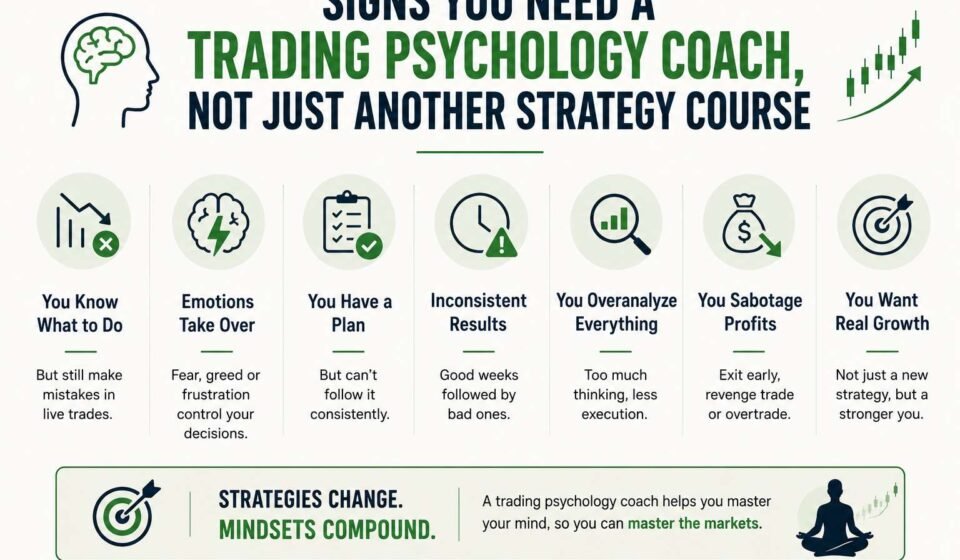

A trader who has been in the market for two or three years usually does not have a knowledge problem anymore. They can explain risk management correctly. They know what a stop loss is for. They can walk you through their own setup step by step. And yet the account still does not grow the way it should.
When this happens, the instinct is almost always to buy another course. A new strategy, a new indicator, a new “system.” This post is about a specific, recognisable set of signs that tell you the next thing you need is not another course. It is a psychology coach.
Sign 1: You can explain the rule perfectly, and still break it
This is the clearest sign there is. If someone asked you right now what your position sizing rule is, you could answer immediately and correctly. But last week, after two losses in a row, you doubled your size on the third trade anyway.
A knowledge gap looks like not knowing the rule. This is different. You know the rule perfectly. The gap is between knowing it and doing it when it actually costs you something to follow it. No course fixes that gap, because the course already gave you the knowledge. It cannot give you the execution.
Sign 2: Your losing trades all have the same “reason” in your journal
Go back through your last twenty losing trades if you keep a journal, or think back honestly if you do not. If the explanation keeps repeating, “got greedy,” “moved my stop,” “entered too early,” “held too long,” that repetition is the actual signal. A different loss every time usually means the market did something unexpected. The same loss every time means you are the variable, not the market.
Sign 3: You trade differently on a demo account than with real money
This is one of the most reliable signs of all. If your demo results are consistently better than your live results, using the exact same strategy, the strategy is not the problem. Something changes the moment real money and real consequences enter the picture, and that something is psychological, not technical.
Sign 4: You have taken more than one course and results have not moved
One course not working could be a bad course. Two or three courses, each teaching a slightly different strategy, each followed by the same pattern of results, is a different story. At that point the common factor across all three courses is you, and specifically, what happens in your head when a live trade is open. More strategy content stacked on top of an execution problem does not fix the execution problem.
Sign 5: You already know what “the discipline books” say, and it has not changed your trading
Most experienced traders have read at least one book on trading psychology. Many can quote the ideas back accurately: cut losses early, let winners run, do not revenge trade. Reading the idea and installing the behaviour are not the same process. A coach’s job is largely that installation process: turning something you already agree with intellectually into something you actually do under pressure, repeatedly, until it becomes normal rather than effortful.
“I don’t need someone to tell me the rules. I need someone to help me actually follow the ones I already know.”
That sentence is close to what most traders in this position eventually say once they stop looking for a new strategy and start being honest about what is actually broken.
Sign 6: You are calm reading a chart after close, but not while the trade is live
Plenty of traders can sit on a Sunday evening, look back at the week’s chart, and explain exactly where the good entry was, where the exit should have been, and what went wrong. That same person, on a Tuesday at 10:15 AM with a live position open, cannot think clearly at all. The analysis is fine. It is the state you are in while a decision actually has to be made that falls apart. A course sharpens the Sunday-evening version of you. It does nothing for the Tuesday-morning version, and the Tuesday-morning version is the one placing the trades.
Sign 7: You have a trading plan document, and you have never once followed it fully
A lot of traders have written a plan at some point: entry rules, stop rules, position sizing, a daily loss limit. Writing it is the easy part. If that document exists somewhere on your laptop and the honest answer is that you have never actually followed it for more than a few days in a row, the plan itself is probably not the issue. The gap is between having a plan and actually running it when the market gets uncomfortable, which is a behavioural gap, not a planning gap.
How these signs tend to compound
These signs rarely show up alone. A trader who freezes during a live trade (sign 6) often also has a plan they cannot stick to (sign 7), which produces the repeating “reason” in the journal (sign 2), which eventually shows up as demo results outperforming live results (sign 3). By the time someone recognises three or four of these together, the pattern has usually been running for a year or more, quietly, in the background of an account that should be performing better than it is.
This is exactly why buying a fourth or fifth course rarely helps at this stage. Each course adds more content to a person who already has enough content. What is missing is not more information, it is someone looking directly at the pattern across trades and naming it clearly enough that it can actually be worked on.
What a coach does differently from a course
A course delivers the same content to everyone, in one direction, usually without seeing a single one of your actual trades. A psychology coach looks at your specific behaviour, your specific patterns, and your specific triggers, and works on those directly. If you want the fuller breakdown of exactly what to look for once you have decided to find one, see this guide to choosing a trading psychology coach in India, and if you want the broader picture of coaching in general, not limited to psychology specifically, see how to choose the best trading coach in India.
What I see most often at Mindful Trading Hub
I started trading in 2018, and for years the only teaching available to me covered technical analysis and setups, never the part that was actually breaking my results. It took five to six years of real losses to understand that the missing piece was never another setup. It was decision-making under pressure. The framework I now teach, ACE (Aware, Control, Execute), exists specifically for traders at the exact point described in this post: they already know the market, and they are stuck inside their own head rather than stuck on strategy.
If more than two of the signs above sound familiar, that is usually a clearer signal than any amount of further research into strategies would be.
Frequently asked questions
What if I’m not sure whether my problem is strategy or psychology?
A simple test: paper trade the exact same setup for two weeks and compare it honestly to your live results. If the paper results are meaningfully better, the strategy works and the gap is psychological.
Can I fix this myself without a coach?
Some traders do, usually through very disciplined journaling and honest self-review over a long period. It is possible, but it tends to take far longer alone, mainly because blind spots are, by definition, hard to see without outside perspective.
Is it normal to need this even after years of trading?
Yes. Behavioural gaps are often more visible in experienced traders, not less, because their knowledge is no longer the limiting factor and the execution gap becomes the only thing left standing between them and consistency.
How is a trading psychology coach different from a general life coach?
A trading psychology coach works specifically inside the context of live trades, real risk, and market-specific pressure, rather than general goal-setting or life circumstances. The mechanisms overlap, but the application is specific to trading decisions.
How many of these signs need to apply before it is worth looking into coaching?
There is no fixed number, but two or more happening together, especially sign 1 (knowing the rule and still breaking it) and sign 3 (demo outperforming live), is usually a strong enough signal on its own. The more of these that overlap, the longer the pattern has likely been running unaddressed.
The real point
Another strategy will not fix a problem that is not about strategy. If you already know what to do and still cannot make yourself do it when a real trade is open, that is not a knowledge gap. It is exactly the kind of gap a psychology coach exists to close.
Jab pata hai kya karna hai, aur phir bhi nahi kar paate, wahi asli kaam shuru hota hai.
Related reading:
- What Is a Trading Decision Coach? (And Why It Is Different From a Strategy Coach)
- How Long It Actually Takes to Become a Consistently Profitable Trader
- Why a Mentor Matters in Trading (And What the Right One Looks Like)
If more than two of these signs sound familiar, you already know what the next step probably is. I run a free live session twice a week for traders with two or more years of experience who know the setups but still cannot execute under pressure. Register for the next free session here.
I am Samir Dash, founder of Mindful Trading Hub. I work with experienced traders on live market decision-making. More about my story here.