

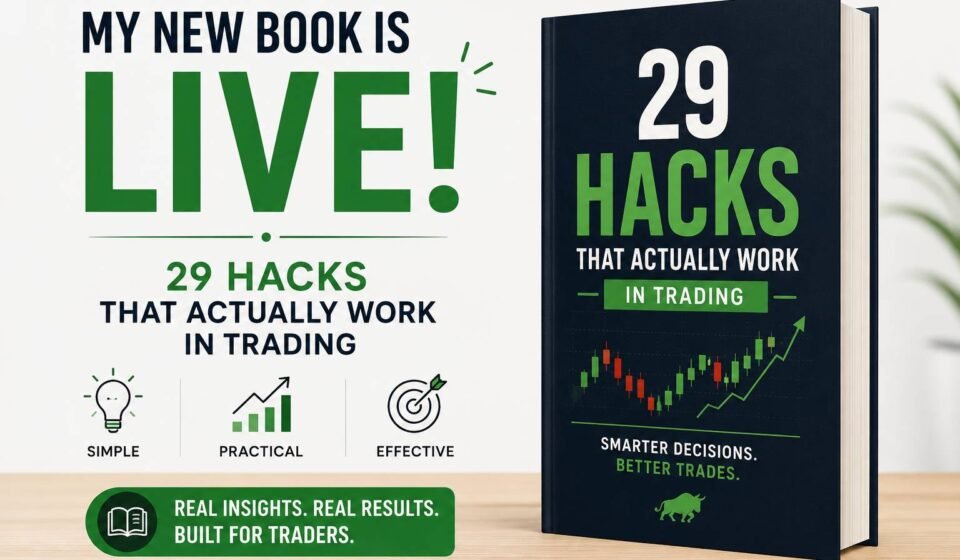

My new book, 29 Hacks That Actually Work in Trading: The Mindful Trader’s Path to Clarity, Confidence & Consistency, is live on Amazon today. It is available now as a Kindle eBook for ₹249 in India.
This post is about why I wrote it, who it is actually for, and what is inside.
Why I wrote it
I started trading in 2018. For years, everything I found to learn from covered the same ground: setups, indicators, chart patterns. Nobody was teaching the part that was actually breaking my results, which was what happened in my own head the moment a trade went live. It took five to six years of real losses, in money and in confidence, to understand that the missing piece was never another setup. It was decision-making under pressure.
This book is the practical, day-to-day version of everything that realisation led to. Where a strategy book gives you a system to follow in sequence, this one is built to be opened anywhere, on a random Tuesday, when you need one specific thing to hold onto before you place a trade.
Who this book is actually for
It is written for traders at any stage, but it will land hardest for one specific kind of reader: someone who already knows the technical side reasonably well and still cannot execute it consistently. If you have ever known exactly what your rule says and still broken it anyway, this book was written with that exact moment in mind.
What is inside
The book has four parts. The first lays the foundation: why most traders fail, the psychology of a trader’s mind, the science of emotion in trading, and the ACE framework (Aware, Control, Execute) that everything else in the book builds on.
The second part is the core of the book: twenty-nine short chapters, one hack each, each built the same way. A real story, practical steps you can actually use, a short reflection question, and a closing thought. None of them require you to be a different kind of person. They are built to be read in a few minutes and used the same day.
A few examples of what is inside:
- Trade With a Plan. Not a vague idea of a plan, a specific one you wrote down before the trade, not during it.
- Manage Your Emotions, Don’t Suppress Them. The difference between pretending you feel nothing and actually working with what you feel.
- Detach From the Outcome. How to separate a good decision from a good result, since they are not the same thing.
- Never Add to a Losing Position. One of the most expensive habits in Indian retail trading, and why it feels so reasonable in the moment.
- Cut Losses Quickly, Let Winners Run. The rule almost every trader has heard, and why so few actually follow it.
- Take Breaks to Reset Your Mind. Why stepping away is a discipline, not a weakness.
- The Market Will Always Be There, Protect Yourself First. The closing hack, and the one underneath most of the other twenty-eight.
The third part moves into healing and growth: how to actually bounce back after a losing stretch, daily rituals that support a calmer trading day, a 30-day mindful trader challenge, and case studies of common trader archetypes that most readers will recognise a piece of themselves in. The fourth part closes with a bigger picture of what consistent, aware trading can actually build over time, not just in an account, but in a life.
Four archetypes you will probably recognise
One section I want to call out specifically is the case studies in Part 3. Instead of describing trading mistakes in the abstract, the book walks through four recurring archetypes, built from patterns that show up again and again in experienced traders.
- The Gambler. Trades for the feeling of action itself, not for a genuine edge, and struggles to sit out a day with no clear setup.
- The Fearful Cutter. Exits winning trades far too early out of fear the gain will disappear, then watches the move continue without them.
- The Overtrader. Cannot leave the screen alone, takes far more trades than any real strategy calls for, and mistakes activity for progress.
- The Patient Sniper. The archetype the other three are working toward, someone who waits for a real setup, sizes it correctly, and can let a losing day be just a losing day.
Most traders see themselves in more than one of these, often depending on the week. The point of naming them clearly is that a pattern you can name is a pattern you can actually start to change, which is a large part of what the whole book is trying to do.
The 30-day challenge inside the book
Part 3 also includes a structured 30-day mindful trader challenge, built to take the ideas in the book out of the reading and into an actual daily practice. It is not a strategy challenge. It is built around the same habits the 29 hacks describe: reviewing trades honestly, sitting out days with no real setup, and tracking not just profit and loss but the decisions that produced them. The idea is that a book alone rarely changes behaviour on its own. A structured 30 days of actually practicing the material gives it a real chance to stick.
Why a book of hacks, not another strategy
There is no shortage of strategy content available to any trader who wants it. What is genuinely rare is a short, honest, practical guide to the behavioural side, written so it can actually be used in the middle of a live trading day rather than read once and filed away. That is the specific gap this book is trying to close. Short chapters, one idea each, built for the moment you actually need them, not for a slow weekend read.
Each hack follows the same structure on purpose: a real story first, so the idea has context and does not feel like a rule handed down from nowhere, then practical steps you can actually apply, a short reflection question to make it personal to your own trading, and a closing thought to carry with you. The format is repetitive by design. Once you know the shape, you can flip open the book to any hack, mid-session, and get what you need in under five minutes.
Why I write this way
I did not want to write a book that only makes sense read start to finish, once, and then sits on a shelf. Trading problems do not show up on a schedule. They show up at 10:47 AM on a Wednesday, in the middle of a live position, when the last thing anyone has time for is a long chapter. Every part of this book, the length of each hack, the structure, the reflection questions, was built around that specific moment rather than around a comfortable reading chair. If it works the way I intended, you should be able to open it after a difficult trade and find something useful before the next one.
A book is a starting point, not the whole answer
I want to be honest about what a book can and cannot do. Reading about a habit and actually installing it under real pressure are two different things. This book will give you the language and the specific, practical steps. For traders who want someone actually looking at their own trades and patterns, that is a different kind of work, and it is exactly what a trading decision coach is for. The book and the coaching are not competing with each other. One gives you the ideas. The other helps you actually live them out when it counts.
Frequently asked questions
What format is the book available in?
It is currently available as a Kindle eBook on Amazon India, priced at ₹249.
Do I need a Kindle device to read it?
No. Amazon’s free Kindle app works on any phone, tablet, or computer, so no separate device is needed.
Is this the same as your other book, Beyond the Chart?
No, they are different books with different purposes. Beyond the Chart works through one complete system in sequence. 29 Hacks is a shorter, more practical collection of the habits I come back to most often, written to be opened anywhere and used immediately rather than read start to finish in order.
Who should read this first if I am new to your work?
29 Hacks is the easier starting point for most readers, since each chapter stands on its own and can be applied the same day, regardless of where you are in your trading journey.
Do I need to read the book in order, front to back?
No. The foundation chapters in Part 1 are worth reading first since they introduce the ACE framework the rest of the book builds on, but the 29 hacks themselves are written to stand alone. You can open the book to any hack and use it without having read the ones before it.
Want the short version instead? Here is a quick summary of all 29 hacks in the book.
Where to get it
The book is live now on Amazon India: 29 Hacks That Actually Work in Trading.
Chhote chhote kadam, roz uthaye jaayein, toh bade badlav khud ba khud aa jaate hain.
Related reading:
- Samir Dash: Founder of Mindful Trading Hub, His Story and Approach
- What Is a Trading Decision Coach? (And Why It Is Different From a Strategy Coach)
- The ACE Framework: Aware, Control, Execute Explained
If the ideas in this book resonate and you want someone looking at your own trades specifically, not just the general principles, that is what I do live. I run a free live session twice a week for traders with two or more years of experience who know the setups but still cannot execute under pressure. Register for the next free session here.
I am Samir Dash, founder of Mindful Trading Hub. I work with experienced traders on live market decision-making. More about my story here.