
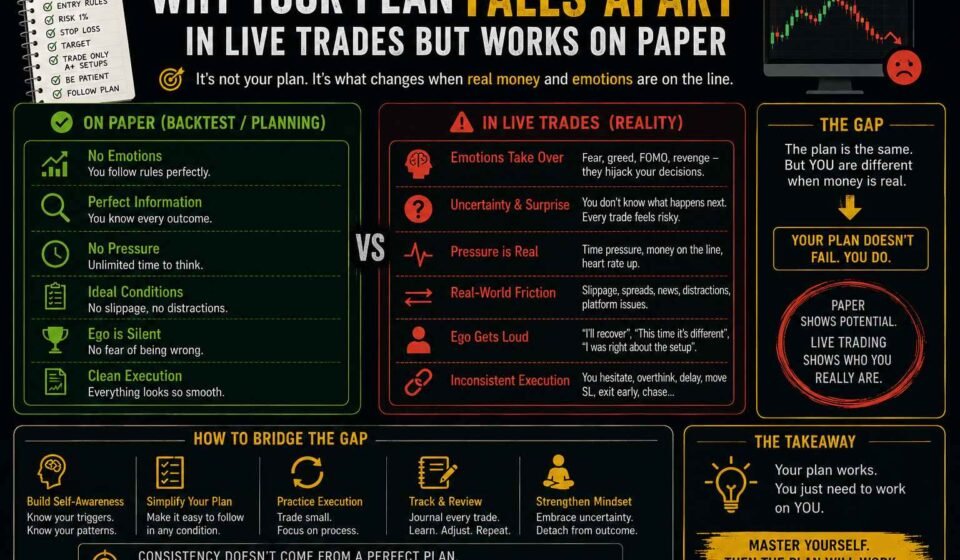

The backtest showed a 62% win rate and a smooth equity curve. The live account, trading the exact same rules, looks nothing like it. This is one of the most common and most misdiagnosed problems in trading, and it is almost never about the plan itself.
This post explains the actual mechanism behind the gap between paper and live performance, and what closes it.
What “the plan” actually contains, and what it leaves out
A written trading plan usually specifies entry conditions, stop placement, target or exit rule, and position size. That is a complete plan for what to do. It is not a complete plan for how to actually do it when real money and real emotion are attached to the outcome.
A backtest, and even paper trading, tests the first part perfectly. It cannot test the second part at all, because there is no real consequence riding on the decision. This is the actual source of the gap, and it explains why more backtesting, more paper trading, or a “better” plan does not fix it. The missing piece was never in the plan.
The three places live trading differs from paper, mechanically
1. The stop-loss decision becomes negotiable
On paper, a stop-loss is a number. Live, at the moment price approaches that number, a live option appears that did not exist in the backtest: the choice to move it. Backtests execute the rule exactly as coded. Live trading gives you, in that exact moment, the ability to override your own rule, and the emotional pull to do so is strongest precisely when the stop is closest to being hit.
2. Position size feels different depending on the day
A backtest applies the same position sizing rule uniformly across every trade in the dataset. Live, position size gets influenced by how the last few trades went, how confident you feel this morning, and how the market has moved so far today. This is not a flaw unique to undisciplined traders. It is what happens by default unless a specific rule prevents it, because sizing decisions live are made by a person in a state, not by a script.
3. Entries get taken, or skipped, based on feel
A backtest takes every signal the code defines, without hesitation and without skipping any. Live, a trader can look at a technically valid setup and skip it because it “does not feel right,” or take an invalid setup because it “looks too good to pass up.” Both of these are Control failures inside the ACE framework, the step where a pre-decided rule is supposed to override an in-the-moment impulse, and it is exactly this step that a backtest cannot simulate, because a backtest has no impulses to override.
Why more backtesting does not close this gap
“I need to backtest this more before I trust it.”
That instinct is reasonable for testing whether the setup itself has an edge. It does nothing for the execution gap, because the execution gap is not a property of the setup. It is a property of the person executing it under real stakes. A trader can backtest the same strategy for another six months and the live results will still diverge in the same way, because the thing that needed testing, the trader’s own behavior under real risk, was never part of the backtest to begin with.
What actually closes the gap
- Trade small enough live that the emotional weight approximates paper trading, then scale up slowly. If the size is small enough that a stop-out does not trigger a strong emotional reaction, you can build the habit of following the rule mechanically before the stakes get large enough to test it under real pressure.
- Write the plan for each trade before entry, including what you will do at each specific price level, not just the entry. A plan that only specifies the entry leaves every subsequent decision, moving the stop, taking a partial exit, holding past target, to be improvised live, which is exactly where the gap opens.
- Track rule adherence separately from P&L. A trade that lost money but followed every rule is a success from an execution standpoint. A trade that made money by breaking a rule is a failure that happened to pay out. Conflating the two teaches the wrong lesson over time.
- Review live trades specifically for the moment the plan was abandoned, not just the outcome. Most execution gaps have a single identifiable moment, often a specific price level or a specific feeling, where the written plan and the actual action diverged. Finding that moment across enough trades reveals a pattern that a single loss never shows on its own.
A concrete example of the gap
A trader backtests a strategy: enter on a pullback to the 20-period moving average in an uptrend, stop below the recent swing low, target at 2R. Backtested over 200 historical setups, it returns a 55% win rate and a positive expectancy.
Live, the trader takes the same setup. Price pulls back to the average, they enter. Price then dips slightly below their planned stop level intraday before recovering. In the backtest, this trade is a clean stop-out, counted, moved on. Live, the trader, watching the position in real time, sees price approaching the stop and thinks the move looks like it is about to reverse. They move the stop down by a few points to “give it room.” Price recovers exactly as they hoped, and the trade ends up a winner.
This looks like a good outcome, and it is, this one time. But the trader has just taught themselves that moving a stop under pressure works. The next time this happens, the move does not reverse, and the loss that should have been 1R becomes 2.5R, because the rule that would have capped it was already treated as negotiable. The backtest never faced this choice. The live account faces it constantly.
Why traders keep believing “a better plan” is the fix
Every time the gap shows up, the natural response is to look for a flaw in the plan itself. Maybe the moving average period needs adjusting. Maybe the stop needs to be wider. Maybe a filter needs adding to avoid choppy conditions. Sometimes these adjustments genuinely help. Often, they do not, because the plan was never the actual point of failure.
This search for a better plan is appealing because it is a comfortable problem to work on. Tweaking a strategy on a spreadsheet does not require confronting the harder, more personal question of why you moved that stop under pressure, or why you skipped that entry because it did not feel right. Plan revision feels like progress and avoids the more uncomfortable review of your own behavior in the moment. After enough cycles of this, a trader can end up with a dozen strategy versions, all reasonably sound on paper, and the same live execution gap following every single one of them into live trading.
A practical review method that targets the real gap
Instead of reviewing trades only by outcome, win or loss, review each one against three specific questions: Was the entry taken exactly as the written plan specified. Was the stop respected without being moved. Was the exit taken at the planned level, not early from fear and not late from hope.
Score each trade with a simple yes or no on all three. Over 30-50 trades, this produces a much clearer picture than P&L alone. A trader who scores yes on all three questions across most trades but still has mixed results has a strategy problem worth revisiting. A trader who scores no on one or more questions frequently has an execution gap, and no amount of strategy revision will close it, because the strategy was never actually being tested as written.
Frequently asked questions
Does this mean backtesting is not useful?
Backtesting is useful and necessary for validating whether a strategy has a real statistical edge. It is simply not designed to test execution under real financial and emotional stakes, which is a separate skill that has to be built live, deliberately.
How small should my live size be when starting a new strategy?
Small enough that a full stop-out does not produce a strong emotional reaction. This varies by trader and by account size, but a useful test is whether you can take the loss and move to the next setup without needing to talk yourself into it.
Is it normal for live results to be worse than backtested results, even with good execution?
Some gap is normal and expected, due to slippage, spread, and market conditions changing after the backtest period ends. A large, consistent gap tied to specific moments of rule-breaking is a different and more fixable problem than natural market variance.
How do I know if my execution gap comes from Aware, Control, or Execute?
Review the moment the plan was abandoned. If you did not notice your own state going into the trade, that is an Aware gap. If you noticed the state but acted anyway, that is a Control gap. If the plan itself was sound and followed but poorly timed mechanically, that points toward the Execute stage itself.
Will this gap ever fully close?
It narrows significantly with deliberate practice at small size, but some gap between planned and live behavior is normal for any human being making decisions under real stakes. The goal is a small, stable gap, not a zero gap.
The real point
A plan that works on paper and fails live is not proof the plan is wrong. It is proof that the plan was only ever tested against a script, never against a person under real pressure.
The market does not reward better predictions. It rewards better decisions, and those are only proven live, never on paper.
Kagaz par sab sahi lagta hai, asli test toh market mein hota hai.
Related reading:
- Trading Psychology: The Complete Guide for Indian Traders
- How to Make Calm Decisions While a Trade Is Still Open
- You Know the Strategy. Why Can You Not Follow It?
Want to break this loop properly? I run a free live session twice a week for traders with two or more years of experience who know the setups but still cannot execute under pressure. Register for the next free session here.
I am Samir Dash, founder of Mindful Trading Hub. I work with experienced traders on live market decision-making. More about my story here.