
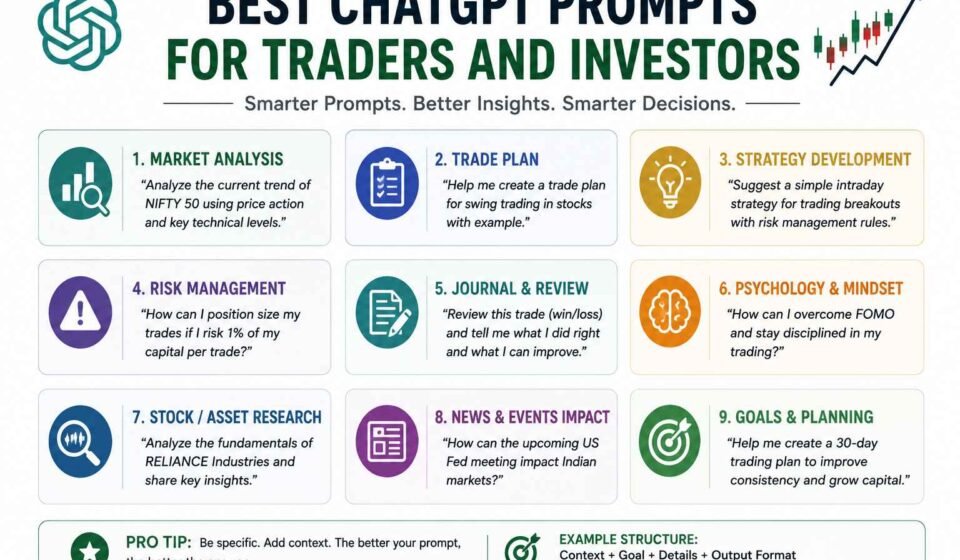

The right ChatGPT prompt for a trader is specific, narrow, and asks for explanation or organization rather than prediction. That single principle is what separates a prompt that actually helps from one that quietly wastes your time or, worse, gives you a confident wrong answer. This post is a practical, ready-to-use library of prompts built around that principle, organized by what you are actually trying to do, plus a short list of prompts you should never rely on.
This piece assumes you already understand where the line between safe and risky AI use sits. If you have not read it yet, how to use AI in trading: a practical guide covers that groundwork in more depth. Here, we go straight to the actual prompts.
Prompts for learning a concept faster
These are the lowest-risk, highest-value prompts you can use. You are asking for an explanation of something that already has a settled, correct answer, not a prediction about the future.
Example prompts
“Explain what open interest means in options trading, using a simple real-world analogy.” “What is the difference between a stop loss order and a trailing stop loss order, explained simply.” “Explain why an option’s time value decays faster as it gets closer to expiry.” “What does implied volatility actually measure, in plain English.”
Why these work well
Each of these has a real, checkable answer that does not change based on today’s market conditions. You can ask a follow up question immediately if the first explanation does not click, the same way you would with a patient teacher, and there is very little risk in getting it wrong since it is not tied to a live decision.
Prompts for organizing your own trading rules
These prompts turn what is already in your head, or scattered across a notebook, into a clean, usable document.
Example prompts
“Here are my entry, stop loss, position sizing, and exit rules in rough notes. Organize them into a clear, numbered checklist I can follow before every trade: [paste your notes].” “Rewrite this trading rule so it is unambiguous and leaves no room for me to talk myself out of following it: [paste your rule].” “I want a pre-trade checklist based on these criteria: [list your criteria]. Format it as a short checklist I can glance at in under thirty seconds.”
Why these work well
You are supplying the actual content, your own rules and reasoning, and asking AI to organize and clarify it, not to invent new rules from scratch. The thinking stays yours. The tool just helps you get it into a usable, consistent format.
Prompts for reviewing your own trading journal
If you keep a trading journal, these prompts help you find patterns you might be too close to see on your own.
Example prompts
“Here are my last twenty trade journal entries, including entry reason, outcome, and my notes on how I felt during the trade. What patterns do you notice in my losing trades specifically: [paste your journal entries].” “Based on these journal entries, do my best trades and worst trades share anything in common in terms of time of day, setup type, or my stated confidence level: [paste entries].” “Summarize the three most common reasons I exited a trade early, based on these notes: [paste entries].”
Why these work well
Again, you are working entirely from your own real, historical data. AI is helping you process and summarize information that already exists, not generating anything new about the market itself. This is one of the genuinely underused ways traders can use these tools well.
Prompts for stress testing your reasoning before a trade
Use these before you enter a trade, as a devil’s advocate against your own thinking, never as the reason to enter.
Example prompts
“Here is my reasoning for a trade I am considering: [describe your setup and reasoning]. What am I not considering? What would make this reasoning wrong?” “Play devil’s advocate against this trade idea and list every weakness you can find: [describe your idea].” “I have a rule that says [describe your rule]. Based only on that rule, would this specific situation qualify as a valid setup: [describe the situation].”
Why these work well
The AI is not telling you whether to take the trade. It is helping you pressure test reasoning you already have, which is a genuinely useful second pair of eyes, as long as the final decision still comes from you, not from whether the AI’s critique felt reassuring or alarming.
Prompts for checking your risk-reward math
Example prompts
“My entry is at [X], my stop loss is at [Y], and my target is at [Z]. Walk me through the risk-reward ratio and how much I am risking in rupee terms if my position size is [N] shares or lots.” “Given a total account size of [X] and a rule to risk no more than [Y]% per trade, what is the maximum position size for a trade where my stop loss is [Z] points away?”
Why these work well
This is arithmetic, not prediction. AI can walk through the calculation clearly and quickly, but you should always recompute anything that is about to change how much capital you actually put at risk, rather than trusting a single generated number blindly, since a small typo in what you paste in can throw off the whole calculation.
Prompts you should never rely on
A few categories of prompts will get you a fluent, confident-sounding answer that is not actually reliable, no matter how well the AI phrases it. Avoid building any real decision around prompts like these: “Which stock should I buy today.” “Is now a good time to enter Nifty.” “Predict where this stock will be next week.” “Give me a guaranteed profitable strategy.” Each of these asks for something no tool, AI or otherwise, can actually deliver reliably: certainty about something that has not happened yet. The deeper reasoning behind why these specific kinds of questions fail is covered in can you trust ChatGPT or AI for stock market advice.
A simple habit that makes every prompt better
Before you send any prompt, ask yourself whether you are asking AI to explain or organize something, or asking it to decide something for you. The first category is where every prompt in this post lives. The moment a prompt starts asking “should I” or “which one will,” you have quietly slipped into the second category, and that is exactly where a confident, fluent answer becomes the most dangerous, because it sounds just as certain as a good one.
Making these prompts even more useful
The single biggest upgrade you can make to any of these prompts is specificity. A vague prompt gets a vague, generic answer. Naming your exact numbers, your exact rule, or pasting your actual journal entries instead of describing them from memory gets you an answer that is genuinely useful to your specific situation instead of a generic response that could apply to anyone. It is also worth asking a follow up question whenever an answer feels slightly off or too general, the same way you would push a human expert to be more precise, rather than accepting the first response at face value.
Frequently asked questions
Do I need to use these exact prompts word for word?
No, treat them as templates. Swap in your own numbers, rules, and situations. The structure, being specific and asking for explanation or organization rather than prediction, matters more than the exact wording.
Can I ask ChatGPT to build a full trading strategy for me from these prompts?
You can ask it to help organize a strategy you already have in mind, but building a genuinely new strategy from scratch and trusting it without your own testing and understanding is a mistake. Any strategy needs to be understood and validated by you before you risk real money on it.
Is it safe to paste my actual account numbers into these prompts?
Be cautious with anything containing personally identifying or account-specific information. Rounding numbers or using placeholder figures for the shape of the calculation is often safer than pasting exact account details.
Will these prompts work the same on any AI chatbot, not just ChatGPT?
The principles apply broadly across AI chatbots, since the underlying issue, confident answers to prediction questions being unreliable, is not specific to one product. The exact wording that works best can vary slightly between tools.
How often should I use AI prompts like these?
As often as they genuinely save you time on explanation, organization, or review. There is no minimum or ideal frequency. The habit worth building is checking, every time, whether you are using a prompt from the safe categories above or drifting into asking for a prediction.
The bottom line
The best ChatGPT prompts for trading are the boring ones: explain this concept, organize my rules, review my own journal, check my own math. The exciting-sounding prompts, which stock will go up, is now a good entry, are exactly the ones that will not hold up. Keep your prompts specific, keep them about explaining and organizing rather than predicting, and the decision stays where it should, with you.
Achha prompt woh hai jo samjhaye ya organize kare, jo predict karne ki koshish kare usse door raho.
Related reading:
- AI Trading Tools: What They Can and Cannot Do For You
- Why AI Chatbots Get Financial Questions Wrong Sometimes
Want to learn this from the source? I run a free live session twice a week for traders with two or more years of experience who know the setups but still cannot execute under pressure. Register for the next free session here.
I am Samir Dash, founder of Mindful Trading Hub. I work with experienced traders on live market decision-making. More about my story here.