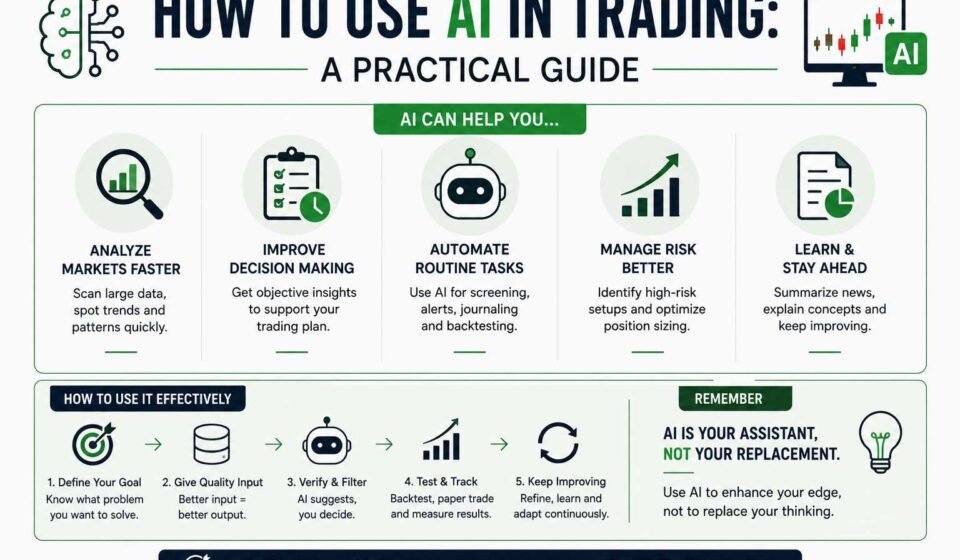

Using AI in trading, in practice, means using a tool like ChatGPT to speed up the parts of your process that are about understanding and organizing, not the part where you decide what to actually do with your money. That is the one-line answer. The rest of this guide is the specific, practical version of it: exactly where AI genuinely helps a trader’s day to day process, and exactly where handing it more than that starts costing you money instead of saving you time.
This is a how-to guide, not a review of AI-branded trading apps. If you want an honest look at products marketed as “AI trading tools,” that is covered separately in AI trading tools: what they can and cannot do for you. This piece is about you, personally, using a general AI assistant as part of your own trading routine.
Start with what AI is actually good at
A general AI assistant is built to understand language, organize information, and explain things clearly. It is not built to know what a stock will do tomorrow, and it does not have live, verified market data by default. Keeping that distinction in mind before you open a chat window saves you from the single biggest mistake traders make with these tools: asking them to predict instead of asking them to help you think.
Use case one: learning concepts faster
This is the safest and most useful starting point. If you come across a term or an idea you half understand, an AI assistant is a genuinely good place to get it explained a second or third way until it clicks. Ask it to explain open interest, or the difference between a stop loss and a trailing stop loss, or why implied volatility affects an option’s price. Ask follow up questions the way you would with a patient teacher. None of this touches your money, so there is very little downside and real time saved.
A practical way to use it
Instead of a vague prompt like “explain options to me,” give it a specific, narrow question: “Explain what happens to a call option’s value as expiry approaches, assuming the stock price does not move.” Narrow questions get more useful, checkable answers than broad ones.
Use case two: organizing your own trading rules
Most traders have their rules scattered across a notebook, a few screenshots, and their own memory. AI is genuinely useful for turning that mess into a clean, written document. Describe your entry rule, your stop loss rule, your position sizing rule, and your exit rule in plain language, and ask it to organize them into a clear checklist you can actually follow. The thinking still has to be yours. The tool is just helping you get it out of your head and onto paper in a usable form.
Use case three: reviewing your own trade journal
If you already keep a trading journal, you can paste in a week or a month of entries and ask AI to help you spot patterns you might be too close to see yourself. Did most of your losing trades happen at a particular time of day. Did you tend to size up right after a win. AI is working with your own real data here, not making anything up, which is a much safer use of the tool than asking it to predict what is coming next.
Use case four: stress testing your reasoning before a trade
Before you enter a trade, you can describe your setup and your reasoning to an AI assistant and ask it to poke holes in it. What am I not considering. What would make this trade wrong. This works because you are using it as a devil’s advocate against your own thinking, not as a source of a new idea. The decision still has to survive your own judgment, not the AI’s approval.
Use case five: summarizing research faster
If you are reading a company’s results, a long report, or a dense article, you can ask AI to summarize the key points so you can decide whether it is worth reading in full. This saves real time. It is still worth reading the original source yourself before it changes a decision, since a summary can miss nuance or, occasionally, get a detail wrong.
Use case six: checking your own risk-reward math
Position sizing and risk-reward calculations are simple in theory and easy to get wrong under real pressure, especially when you are moving fast or trading multiple positions. You can describe your entry, your stop loss level, your target, and your account size, and ask AI to walk through the arithmetic with you: how much you are risking in rupee terms, what your reward-to-risk ratio actually works out to, and whether your position size matches the risk limit you have set for yourself. This is a calculation check, not a trading decision, which keeps it firmly in the safe category. Treat the output as a second pair of eyes on your own numbers, and always recompute anything that is about to change how much capital you put on the line, rather than trusting a single AI-generated number blindly.
Where to stop: the line you should not cross
Every use case above has one thing in common. You are the one who already has the information, the data, or the reasoning, and AI is helping you process it faster. The moment you ask AI to supply the missing piece itself, which stock will go up, whether now is a good entry, what your target should be, you have crossed from research into decision making, and that is exactly where AI stops being reliable. It does not have live, verified prices. It cannot see what has not happened yet. A fluent, confident sounding answer to an unanswerable question is still an unanswerable question.
A simple test before you act on anything AI tells you
Ask yourself one question before any AI-assisted output changes what you actually do with money: could you explain and defend this reasoning yourself, in your own words, without mentioning that AI said so. If yes, you were using AI to organize or accelerate your own thinking, which is the safe use. If no, you were about to let a chatbot make the call for you, which is the one thing it should never be used for.
How this fits into a bigger trading system
None of this replaces the actual skill of trading, which is still about your own rules, your own risk management, and your own discipline to follow your plan when a position is live and moving. AI can help you build and organize that system faster. It cannot execute it for you, and it cannot feel the pressure of a live trade the way you do, which is ultimately what the ACE framework is about, staying aware, in control, and actually executing your own plan under real pressure. If you are curious about building an automated system rather than using AI as a personal assistant, that is a different and much bigger undertaking, covered in algo trading for retail traders in India.
Frequently asked questions
Can I use ChatGPT to pick stocks for me?
You can ask it to, but you should not act purely on the answer. It does not have reliable, live market data and cannot know what a stock will do next. Use it to research and organize your own thinking, not to supply the final pick.
Is it safe to paste my trading data into an AI chatbot?
Be mindful of what you share, especially anything containing personal or account-identifying information. Summaries of your own anonymized trade patterns are generally lower risk than pasting raw account statements.
Do I need to be technical to use AI in my trading process?
No. Everything described in this guide works through plain conversation, typing questions and instructions in normal language. No coding is required for any of these use cases.
Will using AI make me a better trader on its own?
No. It can make your research and organization faster, but the actual skill of trading, discipline, risk management, and decision making under pressure, still has to be built by you, through practice and honest review.
How is this different from an AI trading bot?
An AI trading bot places trades automatically based on its own logic. This guide is about you using a general AI assistant as a personal research and organization tool while you remain the one making every actual trading decision.
The bottom line
Used well, AI is a fast, patient research assistant for a trader: explaining concepts, organizing your rules, reviewing your own journal, and stress testing your reasoning. Used badly, it becomes a confident sounding source of decisions that were never really yours. The line between the two is simple to state and easy to forget in the moment, which is exactly why it is worth writing down and checking yourself against it every time.
AI se apna process fast karo, apna faisla khud lo, yeh farak kabhi mat bhoolo.
Related reading:
- AI Trading Tools: What They Can and Cannot Do For You
- Algo Trading for Retail Traders in India: What It Actually Takes
- How to Keep a Trading Journal That Changes Your Behaviour
Want to learn this from the source? I run a free live session twice a week for traders with two or more years of experience who know the setups but still cannot execute under pressure. Register for the next free session here.
I am Samir Dash, founder of Mindful Trading Hub. I work with experienced traders on live market decision-making. More about my story here.