
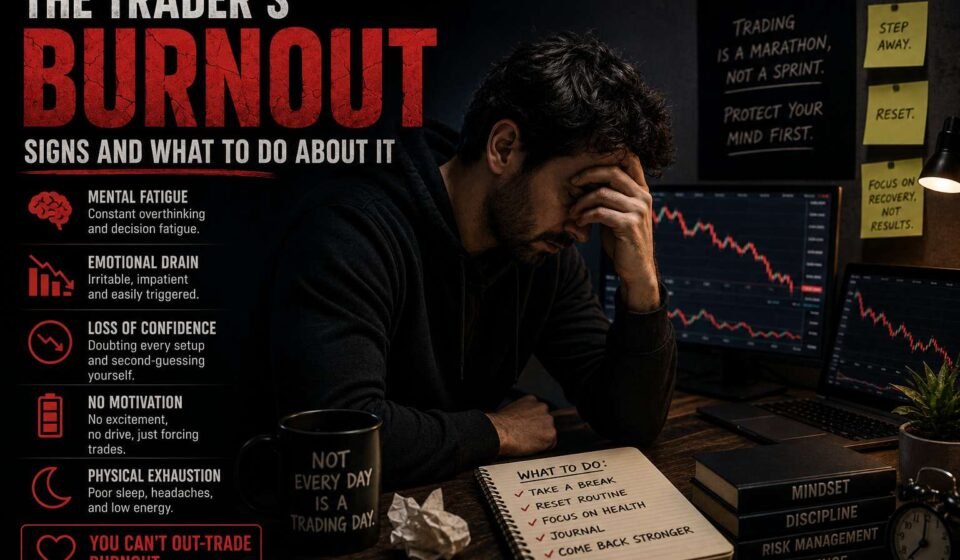

Trading burnout does not look like a trader who is visibly tired and stressed. It looks like a trader who used to check the charts three times a day and now checks them out of habit, without really looking. The caring is gone before the person notices it is gone.
This post covers what burnout actually looks like in a trader, why it happens even to people who love the work, and what actually helps, as opposed to what just sounds like it should help.
Why trading burnout is different from job burnout
Job burnout usually comes from too much of the same task with too little control over it. Trading burnout has an extra layer, because the task itself involves constant small losses of control. Even a good trader is wrong on a meaningful share of trades. A job rarely tells you, multiple times a day, that your last decision was incorrect. Trading does, and it does this even on days when your process was completely sound.
This means trading burnout builds from a source most jobs do not have: the emotional cost of being wrong often, on a task you cannot fully control, with real money attached to every attempt.
The signs, in the order they usually appear
1. Setups stop feeling interesting
Early signs of burnout rarely show up as sadness. They show up as flatness. A setup that used to make you sit up straight now gets a shrug. This is often the first sign, and it is the one most traders dismiss, because nothing looks visibly wrong yet.
2. The journal stops getting filled in honestly, or at all
Reviewing your own trades requires a level of energy that burnout quietly removes first. Traders in the early stage of burnout often keep trading but quietly stop journaling, because journaling requires facing the pattern, and facing the pattern takes energy they no longer have.
3. Rule-breaking becomes frequent instead of occasional
A trader who normally breaks a rule once or twice a month starts breaking rules several times a week. This is not usually a discipline collapse. It is burnout showing up as reduced capacity to hold a boundary, because holding boundaries costs mental energy that is already spent elsewhere.
4. Physical signs show up around market hours specifically
Tight chest or shallow breathing right before the market opens. Trouble sleeping the night before a trading day, even when nothing specific is worrying you. Appetite changes on trading days that do not show up on off days. These are worth taking seriously, because the body usually notices burnout before the mind admits it.
5. Trading feels like an obligation, not a choice
This is the clearest late-stage sign. A trader who used to choose to trade now feels like they have to, even on days their own rules would say to sit out. The activity that used to have some pull now has none, and continues only from habit or financial pressure.
What causes it, mechanically
Burnout in trading usually comes from one or more of three sources stacking on top of each other over months.
- Too many decisions per day for too long without a real break. Every trade decision, every re-entry, every stop adjustment draws from the same limited mental energy. Traders who watch every candle for months without a genuine day off run this reserve down slowly and rarely notice until it is empty.
- A losing streak with no recovery plan. A string of losses is stressful on its own. A string of losses with no clear plan for what to do about it, just more of the same trading, keeps the stress active every single day instead of letting it resolve.
- Identity fused too tightly to daily results. When a trader’s sense of self rises and falls with each day’s P&L, every single trading day becomes an emotional event rather than a data point. Over months, that is exhausting in a way that has nothing to do with hours worked.
Notice that none of these are about working too many hours in the way an office job burns people out. They are about the emotional cost of the decisions themselves, repeated without recovery time.
“I should be able to handle this, I’ve been doing it for years.”
That thought is common right before burnout becomes visible, and it is exactly backwards. Years of experience do not make a trader immune to burnout. They often make the signs harder to notice, because the trader has learned to push through discomfort as a matter of habit.
What actually helps
- A real break, not a lighter trading schedule. Reducing position size while still watching every candle does not rest the part of the brain that is actually tired. A full 2-3 week break from charts, not just from trading, is what resets decision-making capacity.
- Separating identity from daily P&L. This is covered in depth in Building a Trading Identity That Survives Losing Streaks. The short version: your worth as a trader should be judged by your process over months, not your result today.
- Fixed trading hours, not “whenever the market moves.” Traders who watch the market all session, waiting for something to happen, burn out faster than traders who trade a defined window and step away for the rest of the day.
- External accountability. A trading group, a mentor, or even a simple weekly review call gives the nervous system a reason to pace itself, rather than running at full intensity because nobody is watching the toll it is taking.
Why traders push through burnout longer than they should
Most professions have visible cues that force a break, a manager noticing declining output, a colleague asking if you are okay, a formal leave policy. Trading, especially solo trading, has none of these built in. Nobody notices your burnout except you, and by the time you notice it yourself, it has usually been building for weeks.
There is also a specific belief that keeps traders pushing through: the idea that stepping away means falling behind, missing the move, losing the rhythm that took months to build. This belief is almost always wrong in practice. A trader trading through burnout produces worse decisions than a trader who took three weeks off and returned with a rested mind. The market will still be there. The missed rhythm returns faster than most traders expect, usually within a week or two of resuming with clear rules.
Building recovery into the schedule before it is needed
The traders who handle burnout best are rarely the ones with the best recovery techniques. They are the ones who built recovery into their calendar before burnout arrived, the same way a runner builds rest days into a training plan rather than waiting for an injury to force one.
This can be as simple as one full day per week with zero market exposure, not reduced exposure, zero. It can mean a mandatory week off every quarter, scheduled in advance regardless of how the trading has gone. It can mean a hard stop time each day, after which charts do not get reopened even to “just check.” None of these need to happen in response to visible burnout symptoms. Built in early, they prevent the slow decline described above from ever reaching the later stages.
Frequently asked questions
How is trading burnout different from just having a bad week?
A bad week is tied to specific losses and usually passes once the losses stop. Burnout is tied to the accumulated cost of the activity itself and persists even during flat or slightly winning stretches. If the flatness continues through a decent week, that points to burnout rather than a bad-week feeling.
Can I trade my way out of burnout by taking a few big wins?
No, and trying usually makes it worse. A big win during burnout often gets followed by oversized, careless trades, because the underlying exhaustion has not actually been addressed, only masked temporarily by a good result.
How long does recovery from trading burnout usually take?
It varies, but a genuine 2-3 week full break, followed by a slow reintroduction with a smaller position size and a fixed daily trading window, is a reasonable starting structure for most traders.
Is burnout a sign that I should quit trading altogether?
Not automatically. Burnout is often a signal about pace and structure rather than about fit. See How to Know If You Should Quit Trading for how to tell the two apart using your actual numbers, not just how tired you feel right now.
Can burnout happen even when I am profitable?
Yes, and it often does. Profitability and burnout are measuring different things. A trader can be up for the year and still be running on empty, because the emotional cost of the decisions has nothing to do with whether those decisions happened to work out.
The real point
Burnout is not a character flaw and it is not proof you are unfit for trading. It is what happens to anyone who makes hard decisions repeatedly without building in recovery time.
The market does not reward better predictions. It rewards better decisions, and tired traders make worse ones no matter how experienced they are.
Thakaan chhupti nahi hai, woh sirf decisions mein dikhne lagti hai.
Related reading:
- Trading Psychology: The Complete Guide for Indian Traders
- Trading With Family Money: The Extra Pressure No One Talks About
- Building a Daily Practice: Meditation, Movement and Markets
Want to break this loop properly? I run a free live session twice a week for traders with two or more years of experience who know the setups but still cannot execute under pressure. Register for the next free session here.
I am Samir Dash, founder of Mindful Trading Hub. I work with experienced traders on live market decision-making. More about my story here.