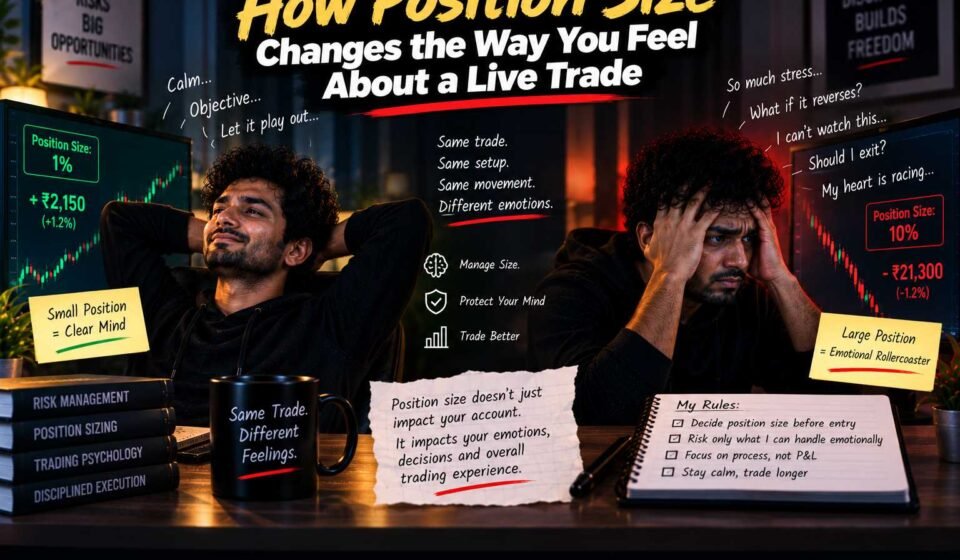

Take the exact same setup. Same stock, same chart pattern, same stop loss level in points, same target. Trade it with 1 lot and it feels manageable, almost boring. Trade it with 3 lots and your hand is on the mouse the entire time, ready to close it the second it dips.
The setup did not change. The chart did not change. The only thing that changed is the number of rupees moving per point, and that single number is enough to turn a calm trader into an anxious one, holding the exact same idea.
This post covers why position size affects your emotions independently of the setup quality, what actually happens in your decision-making once size crosses a certain threshold, and how to find the size where you can actually execute your plan instead of just watching the P&L.
Risk on paper versus risk in the body
On paper, position size is just arithmetic. If your stop is 30 points away and you are risking 2% of your capital, the position size calculation gives you an exact number of lots or shares. This calculation does not care how the size feels.
But you are not a calculator, you are a person holding a position, and your body reacts to the rupee amount moving on the screen, not to the percentage of capital it represents. Losing ₹8,000 does not feel like “2% of capital” while it is happening. It feels like ₹8,000, a number you can compare to your monthly expenses, your EMI, or what you spent on your last family trip. The percentage is correct. The feeling is calculated in absolute rupees.
This is why two traders with identical risk percentages, one with a ₹5 lakh account and one with a ₹50 lakh account, can have completely different emotional experiences of “the same” 2% risk trade. The larger account holder is watching a bigger number swing, and the bigger number pulls harder on attention regardless of what the underlying math says.
The threshold effect: why one extra lot changes everything
Most traders discover, usually the hard way, that there is a specific size where their behaviour changes noticeably. Below that size, they can follow their plan calmly. At or above it, they start moving stops, exiting early, or freezing when they should act.
This threshold is rarely obvious from position sizing rules alone, because it is not primarily a math threshold, it is a psychological one. It shows up as specific, recognisable behaviour:
- Checking the position significantly more often than usual, breaking whatever checking rhythm you normally hold to.
- Feeling a physical response, a tightness in the chest or stomach, that does not happen at your normal size.
- Wanting to exit at breakeven the moment the trade is flat, even though your stop is still far away.
- Rehearsing what you will tell yourself if it goes wrong, before it has actually gone wrong.
If any of these show up consistently at a particular size, that size is above your current threshold, regardless of what your risk percentage calculator says is technically allowed.
Why this matters more in F&O than in equity delivery
Futures and options carry leverage, which means a relatively small capital outlay controls a much larger notional position. A single lot of Nifty futures moves substantially more rupees per point than most traders intuitively expect when they first start trading it. This gap between what the position “costs” to enter and what it actually risks is exactly where the threshold effect tends to bite hardest, because traders size based on margin available rather than on how the rupee swing will actually feel while the trade is live.
The first sixty seconds tell you the truth about your size
“I entered and immediately felt like I wanted it to be over.”
This feeling, in the first minute after entry, covered in more depth in The First 60 Seconds After You Enter a Trade, is one of the clearest signals that your size is above your comfort threshold for that particular setup. A well-sized position, even one you care about, generally feels neutral in the first minute. An oversized position often feels urgent immediately, before the price has even moved meaningfully.
If you notice this feeling regularly, it is worth treating it as data about your size rather than something to push through with willpower. Willpower is a limited resource and it will not hold up trade after trade if the size itself is the problem.
How to actually find your working size
Position sizing calculators tell you the maximum size your risk rules allow. They do not tell you the size at which you can actually execute your plan calmly. Finding that second number takes a bit of deliberate testing.
- Start smaller than your calculated maximum for a stretch of trades, even if it feels like leaving money on the table. The goal here is information, not maximum return.
- Track how closely you followed your written plan at each size, not just your P&L. Did you hold to your stop? Did you take partial profit where planned? Did you check the chart on your normal schedule or compulsively?
- Increase size gradually, one step at a time, only after a size has produced calm, plan-following execution across a meaningful number of trades, not just one or two lucky ones.
- Notice the size where execution quality drops, even if the trades at that size happened to win. A win at a size you could not calmly manage is not proof the size was right, it is a lucky outcome on a size that is still too large for you right now.
This process is slower than jumping straight to your maximum allowed size, but it produces a number you can actually trade from, rather than a number that only works on a calm chart in your head.
Why bigger size does not mean bigger conviction
A common trap is treating position size as a proxy for how confident you are in a setup. A trade you feel very sure about gets a bigger size, a trade you are less sure about gets a smaller one. This feels logical, but it quietly links your emotional state to your risk, which is backwards. Confidence is not a reliable predictor of outcome, and sizing up because you “feel it” is one of the more common ways good traders take an outsized loss on a trade that looked no different from their normal setups on paper.
Size should come from your risk rules and your tested comfort threshold, not from how strongly you feel about a particular idea today.
What to do the moment you realise you are oversized
If a trade is already live and you notice the threshold behaviours listed earlier, the calmest fix is usually to reduce, not to exit entirely. Booking partial profit or partial loss to bring the remaining position down to a size you can manage often restores your ability to follow the rest of your plan. This is a better outcome than either freezing in an oversized position or panicking out of the entire trade because the size, not the setup, became the problem.
Frequently asked questions
How do I know if my position size is too big for me?
Watch your behaviour, not just your P&L. If you check the trade far more often than usual, feel physical tension that is absent at smaller sizes, or want to exit at breakeven regardless of your stop, the size is likely above your current threshold.
Should position size be the same across every trade?
Not necessarily in absolute terms, but it should follow a consistent rule, for example a fixed percentage of capital per trade based on your stop distance. What should stay consistent is that the rule decides the size, not how confident you feel that day.
Can I train myself to handle bigger size over time?
Yes, this is normal and expected as your account grows and your experience with a given size increases. The key is increasing gradually and testing execution quality at each step, rather than jumping straight from a comfortable size to a much larger one.
Is it wrong to reduce position size after a losing streak?
No, this is a reasonable and common practice. Reducing size during a losing streak is a risk management decision, not a sign of weakness, and it often restores the calm needed to trade your plan correctly again.
Why does the same percentage risk feel different in a bigger account?
Because your emotional response tracks the absolute rupee number moving on screen, not the percentage. A bigger account produces bigger absolute swings at the same percentage risk, which is why the sizing threshold needs to be re-tested as your account grows, not assumed to stay constant.
The real point
Position size is not just a risk management number, it is the volume dial on every emotion you will feel during the trade. The market does not reward better predictions. It rewards better decisions, and a decision made from a size you cannot calmly hold is rarely a good one, no matter how correct the setup turns out to be.
Size wahi rakho jo dimaag shant rakhe, sirf calculator khush na kare.
Related reading:
- The ACE Framework: Aware, Control, Execute Explained
- Mindfulness for Traders: What It Actually Means (Not Just Sitting Still)
- What Happens in Your Brain While a Trade Is Open
- Action Bias: Why Traders Feel the Need to Always Be in a Trade
Want to break this loop properly? I run a free live session twice a week for traders with two or more years of experience who know the setups but still cannot execute under pressure. Register for the next free session here.
I am Samir Dash, founder of Mindful Trading Hub. I work with experienced traders on live market decision-making. More about my story here.