

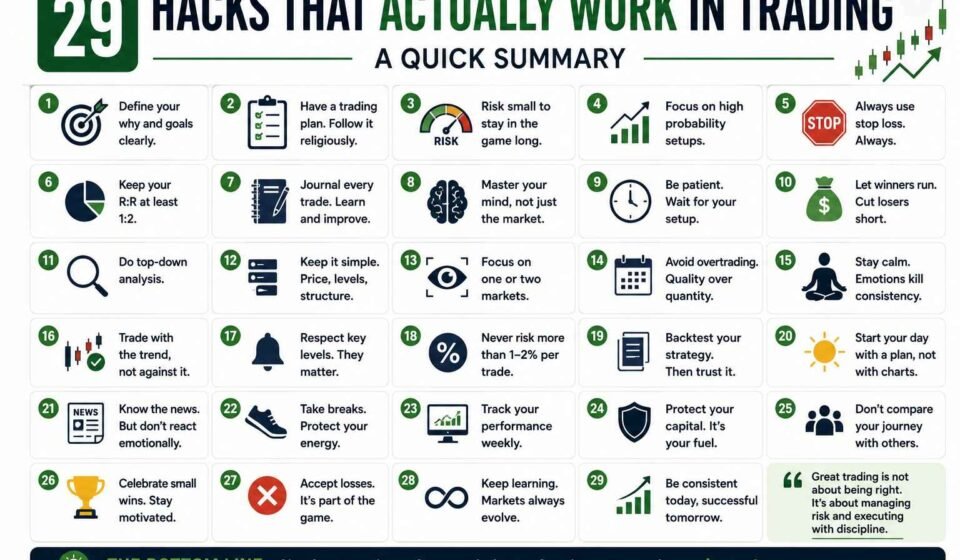

29 Hacks That Actually Work in Trading, written by Samir Dash, founder of Mindful Trading Hub, is a practical, chapter-by-chapter guide to the behavioral side of trading, the part strategy courses almost never cover. This post is a quick, complete summary: what the book contains, what each of the four parts covers, and the full list of all 29 hacks, so you know exactly what is inside before you decide whether to read it.
Who wrote 29 Hacks That Actually Work in Trading
Samir Dash spent twelve years in the corporate world before moving into full-time trading, a transition that brought heavy losses, anxiety, and self-doubt before it brought any real consistency. Rather than walk away, he turned to Vipassana meditation and honest self-reflection, and slowly came to a conclusion that reshaped how he trades and teaches: profitable trading was never really about charts and strategies alone, it is about learning to master your own mind first. That realization became the foundation of Mindful Trading Hub, the community and coaching practice Samir now runs, and it is the throughline of every hack in this book. You can read more about how he got here in Samir Dash’s trading journey and Samir Dash: founder of Mindful Trading Hub, his story and approach.
What the book is actually about
The subtitle says it plainly: The Mindful Trader’s Path to Clarity, Confidence and Consistency. Every trader eventually discovers that the real battle is not on the chart, it is inside their own head, in the seconds between a setup appearing and a decision getting made. Samir Dash built this book around that exact gap, using his own losses, his Vipassana practice, and years of coaching other traders through the same pattern.
The four parts of the book
Part 1: Foundations
Five chapters that set up everything that follows: why most traders fail, the psychology of a trader’s mind, the science of emotions in trading, and the ACE Framework (Aware, Control, Execute), Samir Dash’s signature model for building psychological balance under pressure. Part 1 closes with a chapter on why a trader’s journey is emotional first, financial second.
Part 2: 29 Hacks That Actually Work in Trading
The core of the book. Twenty-nine short, standalone chapters, one hack each, built the same way every time: a real story, practical steps, a short reflection question, and a closing thought. None of them require you to be a different kind of person. Each one is written to be read and used in a few minutes, mid-session, not saved for a slow weekend read.
Part 3: Healing and Growth
Five chapters that move past the individual hacks into a bigger practice: how to actually bounce back after a losing stretch, daily rituals for a calmer trading day, a structured 30-day mindful trader challenge, an emotional compass for recognizing your own state before it wrecks a trade, and case studies built around recurring trader archetypes.
Part 4: Vision and Conclusion
Two closing chapters on the bigger picture, what consistent, aware trading actually builds over time, followed by the author’s note, acknowledgements, and an invitation to Samir Dash’s free live masterclass.
All 29 hacks, listed in full
Here is every hack in the book, in order, exactly as it appears in the table of contents:
- Trade With a Plan
- Control Your Risk
- Manage Your Emotions, Don’t Suppress Them
- Consistency Beats Intensity
- Journal Every Trade
- Patience Pays the Most
- Detach From the Outcome
- Master One Setup First
- Don’t Trade Every Day
- Avoid News-Driven Trading
- Respect Your Stop-Loss
- Never Add to a Losing Position
- Cut Losses Quickly, Let Winners Run
- Don’t Marry Your Trades
- Avoid Overtrading
- Respect the Power of Compounding
- Keep Your Risk Per Trade Small
- Diversify, But Don’t Over-Diversify
- Have a Trading Plan and Stick to It
- Learn to Sit on Cash
- Don’t Try to Predict the Market
- Don’t Let One Trade Define You
- Take Breaks to Reset Your Mind
- Don’t Chase the Market
- Don’t Compare Your Journey With Others
- Don’t Overcomplicate Your Strategy
- Don’t Mix Trading and Investing
- Don’t Trade to Escape Emotions
- The Market Will Always Be There, Protect Yourself First
Notice the last hack is deliberately the closing one. Every other hack in the book sits underneath it in some way: none of the other twenty-eight matter if you have already damaged yourself, financially or emotionally, past the point of being able to keep trading at all.
The 29 hacks grouped by theme
The hacks are not organized into labeled sections inside the book itself, since each one is written to stand alone, but reading them together, a few natural clusters show up.
Risk and money management runs through Control Your Risk, Respect Your Stop-Loss, Never Add to a Losing Position, Cut Losses Quickly Let Winners Run, Keep Your Risk Per Trade Small, Diversify But Don’t Over-Diversify, and Respect the Power of Compounding. These are the hacks that protect your capital directly.
Emotional and psychological discipline covers Manage Your Emotions Don’t Suppress Them, Detach From the Outcome, Patience Pays the Most, Don’t Marry Your Trades, Don’t Let One Trade Define You, and Don’t Compare Your Journey With Others. These are the hacks aimed at what is happening inside you while a position is live.
Behavioral patterns and habits includes Trade With a Plan, Consistency Beats Intensity, Journal Every Trade, Master One Setup First, Don’t Trade Every Day, Avoid Overtrading, Have a Trading Plan and Stick to It, Learn to Sit on Cash, Don’t Chase the Market, and Don’t Overcomplicate Your Strategy. These focus on what you actually do, session after session, regardless of how you feel. It is worth noticing that the book returns to the idea of having a plan twice, once early as Trade With a Plan and again later as Have a Trading Plan and Stick to It, since writing a plan and actually following it under pressure are two different skills that both need reinforcing.
Boundaries and self-protection ties together Avoid News-Driven Trading, Don’t Try to Predict the Market, Take Breaks to Reset Your Mind, Don’t Mix Trading and Investing, Don’t Trade to Escape Emotions, and the closing hack, The Market Will Always Be There, Protect Yourself First. This cluster is about knowing where trading ends and the rest of your life needs to stay protected.
The ACE Framework, in one paragraph
Almost everything in the book connects back to a three-part idea Samir Dash calls the ACE Framework. Awareness means noticing what you are actually feeling and what is driving a decision in the moment, rather than realizing it only afterward. Control means creating a pause between that feeling and your next action, instead of reacting instantly. Execute means actually following through on the plan you made when you were calm, even when the in-the-moment version of you wants something different. The full breakdown lives in the ACE Framework: Aware, Control, Execute explained.
The four trader archetypes from Part 3
One section worth knowing about before you read: Part 3 introduces four recurring trader archetypes, built from patterns Samir Dash has seen repeatedly while coaching. The Gambler trades for the feeling of action rather than a genuine edge. The Fearful Cutter exits winning trades too early and watches the move continue without them. The Overtrader cannot leave the screen alone and mistakes activity for progress. The Patient Sniper is what the other three are working toward, someone who waits for a real setup, sizes it correctly, and can let a losing day just be a losing day. Most readers recognize themselves in more than one, often depending on the week.
Who this book is written for
It is written for traders at any stage, but it lands hardest for one specific kind of reader: someone who already understands the technical side reasonably well and still cannot execute it consistently. If you have ever known exactly what your own rule says and broken it anyway, this book was written with that exact moment in mind.
Frequently asked questions
Who is Samir Dash?
Samir Dash is a trading mindset coach, day trader, and founder of Mindful Trading Hub. He moved from a twelve-year corporate career into full-time trading, and after his own period of heavy losses and self-doubt, built his coaching practice and this book around the psychological side of trading he found nobody else was teaching.
How long is 29 Hacks That Actually Work in Trading?
It is a full-length book organized into four parts and twelve chapters, with the twenty-nine hacks forming the core of Part 2. Each hack chapter is short and self-contained by design, meant to be read in a few minutes.
Do I need to read the 29 hacks in order?
No. Part 1 is worth reading first since it introduces the ACE Framework the rest of the book builds on, but each of the 29 hacks stands on its own. You can open the book to any hack and use it without having read the ones before it.
Is this book only for beginners?
No. It tends to land hardest for traders who already understand the technical side and still struggle to execute consistently, which is often an experienced-trader problem more than a beginner one.
Where can I get 29 Hacks That Actually Work in Trading?
It is available now as a Kindle eBook on Amazon India. See the link below.
Where to get it
29 Hacks That Actually Work in Trading, by Samir Dash, is live now on Amazon India: 29 Hacks That Actually Work in Trading. For the full story behind why Samir Dash wrote it, see the original book launch post.
Kitaab padhna shuruaat hai, asli kaam roz us hack ko apni trading mein use karna hai.
Related reading:
- Samir Dash on What Makes Trading Coaching Actually Work
- What Is a Trading Decision Coach? (And Why It Is Different From a Strategy Coach)
If the ideas in this book resonate and you want someone looking at your own trades specifically, not just the general principles, that is what I do live. I run a free live session twice a week for traders with two or more years of experience who know the setups but still cannot execute under pressure. Register for the next free session here.
I am Samir Dash, founder of Mindful Trading Hub and author of 29 Hacks That Actually Work in Trading. I work with experienced traders on live market decision-making. More about my story here.