

Most traders who ask this question want a number. So here is one: 2 to 4 years of active, screen-time trading, with real money, before consistent profitability becomes the normal state rather than an occasional good month.
That number surprises people. Ads and course sellers talk about 90-day transformations. The real timeline is longer, and it is longer for a specific reason that has nothing to do with intelligence or effort. This is the pillar post on the subject. It covers what “consistently profitable” actually means, why the timeline is what it is, what the journey looks like stage by stage, and how to tell if you are on track.
What “consistently profitable” actually means
Before the timeline, the definition needs to be precise, because most traders are measuring the wrong thing.
Consistently profitable does not mean every month is green. It means your account grows over a rolling 12-month period, your maximum drawdown stays inside a number you decided in advance, and you can explain every losing trade using your own rules rather than bad luck. A trader who is up 40% for the year but cannot explain three of their losses is not consistent. They got lucky on the trades that offset the unexplained ones.
This matters because traders who chase a green month as the goalpost keep resetting their own clock. One good month feels like arrival. One bad month after it feels like failure. Neither is true. The unit that matters is a full year, ideally two.
Why the timeline is 2 to 4 years, not 6 months
The honest answer has three layers, and only one of them is about market knowledge.
Layer 1: Strategy knowledge (fast)
Learning setups, indicators, and price action patterns takes months, not years. Most traders with 2 or more years of screen time already have this. If you can read a chart and explain your entry logic to another trader, this layer is done for you.
Layer 2: Statistical sample size (slow, fixed by the calendar)
A trading edge only shows itself over a large enough sample of trades across different market conditions. A strategy that worked beautifully in a trending market from January to April can fall apart in a sideways market from May to August. You do not know your real edge until you have traded through at least one full cycle of trending, sideways, and volatile conditions. In Indian markets, that cycle rarely completes in under 12 months, and often takes longer.
This layer cannot be rushed by trading more hours per day. It is gated by calendar time, not effort.
Layer 3: Decision-making under real risk (slowest)
This is the layer almost nobody accounts for, and it is the one that actually determines the 2 to 4 year figure.
Executing a plan on a demo account or in your head is not the same skill as executing it when ₹40,000 of real money is on the line. The gap between the two is not knowledge. It is the ability to stay aware of your own state, keep control of your actions when the trade moves against you, and execute the plan you wrote instead of the plan your fear writes in the moment. Building that skill requires repeated exposure to real losses, real drawdowns, and real temptation, followed by review, followed by more exposure. There is no shortcut through this layer because it is built through repetition under actual stress, the same way a pilot cannot become calm in turbulence by reading about turbulence.
This is why the timeline stretches past a year even for traders who already understand strategy. The ACE framework is built specifically to accelerate this third layer, because most trading education spends all its time on layer 1 and none on layer 3.
The four stages most traders pass through
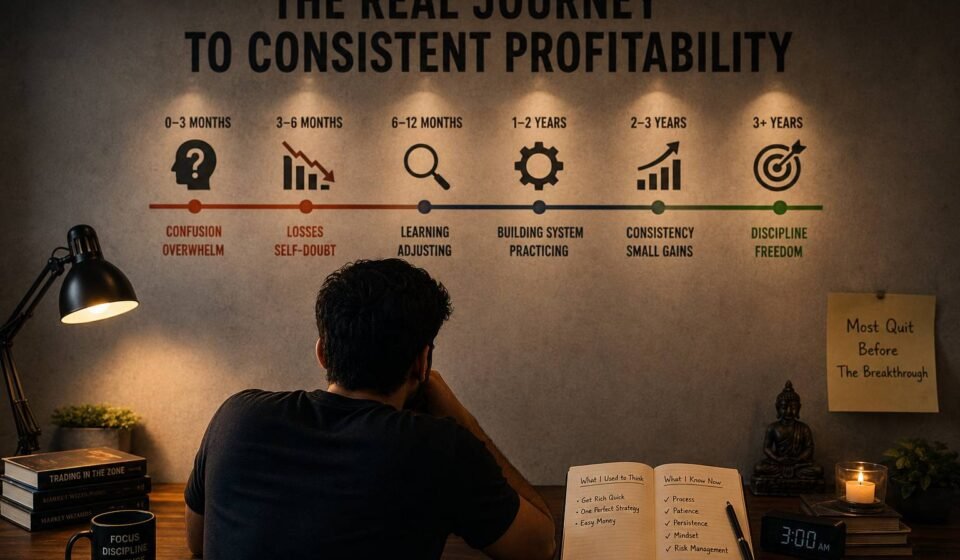
- Stage 1: Enthusiastic beginner (months 1-6). Learning setups, backtesting, first live trades. Account is usually flat to slightly down. Confidence is high because losses feel like a knowledge gap that more learning will fix.
- Stage 2: The grind (year 1-2). Strategy is decent, but results are erratic. Some months are strongly green, others erase two months of gains in a week. This is where most traders quit, because it looks like the strategy is broken. It is usually not the strategy. It is layer 3, the execution gap.
- Stage 3: Rule tightening (year 2-3). Risk per trade gets smaller and more consistent. Position sizing becomes mechanical instead of emotional. Journaling starts catching patterns before they cost money. Drawdowns shrink even though win rate does not necessarily improve.
- Stage 4: Consistency (year 2-4 onward). Monthly variance narrows. You can explain every loss. Account growth becomes boring in the best sense of the word.
Traders with 2-5+ years of market experience who still are not profitable are almost always stuck in Stage 2, not because they lack strategy knowledge, but because they never deliberately built layer 3.
Why the standard advice makes the timeline worse
Most trading content optimizes for Stage 1. New indicators, new setups, new strategies. This actively slows down Stage 2 and 3, because switching strategies resets your statistical sample size back to zero every time.
“Maybe I just need a better strategy. This one clearly isn’t working.”
That thought, when it shows up after a losing week, is usually wrong. A trader who switches strategies every 3-4 months never accumulates enough sample size in any single approach to find out whether it actually works. They stay in Stage 1 forever, dressed up as continuous improvement.
What actually shortens the timeline
Three things compress the 2-4 year window, sometimes significantly.
- One strategy held for a full year minimum. Not because it is the perfect strategy, but because you cannot judge any strategy without a real sample size.
- A written rule set that does not change mid-drawdown. Rules changed after three losing trades are not improvements, they are panic dressed as strategy revision.
- Deliberate work on the Aware and Control stages, not just Execute. Most traders only work on execution, the actual clicking of the buy button. The bigger gains come from noticing your state before the trade and controlling the impulse in the moment, which is what the first two letters of ACE cover.
Traders who do all three often reach Stage 4 in closer to 2 years than 4. Traders who skip all three can trade for 6 years and still be in Stage 2, cycling between hope and frustration.
How to tell if you are actually on track
Progress in this journey does not look like a smoothly rising account curve. It looks like this instead:
- Your average loss size is shrinking even if your win rate is not improving.
- You can predict, before checking the outcome, which of your trades broke a rule.
- Your worst month this year is smaller than your worst month last year.
- You stopped needing a new strategy every quarter.
If those four are true, you are on the 2-4 year track even if your account is not yet where you want it. If none of them are true after 2 or more years, that is a different conversation, covered in How to Know If You Should Quit Trading.
Frequently asked questions
Is it really impossible to become profitable in under a year?
Not impossible, but rare and usually not durable. A trader can get lucky with a strong trending market in their first year. The real test is whether they stay profitable through the next sideways or volatile phase, which is where the sample size and execution layers actually get tested.
I have been trading for 3 years and I am still not consistent. Is something wrong with me?
Usually not. The most common cause is strategy switching, which resets the clock on layer 2 repeatedly, or never deliberately building the awareness and control layers, which means layer 3 never gets built either. Both are fixable without starting over.
Does trading full time speed this up compared to part time?
Not necessarily, and it can slow it down. Full-time traders often take more trades per day, which increases the temptation to break rules under pressure, without necessarily increasing genuine skill-building repetitions. See Trading as a Side Income vs Full-Time: What Changes for the specific tradeoffs.
What is the single biggest thing that shortens the timeline?
Keeping one strategy and one risk framework in place long enough to get a real statistical sample, combined with actively training decision-making under pressure rather than only studying charts.
Can course education replace the years of real experience?
It can replace layer 1, the strategy knowledge. It cannot replace layer 3, the ability to execute under real risk, because that is built through repeated exposure to real stakes, not through information.
The real point
The 2-4 year figure is not a punishment. It is simply how long it takes a human being to build a new decision-making habit under real financial stress, tested across enough different market conditions to trust it.
The market does not reward better predictions. It rewards better decisions, repeated long enough to become boring.
Samay lagega, lekin sahi disha mein lagega toh waqt barbaad nahi hai.
Related reading:
- Trading Psychology: The Complete Guide for Indian Traders
- Trading With Family Money: The Extra Pressure No One Talks About
- Building a Daily Practice: Meditation, Movement and Markets
- How Long It Really Takes to Rebuild Trading Discipline
- Trading Mindset: How Consistently Profitable Traders Think
Want to break this loop properly? I run a free live session twice a week for traders with two or more years of experience who know the setups but still cannot execute under pressure. Register for the next free session here.
I am Samir Dash, founder of Mindful Trading Hub. I work with experienced traders on live market decision-making. More about my story here.