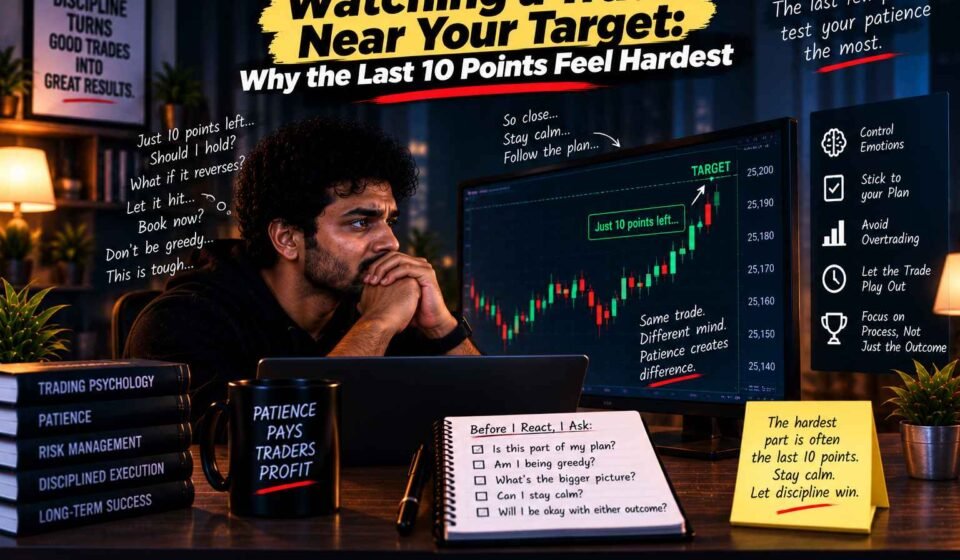

The trade has moved 55 points in your favour. Your target was 60. You are close, closer than you have been all trade, and this should feel like the easy part. It is not. It is often the hardest ten points of the entire trade.
Every small pullback now feels like the trade turning against you, even though it is well within normal movement. Your finger hovers over the exit button. A voice in your head says take it now, lock it in, don’t be greedy. Another voice says wait, you’re so close, don’t waste it. Both voices are loud, and neither of them is looking at your actual plan.
This post covers why the final stretch before a target is often more emotionally difficult than the rest of the trade combined, what is happening in your thinking during this window, and how to hold your plan through it without either bailing early or holding too long out of stubbornness.
Why “almost there” is harder than “far away”
When a trade is 55 points from your target with a 55-point target still ahead, there is no specific number to fixate on yet. Your attention is broader, watching the general trend rather than a specific price level. This tends to feel calmer, even when the trade is objectively less certain at that stage.
As price approaches the target, your attention narrows sharply onto that one specific number. This is the same narrowing effect that happens near a stop loss, but with an added layer, because now there is something to lose in a different sense: a profit that already exists on paper. The closer you get, the more that paper profit starts to feel like money you already have, even though the position is still open and nothing is locked in until you actually exit.
The mechanism: an unrealised gain starts to feel like a possession
Once a trade shows a meaningful open profit, your brain starts treating that number less like a moving estimate and more like something you own. This shift is subtle but powerful. Losing a gain you already mentally “have” feels different from never having gained it in the first place, even though the actual financial outcome, ending the day with the same rupee amount, is identical either way.
This is why a pullback from 55 points of profit to 45 points of profit can feel worse than a trade that simply never got past 20 points. Nothing was actually lost in absolute terms, you are still up 45 points. But it feels like a loss of 10 points, because your brain had already started treating the 55 as belonging to you.
Why traders exit early near a target
This mental ownership effect explains most early exits near a target. A trader sitting at 55 out of a 60-point target sees a 3-point pullback and thinks, “I should lock this in before it gives more back.” The trade has not done anything unusual, it is still well above where it started and nowhere near the stop. But the fear of losing the gain that already feels owned overrides the plan, and the trader exits at 55, five points short of a target that may well have been reached if they had simply waited.
Do this consistently across many trades and the effect compounds. Systematically exiting 5 to 10 points short of target on winning trades, even occasionally, quietly reduces the average size of your wins over time, without ever showing up as a single dramatic mistake you would notice and correct.
Why some traders do the opposite and hold too long
“It’s basically at target, let me just squeeze a bit more out of it.”
The opposite failure also happens near a target, usually driven by a different mechanism, a sense that a pre-set target was too conservative now that the market has proven the direction was right. This thought feels like ambition, but it quietly abandons the plan in the other direction. A target that was set based on a real level, resistance, a measured move, a risk-reward ratio, does not become less valid just because price is approaching it faster or more smoothly than expected.
Both failures, exiting early and holding too long, come from the same root cause: reacting to how the trade feels in the final stretch instead of executing the plan that was written when you could think clearly.
How to actually hold through the last stretch
The tools here are the same ones covered in Why You Should Decide Your Exit Before You Enter, applied specifically to this window.
- Use partial profit booking if your plan includes it. Booking half the position at a defined level and letting the rest run to target removes a large amount of the emotional pressure, because part of the gain is already locked in and cannot be “lost” by a pullback.
- Do not adjust the target once price is close to it, in either direction. A target adjusted upward because the move looks strong, or downward because you are anxious about giving profit back, is not really a target anymore, it is a moving guess.
- Reduce how often you check price in this window, following the same logic as The One-Trade Rule: Why You Should Not Watch Every Tick. This is the exact window where the urge to watch is strongest, and also where watching does the most damage, because every small pullback near a target feels amplified.
- Remind yourself what the target was based on, not just the number itself. If it was resistance from a prior swing high, that level has not moved just because your attention has narrowed on the final few points.
A simple reframe that helps in the moment
When the pull to exit early shows up, it can help to mentally separate the profit into two categories: the profit you have already locked in through any partial booking, which is genuinely yours, and the remaining open profit, which is still just a number on a screen, exactly as uncertain as it was when the trade was at breakeven. The remaining portion has not changed its nature just because it is bigger now. It is still open risk, moving in both directions, until you actually close it.
Why the discipline here compounds over time
Consistently holding to a well-set target, rather than flinching in the last stretch, does not change any single trade dramatically. What it changes is the shape of your results over many trades. Winners that are allowed to reach their full planned size, rather than being cut short by anxiety, are what typically separate a system that works on paper from one that actually produces the returns the plan was designed for.
Frequently asked questions
Why do I feel more anxious the closer my trade gets to target?
Your attention narrows onto the target price as it approaches, and the open profit starts to feel like something you already own, which makes any pullback feel like a loss even though you remain in profit. This is a normal psychological response, not a sign the trade is going wrong.
Is it wrong to book profit early if I feel nervous?
If your plan includes partial profit booking at specific levels, using it is following the plan, not reacting to nerves. If you are exiting at a level you did not pre-define, purely because of discomfort, that is a plan deviation worth noticing, even if it occasionally works out.
Should I move my target further away if the trade is moving faster than expected?
Only if your plan includes a specific trailing rule decided in advance. Extending a target in the moment because the move “feels strong” is usually greed responding to momentum, not analysis.
How do partial exits help with this specific problem?
Booking part of the position locks in a portion of the gain, which reduces how much of the remaining profit still feels emotionally “at risk.” This often makes it easier to hold the rest of the position to the full target without flinching at every pullback.
Why does a small pullback near target feel worse than a bigger one earlier in the trade?
Because the open profit near target has started to feel like a possession rather than an estimate. A pullback earlier in the trade, before that mental ownership sets in, does not trigger the same response, even if it is a larger move in absolute terms.
The real point
The last ten points before a target are not actually harder to trade, they are harder to sit through. The market does not reward better predictions about exactly where a move will end. It rewards better decisions about holding a plan you already trusted enough to write down before the pressure of the final stretch arrived.
Target ke paas dhairya sabse zyada zaroori hota hai.
Related reading:
- How to Make Calm Decisions While a Trade Is Still Open
- How to Read a Nifty Chart Before the Market Opens
- What Happens in Your Brain While a Trade Is Open
- Action Bias: Why Traders Feel the Need to Always Be in a Trade
- Why You Feel Sick Watching a Big Position Move
- Why Trading Rules Feel Restrictive Until They Save You
Want to break this loop properly? I run a free live session twice a week for traders with two or more years of experience who know the setups but still cannot execute under pressure. Register for the next free session here.
I am Samir Dash, founder of Mindful Trading Hub. I work with experienced traders on live market decision-making. More about my story here.