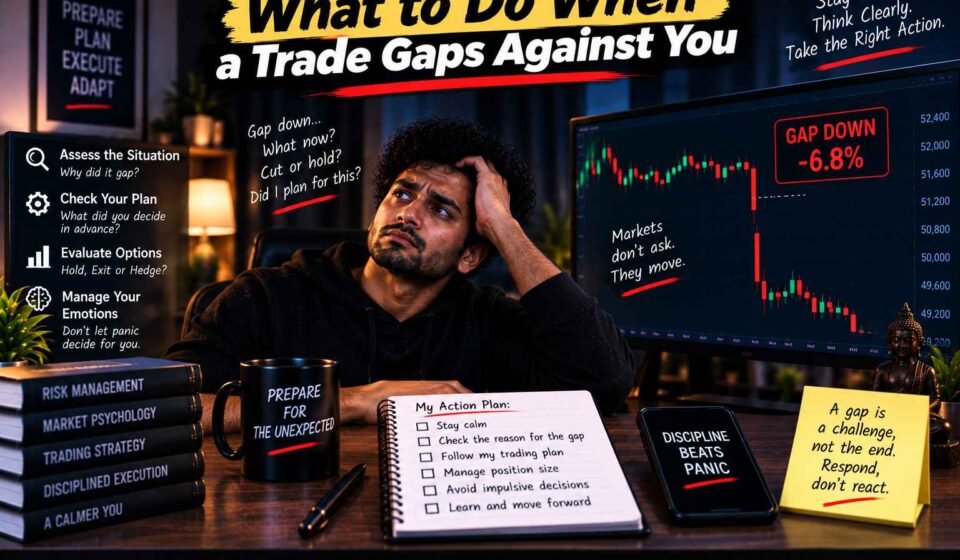

You wake up, open the app, and the stock you are holding has opened 4% below yesterday’s close, well past your stop loss of 2%. Overnight news you had no way to act on moved the price while the market was shut. Your stop loss order, sitting quietly at your planned level, could not help you, because the price never traded through it. It simply appeared on the other side.
This is a gap against your position, and it is one of the more disorienting moments in trading, because it removes the one thing you normally rely on, your stop loss actually working the way you expect it to. This post covers exactly what to do in the first ten minutes after you see a gap like this, and why most of the damage in these moments comes from the reaction, not the gap itself.
Why a gap feels so different from a normal stop-out
A normal stop loss is something you experience in motion. The price approaches your level, sometimes slowly, sometimes fast, and the exit happens roughly where you expected. There is a process to it, even a short one, and the process itself is somewhat calming because it matches what you planned for.
A gap has no process. There is no approach, no warning, no moment where you could have watched it coming. You go from an open position at yesterday’s close to a position that is already well past your stop, with no steps in between. This absence of process is what makes a gap feel so much more jarring than an equivalent loss reached through normal price movement, even when the rupee amount is identical.
The first ten minutes: what actually matters
The instinct in this moment is to do something immediately, close it, average it, check every news source at once. Almost all of that instinct should be resisted for the first few minutes. Here is the order that actually helps.
- Confirm what actually happened before reacting. Check whether this is a stock-specific gap, a sector-wide move, or a broad market gap affecting everything. This single check changes what a sensible response looks like.
- Check your actual loss in rupees, not just the percentage. A 4% gap sounds dramatic. The actual rupee number, especially once compared to your account size, is often more manageable than the percentage makes it feel.
- Re-read your original invalidation condition, written before you entered. A gap does not automatically mean your original thesis was wrong. Sometimes it means the market simply repriced faster than your stop could react, on a thesis that may still hold beyond the immediate move.
- Wait for the first few minutes of trade to establish direction, rather than acting in the opening seconds. Gaps often see an initial extension followed by some retracement as the opening auction settles. Acting in the very first tick after the open means acting at the least reliable price of the entire session.
None of this means holding indefinitely and hoping. It means giving yourself roughly five to ten minutes of actual information before making the exit decision, instead of clicking in a panic the moment the number registers.
The decision: exit now, or exit as planned
Once you have the basic facts, there are really only two sound choices, and both are decisions, not reactions.
- Exit at the current price, accepting the larger-than-planned loss. This is usually correct when the news causing the gap directly and specifically invalidates your original trade idea, for example a stock-specific event that changes the fundamental case you were trading.
- Exit only if price reaches a new, adjusted stop set after assessing the gap, giving the position a small, defined amount of room to see if it stabilises, rather than an open-ended hope. This should be a deliberate, written adjustment, not an unplanned decision to “wait and see” with no new level defined.
What is not a sound choice is holding with no plan at all, waiting to see how you feel about it as the day goes on. That approach almost always ends up costing more than either of the two options above, because it turns one clear decision into an ongoing, draining one made under continued uncertainty.
The averaging-down trap after a gap
“It’s already down this much, if I add here my average price improves a lot.”
This thought shows up often right after a gap, because the math of averaging down looks appealing when the price has already moved a long way. The problem is that this thought treats the gap as a discount rather than as new information. If the gap was caused by something that genuinely changes the case for the stock, adding more capital to a thesis that circumstances have already challenged is not a discount, it is doubling exposure to the same risk that just hurt you.
Averaging down after a gap should only ever happen as part of a pre-existing plan that specifically accounted for this scenario, not as a decision invented in the moment to make the loss feel smaller.
How to reduce gap risk before it happens
The best handling of a gap happens before it occurs, through position sizing that already assumes gaps are possible, covered in more detail in Holding Overnight: The Extra Emotion of F&O Positions Held Past Close. A few specific habits reduce the damage a gap can do:
- Size overnight positions smaller than intraday ones with the same stop distance, since the stop cannot protect you the same way overnight.
- Avoid holding a full-size position through a scheduled event like company results, where a gap is not just possible but statistically likely.
- Keep a rule for what “a gap invalidates my thesis” means for different setups, written in advance, so the first ten minutes after a gap are about checking a rule rather than inventing one under pressure.
Why staying calm here matters more than usual
A gap against you is one of the few moments in trading where your stop loss, the tool you rely on most, did not do its normal job. That alone can shake confidence in your entire process for the rest of the day if you let it. The main pillar post, How to Make Calm Decisions While a Trade Is Still Open, covers the general skill of separating feeling from action. A gap is the hardest single test of that skill, precisely because the usual safety net feels like it failed.
It did not fail. It did exactly what a stop loss order can do, execute at the next available price once the market opens. Understanding that in advance is what allows you to respond to a gap as a known, if uncomfortable, possibility rather than as a betrayal of your plan.
Frequently asked questions
Why didn’t my stop loss protect me from the gap?
A stop loss order triggers when the price trades at or through your level. If the market opens beyond that level without trading through it first, your order fills at the next available price, which can be significantly worse than your intended stop. This is a known limitation of stop orders, not a malfunction.
Should I exit immediately when I see a large gap against me?
Not in the very first seconds. Confirm what caused the gap and let the opening minutes settle before deciding, unless the news is clearly and specifically invalidating to your original thesis, in which case exiting promptly is reasonable.
Is it ever right to hold through a gap and wait for a recovery?
Only if you set a new, defined stop after assessing the situation, with a clear reason for expecting some recovery. Holding with no new plan, purely hoping the price comes back, is not a strategy, it is an extension of the same risk that already surprised you once.
How do I stop panicking every time I see a gap?
Most of the panic comes from having no pre-decided process for this specific situation. Writing a simple gap-response plan in advance, even a short one, removes most of the improvisation that causes the panic.
Can I avoid gap risk completely by only trading intraday?
Yes, intraday-only trading removes overnight gap risk entirely, since positions are closed before the market shuts. This is a valid choice for traders who find overnight uncertainty consistently hard to manage, though it does mean giving up multi-day setups that require holding past the close.
The real point
A gap is not a sign that your process is broken. It is a known, if rare, feature of holding positions through a market close. The market does not reward better predictions about whether a gap will happen. It rewards better decisions about what to do in the ten minutes right after one does.
Gap ho jaye toh ghabrao mat, plan se decide karo.
Related reading:
- How to Make Calm Decisions While a Trade Is Still Open
- How to Read a Nifty Chart Before the Market Opens
- What Happens in Your Brain While a Trade Is Open
Want to break this loop properly? I run a free live session twice a week for traders with two or more years of experience who know the setups but still cannot execute under pressure. Register for the next free session here.
I am Samir Dash, founder of Mindful Trading Hub. I work with experienced traders on live market decision-making. More about my story here.