
You enter the trade. For the first few seconds, nothing has changed. The position is open, the price is close to your entry, and you feel fine.
Then the price moves 15 points against you. Your chest tightens a little. You check the P&L number. Then it moves 20 points in your favour and you feel relief, then greed, then a small fear that it will reverse. All of this happens in about ninety seconds, and none of it involved a new piece of information about the trade itself.
This is the core problem with holding a live position. The trade does not change much minute to minute. Your state does. And most bad exits, early exits, and moved stops come from managing your state, not managing the trade.
This is the pillar post on making calm decisions while a trade is open. It covers why calm gets harder the longer you watch, what is actually happening in your body and attention while you hold, and the specific system that keeps decisions steady regardless of how the price moves.
Why watching a live trade is harder than planning one
When you plan a trade the night before or in the morning, you are working with a chart that is not moving. You can think slowly. You can compare setups. You are not under time pressure.
The moment the trade is live, three things change at once:
- The number in front of you updates every second, and your brain treats a moving number as something that demands attention.
- Money that was hypothetical is now real, even if it is only “real” on paper until you close.
- You can act right now. The option to exit is always one click away, which keeps a low-level decision open in your mind the entire time you hold.
None of this makes you a weak trader. It is what watching a live number does to any person, including experienced ones. The difference between traders who execute well and traders who do not is not that one group feels less pressure. It is that one group has already decided what to do before the pressure arrived.
The mechanism: why the P&L number hijacks your attention
Your attention system is built to track change, not track a plan. A stationary object gets ignored quickly. A moving, colour-coded number that represents your own money is one of the most attention-grabbing things a screen can show you.
Every time the P&L flips from green to red, your brain treats it as new information worth reacting to, even when the actual trade thesis has not changed at all. Nifty moving from 24,850 to 24,838 is normal noise inside a trade with a 60-point stop. But if you are staring at the number, it does not feel like noise. It feels like a signal.
This is why traders with a perfectly good setup exit at breakeven the moment the price dips, even though their own stop loss is 40 points further away. The stop was set by the planning brain. The exit was triggered by the watching brain. They are not the same decision-maker, and the watching brain wins if you give it enough time to look.
The four decisions you actually have to make
Once a trade is open, there are only four decisions available to you. Naming them clearly removes a lot of the fog.
- Do nothing. Let the trade run as planned. This is the correct decision in the vast majority of moments.
- Move the stop to reduce risk. Usually to breakeven or to lock in partial profit, and only at pre-defined levels.
- Take partial profit. Book part of the position at a target you set in advance.
- Exit fully. Either your stop is hit, your target is hit, or your original reason for the trade is no longer true.
Every other action, moving a stop further away, adding to a loser, exiting early on a dip, exiting a winner too soon out of fear, is not really a fifth decision. It is one of these four decisions made from fear or greed instead of from the plan.
What calm actually looks like in the moment
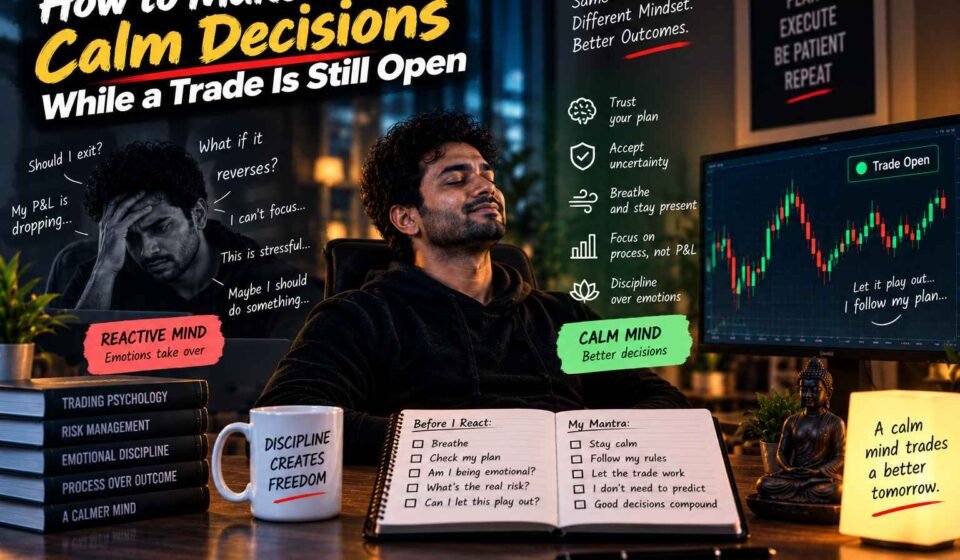
“I already know what I will do if this hits 24,780. I already know what I will do if it hits 24,920. There is nothing to decide right now.”
That thought, or something close to it, is what a calm trader is running while the price moves. It is not the absence of feeling. The trader still notices the tightness in the chest, the small jump when the number goes red. But the next action does not come from the feeling. It comes from a decision that was already made.
Calm is not a mood you create in the moment. It is the result of having nothing left to decide. If you are still deciding what your stop should be while the trade is live, you will not feel calm no matter how many breathing exercises you do.
The system: pre-deciding before you enter
The full detail on this is in Why You Should Decide Your Exit Before You Enter. Here is the summary that matters for staying calm while holding.
Before you click buy or sell, write down, on paper or in a notes app, three numbers and one sentence:
- Stop loss level, in points or rupees, not a feeling like “if it looks weak.”
- Target level, where you plan to book profit, even if partially.
- Invalidation condition, the one thing that, if it happens, means your original idea was wrong regardless of where price is.
- One line on why you are in this trade, so you can check later if the reason still holds.
Once this is written, your only job while the trade is open is to check: has the stop been hit, has the target been hit, or has the invalidation condition occurred. If none of the three is true, there is nothing to do. Saying that sentence to yourself, “nothing to do right now,” is often enough to break the urge to act.
Reducing how much you watch
A large part of staying calm is simply reducing the number of times you look. This is covered in full in The One-Trade Rule: Why You Should Not Watch Every Tick, but the short version applies directly here.
Set price alerts at your stop level and your target level instead of watching the live chart continuously. If the platform allows it, close the P&L column and only look at the price chart, which is less emotionally loaded than a number that says minus ₹4,200. Put the phone face down between checks if you are trading from your phone. Every time you look and there is nothing to decide, you are training your brain that watching is rewarding, which makes you want to watch more, not less.
What to do with the feeling itself
You will still feel something. That is normal and it is not a sign you are doing something wrong.
- Name it in one word, silently. “Anxious.” “Excited.” “Impatient.” Naming a feeling reduces its grip, this is a basic and well established finding about how attention and emotion interact.
- Take one slow breath before you look at the screen again, not after. This resets your state before the number has a chance to hijack it.
- Remind yourself of the invalidation condition, out loud if you are alone. Hearing your own plan is more grounding than reading it silently.
None of this removes the feeling. It just stops the feeling from making the decision for you.
Frequently asked questions
How do I stay calm when a trade moves against me quickly?
Check only one thing: has your stop loss level been hit. If it has not, the fast move is inside your accepted risk, even if it does not feel that way. Fast moves feel more threatening than slow ones because your attention system reacts to speed, not to actual danger level.
Should I close a trade early if I feel anxious, even if my stop has not been hit?
No, not on feeling alone. If your invalidation condition has occurred, close it, that is a plan-based exit. If only the feeling has changed and the price action has not, closing early is treating a body sensation as market information, which it usually is not.
Why do I feel calmer after I exit, even when I exit too early?
Because closing the position removes the open loop your attention was tracking. That relief is real, but it is relief from uncertainty, not proof the exit was correct. Judge the exit against your plan, not against how relieved you felt afterward.
Is it normal to feel nervous on every single trade, even after years of trading?
Yes. Experience reduces the intensity for most traders but rarely removes the feeling completely, especially at larger size. What experience should change is whether the feeling is allowed to change your actions.
What is the single fastest way to calm down mid-trade?
Re-read the one line you wrote about why you entered. If the reason still holds, there is nothing new to decide. This takes ten seconds and works better than trying to talk yourself into feeling calm.
The real point
A calm trade is not one where nothing scary happens. It is one where every decision was already made before the scary part arrived. The market does not reward better predictions. It rewards better decisions, and the best decisions in a live trade are almost always the ones you made before you had a reason to be afraid.
Trade tab par nahi, plan par chalti hai.
Related reading:
- The ACE Framework: Aware, Control, Execute Explained
- Mindfulness for Traders: What It Actually Means (Not Just Sitting Still)
- What Happens in Your Brain While a Trade Is Open
- How to Make Decisions in the First 5 Minutes After Market Open
- Outcome Bias vs Process: Why Good Decisions Can Still Lose
Want to break this loop properly? I run a free live session twice a week for traders with two or more years of experience who know the setups but still cannot execute under pressure. Register for the next free session here.
I am Samir Dash, founder of Mindful Trading Hub. I work with experienced traders on live market decision-making. More about my story here.