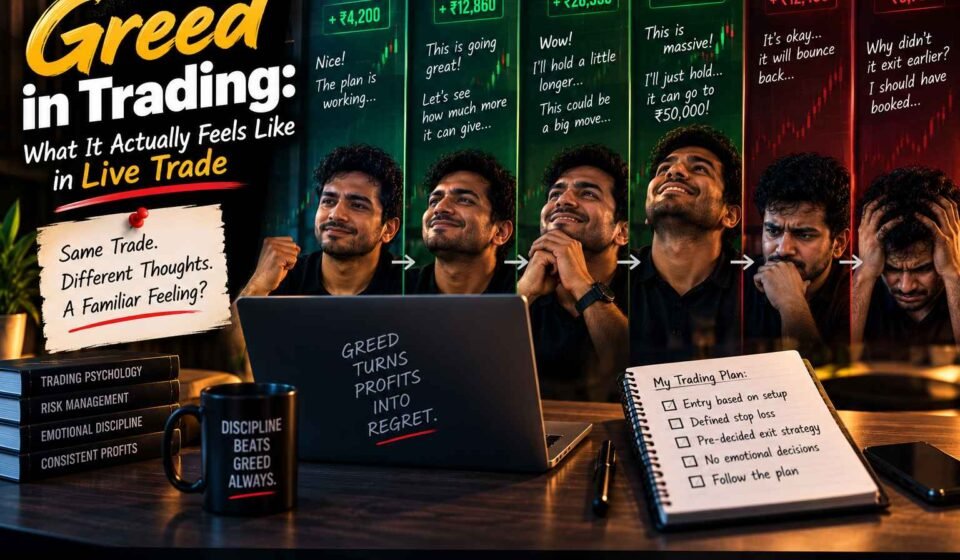

Your target was 24,650. Price touches 24,648. Two points away. Instead of booking, you watch it print 24,652, then 24,660. A voice in your head says, “it’s clearly got more in it, let it run.” Forty minutes later, price is back at 24,600 and your planned profit is now a smaller one, and you are staring at the same chart wondering what happened.
This is the pillar post on greed in trading. It covers what greed actually feels like while a position is open, why it is so easy to mistake for good judgment, and what stops it from costing you money.
What greed in trading actually is
Greed in trading is the urge to extract more from a position than your plan called for, driven by the presence of an existing profit rather than by any new evidence that the trade has further to run.
The important distinction is what is driving the decision. A trader who extends a target because a new higher-timeframe level appeared is adjusting to information. A trader who extends a target because the current number “feels too small now that I’ve seen it” is acting on greed. Same action, on the outside. Completely different cause.
What it actually feels like, not what people assume
Most traders picture greed as an obvious, almost cartoonish emotion, rubbing hands together at a big win. That is not how it shows up in a live trade. In reality it feels like:
- Calm confidence, not excitement. The feeling is closer to certainty than hunger. “This is obviously going further” sounds like analysis, not appetite.
- A shifting target. Your original target gets touched or nearly touched, and a new, higher number appears in your head, without any new chart reason to support it.
- Irritation at the idea of booking. If a friend suggested you take profit right now, the thought produces a flash of resistance, almost defensiveness.
- Comparison to a bigger number you saw once. “Last month this move went 200 points, this is only 90, it’s not done yet” even though last month’s trade has nothing to do with this one.
- A quiet unwillingness to write down why you are still holding. If you try to write the reason for staying in past target, the sentence is hard to finish honestly.
If two or more of these show up while your target is in sight, that is greed operating, not analysis.
Why greed feels like good judgment while it is happening
The mechanism starts with the endowment effect, the same one that drives bad decisions about adding to a winner. Once a gain exists on screen, your brain starts treating it as already yours. A target that once looked reasonable, back when the trade was flat, now looks small compared to what you have already “earned.” The comparison point silently shifted, from zero to the current profit, without you noticing the shift happen.
Layered on top of that is a simple availability effect. The biggest, most memorable wins you have ever had are the ones that ran far past a normal target. Those trades are vivid in memory precisely because they were rare. Greed uses those memories as if they were the base rate, when they were actually the exception.
The combination produces a feeling that is calm and confident, because it is not competing against fear. It is being fed by two things that both feel like evidence: a profit that already exists, and a memory of a bigger one that once did.
“This is clearly a strong trend, my original target was too conservative.”
That thought arrives dressed as skill. It is actually the endowment effect and a cherry-picked memory, combined.
Why greed is harder to catch than fear
Fear during a trade usually feels bad, which makes it noticeable. You feel your stomach tighten, your breathing change, and something in you flags that as a problem worth examining.
Greed feels good. It feels like confidence, like being right, like finally understanding the market. Nothing about it signals “this might be a mistake,” which is exactly why it survives so many rounds of trading without being named. You do not go looking for a fix to a feeling that feels this pleasant.
What greed costs, in a concrete example
Say your plan targets 60 points on a Nifty trade, with a 1:2 risk to reward ratio against a 30-point stop. Price reaches 58 points, you hold for more, and over the next 25 minutes it drifts back to 20 points before you finally exit. You gave back 38 of your 58 points, not because the trade thesis broke, but because the target moved in your head after the profit appeared.
Across a month of trading, giving back even a third of your gains this way on your better trades quietly erases much of the edge your strategy produced. It never shows up as a single dramatic loss. It shows up as good trades that ended smaller than they should have.
A comparison worth sitting with
Two traders take the same Nifty long from 24,500, both with a target of 60 points at 24,560. Price reaches 24,558, two points short.
Trader one has an order pre-placed at 24,560 and books there automatically. Trader two watches it approach, thinks “this is clearly stronger than a 60-point move,” and cancels the pending order to let it run. Price touches 24,575, then reverses all the way to 24,510 before trader two finally exits, ending with just 10 points instead of the planned 60.
Both traders were looking at the exact same chart. The only difference was whether the target lived as a written rule executed by an order, or as a feeling that got renegotiated the moment it was about to pay out.
How to manage greed without pretending you will stop feeling it
- Write your target before entry and treat it as a contract with yourself, not a suggestion. If you want to extend it, that decision belongs before the trade, not during it.
- Use a partial booking rule. Book half or two-thirds of the position at your original target, and let the remainder run with a trailing stop. This satisfies both the plan and the part of you that wants to chase more, without risking the whole gain.
- Notice the shifted comparison point. If you catch yourself comparing this trade’s profit to your biggest ever win rather than to your plan, that is the signal to book, not to hold.
- Set an automatic order at target rather than relying on a manual exit. Removing the live decision removes the moment where greed gets a vote.
- Review your “held past target” trades weekly. Most traders are surprised how often the extra hold produced a smaller result, not a bigger one, once they actually count it.
- Remember that the goal is a consistent process across hundreds of trades, not the maximum possible result on any single one. Chasing the biggest possible outcome on today’s trade is what quietly erodes the average outcome across every trade you take.
This is the Control step in the ACE framework. Awareness is recognising the calm, confident feeling as greed rather than skill. Control is the partial booking rule and the pre-placed order that acts regardless of how convincing that feeling is in the moment.
Frequently asked questions
How do I know if I’m being greedy or if the trade genuinely has more room?
Ask whether a new chart reason appeared, one you could point to on the screen, or whether the only thing that changed is the size of your current profit. A genuine reason exists independently of your P&L. Greed is caused by the P&L itself.
Is it wrong to ever hold past your original target?
No, if the decision to hold was structured in advance, such as a partial booking rule with a trailing stop on the rest. It becomes a problem when the target moves live, in your head, purely because a profit appeared.
Why does greed feel so different from fear during a trade?
Fear usually produces uncomfortable physical sensations that get noticed. Greed produces a pleasant feeling of confidence, which rarely gets questioned, because nothing about it feels like a warning sign.
Does greed only show up on winning trades?
It shows up most clearly there, but it also appears in oversized entries when a setup looks unusually good, or in adding size purely because a trade is moving fast. The common thread is chasing more than the plan called for, based on a feeling rather than a rule.
What is the fastest way to reduce greed in the moment?
A pre-placed order at your target removes the live decision entirely. If greed cannot get a vote because the exit already executed, the feeling becomes irrelevant to the outcome.
The real point
Greed rarely announces itself as greed. It shows up sounding like confidence, like finally reading the trend correctly, like good judgment. The market does not reward better predictions. It rewards better decisions, and the decision that protects you from greed was made before the profit existed to distort your thinking.
Jitna mila, utna kaafi hai, jab tak plan yehi kehta hai.
Related reading:
- What Happens in Your Brain While a Trade Is Open
- Overtrading: The Habit That Quietly Empties Accounts
- Adding to a Winning Position: When It Is a Plan and When It Is Greed
- The Urge to Exit at Breakeven: Why It Feels Safe and Costs You
Want to break this loop properly? I run a free live session twice a week for traders with two or more years of experience who know the setups but still cannot execute under pressure. Register for the next free session here.
I am Samir Dash, founder of Mindful Trading Hub. I work with experienced traders on live market decision-making. More about my story here.