

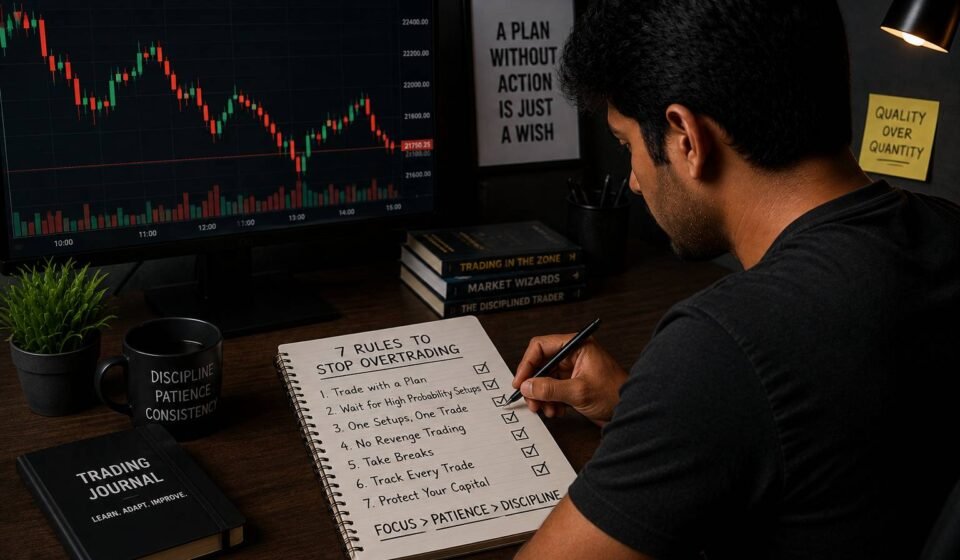

“Take fewer trades” is not a rule. It is a wish with no mechanism attached.
Rules work when they make the wrong action harder or more visible. Everything below is designed to do one of those two things, so you are not relying on being disciplined at 2pm on a slow Tuesday, which is the exact moment discipline is unavailable.
Start with two of these, not seven. Rules three and one, if you want the highest return per unit of effort.
Rule 1: Write your setup as a numbered checklist
Not a description. A list of conditions with a count.
Bad: “I trade pullbacks in a trend.”
Good:
- Price above the 20 EMA on the 15-minute chart.
- Pullback to the 20 EMA or the prior swing high.
- A rejection candle at that level, closed.
- Session time between 9:30 and 14:00.
- Stop distance under 1.5 ATR.
Five conditions. All five or no trade.
The reason this works is not that it improves analysis. It is that a marginal setup now fails visibly. Instead of a vague feeling that this one is a bit weaker, you count three out of five and the answer is decided.
Without the list, marginal setups get quietly promoted. The list makes the promotion an explicit act you have to perform, and it turns out most people will not do that when they have to look at it.
Rule 2: Cap your trades per day, in writing
Pick a number based on your actual data. Look at your last three months, find how many trades met your full criteria on an average day, and set the cap slightly above it.
For most swing and intraday traders the honest number is two or three.
Write it down before the open. When the cap is reached, the terminal closes, including on days when you are green and things are working.
The value of a cap is not the average day. It is the outlier day where you would have taken nine.
Rule 3: Set alerts and leave the screen
This is the single highest-leverage rule here, and the one most traders resist.
You cannot force a trade on a chart you are not watching. Almost every marginal entry requires you to be present, staring, waiting for something to happen.
Practically: mark your levels in the morning, set price alerts, then close the platform. Do something else. Come back when an alert fires.
The objection is always the same, that you will miss the setup. Test it rather than assuming. Run it for two weeks and count how many qualified setups you actually missed. For most traders the number is zero or one, because a setup that requires you to watch every tick to catch was not a setup, it was a reaction.
Rule 4: Define what you do when nothing sets up
Most overtrading happens in undefined time.
You blocked out four hours. Two hours in, nothing has qualified. There is no plan for this situation, so the default fills in, and the default is to keep looking until something appears. Something always appears if you lower the bar enough.
Write the alternative in advance and make it specific:
- “If no setup by 11:30, I review last week’s trades for one hour.”
- “If no setup by 12:00, I close the terminal for the day.”
- “On days with no setup by 10:30, I go for a walk and return at 13:00.”
The specific activity matters less than it being decided in advance. Undefined time gets filled with trading.
Rule 5: Make yourself write the reason before entering
One line, before the order goes in: which conditions are met, where the stop is, why now.
Eight seconds. It is remarkably hard to write on a marginal trade, because there is very little to write. When you cannot fill the line, that is the answer.
This also creates the data you need for rule 7. You cannot audit decisions you never recorded.
Rule 6: Track cost as a percentage of gross profit
One number, monthly. Total brokerage, STT, exchange charges, GST, divided by gross profit.
If costs exceed 10% of gross profit, frequency is eating your edge. Above 25%, it is the main thing wrong with your account.
This is the earliest objective signal available, and it beats intuition because it cannot be argued with. Most traders have never calculated it. Calculate it once and it usually changes behaviour faster than any amount of advice.
Rule 7: Score your compliance, not your P&L
At the end of each week, count two things:
- Trades taken that met all checklist conditions.
- Trades taken that did not.
That ratio is your compliance rate, and it is the only number that measures the thing you are actually trying to change.
Grade yourself on it instead of on profit. A week where you followed the checklist on every trade and finished red is a good week. A week where you made money on trades that broke your rules is a bad week that will cost you later, because it teaches you the wrong lesson.
This separation of decision quality from outcome quality is the Execute step in the ACE framework, and it is the step almost nobody does.
Matching the rule to your cause
Overtrading has four different sources. Apply the rules that fit yours.
| If your cause is | Start with |
|---|---|
| Boredom | Rules 3 and 4. Remove yourself from the screen. |
| FOMO | Rules 1 and 5. Force the criteria to be explicit. |
| Capital anxiety | Rule 6. See the cost of deployment in rupees. |
| Recovery pressure | Rule 2 plus a daily loss limit and a two-strike rule. |
What to expect
Two weeks in, your trade count drops and it will feel wrong. Sitting out feels like not working, and there will be at least one day where a setup you skipped would have paid.
Four weeks in, the cost ratio moves. This is usually the first hard evidence, and it is usually more persuasive than the P&L, which is noisy over a month.
Eight weeks in, most traders find their results improved while doing substantially less. That gap between effort and outcome is the uncomfortable part, and it is also the point.
Frequently asked questions
What if my checklist filters out everything?
Then either your criteria are too strict for current conditions, or conditions genuinely do not suit your system. Both are useful information. Review the criteria monthly, in the evening, with no position on. Never loosen them during a session.
Is a daily trade cap not arbitrary?
Somewhat, yes. It is a blunt instrument that exists to catch the outlier day. On a normal day it will not bind at all. On the day you would have taken nine, it saves you six.
I trade a scalping system with 20 trades a day. Do these apply?
Rules 1, 5, 6 and 7 apply directly. Rule 2 needs a much higher cap, and rule 3 does not apply since your system requires screen presence. The compliance measure in rule 7 matters more for you, not less, because volume amplifies any drift in criteria.
How long until this feels normal?
The restlessness fades in three to four weeks for most people. What takes longer is being comfortable with a flat day, which is genuinely a different relationship with the market rather than a habit change.
Can I use an app or automation to enforce these?
Alerts, a written checklist, and a spreadsheet cover almost all of it. Some traders have their broker set a maximum daily order count. The tool matters much less than whether the rule was written before the session.
The bottom line
You will not stop overtrading by deciding to trade less. You stop by making marginal setups fail a test you can see, and by not being at the screen when there is nothing to do.
Pick two rules. Run them for four weeks. Check the cost ratio.
Kam trades ka matlab kam kaam nahi hai. Matlab sirf sahi trades.
Related reading:
- Averaging Down: Why It Feels Smart and Rarely Is
- Greed in Trading: What It Actually Feels Like in a Live Trade
- How to Build Habits That Actually Stick as a Trader
- Trading Rules You Will Actually Follow: How to Write Them
Want help building your checklist? I run a free live session twice a week for traders with two or more years of experience who know the setups but still cannot execute under pressure. Register for the next free session here.
I am Samir Dash, founder of Mindful Trading Hub. I work with experienced traders on live market decision-making. More about my story here.