
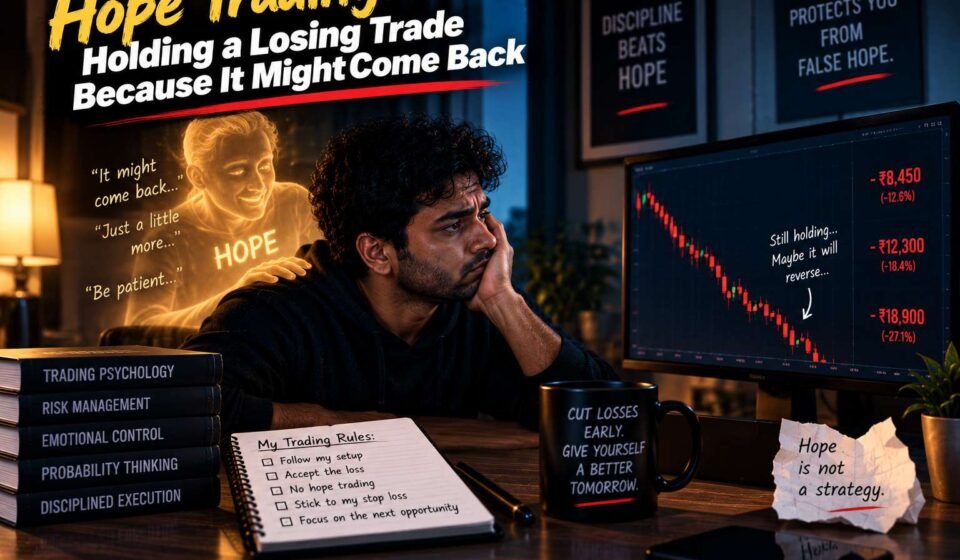

Price is 25 points below your entry, heading toward your stop 5 points further down. You have not touched the order. Not because you are managing the trade. Because part of you is waiting for one green candle that will make this whole thing not have happened. It has been eleven minutes. The candle has not come.
What hope trading actually is
Hope trading is staying in a losing position past the point your analysis or plan supports, specifically because you are waiting for the market to prove you right, rather than because any new evidence suggests it will.
It is closely related to widening a stop loss, but they are not identical. Widening a stop is an active decision to change an order. Hope trading can happen with the stop untouched, simply by mentally negotiating with yourself about whether you will actually let it trigger, or by exiting a few points past it “to see if it recovers first.”
What it looks like from the inside
- You keep watching for a specific reversal candle or pattern that would justify staying in, even though it was not part of your original plan.
- Your internal language shifts from “the trade is working or not” to “it just needs to hold here.”
- You compare the current move to a previous time the same instrument bounced from a similar level, even if the context was different.
- You avoid calculating the actual rupee loss, because doing the math would make the situation feel more real.
- The stop is still in place, but you have already decided, quietly, that you will move it or override it if price gets there.
Why hope shows up instead of acceptance
As long as a trade is still open, the loss exists only as a possibility, not a fact. The moment it closes at the stop, the loss becomes real and final, something you have to write down and own. Hope trading is, underneath the surface, an attempt to keep that moment from arriving.
This connects to the same loss aversion mechanism behind most live-trade psychology. A closed loss is processed by the brain as more painful than an open one of the same size, because the open one still carries a small, comforting possibility of not happening at all. Hope trading is the act of protecting that possibility for as long as you can, even as the odds of it saving you keep getting worse.
There is a second layer specific to hope. Once you have invested attention, hope, and mental energy into a position being right, closing it at a loss can feel like it invalidates that investment, not just the money. This is related to a well known decision-making trap called sunk cost thinking, where past effort gets treated as a reason to continue, even though past effort has no bearing on what happens next.
“It just needs to hold this level, then I’m out of the woods.”
That thought treats the market as something that owes you a specific outcome. The market does not know your entry price and has no obligation to honour it.
Why hope trading is more dangerous than a normal losing trade
A trade that hits its planned stop is a normal, healthy part of any trading system. It costs exactly what you decided it would cost, and then it is over. Hope trading turns that same trade into something else entirely.
- The loss grows past the planned amount, because the stop gets delayed or overridden while you wait for the bounce.
- The time cost grows too. Minutes spent hoping are minutes not spent managing other positions or looking for the next valid setup.
- It often ends in a worse decision, not a better one. If the hoped-for bounce does not arrive, many traders exit in a rush once the discomfort becomes too much, often at an even worse price than the original stop, because the exit is now driven by exhaustion rather than a plan.
- It teaches the wrong lesson if it occasionally works. A rare trade that does bounce back after you hoped and held reinforces the habit, the same way a widened stop that happens to work out reinforces that habit.
The specific trap of “it’s already down this much, might as well wait”
This is one of the most common thoughts inside hope trading, and it is worth naming directly because it sounds logical. The reasoning goes: the loss is already large, so waiting a bit longer for a possible recovery does not add much additional risk.
This reasoning breaks down the moment you check the actual numbers. If your stop is 5 points away and you wait through a further 15-point move against you before finally exiting, you have tripled your loss from the plan, not added a small amount to an already large number. “Might as well wait” is a feeling about how the loss already feels, not a calculation about how much further risk you are actually accepting.
A trade that shows how quickly hope compounds
You short Bank Nifty at 51,200 with a stop at 51,280, risking 80 points. Price rallies to 51,265, fifteen points from your stop. You wait, hoping for a reversal candle. It rallies to 51,278, two points shy. You wait again, now telling yourself “it’s clearly rejecting here, one more candle.” It closes at 51,340, sixty points past your original stop, before you finally exit in a rush because the discomfort has become unbearable.
Your planned loss was 80 points. Your actual loss was 140 points, nearly double, and every extra point came from a series of small, individually reasonable-sounding decisions to wait just a little longer. None of those decisions were made all at once. Each one felt small in isolation, which is exactly how hope trading turns a planned, survivable loss into one that is not.
How to catch hope trading before it costs more
- Treat your stop loss as the actual decision, made in advance, and treat any moment of hoping past it as a signal to check whether you have already effectively decided to override it.
- Use a hard stop order, not a mental one. Hope trading survives far more easily against a mental stop, because there is always one more moment where you could choose not to act.
- Ask what you would tell a friend holding this exact position. Most traders can answer this instantly and correctly, even while unable to apply the same answer to their own trade in the moment.
- Notice language shifts in your own head. “It needs to hold” or “it should bounce here” are hope language. “My stop is X” is plan language. Catching the shift is often enough to prompt action.
- Journal every hope-trading episode with the extra points it cost compared to the planned stop. Seeing the cumulative number across a month is usually more persuasive than any general advice.
This is the Execute step in the ACE framework. The plan and the stop were already decided. Execute means letting that decision run, especially in the exact moment your body is generating reasons to wait just a little longer.
Frequently asked questions
Is hope trading the same as denial?
They are closely related. Denial is refusing to accept that the trade thesis has failed. Hope trading is the behavioural result, staying in the position and waiting for a reversal instead of accepting the stop and moving on.
How is hope trading different from a genuine reason to hold through a pullback?
A genuine hold has a specific, written invalidation point that has not yet been reached, and the reasoning existed before the pullback started. Hope trading has no such point, or keeps moving that point further away as price continues against it.
Why do I keep comparing this trade to one that bounced back before?
Because a memorable past recovery is easy to recall and feels like evidence, even though most losing trades that get held past their stop do not recover in time. This is a form of availability bias, where a vivid memory gets treated as representative of what usually happens.
Does hope trading ever work out?
Occasionally, and that occasional success is exactly what keeps the habit alive. Judge it across many instances rather than the one time it happened to work, because the average outcome is a larger loss than planned.
What is the single best defence against hope trading?
A hard stop loss order placed at entry, combined with a rule that you do not modify or manually override it while the trade is open. Removing the live decision removes hope’s ability to influence the outcome.
The real point
Hope is not a trading strategy. It feels like patience, but it has no plan attached to it, only a wish that the market will change its mind about your entry price. The market does not reward better predictions. It rewards better decisions, and the best decision available in a hope-trading moment is usually the one you already wrote down before the trade started.
Ummeed acchi baat hai, lekin trading mein plan ke bina ummeed sirf ek aur nuksaan hai.
Related reading:
- What Happens in Your Brain While a Trade Is Open
- Overtrading: The Habit That Quietly Empties Accounts
- Adding to a Winning Position: When It Is a Plan and When It Is Greed
Want to break this loop properly? I run a free live session twice a week for traders with two or more years of experience who know the setups but still cannot execute under pressure. Register for the next free session here.
I am Samir Dash, founder of Mindful Trading Hub. I work with experienced traders on live market decision-making. More about my story here.