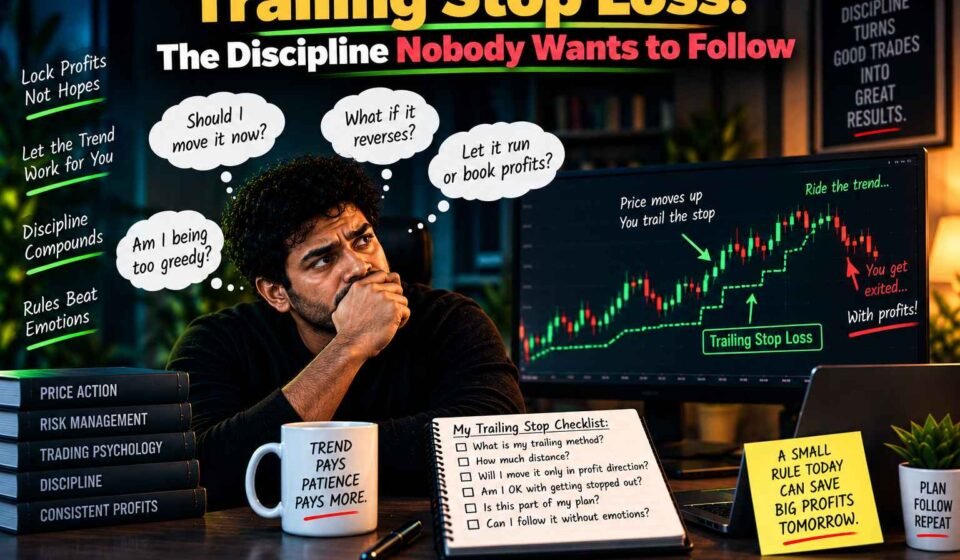

Your trade is up 90 points. Your trailing rule says move the stop up to lock in 60 of those. You look at the chart, see one more green candle forming, and think, “let it breathe a little more before I trail it.” Ten minutes later, price reverses hard, and you exit at 20 points, not 60. Nothing about your trailing rule failed. You just did not follow it.
This happens to traders who can explain trailing stops perfectly in a webinar. The rule is not the hard part. Following it while a profit is sitting in front of you is the hard part.
What a trailing stop actually does
A trailing stop is a stop loss that moves in your favour as the trade gains, locking in more profit as price advances, while never moving backward against you.
Say you are long Nifty from 24,500 with an initial stop at 24,420. Price moves to 24,600, and your trailing rule says to move the stop to 24,550, locking in 50 points. If price then reverses to 24,550, you exit with a gain instead of watching the trade round-trip back to breakeven or a loss.
The mechanism is simple. The discipline to execute it, every single time, without exception, is where almost everyone quietly fails.
Why traders skip the trail even when they believe in it
The trend might still be starting
The moment a trailing stop should move up is usually the moment the trade feels most alive. Momentum is visible, the candles are green, and moving the stop up feels like you are capping a trade that could run much further. This is not laziness. It is a genuine, understandable fear of leaving money on the table, and it fights directly against the rule.
Trailing feels like an admission the move will end
Tightening a stop is, in a small way, planning for the trade to reverse. While a position is running well, most traders do not want to think about it ending. Trailing the stop forces that thought into the room, and many traders postpone it the same way they postpone any uncomfortable thought.
One missed trail that “worked out” teaches the wrong lesson
Occasionally you skip the trail, the trade keeps running, and you end up with a bigger profit than the rule would have locked in. That single result gets remembered far more vividly than the many times skipping it gave back the whole gain. One win against ten silent losses still feels, emotionally, like the skipping “worked.”
“It’s still trending, I’ll trail it after the next leg up.”
That sentence is the exact moment the discipline breaks, and it almost always sounds reasonable when you think it.
The mechanism behind the resistance
Trailing a stop while a trade is winning triggers the same loss aversion mechanism that makes losses hurt roughly twice as much as equivalent gains feel good. But here it works in reverse. Once a gain is visible, your brain starts treating it as already yours, through the endowment effect. Trailing the stop, meaning accepting that price could reverse and take some of it back, feels like a loss even before it happens. So the brain resists the very action designed to protect the gain, because the action itself feels like giving something up.
This is why trailing discipline breaks down more on winning trades than on losing ones. Cutting a loser at least stops ongoing pain. Trailing a winner means voluntarily accepting a smaller number than the one currently on screen, which your brain reads as a loss relative to what it already claimed as yours.
What happens when the trail is skipped, in numbers
Take a trade up 90 points where the rule says trail to lock in 60. Skip it, and there are three realistic outcomes:
- Price keeps running, you exit later with more than 90 points. This is the outcome that gets remembered and repeated in your head.
- Price stalls and reverses to your original stop, and the trade that was up 90 points closes flat or as a small loss.
- Price reverses partway, and you exit somewhere between 0 and 60, well below what the rule would have locked in.
Across a large number of trades, outcomes two and three happen far more often than outcome one. Trend continuation without any pause is the exception, not the norm. The rule exists precisely because most trades give back a meaningful chunk of an unrealised gain before they either continue or fully reverse.
A side-by-side look at what following the rule actually buys you
Take two versions of the same trader, both long Nifty from 24,400, both with a rule to trail the stop to entry plus 40 once price hits entry plus 70. Price runs to 24,480, up 80 points.
Trader one follows the rule the moment it triggers, moving the stop to 24,440. Price then reverses to 24,440 over the next twenty minutes, and the trade closes with a locked-in 40-point gain.
Trader two thinks “let it breathe a little more” and delays. Price reverses the same way, but because the stop was never moved, it closes at the original stop, 24,340, a 60-point loss instead of a 40-point gain.
Same trade, same chart, same rule written down before entry. The only difference between a 40-point win and a 60-point loss was whether the trader executed the plan at the moment it was triggered or gave themselves permission to wait ten more minutes.
How to actually follow a trailing rule
- Write the exact rule before entry. Not “trail it when it looks safe.” A specific instruction, for example “move stop to entry plus 40 points once price reaches entry plus 70 points.”
- Use a mechanical trigger, not a feeling. A fixed point trail, a percentage of the move, or a moving average level all work because they do not require you to judge how the trade “feels.”
- Place the modification as soon as the trigger is hit, not after “one more candle.” The delay is where the discipline usually breaks. Treat the trigger like an alarm, not a suggestion.
- Automate it wherever your broker allows. A GTT-based trailing order or platform-native trailing stop removes the live decision entirely, the same way a bracket order removes freezing at the exit.
- Review skipped trails weekly, not just losing trades. A trade that hit target is still worth checking if the trail was actually followed on the way there, because the habit matters more than any single outcome.
This is the Execute step of the ACE framework. Awareness and Control set the rule. Execute is doing the exact thing you decided, at the exact moment you decided to do it, especially when the trade is going well and following the rule feels unnecessary.
Frequently asked questions
How far should I set my trailing stop?
There is no universal number. It depends on the instrument’s typical range and your original stop distance. A common starting structure is trailing by roughly the same distance as your initial stop, adjusted for how the instrument normally moves. What matters more than the exact distance is that the rule is fixed before entry and followed without exception.
Why do I trail my stops on losing trades but not winning ones?
Tightening a stop on a loser reduces ongoing discomfort, so it feels natural to act. Tightening a stop on a winner feels like accepting a smaller number than what is currently visible, which your brain reads as a loss due to the endowment effect. The emotional pull runs in opposite directions even though the mechanical action is similar.
Is a trailing stop better than a fixed target?
They solve different problems. A fixed target caps the trade at a known point. A trailing stop lets a trend run further while still protecting gained profit. Many traders use a partial fixed target for part of the position and trail the remainder.
What if the market gaps past my trailing stop?
Gaps can cause slippage beyond the trailing level, particularly around news or overnight positions. This is a real limitation of any stop-based system, not a reason to abandon trailing. It is a reason to size positions so a gap through the trail is survivable.
Should I trail every single trade?
Not necessarily every trade type, but every trade where your plan called for a trail should be trailed exactly as written. The discipline problem is not choosing whether to use trailing stops. It is following the ones you already decided to use.
The real point
You already know how a trailing stop works. The gap is not knowledge, it is the ten seconds of resistance that shows up right when the trigger is hit and the trade feels too good to touch. The market does not reward better predictions. It rewards better decisions, made at the moment you said you would make them.
Rule wahi kaam ka hai jo aap uss waqt maanein jab maan-na mushkil ho.
Related reading:
- Risk Management Rules That Actually Get Followed
- When to Exit a Trade: The Decision Framework Most Traders Skip
- Greed in Trading: What It Actually Feels Like in a Live Trade
- How to Place a Stop Loss You Will Not Move
- Stop Loss Hunting: Is the Market Really Targeting You?
- How to Set a Stop Loss in F&O Trading
- Trading Without a Stop Loss: What Happens to Your Account
- The Temptation to Widen Your Stop Loss Mid-Trade
Want to break this loop properly? I run a free live session twice a week for traders with two or more years of experience who know the setups but still cannot execute under pressure. Register for the next free session here.
I am Samir Dash, founder of Mindful Trading Hub. I work with experienced traders on live market decision-making. More about my story here.