
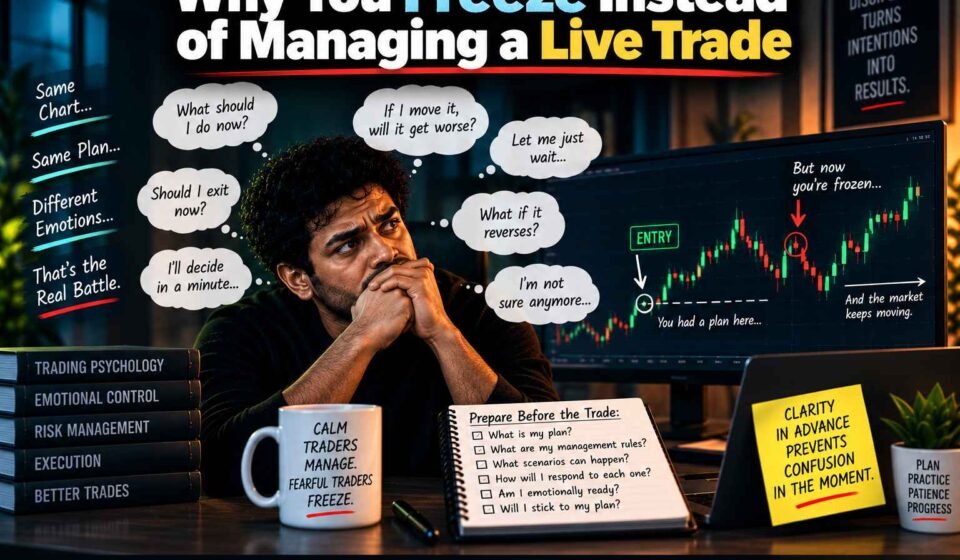

Your target is 30 points away. Price has stalled for six candles, going nowhere. You know you should either book partial profit or tighten your stop. Your hands are on the keyboard. Nothing happens. Four more candles pass. Still nothing. Eight minutes later, price drops through your entry and the decision has been made for you, by the market, not by you.
This is not laziness and it is not a lack of knowledge. You could explain the correct action to someone else in one sentence. The problem is that you could not do it yourself, in the moment, with your own money on the line.
What freezing during a live trade actually is
Freezing is the state where you have enough information to act, you know roughly what the correct action is, and you still do not execute it. Time passes, price moves, and the window for the good decision closes on its own.
It is different from patience. Patience is deliberately not acting because your plan says to wait. Freezing is wanting to act and being unable to, even though nothing about your plan says to wait.
What it looks like from the inside
- You open the order window, look at it, and close it without placing anything.
- You reread the chart for the fifth time looking for more certainty that will not arrive.
- Your mind runs the same two or three thoughts on a loop, without reaching a conclusion.
- You tell yourself “let me watch one more candle,” and then say it again on the next one.
- The moment finally resolves because the market moved, not because you decided anything.
If this happens on more than the occasional trade, it is a pattern worth naming, not a one-off bad day.
Why the brain freezes instead of deciding
Under normal conditions, your brain runs decisions through a part of the prefrontal cortex responsible for weighing options and choosing. Under acute stress, blood flow and activity shift toward faster, older survival circuits. This is a well established response to threat. The market showing an open loss, or a profit that could disappear, is read by your body as a real threat, not an abstract number.
Those older circuits are built for two responses: fight or flight. Trading rarely offers a clean version of either. You cannot physically fight a candlestick, and running away means closing the trade, which many traders also cannot bring themselves to do because closing makes a loss or a missed gain final. What is left is a third, less discussed response: freeze. The body stays still while it waits for the threat to resolve on its own.
This is why freezing tends to hit hardest exactly when the trade matters most, on your biggest position of the week, or after a losing streak when you cannot afford another mistake. The stakes are what trigger the shutdown.
“I’ll decide after this next candle closes.”
That sentence, repeated candle after candle, is the sound of a nervous system waiting for the decision to become obvious, instead of a trader making one.
Two different kinds of freeze
The overload freeze
Too many variables at once. Price, time, news, your P&L, your plan, all competing for attention at the same moment. The brain cannot pick which signal to act on, so it acts on none of them.
The consequence freeze
The decision is simple, but the outcome feels too heavy. Booking a loss on a large position, or closing a winner that might run further, both carry a consequence your mind does not want to own. So it delays owning it, by delaying the decision itself.
The overload freeze is fixed by simplifying what you are watching. The consequence freeze is fixed by making the decision before the weight of it arrives, which means before entry, not during it.
Why “just decide faster” does not work
Telling a frozen trader to act faster is like telling someone in traffic to just merge. The advice is correct and useless at the same time, because the block is not informational. You already know the correct action. The block is that acting on it, in this moment, with this amount of stress in your body, is hard in a way that knowledge does not fix.
The fix has to lower the number of decisions you make live, not increase your speed at making them.
What freezing looks like across a whole trading day
Freezing rarely happens in isolation. It tends to cluster on days where several other stress factors are already present, a losing streak from the previous session, a bigger than usual position, or news that could move the market unexpectedly. On a calm day, with normal size and a rested mind, the same decision that causes a freeze on a hard day often gets made within seconds.
This is a useful thing to track. If you notice freezing shows up mainly on days that already started with poor sleep, or after two consecutive losses, the fix is not really about the moment of the freeze at all. It is about recognising, earlier in the day, that you are in a state where live decisions will be harder than usual, and adjusting size or relying more heavily on pre-placed orders before that state has a chance to cost you anything.
How to reduce the freeze
- Pre-decide the exits before entry. Target, stop, and partial booking level should exist as written numbers before you click buy. A trade with pre-written exits removes the need to decide anything mid-trade. You are only executing.
- Use conditional orders instead of manual ones. A GTT order or a bracket order does not require you to act in the moment at all. It removes the freeze entirely for that part of the trade, because there is nothing left to decide live.
- Shrink your position size until the decision feels ordinary. Freezing is often proportional to how much the outcome matters. A smaller position on the same setup often gets managed cleanly, because the consequence freeze has less to grip onto.
- Set a decision deadline, not a price target, for indecisive moments. If you have not acted within two candles of a decision point, the rule is to exit, not to keep watching. This removes the open-ended waiting that overload freeze feeds on.
- Practice the decision away from live money. Reviewing your last twenty trades and writing what you should have done, and when, trains the same muscle without the stress response attached, so it fires a little easier next time.
- Reduce the number of live decisions per trade to as few as possible. Every extra choice left for the middle of the trade, whether to add, whether to trail, whether to book partial, is another place freezing can take hold. A plan with fewer live branches is a plan you are more likely to actually execute.
This is the Aware and Control steps of the ACE framework working together. Awareness names what is happening in your body as freeze, not indecision about the market. Control is the rule, usually a pre-placed order, that acts on your behalf so your frozen self does not have to.
Frequently asked questions
Is freezing during a trade the same as fear?
They are related but not identical. Fear is the feeling. Freezing is the body’s specific response to that feeling, where action becomes difficult even though you know what to do. You can feel fear and still act. Freezing is when the fear stops the action.
Why do I freeze more on bigger positions?
Because the consequence of the decision feels heavier, and your nervous system reads heavier consequences as bigger threats. Reducing position size often reduces freezing directly, because the stakes attached to the decision drop.
Can conditional orders really fix freezing?
They fix the specific moment where freezing happens, because there is no live decision left to make. The order executes whether or not you are able to act in that instant. This does not fix the underlying stress response, but it removes its ability to cost you money.
Why can I explain the right move but not do it?
Explaining a decision uses your calm, analytical thinking. Executing it under live pressure uses a different system that shifts under stress. The gap between the two is not a character flaw, it is a normal feature of how the brain handles perceived threat.
Does freezing get better with experience?
It often improves as position sizing and pre-planned exits reduce the weight of each individual decision, but it rarely disappears completely just from time in the market. Structure reduces it more reliably than experience alone.
The real point
You do not need to become someone who feels nothing under pressure. You need to become someone who has already decided, before the pressure arrives, so there is nothing left for the frozen version of you to do except let the plan run.
Jab faisla pehle se ho, tab dar ka kaam khatam ho jaata hai.
Related reading:
- Risk Management Rules That Actually Get Followed
- When to Exit a Trade: The Decision Framework Most Traders Skip
- Greed in Trading: What It Actually Feels Like in a Live Trade
Want to break this loop properly? I run a free live session twice a week for traders with two or more years of experience who know the setups but still cannot execute under pressure. Register for the next free session here.
I am Samir Dash, founder of Mindful Trading Hub. I work with experienced traders on live market decision-making. More about my story here.