

Trading Psychology
This is a complete, beginner-friendly course on trading psychology, the inner side of trading that every other course on this site deliberately points toward but does not fully cover on its own. Every strategy, every pattern, and every chart only works if the person reading the chart can actually execute calmly under real pressure.
This is a full course, not a short article, so it does not rush through what is genuinely a deep, important subject. Bookmark this page and come back to it any time you notice yourself struggling with the mental or emotional side of a trade.
A free course by Samir Dash, founder of Mindful Trading Hub.
What You Will Learn
- Step 1: What Is Trading Psychology, and Why It Decides Everything
- Step 2: The Market Cycle of Emotions
- Step 3: Fear in Trading, What It Actually Does to Decision-Making
- Step 4: Greed in Trading, the Other Side of the Same Coin
- Step 5: FOMO, the Fear of Missing Out
- Step 6: Revenge Trading, What It Is and Why It Happens
- Step 7: Overconfidence After a Winning Streak
- Step 8: Analysis Paralysis, When Too Much Information Freezes You
- Step 9: Confirmation Bias in Trading
- Step 10: Loss Aversion, Why Losses Hurt More Than Gains Feel Good
- Step 11: The Sunk Cost Fallacy in an Open Trade
- Step 12: Recency Bias, Overweighting Your Most Recent Trades
- Step 13: Discipline vs Rigidity, Knowing the Difference
- Step 14: The ACE Framework, Aware, Control, Execute
- Step 15: Building a Routine That Protects Your Mind
- Step 16: The Role of a Trading Journal in Managing Psychology
- Step 17: Managing Emotions During a Losing Streak
- Step 18: Managing Emotions During a Winning Streak
- Step 19: Mindfulness and Awareness Techniques for Traders
- Step 20: Common Mistakes Rooted in Psychology
- Step 21: A Simple Checklist for Emotional Readiness Before Trading
- Step 22: Quick Glossary, Every Term in One Place
- Step 23: What to Do Next
- Frequently Asked Questions
Step 1: What Is Trading Psychology, and Why It Decides Everything
Imagine two traders using the exact same strategy, the exact same entries, the exact same stop losses. One follows the plan calmly, trade after trade. The other panics on losses, gets greedy on wins, and quietly breaks the plan a little more each week. Over a year, these two traders will likely end up with very different results, even though they started with an identical strategy.
Trading psychology is the study of this gap, the difference between what a trader knows and what a trader actually does once real money and real emotion are involved. Every course on this site, from candlestick patterns to risk management, teaches you what a good decision looks like. This course is about the much harder part: actually making that decision, calmly, when fear, greed, or impatience are pulling you in a different direction.
Step 2: The Market Cycle of Emotions
Markets move in cycles, and so do the emotions traders feel while living through them. This is one of the oldest, most widely recognized ideas in all of trading psychology.
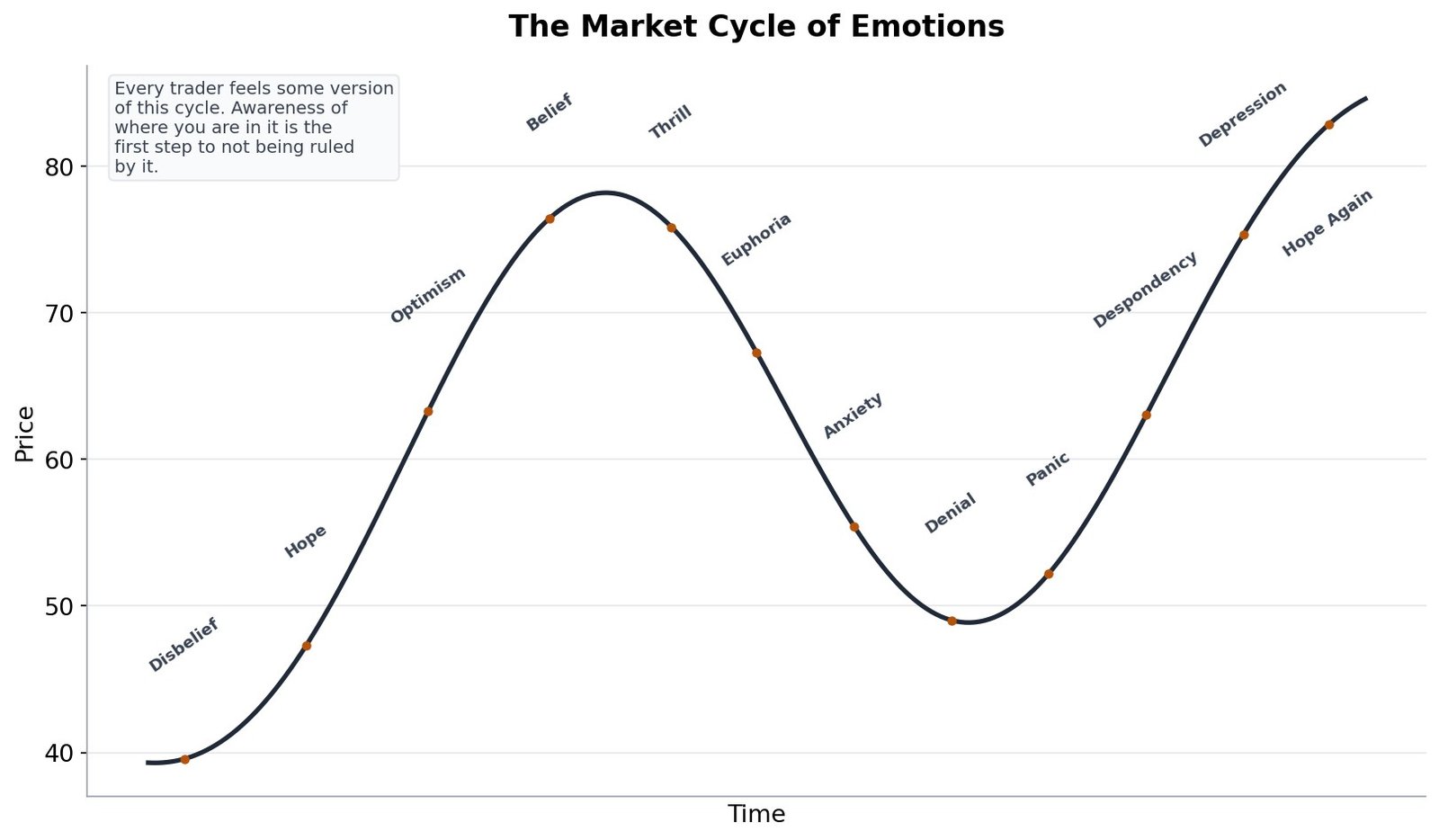
As shown in the picture, a typical cycle moves from disbelief and hope at the very bottom, through growing optimism and belief as price rises, into thrill and euphoria near a top, then anxiety, denial, and panic as price falls, down through despondency near the bottom again, before hope slowly returns. The specific labels matter less than the core lesson: your emotional state tends to move with price, often in exactly the wrong direction for good decision-making, euphoric right when caution is needed most, and despondent right when opportunity is often greatest.
Step 3: Fear in Trading, What It Actually Does to Decision-Making
Fear is not simply an unpleasant feeling to push through, it measurably changes how you make decisions. Under fear, people tend to exit good positions too early, hesitate on valid setups, and avoid taking any risk at all, even well managed, reasonable risk.
Fear is not always wrong, sometimes it is correctly warning you about genuine danger, like an oversized position or an unclear setup. The real skill is not eliminating fear entirely, which is not realistic, but learning to tell the difference between fear that is protecting you and fear that is simply noise left over from a recent loss, a distinction Step 19’s mindfulness techniques help build.
Step 4: Greed in Trading, the Other Side of the Same Coin
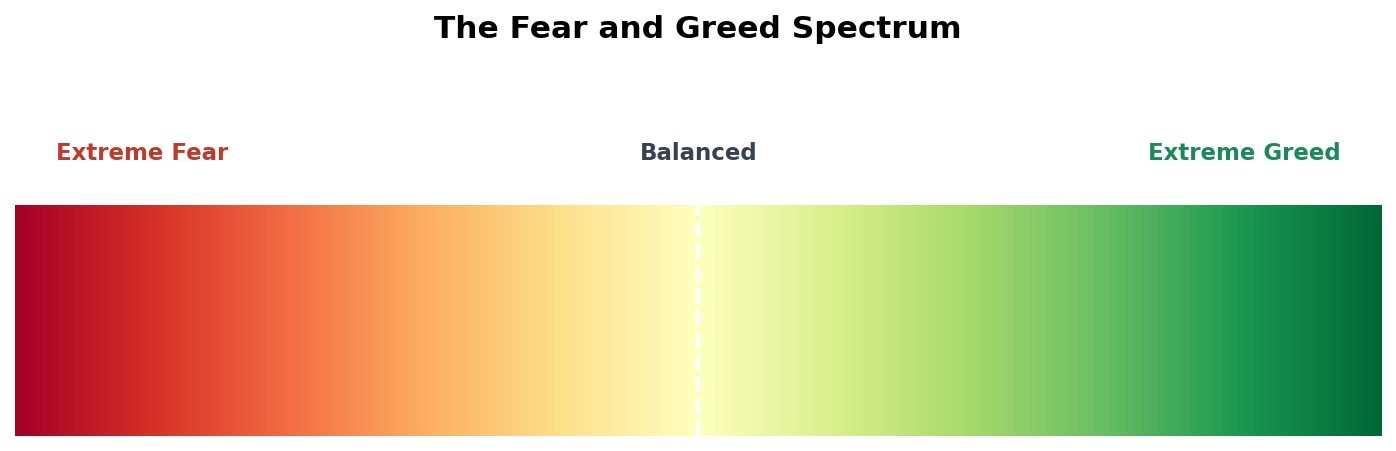
Where fear makes you exit too early or avoid good risk, greed does the opposite: it pushes you to hold a winning position past your planned target hoping for more, to increase your position size beyond your plan because a trade “feels” certain, or to take a setup that does not actually meet your own criteria because the potential reward looks exciting.
Greed is dangerous precisely because it rarely feels like greed in the moment, it usually feels like confidence, or opportunity. As the picture shows, fear and greed are really two ends of the same spectrum, and the goal is not to eliminate either feeling entirely, but to notice when you have drifted toward one extreme and bring your decision-making back toward the balanced middle. This is exactly why a written plan, decided before emotion is involved, matters so much, a theme this course returns to throughout.
Step 5: FOMO, the Fear of Missing Out
FOMO is the specific, uncomfortable feeling of watching a price move happen without you in it, and the urge to jump in immediately, often without your usual setup criteria being met at all.
FOMO entries are a common source of poorly planned trades, since they are driven by the fear of missing a move already in progress, not by an actual, pre-decided setup like the ones covered in this site’s Price Action Trading course. A genuinely useful habit: remind yourself that markets produce new opportunities constantly, missing one single move is never actually a real loss, only a missed hypothetical gain, which feels very different once named plainly.
Step 6: Revenge Trading, What It Is and Why It Happens
Revenge trading is taking an unplanned, often oversized trade specifically to “win back” a recent loss, driven by frustration rather than an actual setup.
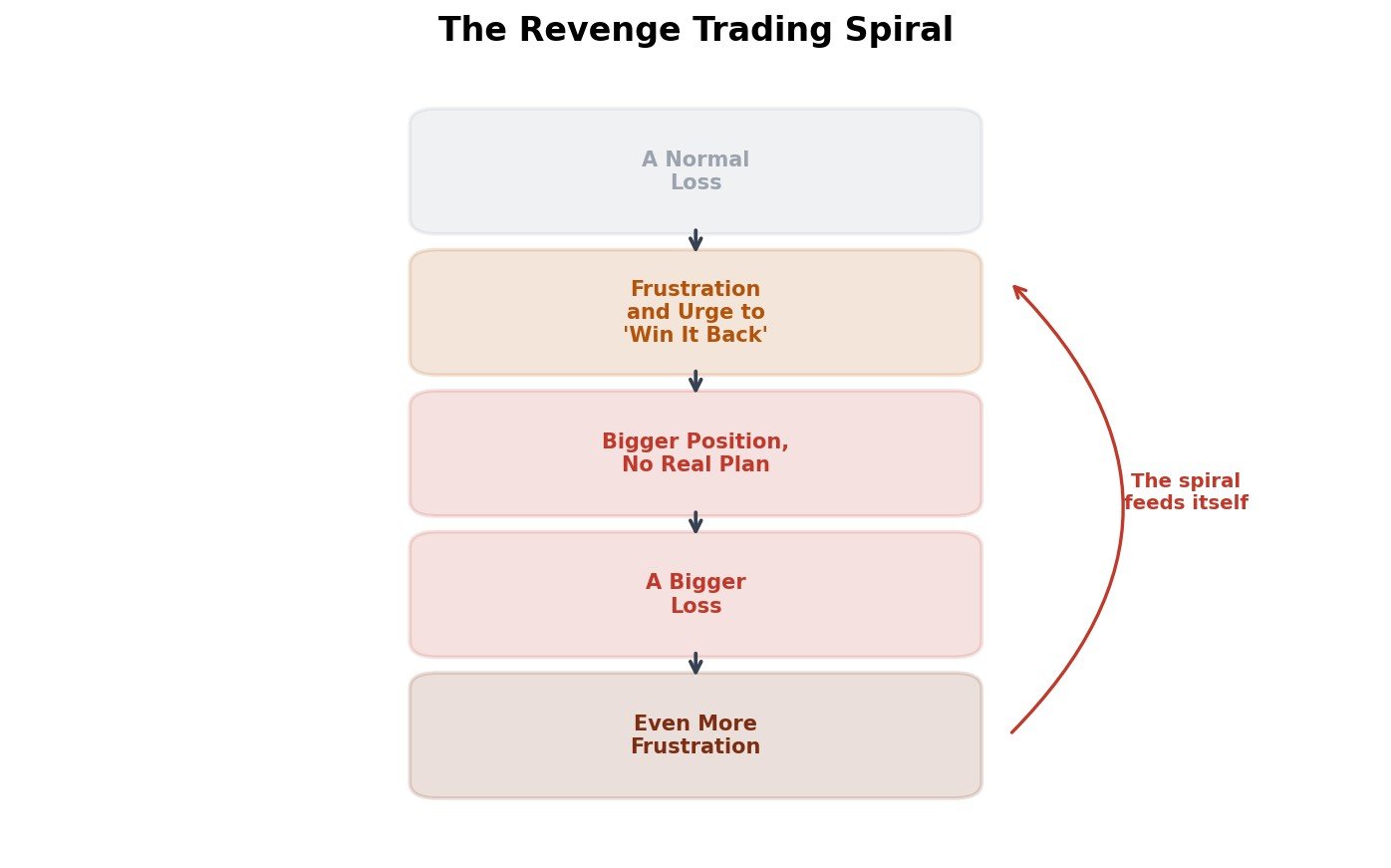
As shown in the picture, this pattern tends to feed itself: a normal, perfectly acceptable loss triggers frustration, which drives a bigger, less planned position, which often produces a bigger loss, which produces more frustration. Recognizing the very first step, the urge to immediately “win it back” right after a loss, is the single most effective point to interrupt this entire spiral, often simply by stepping away from the screen for a short period before placing another trade.
Step 7: Overconfidence After a Winning Streak
A string of winning trades can feel like validation that you have “figured out” the market, leading many traders to increase their position size, loosen their own rules, or skip steps in their checklist, right when a natural, normal losing trade is statistically due.
A useful reframe: a winning streak often reflects favorable market conditions as much as skill, and market conditions change. Treating each trade on its own merits, rather than carrying false confidence from the last several wins into the next decision, helps protect against this specific trap.
Step 8: Analysis Paralysis, When Too Much Information Freezes You
With so many indicators, patterns, and opinions available, it is entirely possible to gather so much conflicting information that you become unable to act at all, watching a valid setup pass by simply because you could not decide in time.
This usually points to an unclear, overly complicated process rather than a lack of information. A simple, specific checklist, like the ones provided at the end of every course on this site, is one of the most direct defenses against analysis paralysis, since it replaces an open-ended decision with a short, concrete set of yes-or-no questions.
Step 9: Confirmation Bias in Trading
Confirmation bias is the natural human tendency to notice information that supports a belief you already hold, while overlooking information that contradicts it. In trading, this often shows up as only seeing the bullish signals once you already want a stock to go up, while quietly dismissing the bearish ones.
A genuinely useful habit is to actively look for the strongest argument against your own trade idea before entering, not just the arguments for it. If you cannot articulate a reasonable case against your own trade, that is often a sign confirmation bias is quietly at work, not a sign the trade is perfect.
Step 10: Loss Aversion, Why Losses Hurt More Than Gains Feel Good
Loss aversion is a well documented pattern in human decision-making: losing a fixed amount of money tends to feel considerably worse than gaining that same amount feels good. This asymmetry quietly shapes a lot of poor trading behavior.
It explains why many traders cut winning trades short (locking in a gain quickly to avoid the discomfort of watching it shrink) while letting losing trades run far longer than planned (avoiding the discomfort of actually realizing the loss). Recognizing that this feeling is a normal, predictable part of human psychology, not a personal failing, makes it easier to consciously act against it when your plan calls for it.
Step 11: The Sunk Cost Fallacy in an Open Trade
The sunk cost fallacy is the tendency to keep investing more time, money, or attention into something specifically because you have already invested a lot in it, even when the original reason no longer holds.
In trading, this often shows up as holding a losing position well past your own stop loss, reasoning that “I’ve already lost this much, I can’t sell now.” The money already lost on a trade is gone either way, regardless of what you decide next. The only real question going forward is whether the trade still makes sense right now, completely independent of how much has already been lost on it.
Step 12: Recency Bias, Overweighting Your Most Recent Trades
Recency bias is giving disproportionate weight to your most recent experiences compared to your overall track record. A trader who just had three losing trades in a row may feel like their entire strategy is broken, even if their actual long term results remain solid.
A trading journal, covered fully in Step 16, is one of the best defenses against recency bias, since it lets you look at your real, complete track record rather than relying on how the last few trades happen to feel in the moment.
Step 13: Discipline vs Rigidity, Knowing the Difference
Discipline means consistently following a well reasoned plan, even when emotion tempts you to deviate. Rigidity means blindly following a rule even once genuine new information shows it no longer fits the situation. These can look similar from the outside, but they come from very different places.
A disciplined trader who sees clear evidence their stop loss level was based on a mistaken read of the chart can thoughtfully adjust it, once, with a clear reason, before the trade is live. A rigid or undisciplined trader moves the stop repeatedly, after the fact, simply because the trade is moving against them emotionally. The real skill is building a plan good enough that discipline rarely needs to bend, and recognizing honestly when you are bending it for a good reason versus an emotional one.
Step 14: The ACE Framework, Aware, Control, Execute
Samir Dash’s ACE framework, used throughout Mindful Trading Hub, offers one structured way to bring everything covered so far together into a repeatable process, rather than leaving emotional management to chance.
Aware means noticing your actual emotional and mental state before you act, recognizing where you currently sit on the emotional cycle from Step 2, rather than acting on autopilot. Control means consciously choosing your response to that state, rather than letting fear, greed, or frustration choose it for you. Execute means then actually carrying out your plan calmly, once awareness and control have done their job, instead of a plan quietly dissolving under pressure. This three step structure does not remove emotion from trading, no framework can do that, but it gives you a repeatable place to intervene before emotion turns into an impulsive decision.
Step 15: Building a Routine That Protects Your Mind
A consistent pre-trading and post-trading routine does real, practical work in protecting your decision-making, not just a nice-to-have habit. This mirrors the pre-market routine covered in this site’s Intraday Trading course, but applies to any trading style.
A simple, effective routine might include a short period of calm, focused preparation before trading begins, a clear checklist reviewed before every single trade (every course on this site ends with one), and a brief, honest review after the session or after each trade closes, rather than moving immediately and reactively into the next decision.
Step 16: The Role of a Trading Journal in Managing Psychology
A trading journal, mentioned throughout this site’s other courses mainly for reviewing strategy, is just as valuable for psychology specifically. Recording not just your entry and exit, but your emotional state and reasoning at the time of the trade, builds an honest record you can review later, with a calmer, clearer head than you had in the moment.
Over weeks and months, this record often reveals patterns an individual trade never would, specific situations, times of day, or emotional states that reliably precede your worst decisions, letting you build specific, targeted defenses against them rather than vague, general willpower alone.
Step 17: Managing Emotions During a Losing Streak
A losing streak, a normal, statistically expected part of trading any strategy, tests psychology more than almost anything else. A few practical habits: review your journal (Step 16) to confirm whether your actual process broke down, or whether this is simply normal variation within a sound strategy; consider reducing position size temporarily, not out of panic, but as a deliberate, planned response to protect capital while confidence rebuilds; and resist the specific urge toward revenge trading covered in Step 6.
Step 18: Managing Emotions During a Winning Streak
A winning streak needs its own deliberate management, since it tests psychology in the opposite direction from Step 17. The overconfidence trap from Step 7 is the main risk here: resist increasing position size or loosening your rules purely because recent results have been good. Continue following the same checklist and process that produced the winning streak in the first place, rather than assuming you have outgrown it.
Step 19: Mindfulness and Awareness Techniques for Traders
Mindfulness, in a trading context, simply means noticing your own internal state, your thoughts, your physical tension, your urge to act, without immediately reacting to it. This is the practical foundation of the “Aware” step in the ACE framework from Step 14.
A simple, practical technique: before placing a trade, especially one that feels urgent or exciting, pause for a few slow breaths and honestly ask yourself what you are actually feeling right now, and whether this specific trade matches your written plan or is being driven by that feeling instead. This brief pause costs almost nothing in terms of missed opportunity, but it reliably catches a meaningful share of poor, emotionally driven decisions before they happen.
Step 20: Common Mistakes Rooted in Psychology
- Trading to feel something, excitement or relief, rather than because a real setup is present.
- Treating a losing streak as proof the strategy is broken, without checking the journal first, as covered in Step 12 and Step 17.
- Confusing confidence from a winning streak with an actual edge, as covered in Step 7.
- Only seeking out information that confirms an existing position, the confirmation bias covered in Step 9.
- Letting one single recent trade color your view of your entire strategy, the recency bias covered in Step 12.
- Treating every rule as unbendable, or every rule as optional, instead of the honest discipline-versus-rigidity distinction from Step 13.
Step 21: A Simple Checklist for Emotional Readiness Before Trading
Save this list, bookmark it, or share it with a friend who is learning alongside you. Go through it before you sit down to trade, not just before an individual trade.
- Am I aware of where I currently sit on the emotional cycle from Step 2, calm, anxious, overconfident, or something else?
- Am I trading because a real setup is present, or because I feel an urge to act?
- If I just had a loss, have I given myself enough space to avoid the revenge trading spiral from Step 6?
- If I just had a winning streak, am I still following my full checklist, not skipping steps out of overconfidence?
- Have I honestly considered the strongest argument against this specific trade, not just the case for it?
- Is my current position size and stop loss based on my plan, or on how confident this particular trade happens to feel?
- Am I in a calm enough state right now to actually execute my plan as written?
Step 22: Quick Glossary, Every Term in One Place
A fast reference for every term used across this course. Bookmark this page and jump here any time a word slips your memory.
- Trading Psychology: The gap between what a trader knows and what a trader actually does under real pressure.
- Market Cycle of Emotions: The recognizable emotional pattern traders tend to move through as price rises and falls.
- FOMO: Fear of missing out, the urge to enter a trade purely because a move is already happening.
- Revenge Trading: Taking an unplanned, often oversized trade to try to immediately win back a recent loss.
- Overconfidence Bias: Overestimating your own skill or certainty after a string of wins.
- Analysis Paralysis: Becoming unable to act due to too much, often conflicting, information.
- Confirmation Bias: Noticing information that supports an existing belief while overlooking information against it.
- Loss Aversion: Losses feeling considerably more painful than an equivalent gain feels good.
- Sunk Cost Fallacy: Continuing a decision specifically because of what has already been invested, rather than its current merit.
- Recency Bias: Overweighting your most recent experiences compared to your overall track record.
- Discipline vs Rigidity: Consistently following a sound plan, versus blindly following a rule even when it no longer fits.
- ACE Framework: Aware, Control, Execute, a structured approach to managing trading psychology in the moment.
Step 23: What to Do Next
This course covers the internal, emotional side of trading psychology. This site’s dedicated Trading Behaviour course covers the closely related but distinct topic of your observable trading habits and actions, overtrading, inconsistent position sizing, and the concrete routines that turn psychological awareness into actual, repeatable behavior. The two are best read together.
Every strategy course on this site, Price Action Trading, Candlestick Patterns, Chart Patterns, Swing Trading, Intraday Trading, Forex Trading, and Option Trading, teaches you what a good decision looks like. Samir Dash’s full ACE framework at Mindful Trading Hub goes deeper into actually building this discipline consistently, for traders who already understand the mechanics covered across this site but still find themselves struggling to execute calmly once real money is on the line.
Frequently Asked Questions
Can trading psychology really be improved, or is it just personality?
It can genuinely be improved with deliberate practice, the same way a technical skill can. A trading journal (Step 16), a clear routine (Step 15), and structured frameworks like ACE (Step 14) all give you concrete, repeatable ways to build this skill over time, rather than leaving it purely to willpower or natural temperament.
Why do I keep breaking my own trading rules even when I know better?
This is extremely common and usually points to an emotional trigger, like fear, greed, FOMO, or frustration after a loss, overriding a plan made in a calmer state. Steps 3 through 12 cover the most common specific triggers, and identifying which one affects you most is the first real step toward managing it.
Is revenge trading really that common?
Yes, it is one of the most widely recognized and widely admitted patterns among traders at every experience level, not a rare or unusual failure. Recognizing the very first urge, immediately after a loss, as described in Step 6, is the most effective point to interrupt it.
How is this course different from the Trading Behaviour course?
This course focuses on the internal, emotional and mental side, what you feel and why. The Trading Behaviour course focuses on the external, observable side, what you actually do, your habits, routines, and patterns of action, as explained in Step 23.
Is this investment advice?
No. Samir Dash is not SEBI-registered, and nothing in this course is a trading recommendation or promise of returns. This content is for educational purposes only. Please read the Disclaimer before acting on anything you read here.
Related Reading on This Site
If you want to go deeper on specific ideas from this course, Samir Dash has written these on blog.samirdash.in:
- Trading Psychology: The Complete Guide for Indian Traders
- FOMO in Trading: Why You Chase Every Move
- Revenge Trading: Why You Keep Trying to Win It Back
- Loss Aversion in Trading Explained
- Confirmation Bias in Trading Explained
Continue Your Learning Path
You understand the feeling side of this. Now look at the behaviour it actually produces.
- Trading Behaviour: the same problem seen from the outside, the actions, not the emotions.
You can also see every course on this site, in order, and pick your own path.
Want to go deeper into managing your trading psychology, with real structure and support? Samir Dash’s ACE framework (Aware, Control, Execute) at Mindful Trading Hub is built specifically around the ideas in this course, for traders who already understand the mechanics but still struggle to execute consistently under pressure. Learn more at Mindful Trading Hub.