

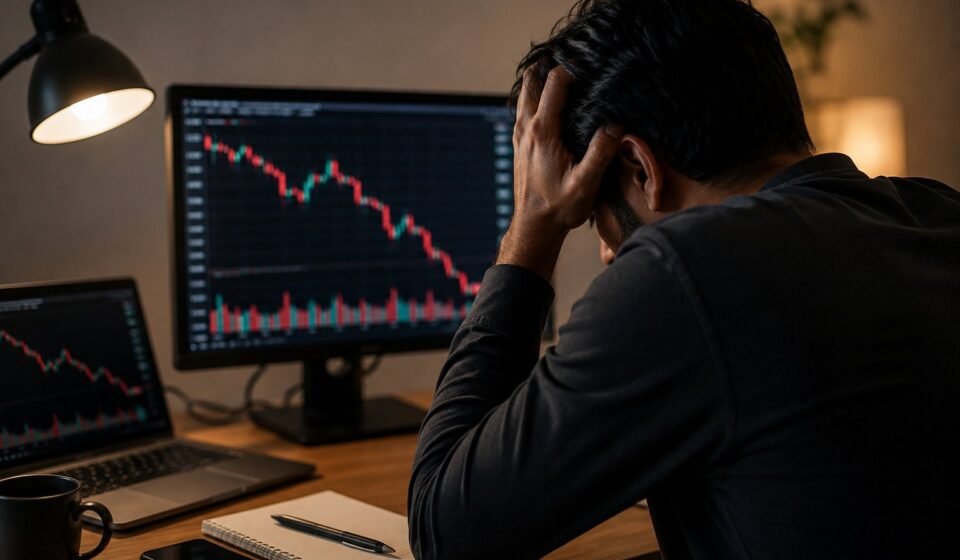

Revenge trading is the act of entering a trade primarily to recover a previous loss, rather than because the setup meets your criteria.
That is the whole definition, and the important word in it is primarily. Almost every revenge trade has a chart justification attached. That is what makes it so hard to catch. You are not entering on nothing. You are entering on something you would have ignored an hour earlier.
This is the pillar post on the subject. It covers what revenge trading is, why it happens at the level of mechanism, how to recognise your own version of it, and what actually stops it.
What it looks like from the inside
The picture most people have is a trader shouting at a screen. That is not it. Revenge trading is usually calm, focused, and feels productive while it is happening.
The reliable markers:
- Re-entry within minutes of a stop out, on the same instrument.
- Size increases after a loss, never after a win.
- The checklist gets skipped because “the move is happening now.”
- Instrument switching. Nifty stopped you out so you move to Bank Nifty, where you have no plan and no data.
- Mental arithmetic about what you need to get back to flat.
- Holding past your stop, because closing it makes the loss real.
If three or more of those are familiar, this is a pattern rather than a bad day.
Why it happens: the open loop
The standard explanation is anger, and it is wrong often enough to be useless.
Here is the better one. A realised loss creates an open loop. Your brain files it the way it files an unsent reply or an unpaid bill, as an unfinished task. Unfinished tasks generate pressure to close them. This is not a trading-specific mechanism, it is how attention works generally. The market being open, and your capital being available, means closing the loop looks immediately possible.
So the thought that starts a revenge trade is almost never “I am furious.” It is:
“The market is still trending. I can make this back before lunch.”
That sentence arrives roughly 90 seconds after the loss, and it does not present itself as a symptom. It presents itself as a plan. You will not catch it by watching for anger, because anger is not what shows up.
Why losses hurt more than wins feel good
There is a second mechanism stacked underneath.
Losses register roughly twice as strongly as equivalent gains. Losing ₹10,000 does not feel like the mirror image of winning ₹10,000. It feels heavier, and it lasts longer. This is one of the most consistently replicated findings in decision research.
The practical consequence for you is specific. When you are down ₹10,000, you are not motivated to recover ₹10,000. You are motivated to shut off a feeling that is running at roughly double intensity. That is why the recovery trade is oversized. The size is calibrated to the feeling, not to the number.
The sequence, in order
Revenge trading has a predictable shape. Knowing the order matters, because each stage has a different intervention.
- Degraded state. Poor sleep, outside money pressure, or yesterday’s loss. This is usually present before the day starts.
- The loss. Stop hit, position closed.
- The 90-second window. The open loop generates the recovery thought. It sounds reasonable.
- The justification. You find a chart reason. There is always one available.
- The oversized entry. Size matches the feeling rather than the plan.
- Escalation. If it loses, the loop is now larger and the next size is larger again.
Most advice targets stage 5, which is far too late. Stage 5 is where you are least capable of intervening. The workable interventions are at stages 1 and 3.
The counterintuitive part: the state comes first
Most traders assume the causality runs loss, then bad psychology, then revenge trading.
Go back through your own journal and you will usually find the reverse. The warning signs precede the losing day rather than following it. Poor sleep the night before. Position size slightly above your rules from the first trade of the morning. More screen time than usual. Financial pressure from outside the market.
Which means the loss did not cause the bad decisions. The degraded state caused both the loss and the decisions.
This is why “just be more disciplined after a loss” reliably fails. By the time you are applying discipline, you are three stages into a sequence that started before the market opened.
This is the Aware step in the ACE framework, and it is the reason it comes first. Awareness is not a feeling you summon. It is a checklist you run at 8:30 in the morning, when you are still able to be honest.
What actually stops it
The full rule set is in How to Stop Revenge Trading After a Big Loss. The core of it:
- A 20-minute stand-up rule after any full stop-out. The urge is time-boxed and expires on its own if you outlast it.
- A daily loss limit in rupees, written on paper before the open. Not a percentage.
- A position size cap so no single trade can take out more than a third of that limit. This does more work than every other rule combined.
- A two-strike rule. Two consecutive full stop-outs and the terminal closes.
- One written line before every entry: setup, stop, why now. It is nearly impossible to write on a revenge trade because there is nothing to write.
What these have in common is that none of them require you to be calm. They are all decided in advance, by the version of you that was.
The cost, in numbers
Worth being concrete about why this matters more than any other single habit.
Assume a disciplined loss is 1R. A typical revenge sequence is a 2R entry, then a 3R entry after that loses. One bad half-hour costs 6R.
If your system produces +0.6R per trade, which is a genuinely good system, that half-hour just erased your next ten trades. And the ten trades will take you two weeks.
This is why revenge trading is the most expensive habit in Indian retail trading. It is not that the losses are frequent. It is that each episode consumes weeks of correct work.
Frequently asked questions
What is revenge trading in simple terms?
Entering a trade mainly to recover a previous loss rather than because the setup met your rules. It usually involves larger size than normal and a shorter gap after the loss than you would otherwise take.
Is revenge trading the same as overtrading?
They overlap but are not identical. Overtrading is taking too many trades, often from boredom or a sense that capital must always be deployed. Revenge trading is specifically triggered by a loss and aimed at recovering it. Revenge trading is usually more expensive, because the size is larger.
How do I know if a trade is a revenge trade or a valid re-entry?
One test. Could you have written down this entry condition before the previous trade closed? If the setup was already on your list, it is a valid re-entry. If you found it after the loss, while looking for something, it is a revenge trade wearing a chart pattern.
Does revenge trading ever work?
Individual revenge trades win often enough to keep the habit alive. That is precisely the problem. A win at stage 5 teaches you that the sequence works, and the next episode will be larger. Judge the behaviour across fifty instances, not one.
Why do I do this when I know better?
Because knowing is a calm-state activity and the trade happens in a degraded state. The gap between the two is not a character flaw, it is the normal condition. That is why the fix is external rules rather than better intentions.
The real point
You are not trying to become someone who feels nothing after a loss. That person does not exist, and if they did they would probably be a worse trader, because the feeling carries information.
You are trying to become someone whose next action was already decided before the loss happened.
The market does not reward better predictions. It rewards better decisions.
Agar decisions badlenge, toh results bhi badlenge.
Related reading:
- Fear of Loss in Trading: Why You Cannot Pull the Trigger
- Averaging Down: Why It Feels Smart and Rarely Is
- What Happens in Your Brain While a Trade Is Open
Want to break this loop properly? I run a free live session twice a week for traders with two or more years of experience who know the setups but still cannot execute under pressure. Register for the next free session here.
I am Samir Dash, founder of Mindful Trading Hub. I work with experienced traders on live market decision-making. More about my story here.