

Trading Foundation
This is the very first course to start with on blog.samirdash.in. It covers the true basics of the stock market, the words, the accounts, the order types, and the ideas that every other course on this site assumes you already know. If you are completely new to trading, start here before anything else.
This is a full course, not a short article, so it covers everything a beginner actually needs, step by step, in plain and simple English. Bookmark this page and come back to it any time a basic word or idea feels unclear while you are reading a more advanced course.
A free course by Samir Dash, founder of Mindful Trading Hub.
What You Will Learn
- Step 1: What Is the Stock Market, in Plain Words
- Step 2: What Is a Share or Stock
- Step 3: Primary Market vs Secondary Market
- Step 4: Stock Exchanges, NSE and BSE
- Step 5: What Is a Market Index
- Step 6: Who Is on the Other Side of Your Trade
- Step 7: What You Need to Start, Demat and Trading Accounts
- Step 8: Market Hours and Trading Sessions in India
- Step 9: Types of Orders, Market, Limit, and Stop Loss
- Step 10: Bid, Ask, and the Spread
- Step 11: Long vs Short, Two Directions You Can Trade
- Step 12: What Is Leverage and Margin
- Step 13: The Four Main Market Segments
- Step 14: Brokerage, Taxes, and Other Charges
- Step 15: Trading vs Investing, What Is the Real Difference
- Step 16: Fundamental Analysis vs Technical Analysis
- Step 17: Risk, Capital, and Why Most Beginners Struggle
- Step 18: Common Beginner Mistakes When Starting Out
- Step 19: A Simple Checklist Before Your First Trade
- Step 20: Quick Glossary, Every Term in One Place
- Step 21: What to Do Next
- Frequently Asked Questions
Step 1: What Is the Stock Market, in Plain Words
Picture a big, busy marketplace, but instead of people selling vegetables or clothes, they are buying and selling tiny pieces of ownership in real companies. That is the stock market. It is simply a place, now almost entirely online, where people buy and sell small ownership pieces of companies.
When you buy one of these pieces, you actually own a tiny slice of that real company. If the company does well and grows in value, your tiny slice can become worth more. If the company struggles, your slice can become worth less. The stock market is simply the system that lets millions of people do this buying and selling safely, fairly, and quickly, every single day.
Step 2: What Is a Share or Stock
A share, also called a stock, is one single unit of ownership in a company. Imagine a company is cut into 10 crore equal pieces, and you buy 100 of those pieces. You now own a very small, but real, part of that company.
Owning shares usually gives you a claim on a tiny portion of the company’s profits, sometimes paid out as a dividend, and in many cases a small vote on major company decisions. The price of one share simply reflects what buyers and sellers currently agree that tiny ownership piece is worth, and that agreed price changes constantly as more people buy and sell throughout the day.
Step 3: Primary Market vs Secondary Market
A company’s shares are first created and sold to the public in what is called the primary market, most commonly through an event called an IPO, short for Initial Public Offering. This is the one time the company itself directly receives money from investors in exchange for new shares.
After an IPO, those same shares start trading between ordinary investors, buyer to buyer, seller to seller, on the stock exchange. This everyday buying and selling is called the secondary market. When you open a trading app and buy a share of an already-listed company, you are buying it from another investor in the secondary market, not from the company itself.
Step 4: Stock Exchanges, NSE and BSE
A stock exchange is the official, regulated platform where buyers and sellers actually meet to trade shares. In India, the two major stock exchanges are the NSE, the National Stock Exchange, and the BSE, the Bombay Stock Exchange, the oldest stock exchange in Asia.
Most companies you can trade are listed on both exchanges, and the price is generally nearly identical on each, since the same share is being traded by the same pool of buyers and sellers. Both exchanges are regulated by SEBI, the Securities and Exchange Board of India, which sets the rules designed to keep trading fair and transparent for everyone.
Step 5: What Is a Market Index
A single stock’s price only tells you about one company. A market index solves this by combining many stocks together into one single number, so you can get a quick sense of how the overall market, or a specific part of it, is doing.
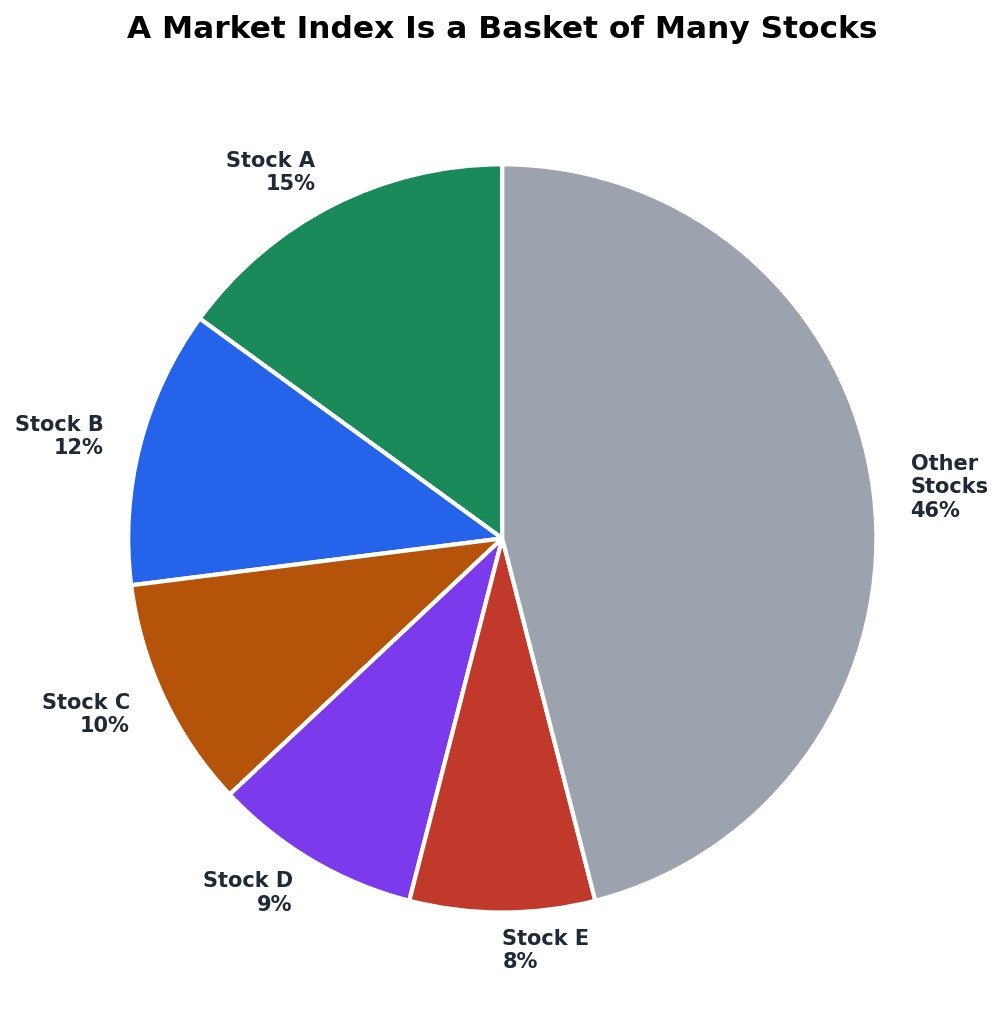
Think of an index like a fruit basket. Instead of tracking the price of one single apple, you track the combined value of an entire basket containing apples, bananas, and oranges, in fixed proportions. In India, the two most watched indices are the Nifty 50, which tracks 50 large companies on the NSE, and the Sensex, which tracks 30 large companies on the BSE. When you hear “the market is up today,” it almost always means one of these indices has risen.
Step 6: Who Is on the Other Side of Your Trade
Every single time you buy a share, someone else is selling it to you. Every time you sell, someone else is buying. The stock market always needs two matched sides for any trade to actually happen.
The people and institutions on the other side of trades vary widely: other individual investors like you, large mutual funds managing money for thousands of people, foreign institutional investors bringing money in from outside India, insurance companies, pension funds, and professional trading firms. Understanding that real people and real institutions, often with very different goals and time horizons than you, are always on the other side of your trade is a useful habit for thinking clearly about the market.
Step 7: What You Need to Start, Demat and Trading Accounts
To actually buy and hold shares in India, you need two connected accounts, usually opened together through the same broker. A Demat account (short for dematerialized account) is where your shares are actually held electronically, similar to how a bank account holds your money, instead of old fashioned paper share certificates.
A trading account is what you actually use to place buy and sell orders, connected to the stock exchange. Your trading account is linked to both your Demat account, where bought shares land, and your bank account, where the money for buying and selling actually moves to and from. A broker is the SEBI-registered company that provides you with these accounts and the platform or app you use to place trades.
Step 8: Market Hours and Trading Sessions in India
Indian stock exchanges are not open all day, every day. The main trading session for equities on the NSE and BSE normally runs on business days, Monday through Friday, excluding exchange holidays. There is also a short pre-open session before the main session begins, which helps set a fair opening price based on orders placed in advance.
Exact timings can occasionally be adjusted by the exchanges, so it is always worth confirming the current official hours directly with NSE or BSE, or your broker’s app, rather than assuming they never change. Outside these hours, you generally cannot place a new equity trade that executes immediately, though some brokers offer limited after-hours order placement for execution once the market reopens.
Step 9: Types of Orders, Market, Limit, and Stop Loss
When you want to buy or sell a share, you do not just say “buy” or “sell.” You choose a specific order type that tells the exchange exactly how and when you want that trade to happen.
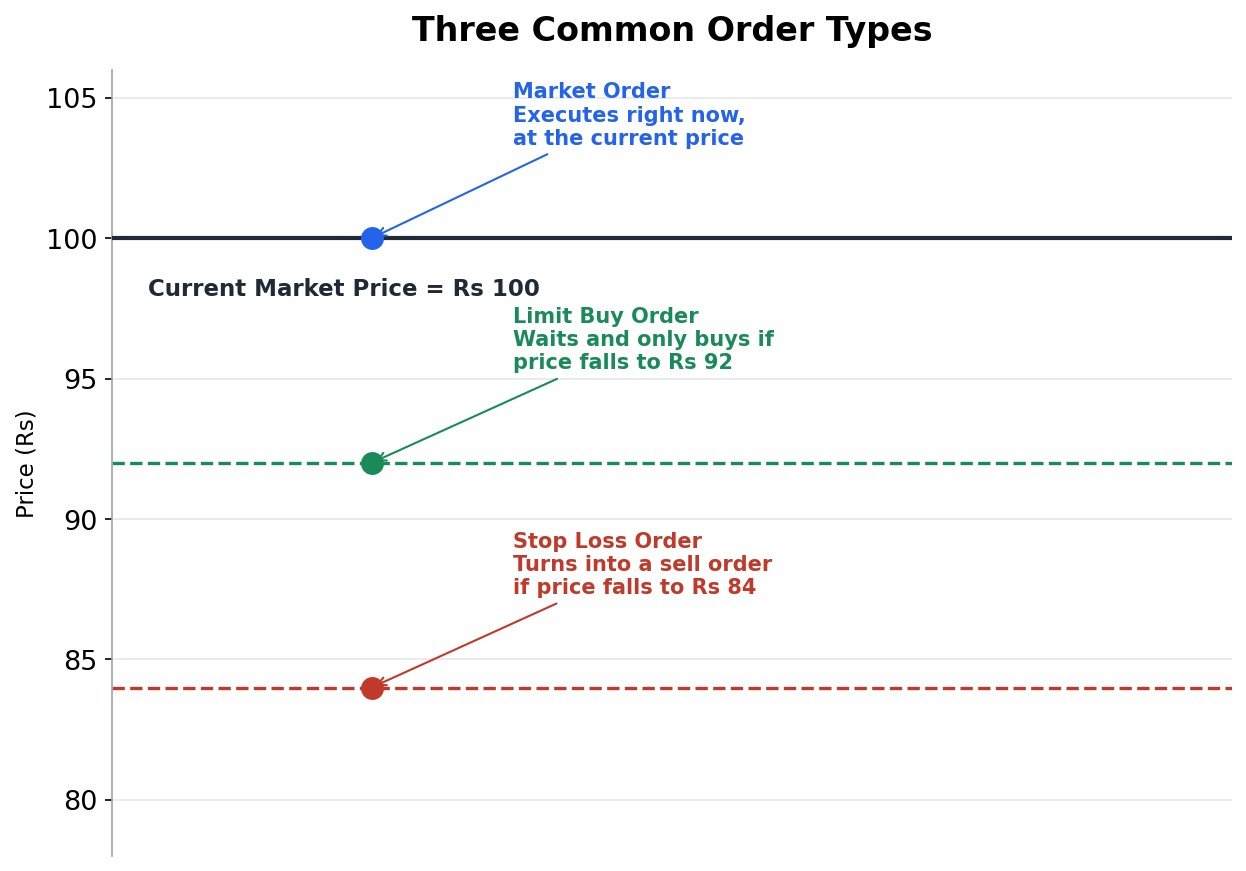
A market order executes immediately, at whatever the current price happens to be. It prioritizes speed over price certainty. A limit order only executes at your chosen price or better, and simply waits, possibly never filling at all, if the market never reaches your price. A stop loss order sits quietly and does nothing until price reaches a trigger level you set, at which point it turns into a market order, most commonly used to automatically exit a losing position before the loss grows larger.
Step 10: Bid, Ask, and the Spread
At any given moment, a stock does not have just one single price. It has a bid price and an ask price, and understanding the difference helps explain exactly how your order actually gets filled.
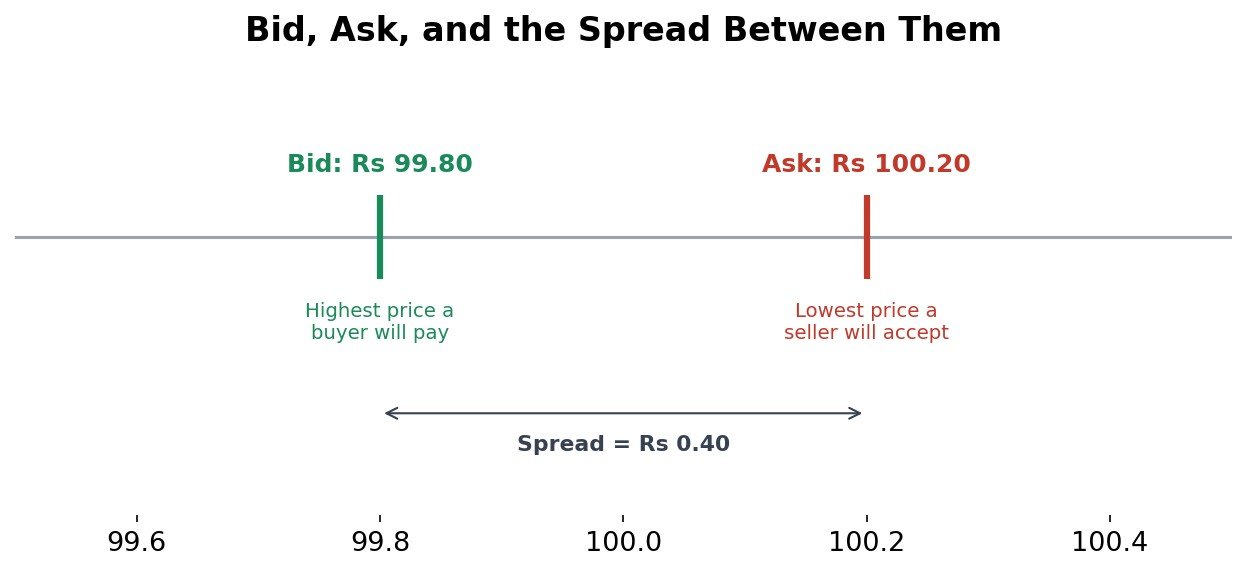
The bid is the highest price any buyer is currently willing to pay. The ask, sometimes called the offer, is the lowest price any seller is currently willing to accept. The small gap between them is called the spread. A heavily traded stock usually has a very small, tight spread, while a thinly traded stock can have a wider spread, which quietly adds to your cost of trading in and out.
Step 11: Long vs Short, Two Directions You Can Trade
Most beginners assume the only way to make money in the market is to buy low and sell high later. That is only half the picture.
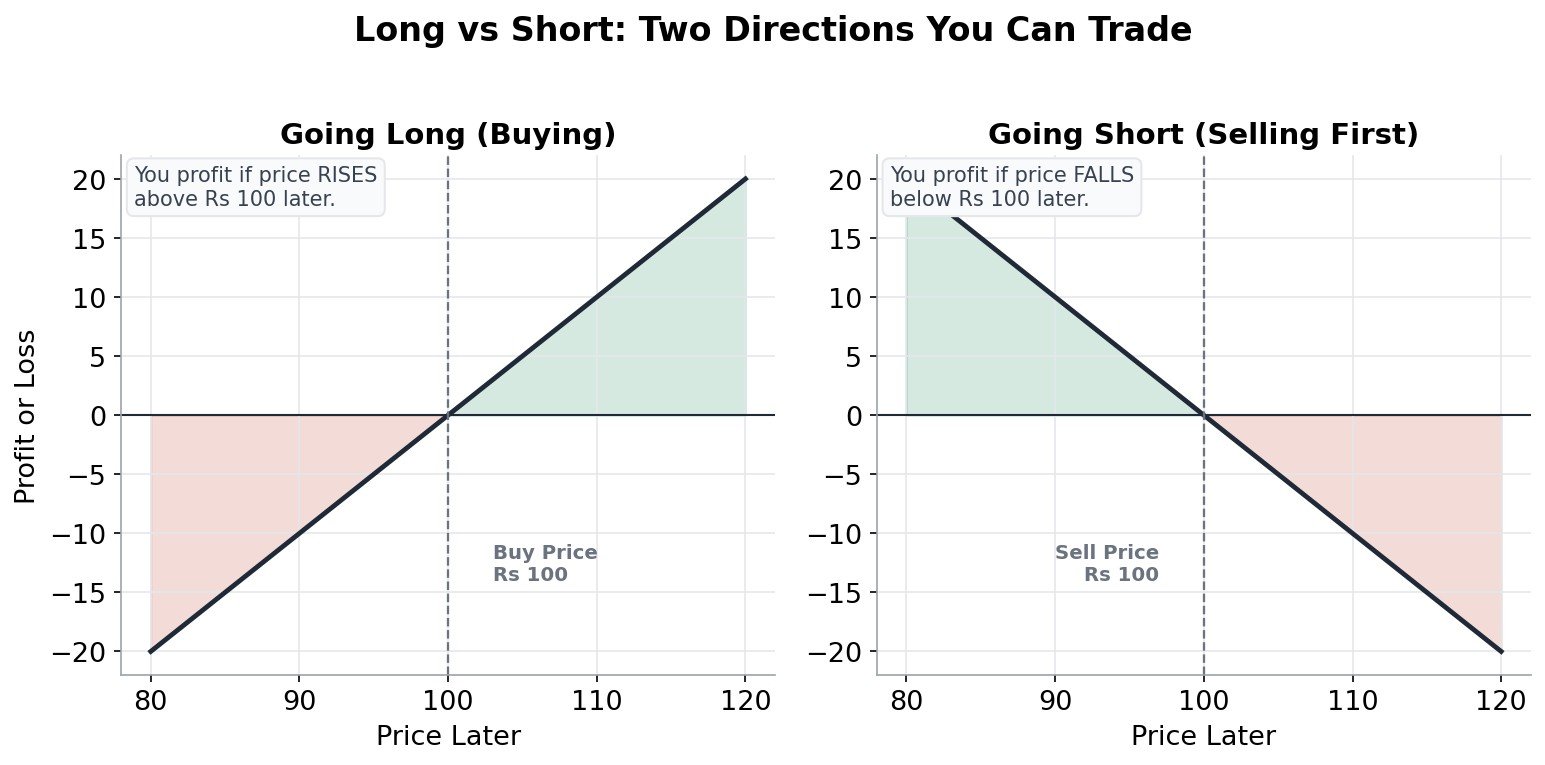
Going long simply means buying first, with the goal of selling later at a higher price, the traditional, most intuitive direction. Going short, also called short selling, flips the order: you effectively sell first (by borrowing the shares through your broker) with the goal of buying them back later at a lower price, profiting from a fall instead of a rise. Short selling generally involves more rules, margin requirements, and risk considerations than simply going long, and is usually something beginners learn well after they are comfortable with the basics.
Step 12: What Is Leverage and Margin
Leverage means controlling a larger position than the cash you actually put in, by borrowing the rest, usually from your broker. Margin is the portion of money you must put in yourself as security, with the broker effectively covering the rest.
For example, with 5 times leverage, Rs 20,000 of your own margin might let you control a position worth Rs 1,00,000. Leverage multiplies your potential profit, but it multiplies your potential loss by exactly the same amount, which is why it is treated as a more advanced, higher risk tool, not something a brand new beginner should reach for immediately. Leverage is most commonly available in the futures and options segment covered in Step 13, far less so in plain equity delivery trading.
Step 13: The Four Main Market Segments
Beyond plain shares, Indian markets offer a few distinct segments, each with its own purpose and risk profile.
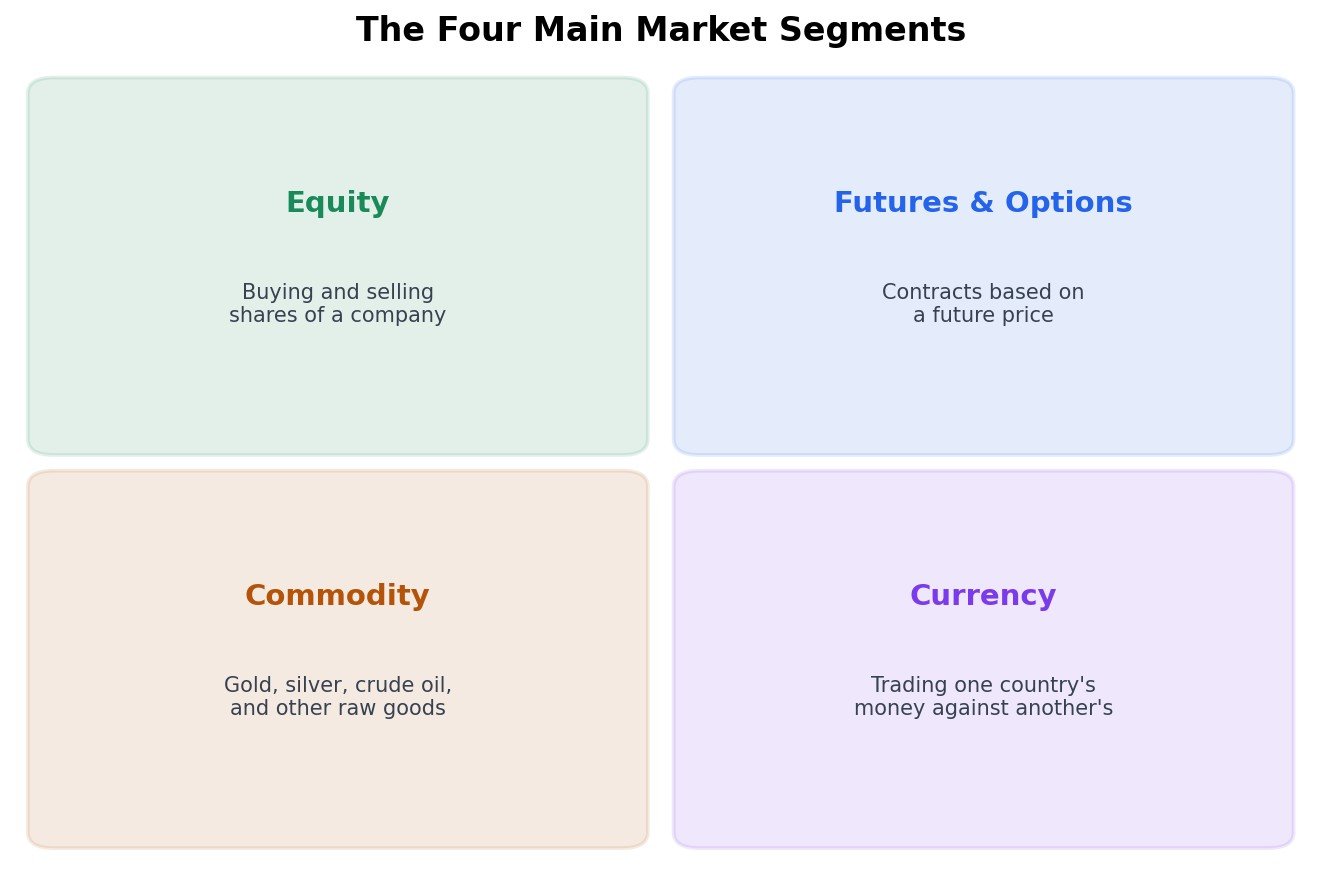
Equity is plain buying and selling of company shares, covered throughout this course. Futures and Options, often shortened to F&O, are contracts whose value is based on an underlying asset’s future price, generally considered more advanced and more risky, and covered in full in this site’s dedicated Option Trading course. Commodity trading involves raw goods like gold, silver, and crude oil. Currency trading involves one country’s money traded against another’s, such as the US Dollar against the Indian Rupee. A complete beginner usually starts with plain equity, and only explores the other segments once the fundamentals in this course feel comfortable.
Step 14: Brokerage, Taxes, and Other Charges
Trading is never completely free. A few costs apply to nearly every trade, and ignoring them is a common beginner mistake.
Brokerage is the fee your broker charges for executing your trade, which varies significantly between different brokers and different types of trades. Beyond brokerage, exchanges and the government add several smaller charges: transaction charges, GST on brokerage and other fees, stamp duty, and a Securities Transaction Tax. Capital gains tax applies to the actual profit you make when you sell shares, with different rules depending on how long you held the shares before selling.
This course deliberately avoids stating exact current brokerage rates or tax percentages, since both change over time through broker pricing updates and government Budget announcements. Always check your specific broker’s current charges and consult a Chartered Accountant for your personal tax situation, rather than relying on a number that may already be outdated.
Step 15: Trading vs Investing, What Is the Real Difference
These two words are often used loosely, but they describe genuinely different approaches, mainly separated by time horizon and the kind of analysis involved.
Investing generally means buying shares with a long time horizon, often years, based mainly on a company’s underlying business quality and growth prospects, sometimes called fundamental analysis, covered in Step 16. Trading generally means buying and selling over a much shorter time horizon, from minutes to a few weeks or months, often based mainly on reading the price chart itself, an approach covered in depth in this site’s dedicated Price Action Trading course. Neither approach is universally “better,” they simply require different skills, different time commitments, and different temperaments, and many people eventually use a mix of both.
Step 16: Fundamental Analysis vs Technical Analysis
These are the two main schools of thought used to decide what to buy or sell, and most traders and investors lean more heavily toward one, even while being aware of the other.
Fundamental analysis studies a company’s actual business: its revenue, profit, debt, management quality, and its industry’s outlook, to judge whether its current share price fairly reflects its real value. Technical analysis studies the price chart itself, patterns, trends, support and resistance, to judge what buyers and sellers are likely to do next, largely independent of the underlying business details. Price action trading, the subject of this site’s dedicated course on the topic, is a specific, popular style within technical analysis.
Step 17: Risk, Capital, and Why Most Beginners Struggle
It is worth saying plainly, early on: trading and investing both carry real risk, and it is entirely possible to lose money, including money you worked hard for. This is not meant to discourage you, it is meant to set the right expectations from day one.
A few honest reasons many beginners struggle: trading with money they cannot actually afford to lose, which creates emotional pressure that clouds clear decision-making; using leverage (Step 12) before understanding how quickly it can amplify a loss; entering trades without a clear plan, chasing excitement rather than following a thought-out reason; and expecting fast, easy profits instead of treating this as a genuine skill that takes real time and honest practice to build. Every course on this site is built around managing this risk sensibly, not pretending it does not exist.
Step 18: Common Beginner Mistakes When Starting Out
- Starting with real money before understanding the basics in this course. There is no cost to learning the fundamentals first.
- Not knowing the difference between a Demat account and a trading account, and how they connect to your bank account, before placing a first trade.
- Using a market order when a limit order would have given far more control over the price actually paid.
- Jumping straight into leverage or Futures and Options before being comfortable with plain equity trading and risk basics.
- Ignoring brokerage and other charges when judging whether a trade was actually profitable after costs.
- Trading with money meant for essential expenses, instead of money that is genuinely surplus and can be risked.
- Expecting to get rich quickly, instead of treating trading as a skill that takes real, honest time to build.
Step 19: A Simple Checklist Before Your First Trade
Save this list, bookmark it, or share it with a friend who is learning alongside you. Go through it before you place your very first real trade.
- Do I understand what a share actually represents, real ownership in a real company?
- Do I have both a Demat account and a trading account set up with a SEBI-registered broker?
- Do I understand the difference between a market order, a limit order, and a stop loss order?
- Am I using money I can genuinely afford to lose, separate from essential expenses?
- Do I understand that brokerage, taxes, and other charges will reduce my actual profit?
- Have I decided whether I am trading or investing for this specific purchase, and why?
- Am I starting with plain equity, rather than jumping straight into leverage or Futures and Options?
Step 20: Quick Glossary, Every Term in One Place
A fast reference for every term used across this course. Bookmark this page and jump here any time a word slips your memory.
- Share / Stock: One unit of ownership in a company.
- IPO: Initial Public Offering, when a company first sells shares to the public.
- Primary Market / Secondary Market: Where shares are first created and sold, versus where they trade between investors afterward.
- Stock Exchange: A regulated platform where buyers and sellers trade shares, such as NSE or BSE.
- SEBI: The Securities and Exchange Board of India, the main market regulator.
- Market Index: A single number combining many stocks together, such as the Nifty 50 or the Sensex.
- Demat Account: Where your shares are electronically held.
- Trading Account: What you use to actually place buy and sell orders.
- Broker: A SEBI-registered company that provides your trading platform and accounts.
- Market Order: An order that executes immediately at the current price.
- Limit Order: An order that only executes at your chosen price or better.
- Stop Loss Order: An order that triggers a market order once a set price is reached, often used to limit a loss.
- Bid / Ask: The highest price buyers are offering, and the lowest price sellers will accept.
- Spread: The gap between the bid price and the ask price.
- Long / Short: Buying first expecting a rise, versus selling first expecting a fall.
- Leverage / Margin: Controlling a larger position by borrowing, and the portion of money you put in yourself.
- Equity, Futures & Options, Commodity, Currency: The four main market segments.
- Brokerage: The fee a broker charges for executing your trade.
- Capital Gains Tax: Tax on the actual profit made when shares are sold.
- Trading / Investing: Shorter time horizon chart-based activity, versus longer time horizon business-based activity.
- Fundamental Analysis / Technical Analysis: Studying a company’s business, versus studying its price chart.
Step 21: What to Do Next
Once these foundations feel comfortable, this site offers several dedicated courses to go deeper. The Candlestick Patterns course and the Chart Patterns course build directly on the chart reading introduced briefly in Step 16. The Price Action Trading course brings those patterns together into a complete trading approach. The Option Trading course explains the Futures and Options segment mentioned in Step 13 in full detail.
But the mechanics covered across every course on this site are only one half of becoming a consistent trader. The other half is the decision-making that happens once real money and real emotion are involved. Samir Dash’s ACE framework (Aware, Control, Execute) at Mindful Trading Hub focuses specifically on that second half, for traders who understand the basics but still struggle to execute consistently under pressure.
Frequently Asked Questions
How much money do I need to start trading?
There is no fixed minimum required by the market itself, some brokers allow you to start with a very small amount. The more important question is whether that money is genuinely surplus, money you can afford to lose, not money needed for essential expenses, as covered in Step 17.
Do I need a Demat account even if I only want to trade Futures and Options?
A trading account is required for Futures and Options, but a Demat account is not strictly needed for F&O alone since these are contracts, not share ownership. However, most brokers open both together by default, and you will need a Demat account the moment you want to buy and hold plain equity shares.
What is the difference between NSE and BSE? Does it matter which one I use?
Both are SEBI-regulated stock exchanges, and most listed companies trade on both with nearly identical prices. Your broker’s app usually lets you choose, or defaults to one, and for most beginners this choice makes very little practical difference.
Should I start with trading or investing?
There is no universally correct answer, it depends on your time availability, temperament, and goals, as covered in Step 15. Many beginners find it easier to start by learning fundamentals like this course, then explore chart reading through the Candlestick Patterns and Chart Patterns courses, before deciding which approach, or mix of both, suits them.
Is leverage something I should use as a beginner?
Most educators suggest beginners avoid leverage until they are fully comfortable with plain equity trading and have a clear, tested understanding of risk, since leverage amplifies losses just as much as it amplifies profits, as explained in Step 12.
Is this investment advice?
No. Samir Dash is not SEBI-registered, and nothing in this course is a stock tip, investment recommendation, or promise of returns. This content is for educational purposes only, explaining how the market works in general. Please read the Disclaimer before acting on anything you read here.
Related Reading on This Site
If you want to go deeper on specific ideas from this course, Samir Dash has written these on blog.samirdash.in:
- How to Open a Demat Account: Step by Step
- Order Types in Trading Explained
- NSE vs BSE: What Actually Differs
- Bid-Ask Spread Explained: The Hidden Cost of Every Trade
Continue Your Learning Path
You have the basics down. Two paths open up from here, and both build directly on what you just learned.
- Candlestick Patterns: learn to read the first real signal on a chart, one candle at a time.
- Chart Patterns: learn the bigger shapes that form over many candles together.
You can also see every course on this site, in order, and pick your own path.
Want to trade with more clarity and less emotional reactivity? Samir Dash’s ACE framework (Aware, Control, Execute) helps traders build the decision-making discipline that market knowledge alone can’t teach. Learn more at Mindful Trading Hub.