

Crypto Trading
This is a complete, beginner-friendly course on cryptocurrency, written assuming you have never bought or even looked at crypto before. We start from the very first idea, what a cryptocurrency actually is, and build all the way up to wallets, exchanges, trading, security, and exactly how crypto is taxed in India today.
This is a full course, not a short article, so it does not rush. We use simple examples and pictures wherever they genuinely help explain an idea. Bookmark this page and come back to it any time a word or concept feels unfamiliar.
A free course by Samir Dash, founder of Mindful Trading Hub.
What You Will Learn
- Step 1: What Is Cryptocurrency, in Plain Words
- Step 2: What Is a Blockchain, the Technology Behind Crypto
- Step 3: What Is Bitcoin, the First Cryptocurrency
- Step 4: What Is Ethereum and Smart Contracts
- Step 5: Altcoins, Tokens, and Stablecoins Explained
- Step 6: How New Coins Are Created, Mining vs Staking
- Step 7: Crypto Wallets, Hot Wallet vs Cold Wallet
- Step 8: Public Keys, Private Keys, and Seed Phrases
- Step 9: Centralized vs Decentralized Exchanges
- Step 10: How to Buy Your First Crypto, Step by Step
- Step 11: Market Cap, Circulating Supply, and Why Price Alone Misleads You
- Step 12: Volatility in Crypto, Why It Swings So Much
- Step 13: Reading a Crypto Chart
- Step 14: What Is DeFi, Decentralized Finance Explained
- Step 15: What Are NFTs, Non-Fungible Tokens Explained
- Step 16: What Is an ICO, IEO, and Token Launch
- Step 17: Crypto Trading vs Investing (HODLing)
- Step 18: Common Crypto Trading Strategies
- Step 19: Risk Management in Crypto, Position Sizing for High Volatility
- Step 20: Security Basics, Avoiding Scams, Rug Pulls, and Hacks
- Step 21: Is Crypto Legal in India? Taxation and Regulation Explained
- Step 22: Common Beginner Mistakes in Crypto
- Step 23: A Simple Checklist Before Your First Crypto Trade
- Step 24: Quick Glossary, Every Term in One Place
- Step 25: What to Do Next
- Frequently Asked Questions
Step 1: What Is Cryptocurrency, in Plain Words
Imagine money that is not printed by any government and not stored in any single bank’s computer. Instead, it exists as entries in a shared digital record that thousands of computers around the world keep an identical copy of, all agreeing with each other on who owns what.
That is cryptocurrency, in plain words. It is digital money secured by computer code and math, instead of being issued and controlled by a central bank or government. “Crypto” refers to cryptography, the math-based techniques used to keep the system secure and trustworthy without needing one central authority in charge.
Step 2: What Is a Blockchain, the Technology Behind Crypto
A blockchain is the specific technology that makes cryptocurrency possible. Think of it as a shared notebook that thousands of computers all keep an identical, constantly updated copy of, rather than one single company controlling the only copy.
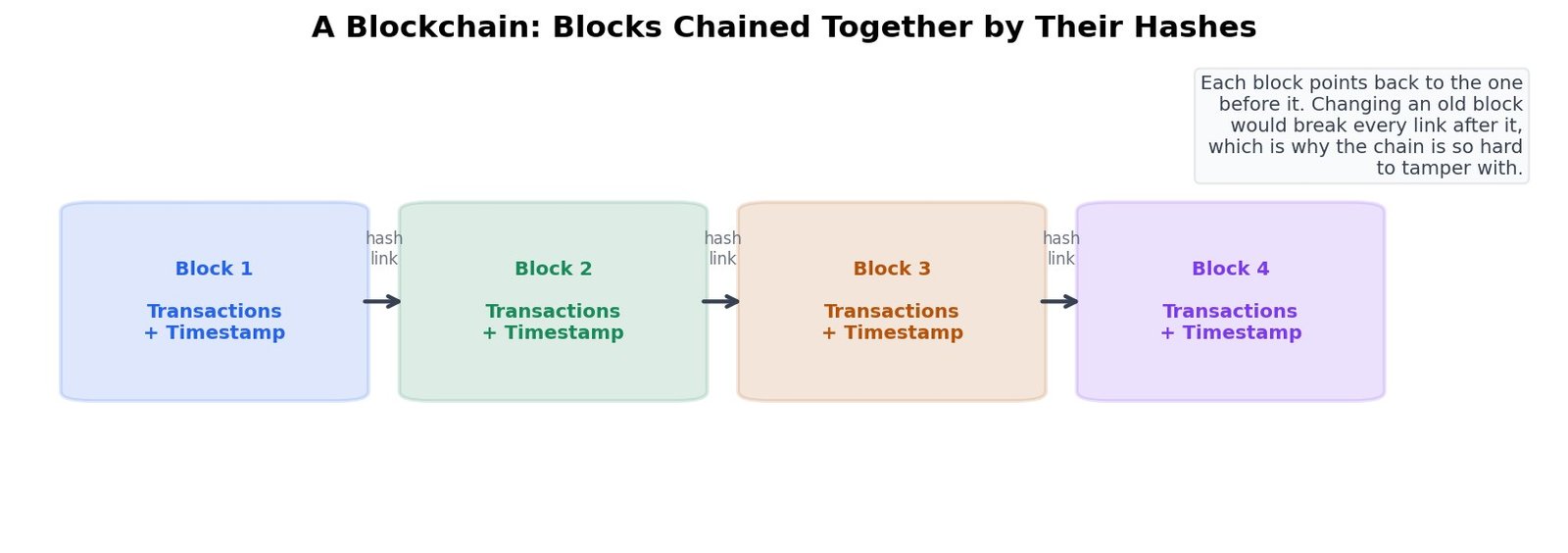
New transactions get grouped together into a “block.” Each block contains a unique digital fingerprint, called a hash, of the block before it, as shown above. This creates a chain where every block is cryptographically linked to the one before it. If anyone tried to secretly change an old transaction, it would change that block’s fingerprint, breaking every single link in the chain after it, which every other computer in the network would immediately notice. This is the core reason blockchains are considered so difficult to tamper with.
Step 3: What Is Bitcoin, the First Cryptocurrency
Bitcoin, launched in 2009, was the very first cryptocurrency, and remains the largest by total value. It was created specifically to work as a form of digital money that no single government, bank, or company controls.
Bitcoin has a hard, mathematically fixed maximum supply of 21 million coins that will ever exist, built directly into its code. This fixed supply is a core part of its appeal to many holders, since it cannot simply be printed in unlimited quantities the way a government can print more of its own currency. Bitcoin uses the mining process explained in Step 6 to create new coins and confirm transactions.
Step 4: What Is Ethereum and Smart Contracts
Ethereum, launched in 2015, is the second largest cryptocurrency by value, but it was built for a very different purpose than Bitcoin. While Bitcoin was designed mainly as digital money, Ethereum was designed as a platform for running programs, called smart contracts, directly on its blockchain.
A smart contract is simply a program that runs exactly as written, automatically, once its conditions are met, with no company or person needed to manually execute it. For example, a smart contract could automatically release a payment the moment a specific condition is verified, with no human processing the transaction in between. This idea, programmable automation running directly on a blockchain, is the foundation for DeFi (Step 14) and NFTs (Step 15).
Step 5: Altcoins, Tokens, and Stablecoins Explained
Beyond Bitcoin and Ethereum, thousands of other cryptocurrencies exist, and the terms used to describe them matter.
- Altcoin: Simply means any cryptocurrency that is not Bitcoin, a very broad category covering everything from well established projects to brand new, unproven ones.
- Token: A cryptocurrency built on top of an existing blockchain, like Ethereum, rather than having its own independent blockchain. Many altcoins are technically tokens in this sense.
- Stablecoin: A cryptocurrency specifically designed to hold a stable value, usually pegged to a real currency like the US Dollar. Stablecoins are commonly used to move value around the crypto world without being exposed to the sharp volatility covered in Step 12.
Step 6: How New Coins Are Created, Mining vs Staking
New coins do not simply appear. Each blockchain uses a specific process to decide who gets to add the next block of transactions, and new coins are typically awarded to whoever does.
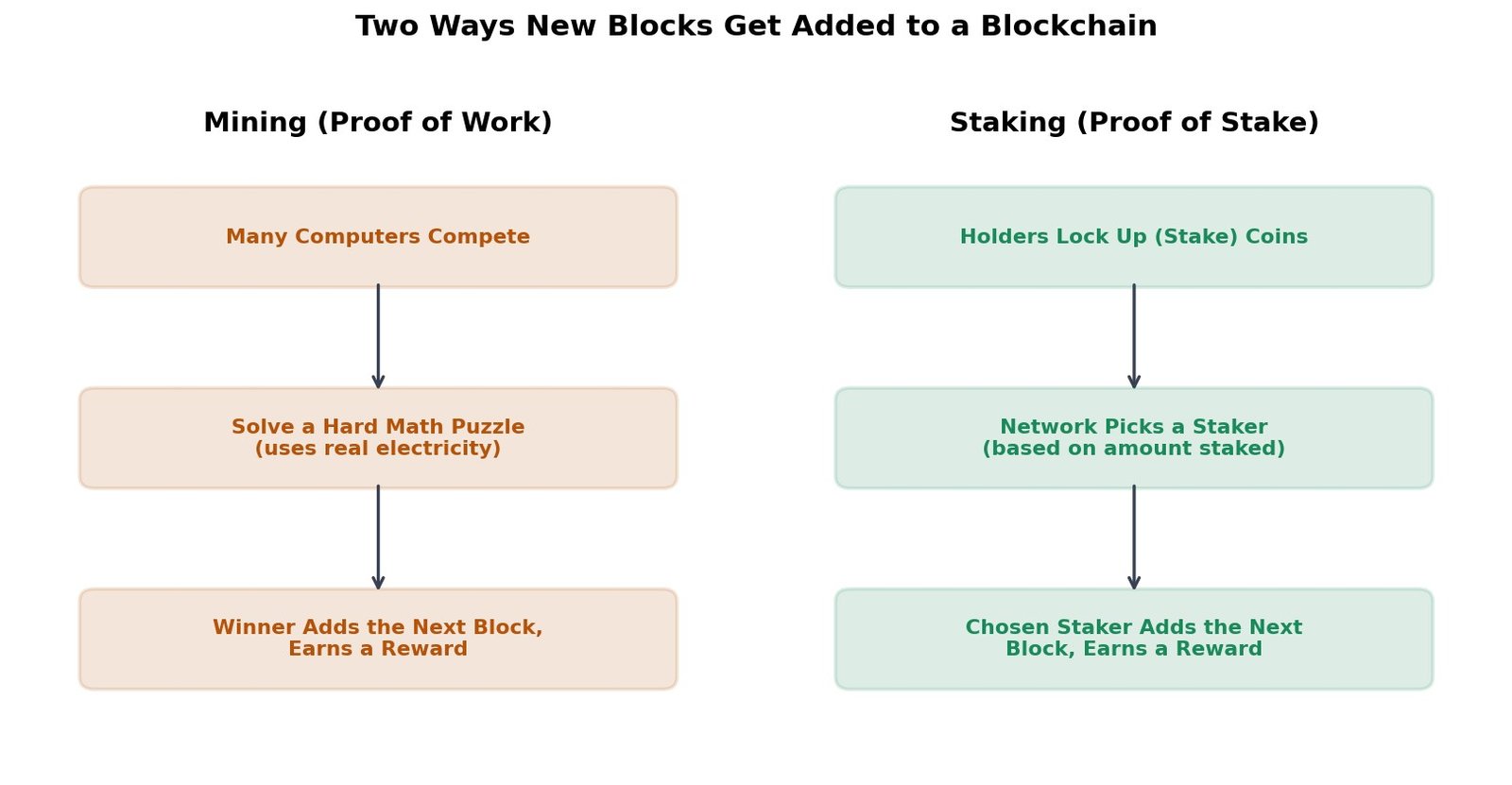
Mining, used by Bitcoin, follows a system called Proof of Work. Many computers compete to solve an extremely difficult math puzzle, using real electricity and computing power, and whichever one solves it first gets to add the next block and earn the reward. Staking, used by Ethereum and many newer blockchains, follows a system called Proof of Stake instead. Instead of competing by raw computing power, holders lock up, or “stake,” their own coins as a form of commitment, and the network selects a staker to add the next block, generally with a higher chance given to those who have staked more. Proof of Stake uses dramatically less electricity than Proof of Work, which is a major reason many newer blockchains have adopted it.
Step 7: Crypto Wallets, Hot Wallet vs Cold Wallet
A crypto wallet does not actually “store” your coins the way a physical wallet stores cash. It stores the keys (explained fully in Step 8) that prove you own coins recorded on the blockchain, and lets you use them.
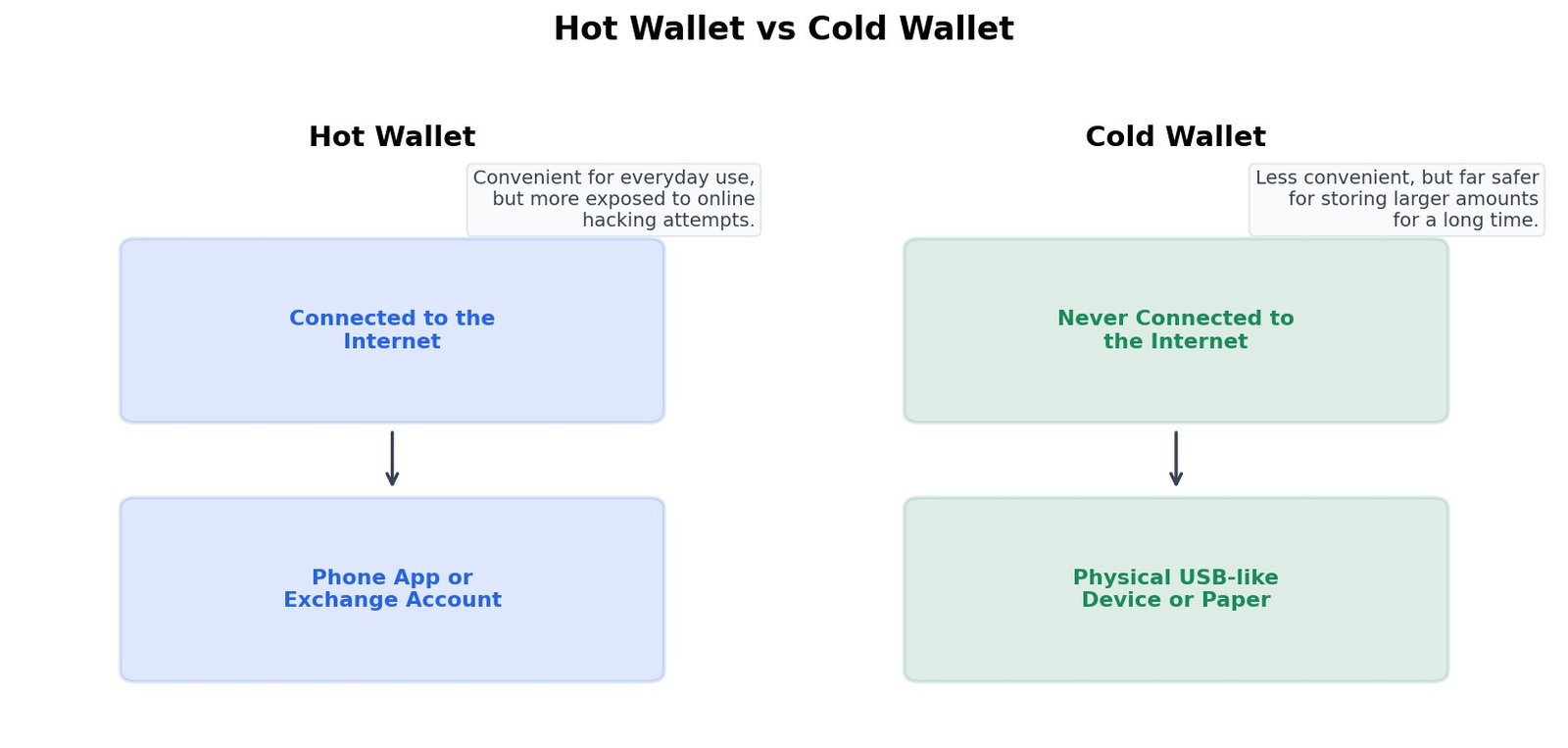
A hot wallet is connected to the internet, usually a phone app or an account on an exchange, convenient for frequent, everyday use, but more exposed to online hacking attempts simply because it is always connected. A cold wallet is a physical device, often resembling a small USB drive, that is never connected to the internet, making it far more difficult for a remote hacker to access, though less convenient for quick, frequent transactions. Many experienced holders use a hot wallet for small, active amounts and a cold wallet for larger amounts they do not plan to move often.
Step 8: Public Keys, Private Keys, and Seed Phrases
Every crypto wallet is built on a pair of cryptographic keys. Your public key (or the wallet address derived from it) is like a bank account number, safe to share with anyone who wants to send you crypto. Your private key is like the password that actually controls that account, and it must never be shared with anyone.
A seed phrase, usually 12 or 24 random words, is a human-readable backup of your private key. Anyone who has your seed phrase can fully access and move your funds, with no way to reverse it and no company to call for help, since there is no central authority to appeal to on most blockchains. Writing your seed phrase down on paper and storing it somewhere safe and offline, never typing it into a website or sharing a photo of it, is one of the single most important security habits in all of crypto, a point Step 20 returns to directly.
Step 9: Centralized vs Decentralized Exchanges
An exchange is where you actually buy, sell, and trade crypto, and exchanges come in two fundamentally different models.
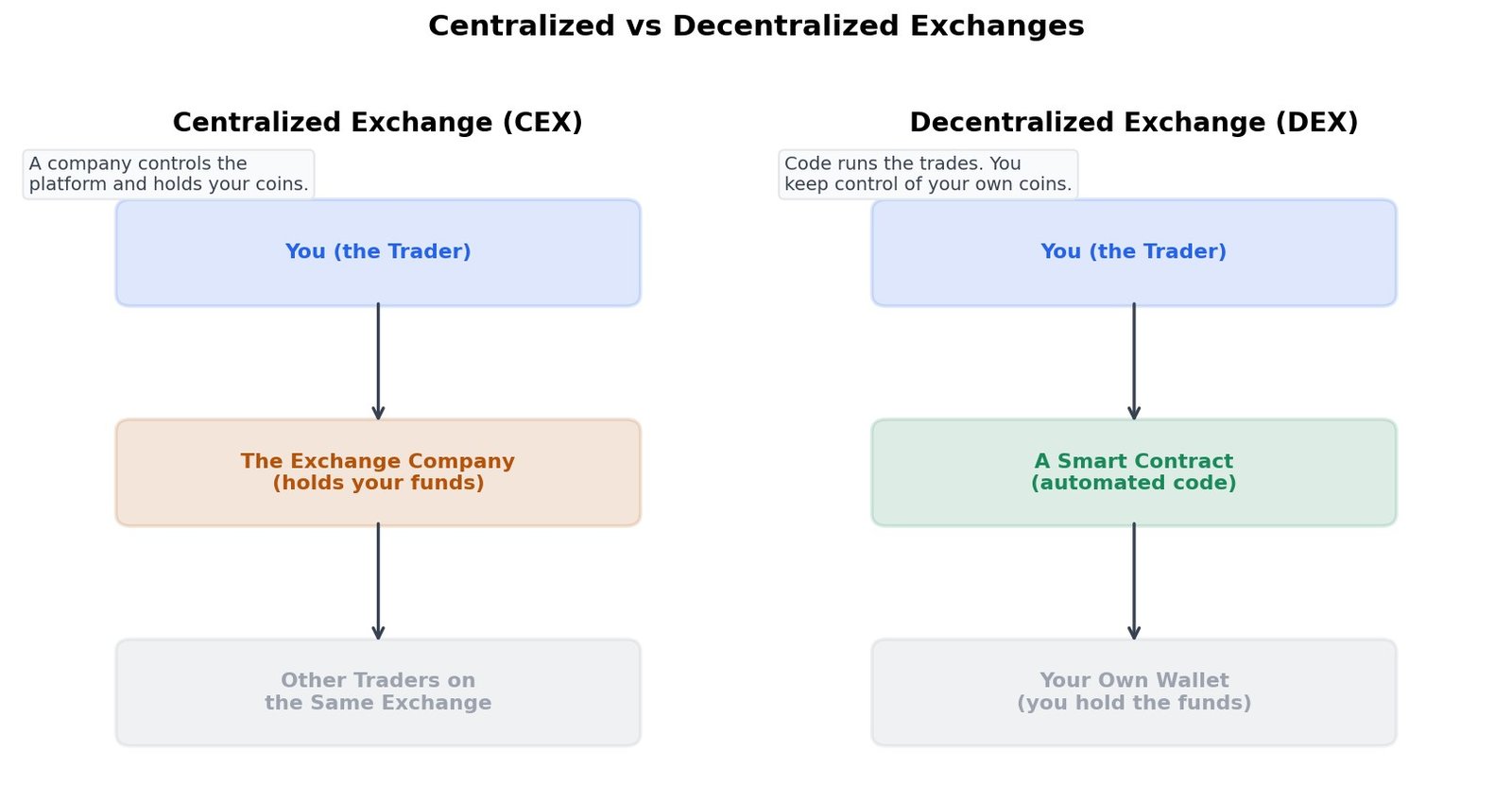
A Centralized Exchange (CEX), such as the major platforms most beginners start with, is run by a company that holds your funds on your behalf, similar to how a bank holds your money, and generally offers an easier, more familiar experience. A Decentralized Exchange (DEX) instead uses smart contracts (Step 4) to let you trade directly from your own wallet, with no company ever holding your funds, but generally requiring more technical comfort and personal responsibility for security.
Step 10: How to Buy Your First Crypto, Step by Step
Here is the typical, practical sequence for buying crypto through a centralized exchange registered to operate in India, which is the most common starting point for beginners:
- Choose a crypto exchange that is registered with FIU-IND (India’s Financial Intelligence Unit), covered further in Step 21.
- Complete the exchange’s KYC (Know Your Customer) process, usually requiring your PAN card and a government ID.
- Deposit funds into your exchange account using a bank transfer or another supported payment method.
- Choose the cryptocurrency you want to buy and place an order, similar to the order types covered in this site’s Trading Foundation course.
- Once purchased, decide whether to keep your crypto on the exchange for convenience, or move it to your own wallet (Step 7) for greater control and security.
Step 11: Market Cap, Circulating Supply, and Why Price Alone Misleads You
One of the most common beginner mistakes is judging whether a coin is “cheap” or “expensive” purely by looking at its price per coin. This can be seriously misleading.
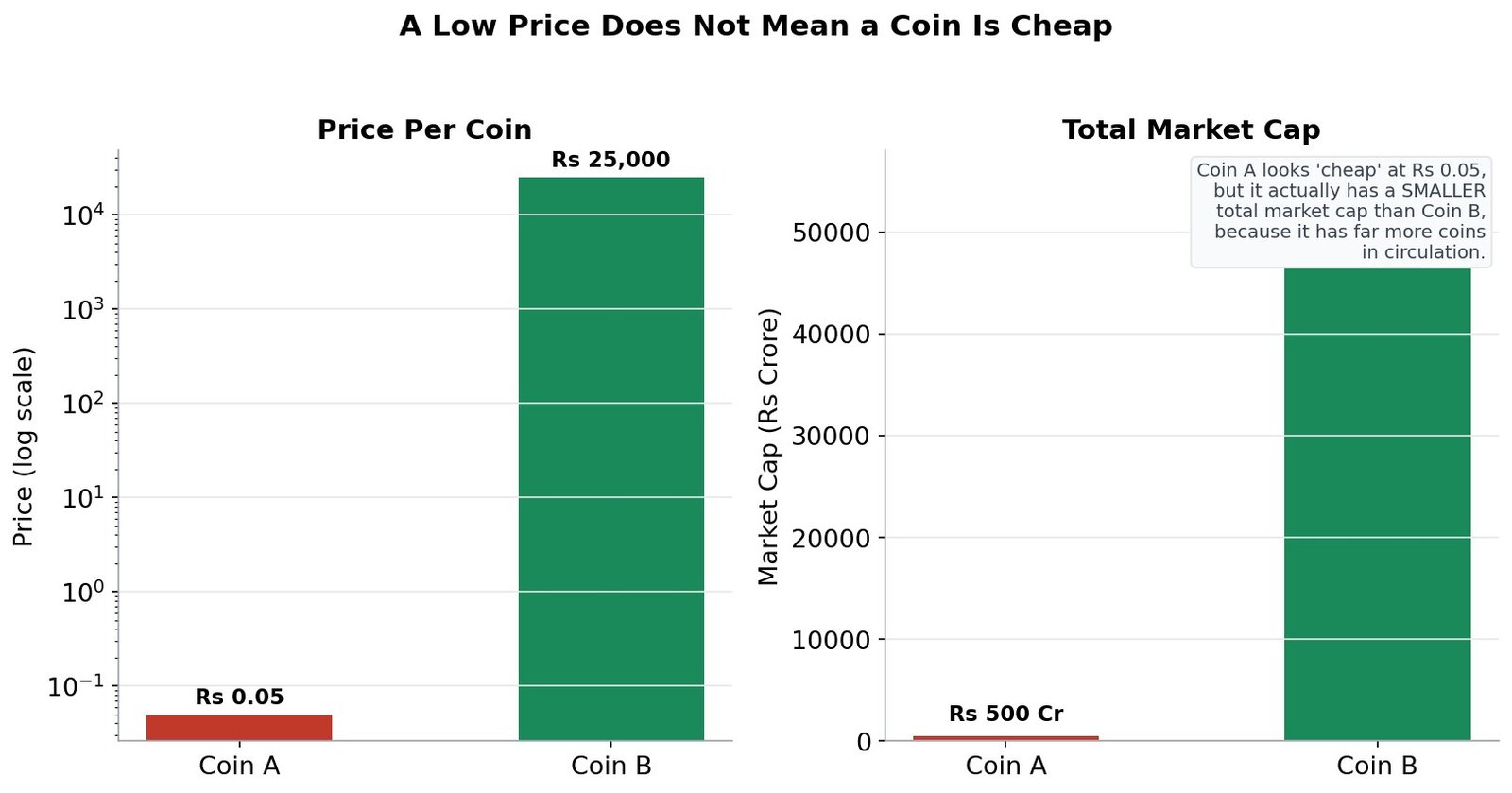
Market cap (market capitalization) is the real measure of a cryptocurrency’s total value, calculated as the price per coin multiplied by the circulating supply, the total number of coins currently in existence and available to trade. As the picture shows, a coin priced at just Rs 0.05 can still have a smaller total market cap than a coin priced at Rs 25,000, simply because the two coins have very different circulating supplies. A low price per coin says almost nothing about whether a project is actually small or large; market cap is the number that actually matters for that comparison.
Step 12: Volatility in Crypto, Why It Swings So Much
Crypto is well known for moving far more dramatically, in both directions, than traditional assets like large stocks or gold.
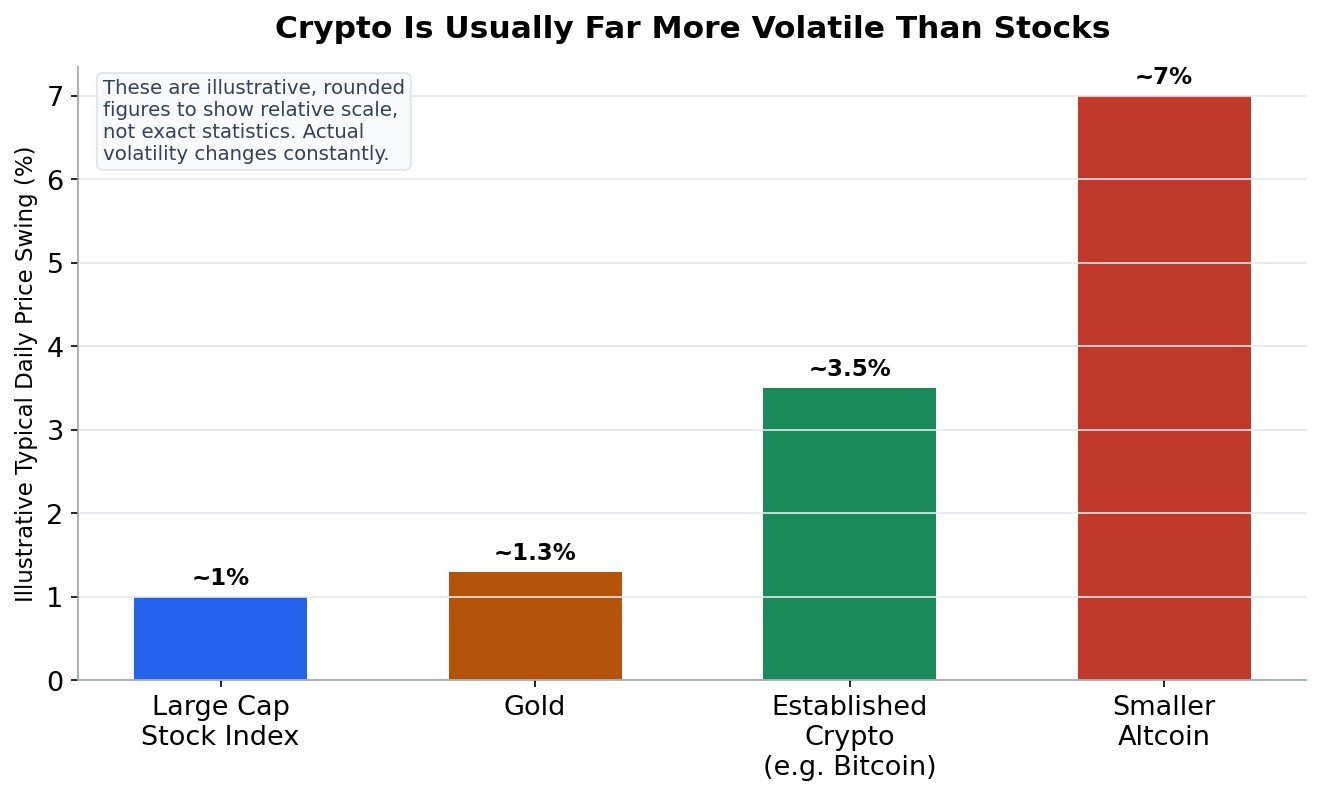
A few honest reasons for this: crypto markets are relatively young and still developing deep, stable participation compared to decades-old stock markets; many coins, especially smaller altcoins, have relatively low trading volume, so even moderate buying or selling can move the price sharply; crypto trades 24 hours a day, every day, with no closing bell to pause sudden moves; and sentiment, news, and social media can shift very quickly in this market. This volatility is exactly why Step 19’s risk management ideas matter so much more in crypto than in many other markets.
Step 13: Reading a Crypto Chart
Crypto price charts use the exact same candlestick format covered in this site’s Candlestick Patterns and Chart Patterns courses. A candle still shows the open, high, low, and close for a chosen time period, and every pattern and chart shape covered in those courses, support and resistance, trend structure, head and shoulders, triangles, and the rest, applies directly to crypto charts too.
The one genuine difference worth knowing: because crypto trades 24 hours a day with no fixed session close, some traders use a different daily candle “close” time depending on their exchange or charting platform, usually midnight UTC. This is a minor technical detail, but worth knowing so a daily candle’s exact close does not confuse you when comparing charts from different sources.
Step 14: What Is DeFi, Decentralized Finance Explained
DeFi, short for Decentralized Finance, refers to financial services, lending, borrowing, trading, and earning interest, built using smart contracts (Step 4) instead of a traditional bank or financial company.
For example, a DeFi lending platform might let you deposit crypto and earn interest from other users borrowing it, all handled automatically by code, with no bank in the middle approving or processing anything manually. DeFi is generally considered a more advanced area of crypto, since smart contract code can contain bugs or vulnerabilities, and there is typically no customer support line or deposit insurance if something goes wrong, unlike a traditional regulated bank.
Step 15: What Are NFTs, Non-Fungible Tokens Explained
A regular cryptocurrency, like Bitcoin, is “fungible,” meaning any one coin is identical in value and interchangeable with any other coin of the same type, exactly like how any one Rs 100 note is interchangeable with another. An NFT (Non-Fungible Token) is the opposite: a unique, one-of-a-kind digital token recorded on a blockchain, typically used to represent ownership of a specific digital (or sometimes physical) item, such as digital art, a collectible, or an in-game item.
Because each NFT is unique, its value is driven entirely by what someone else is willing to pay for that specific item, not by a broader, liquid market the way a cryptocurrency’s price is. This makes the NFT market generally far more illiquid and speculative than trading established cryptocurrencies themselves.
Step 16: What Is an ICO, IEO, and Token Launch
New crypto projects need a way to raise funds and distribute their new tokens to the public, and this has taken a few common forms over the years.
- ICO (Initial Coin Offering): A project sells its new tokens directly to the public, often very early, before the project has launched or proven anything, historically with very little regulatory oversight.
- IEO (Initial Exchange Offering): Similar to an ICO, but conducted through an established exchange, which performs at least some vetting of the project before listing it, generally considered to carry somewhat more credibility than a pure ICO.
- Token Launch: A broader, more general term covering any method a project uses to first distribute and begin trading its token.
Historically, ICOs in particular have carried a very high rate of failed or fraudulent projects, making early-stage token launches one of the highest risk, most speculative corners of the entire crypto space, worth approaching with real caution and skepticism rather than excitement about quick gains.
Step 17: Crypto Trading vs Investing (HODLing)
Just like the trading versus investing distinction covered in this site’s Trading Foundation course, crypto participants generally fall into two broad approaches.
Trading means buying and selling over a shorter time horizon, often using the chart reading skills from Step 13, aiming to profit from price swings themselves. Investing, often called “HODLing” in crypto culture (originally a misspelling of “holding” that became a widely used term), means buying and holding for a much longer time horizon, based on a belief in a project’s long term value, largely ignoring short term price swings. Neither approach is automatically correct, and given the volatility covered in Step 12, both come with real, genuine risk that deserves honest respect, not excitement alone.
Step 18: Common Crypto Trading Strategies
Several of the same strategy styles covered in this site’s Forex Trading course apply directly to crypto, alongside a few that are more specific to this market.
- Trend Following and Breakout Trading: Using the trend and breakout ideas from the Price Action Trading course, applied to crypto’s often sharp, fast moves.
- Swing Trading: Holding positions for days to weeks, aiming to capture a larger move without needing constant screen time.
- Dollar Cost Averaging (DCA): Investing a fixed amount at regular intervals, regardless of price, rather than trying to time a single perfect entry. This is popular specifically because of how volatile and hard to time crypto can be.
- Arbitrage: Exploiting small, temporary price differences for the same coin across different exchanges, generally requiring speed, technical setup, and capital that make it more suited to advanced participants.
Step 19: Risk Management in Crypto, Position Sizing for High Volatility
Given the volatility shown in Step 12, the position sizing math from this site’s Option Trading and Forex Trading courses matters just as much here, arguably more. A worked example: if you decide to risk only 1% of a Rs 1,00,000 crypto allocation on a single trade, that is Rs 1,000. If your stop loss is 8% below your entry price (a realistic distance given crypto’s typical swings), your position size should be calculated so that an 8% adverse move costs you exactly Rs 1,000, not an amount you only discover after the fact.
Because crypto can gap sharply, especially over a weekend or during a sudden news event, with no fixed market close to pause trading, many experienced crypto traders also deliberately keep individual position sizes smaller than they might in a less volatile market, precisely to account for moves that can happen faster than a stop loss order can always perfectly protect against.
Step 20: Security Basics, Avoiding Scams, Rug Pulls, and Hacks
Crypto’s lack of a central authority is part of its appeal, but it also means there is generally no customer support line to reverse a mistake or a theft. A few essential security habits:
- Never share your private key or seed phrase with anyone, including anyone claiming to be “support” from an exchange or wallet provider. No legitimate support staff will ever ask for it.
- Be skeptical of guaranteed returns. Any offer promising guaranteed or unusually high, fixed returns on crypto is a significant red flag for a scam.
- Understand “rug pulls.” This refers to a new project’s creators abruptly abandoning it and disappearing with investors’ funds, a well documented risk specifically with new, unproven, low market cap tokens, covered in Step 16.
- Use two-factor authentication (2FA) on every exchange account, and consider a cold wallet (Step 7) for any amount you are not actively trading.
- Double check every wallet address before sending funds. Crypto transactions are generally irreversible once confirmed, there is no bank to call to reverse a mistaken transfer.
Step 21: Is Crypto Legal in India? Taxation and Regulation Explained
This is one of the most important sections in this entire course. Please read it carefully before trading or investing any real money.
Crypto is legal to buy, hold, and trade in India. It is not banned, but it is also not recognized as legal tender, meaning you cannot use it to pay for everyday goods and services the way you use the Rupee. Instead, India regulates crypto mainly through taxation and anti-money laundering rules, rather than through a single, comprehensive, dedicated crypto law.
Since the 2022 Union Budget, profits from crypto, officially called Virtual Digital Assets (VDAs) in Indian tax law, are taxed at a flat 30% rate, regardless of how long you held the asset or your regular income tax slab. This flat 30% rate has remained unchanged through the most recent Budget. A crucial detail many beginners miss: you generally cannot offset a loss on one crypto asset against a gain on another crypto asset, cannot offset crypto losses against any other type of income, and cannot carry forward crypto losses to future years. Each VDA is effectively taxed in isolation. On top of this, a 1% TDS (Tax Deducted at Source) applies to crypto transactions, deducted at the time of the transaction itself, at a threshold of Rs 50,000 per year for certain specified categories of individuals and Rs 10,000 per year for others, rising to 20% if your PAN is not provided.
On the regulatory side, crypto exchanges operating in India are required to register with FIU-IND (the Financial Intelligence Unit of India) under anti-money laundering law, and complete proper KYC verification for their users, exactly as covered in Step 10. Exchanges that have not completed this registration have faced real enforcement action, including fines and restrictions. This is exactly why Step 10 specifically recommends choosing an exchange registered with FIU-IND.
Because the no-loss-offset rule in particular is easy to get wrong, and because crypto tax rules are a genuinely active, evolving area of Indian law, please keep clean, complete records of every transaction and consult a Chartered Accountant experienced with VDA taxation before filing your return. This course explains the current framework for genuine educational understanding, not as personalized tax or legal advice for your specific situation.
Step 22: Common Beginner Mistakes in Crypto
- Judging a coin as “cheap” by its price alone, instead of understanding market cap, as explained in Step 11.
- Keeping large amounts on an exchange long term instead of moving them to a personal wallet, as covered in Step 7.
- Sharing a seed phrase or private key with anyone, under any circumstance, as warned in Step 8 and Step 20.
- Chasing a coin purely because its price has already risen sharply, without understanding the project or the real risk involved.
- Trading full position sizes without adjusting for crypto’s higher typical volatility, as explained in Step 19.
- Ignoring the no-loss-offset tax rule from Step 21 until it becomes an unpleasant surprise at filing time.
- Falling for guaranteed-return offers that are, in reality, scams, as covered in Step 20.
Step 23: A Simple Checklist Before Your First Crypto Trade
Save this list, bookmark it, or share it with a friend who is learning alongside you.
- Am I using an exchange that is properly registered and compliant in India, as explained in Step 21?
- Do I understand market cap, not just price per coin, before judging whether a coin seems cheap, as covered in Step 11?
- Have I written down my seed phrase safely offline, and never shared it with anyone?
- Have I sized this position appropriately for crypto’s typical volatility, as explained in Step 19?
- Do I understand how this trade will actually be taxed, including the no-loss-offset rule from Step 21?
- Is this a project I have genuinely researched, or am I simply chasing a price that has already moved?
- Am I using money I can genuinely afford to lose, given how volatile this market can be?
Step 24: Quick Glossary, Every Term in One Place
A fast reference for every term used across this course. Bookmark this page and jump here any time a word slips your memory.
- Blockchain: A shared, constantly updated digital record kept identically across thousands of computers.
- Bitcoin: The first cryptocurrency, with a fixed maximum supply of 21 million coins.
- Ethereum: The second largest cryptocurrency, built as a platform for running smart contracts.
- Smart Contract: A program that runs automatically on a blockchain once its conditions are met.
- Altcoin / Token / Stablecoin: Any non-Bitcoin cryptocurrency, a coin built on another blockchain, and a coin designed to hold a stable value.
- Mining (Proof of Work) / Staking (Proof of Stake): Two different systems for deciding who adds the next block and earns new coins.
- Hot Wallet / Cold Wallet: An internet-connected wallet for convenience, and an offline device for stronger security.
- Public Key / Private Key / Seed Phrase: Your shareable address, your secret controlling password, and its human-readable backup.
- CEX / DEX: A centralized exchange run by a company, and a decentralized exchange run by smart contracts.
- Market Cap / Circulating Supply: A coin’s total value, and the number of coins currently in existence and tradeable.
- DeFi: Decentralized Finance, financial services built using smart contracts instead of a traditional institution.
- NFT: A Non-Fungible Token, a unique, one-of-a-kind digital token.
- ICO / IEO: An Initial Coin Offering and an Initial Exchange Offering, two ways new tokens are first sold to the public.
- HODL: Crypto slang for holding an asset long term, largely ignoring short term price swings.
- Dollar Cost Averaging (DCA): Investing a fixed amount at regular intervals, regardless of price.
- Rug Pull: A scam where a project’s creators abandon it and disappear with investor funds.
- VDA: Virtual Digital Asset, the official term Indian tax law uses for cryptocurrency.
- FIU-IND: The Financial Intelligence Unit of India, which crypto exchanges must register with for anti-money laundering compliance.
Step 25: What to Do Next
Reading a crypto chart uses exactly the same skills taught in this site’s Candlestick Patterns, Chart Patterns, and Price Action Trading courses, so those are a natural next step to deepen your technical reading ability. If you are curious how crypto’s volatility and trading mechanics compare to another leveraged market, this site’s Forex Trading course covers a similarly fast moving world with its own important legal considerations.
But understanding crypto mechanics, taxation, and security is still only one half of becoming a consistent trader or investor. The other half is the decision-making that happens once real money and real volatility are involved, and few markets test that decision-making as sharply as crypto does. Samir Dash’s ACE framework (Aware, Control, Execute) at Mindful Trading Hub focuses specifically on that second half, for traders who understand the mechanics but still struggle to execute consistently under pressure.
Frequently Asked Questions
Is cryptocurrency legal in India?
Yes, buying, holding, and trading crypto is legal in India, though it is not recognized as legal tender. It is regulated mainly through taxation (a flat 30% tax plus 1% TDS, explained fully in Step 21) and anti-money laundering compliance for exchanges, rather than through one comprehensive, dedicated crypto law.
Can I offset a crypto loss against a crypto gain?
Generally, no. Indian tax law treats each Virtual Digital Asset in isolation, meaning a loss on one coin typically cannot be offset against a gain on another coin, against other income, or carried forward to future years, as explained in Step 21. Please confirm your specific situation with a Chartered Accountant.
Do I need a cold wallet as a complete beginner?
Not necessarily right away. Many beginners start with a reputable exchange’s own wallet while learning the basics in Step 10, and consider a cold wallet once they are holding larger amounts they do not plan to trade frequently, as explained in Step 7.
Why do crypto prices swing so much more than stocks?
Several honest factors contribute, including a relatively young market, lower trading volume on many coins, 24 hour non-stop trading with no closing bell, and fast-moving sentiment, all covered in Step 12. This is exactly why risk management, covered in Step 19, matters so much in this market.
What is the safest way to avoid crypto scams?
Never share your private key or seed phrase with anyone, be deeply skeptical of guaranteed or unusually high returns, and research a project properly instead of buying purely because its price is rising quickly, all covered in Step 20.
What is the real difference between a coin and a token?
A coin, like Bitcoin or Ether, has its own independent blockchain. A token is built on top of an existing blockchain, most commonly Ethereum, instead of having its own, as explained in Step 5. Many projects you hear about day to day are technically tokens, not coins.
Can I buy a small fraction of a Bitcoin instead of a whole one?
Yes. Nearly every exchange lets you buy a small fraction of a coin, often down to a tiny decimal amount, so you never need the full price of one whole coin to get started, as touched on in Step 10.
What happens to my crypto if an exchange shuts down?
If your funds are held on a centralized exchange (Step 9) and it shuts down, becomes insolvent, or is hacked, your funds may be at serious risk, and recovery is often difficult or impossible, since most exchanges are not backed by deposit insurance the way a bank account is. This is exactly why Step 7 discusses moving larger, longer term holdings to your own wallet instead of leaving them on an exchange.
Is crypto mining still worth it for an individual at home?
For most well established coins like Bitcoin, mining today generally requires specialized, expensive hardware and significant electricity costs, making it impractical for an average individual compared to large, dedicated mining operations, as touched on in Step 6. Staking, also covered in Step 6, is generally far more accessible for an individual holder.
What is a gas fee?
A gas fee is the small payment required to process a transaction or run a smart contract (Step 4) on certain blockchains, most notably Ethereum. It compensates the network for the computing power used, and it can rise significantly during busy periods when many people are transacting at once.
Can I lose more money than I originally invested in crypto?
If you are simply buying and holding crypto with your own money, your maximum loss is what you invested, similar to buying a stock outright. However, using leverage or margin on a crypto exchange, or participating in certain DeFi activities (Step 14), can expose you to losses larger than your original investment, which is exactly why Step 19’s risk management ideas matter so much.
How can I tell if a new crypto project is legitimate?
There is no perfect test, but useful habits include checking whether the team is public and identifiable, whether the project has real, working code rather than just promises, whether it is listed on a reputable, FIU-IND registered exchange (Step 21), and staying skeptical of guaranteed returns or urgent, hype-driven marketing, all connected to the rug pull warning in Step 20.
Is this investment advice?
No. Samir Dash is not SEBI-registered, and nothing in this course is a recommendation to buy or sell any specific cryptocurrency, or a promise of returns. The tax and regulatory information in Step 21 is a general educational summary, not personalized tax or legal advice, and rules can change, so please verify your specific situation with a qualified Chartered Accountant or professional before acting on anything here. Please also read the Disclaimer.
Related Reading on This Site
If you want to go deeper on specific ideas from this course, Samir Dash has written these on blog.samirdash.in:
- How Crypto Trading Works: A Beginner’s Guide
- Crypto Exchanges in India Explained
- Crypto Regulation in India Explained
- Stablecoins Explained: What Every Crypto Trader Should Know
- Spot vs Futures Crypto Trading: What’s the Difference?
Continue Your Learning Path
You understand crypto. Here is what most readers explore next.
- Swing Trading: hold positions for days to weeks instead of hours.
- Intraday Trading: open and close every position within the same day.
- Trading Psychology: the inner game every strategy eventually runs into.
You can also see every course on this site, in order, and pick your own path.
Want to trade with more clarity and less emotional reactivity? Samir Dash’s ACE framework (Aware, Control, Execute) helps traders build the decision-making discipline that market knowledge alone can’t teach. Learn more at Mindful Trading Hub.