

Forex Trading
This is a complete, beginner-friendly course on forex trading, written assuming you have never looked at a currency chart before. We start from the very first idea, what forex even means, and build all the way up to advanced topics like currency correlation, the carry trade, and funded trading accounts.
This is a full course, not a short article, so it does not rush. We use simple examples and pictures wherever they help, and we also spend real time on something most forex content skips entirely: what Indian law actually allows, since this matters just as much as the trading concepts themselves. Bookmark this page and come back to it any time.
A free course by Samir Dash, founder of Mindful Trading Hub.
What You Will Learn
- Step 1: What Is Forex Trading, in Plain Words
- Step 2: Why the Forex Market Exists, Who Actually Uses It
- Step 3: Currency Pairs Explained, Base and Quote Currency
- Step 4: Major, Minor, and Exotic Currency Pairs
- Step 5: How to Read a Forex Quote
- Step 6: What Is a Pip, and Why It Matters
- Step 7: Lot Sizes, Standard, Mini, Micro, and Nano
- Step 8: Bid, Ask, and the Spread in Forex
- Step 9: Leverage and Margin in Forex
- Step 10: How Profit and Loss Is Actually Calculated
- Step 11: The 24 Hour Forex Market and Its Trading Sessions
- Step 12: What Actually Moves Currency Prices
- Step 13: Fundamental Analysis in Forex
- Step 14: Technical Analysis in Forex
- Step 15: Types of Forex Orders
- Step 16: How to Place a Forex Trade, Step by Step
- Step 17: Currency Correlation
- Step 18: The Carry Trade Explained
- Step 19: Common Forex Trading Strategies
- Step 20: Risk Management and Position Sizing in Forex
- Step 21: Is Forex Trading Legal in India? The Rules You Must Know
- Step 22: How to Choose a Forex Broker
- Step 23: Broker Types, Market Maker vs ECN/STP
- Step 24: Funded Trading Accounts (Prop Firms) Explained
- Step 25: How to Evaluate a Prop Firm, Red Flags to Watch
- Step 26: Common Beginner Mistakes in Forex
- Step 27: A Simple Checklist Before You Trade Forex
- Step 28: Quick Glossary, Every Term in One Place
- Step 29: What to Do Next
- Frequently Asked Questions
Step 1: What Is Forex Trading, in Plain Words
Imagine you are going on a trip from India to the United States. Before you leave, you walk up to a currency exchange counter and swap your Indian Rupees for US Dollars. The counter gives you a certain number of dollars for every rupee, based on a rate that changes every single day.
Forex trading, short for foreign exchange trading, is simply this same idea, buying one country’s currency while selling another, done as a financial activity instead of for a trip. “Forex” or “FX” is just short for foreign exchange. When you trade forex, you are always trading one currency against another, betting that one will rise or fall in value compared to the other.
The forex market is the largest financial market in the world by trading volume, far bigger than any single stock market, because every country, every business doing international trade, and every traveler needs to exchange currencies constantly.
Step 2: Why the Forex Market Exists, Who Actually Uses It
The forex market did not start as a place for individual traders to speculate. It exists because the real, physical world needs a way to exchange currencies constantly.
A company in India importing machines from Germany needs to pay in Euros. A tourist traveling from Japan to Thailand needs Thai Baht. A government managing its economy needs to buy and sell its own currency to keep things stable. Central banks, commercial banks, large companies, investment funds, governments, and individual retail traders are all part of this same market, though the vast majority of daily volume comes from banks and large institutions, not individual traders like you.
Step 3: Currency Pairs Explained, Base and Quote Currency
You can never buy or sell a currency on its own, only against another currency. This is why forex is always written as a pair, like EUR/USD or USD/JPY.
The first currency in the pair is called the base currency. The second is called the quote currency. The price tells you how much of the quote currency it takes to buy one unit of the base currency. For example, if EUR/USD is trading at 1.0850, it means 1 Euro can buy 1.0850 US Dollars.
When you buy a pair, you are buying the base currency and selling the quote currency at the same time. When you sell a pair, you are doing the exact opposite. This is the one idea every other concept in this course builds on top of.
Step 4: Major, Minor, and Exotic Currency Pairs
Not every currency pair trades the same way. Traders generally group pairs into three categories, based mainly on how heavily they are traded.
- Major Pairs: Always include the US Dollar paired with another major global currency, such as EUR/USD, GBP/USD, USD/JPY, and USD/CHF. These are the most heavily traded pairs, usually with the tightest spreads (Step 8 explains spreads).
- Minor Pairs: Pairs between major currencies that do not include the US Dollar, such as EUR/GBP or GBP/JPY. Still liquid, but generally traded less than the majors.
- Exotic Pairs: Pair a major currency with the currency of a smaller or developing economy, such as USD/TRY (Turkish Lira) or USD/ZAR (South African Rand). These typically have wider spreads and can move more unpredictably.
Step 5: How to Read a Forex Quote
A forex quote always shows two prices side by side, not one. For example: EUR/USD 1.0850 / 1.0852.
The first, lower number is the price at which you can sell the pair. The second, slightly higher number is the price at which you can buy it. This gap exists on every single forex quote you will ever see, and Step 8 explains exactly why. For now, the key habit is simply knowing that a forex price is always really two prices, not one.
Step 6: What Is a Pip, and Why It Matters
A pip, short for “percentage in point,” is the standard small unit used to measure how much a currency pair has moved. For most pairs, it is the fourth decimal place in the quote.
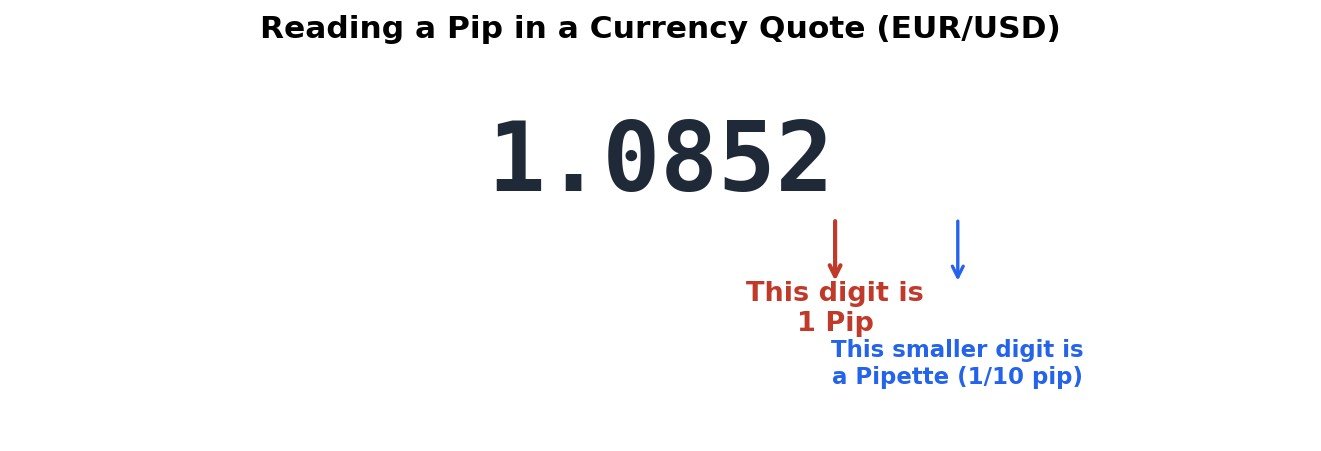
If EUR/USD moves from 1.0850 to 1.0860, it has moved 10 pips. Many brokers also show a fifth decimal digit, called a pipette, equal to one tenth of a pip, giving slightly more precise pricing. Pips matter because almost everything in forex, profit, loss, and spread, is measured using them, which Step 10 builds on directly.
Step 7: Lot Sizes, Standard, Mini, Micro, and Nano
Forex is not bought and sold in single units of currency, it trades in fixed bundles called lots. The lot size you choose directly determines how much each pip movement is actually worth in real money.
- Standard Lot: 1,00,000 units of the base currency.
- Mini Lot: 10,000 units, one tenth of a standard lot.
- Micro Lot: 1,000 units, one hundredth of a standard lot.
- Nano Lot: 100 units, offered by some brokers for extremely small, practice-sized positions.
Smaller lot sizes let a beginner trade with far less capital and far less risk per pip while still learning the real mechanics, which is why many new traders start with micro or mini lots rather than a full standard lot.
Step 8: Bid, Ask, and the Spread in Forex
Just like the stock market basics covered in this site’s Trading Foundation course, forex prices always have a bid and an ask. The bid is the price you can sell at. The ask is the price you can buy at, always a little higher. The gap between them is called the spread.
The spread is effectively the cost of entering and exiting a trade, and it is usually how a broker earns money, especially when it advertises “zero commission” trading. Major pairs like EUR/USD typically have very tight spreads because so many participants are trading them constantly. Exotic pairs, covered in Step 4, usually have much wider spreads.
Step 9: Leverage and Margin in Forex
Forex is well known for offering very high leverage, often far higher than what is available in equity trading. Leverage lets you control a large position using only a small amount of your own money, called margin.
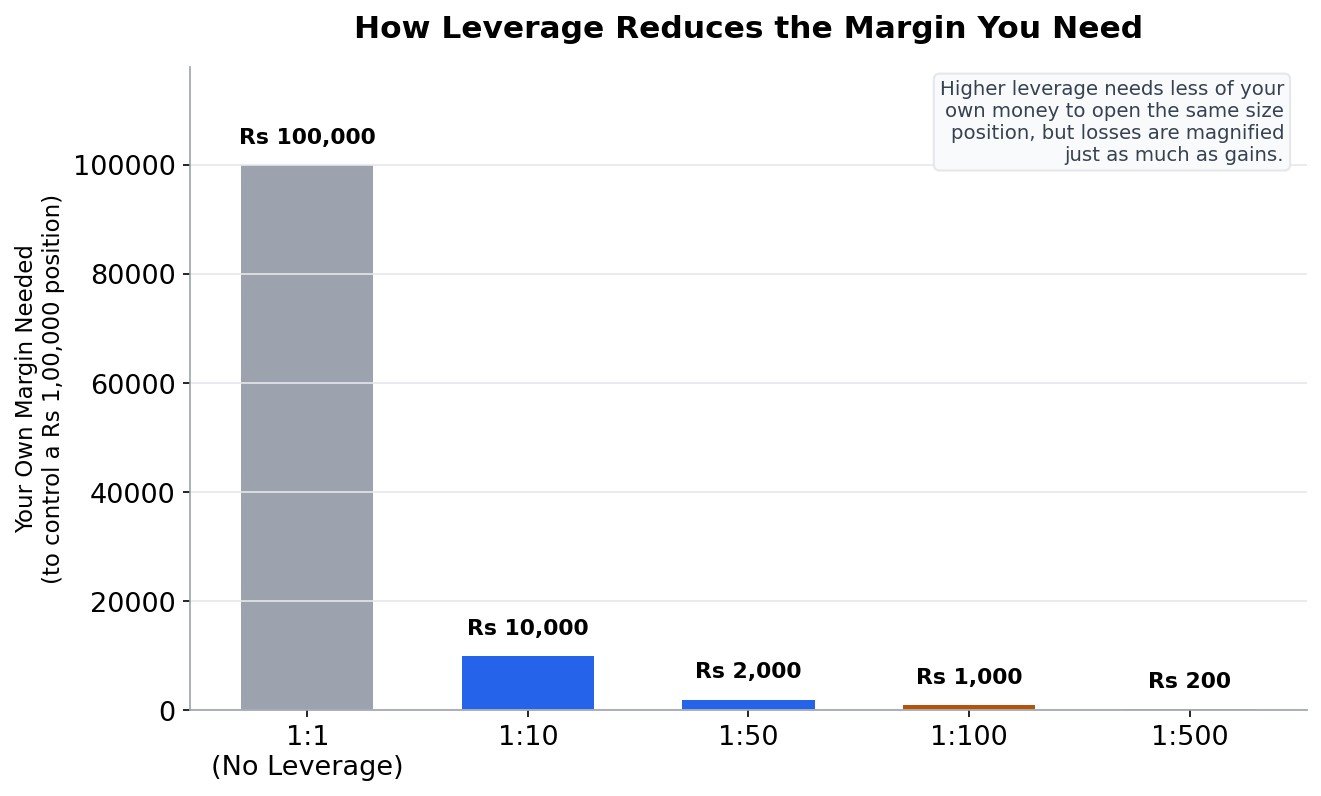
With 1:100 leverage, controlling a Rs 1,00,000 position only needs Rs 1,000 of your own margin. This is exactly why forex can feel so accessible with a small amount of capital. But leverage is a double edged tool: it multiplies your potential profit, and it multiplies your potential loss by precisely the same amount. A small, unfavorable price move can wipe out a highly leveraged position’s entire margin very quickly, which is why Step 20’s risk management ideas are not optional extras in forex, they are essential.
Step 10: How Profit and Loss Is Actually Calculated
Once you know pip value (Step 6) and lot size (Step 7), calculating profit or loss on a forex trade is simple arithmetic.
For a standard lot (1,00,000 units) on a pair quoted in US Dollars, one pip is typically worth about $10. So, if you bought 1 standard lot of EUR/USD and the price moved 25 pips in your favor, your profit would be roughly 25 multiplied by $10, which is $250, before any spread or broker charges. If the price moved 25 pips against you instead, you would have an equivalent $250 loss. A mini lot would make that same pip worth about $1, and a micro lot about $0.10, directly connecting your chosen lot size to exactly how much each pip move actually costs or earns you.
Step 11: The 24 Hour Forex Market and Its Trading Sessions
Unlike a stock exchange with fixed opening and closing hours, the forex market runs 24 hours a day on business days, because it simply follows the sun, major financial centers around the world opening and closing in sequence.
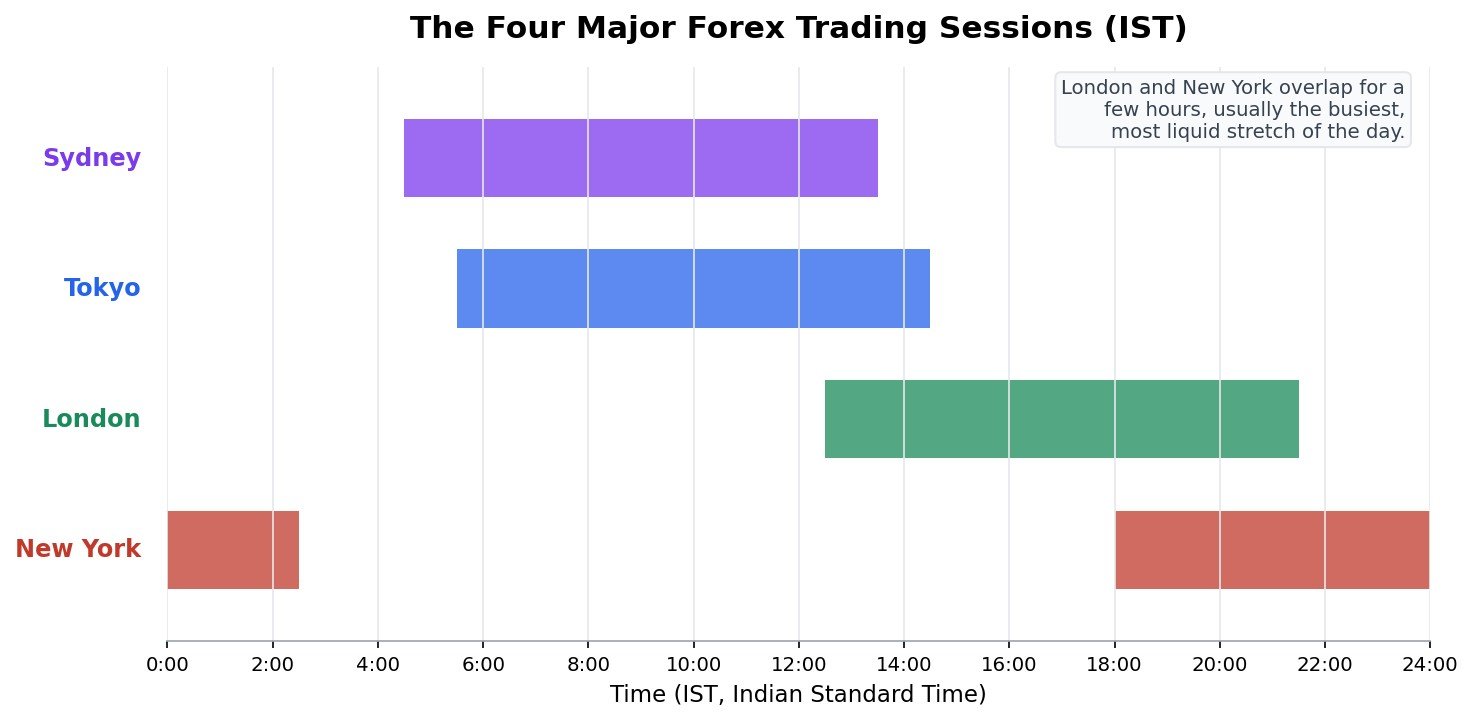
The four major sessions are Sydney, Tokyo, London, and New York. As shown above, London and New York overlap for a few hours each day (roughly 6:00 PM to 9:30 PM IST, though exact times shift slightly with daylight saving changes abroad), which is generally the most active, most liquid period of the entire day. Many traders specifically choose to trade during this overlap, since tighter spreads and stronger price movement are both more likely when more of the world’s major participants are active at the same time.
Step 12: What Actually Moves Currency Prices
A currency’s value is, at its core, a reflection of confidence in that country’s economy relative to another country’s economy. A few forces drive most of the real movement.
- Interest Rates: Set by a country’s central bank, these are often the single biggest driver. Higher interest rates tend to attract foreign investment seeking a better return, which can increase demand for that currency.
- Economic Data: Reports on inflation, employment, GDP growth, and trade balances all shift perception of an economy’s health, and currency prices react accordingly.
- Geopolitical Events: Elections, conflicts, trade disputes, and major policy announcements can shift sentiment quickly, sometimes causing sharp, fast currency moves.
- Market Sentiment: Broad shifts between “risk-on” (investors feeling confident, favoring higher-growth currencies and assets) and “risk-off” (investors feeling cautious, favoring traditionally safer currencies) also move prices, often independent of any single piece of news.
Step 13: Fundamental Analysis in Forex
Fundamental analysis in forex means studying these real economic forces from Step 12 to form a view on a currency’s likely direction. A trader following this approach watches central bank meetings, interest rate decisions, and scheduled economic data releases closely, often using what is called an economic calendar, a published schedule of upcoming data releases and their expected impact.
A core idea in forex fundamental analysis is the interest rate differential, the gap between two countries’ interest rates. All else being equal, a currency from a country with meaningfully higher interest rates than its pair tends to be more attractive to hold, a concept that becomes especially important in Step 18’s discussion of the carry trade.
Step 14: Technical Analysis in Forex
Technical analysis means reading the price chart itself to make trading decisions, largely independent of the underlying economic reasons from Step 13. Every idea in this site’s Price Action Trading, Candlestick Patterns, and Chart Patterns courses applies directly to forex charts, since candles, support and resistance, trend structure, and chart patterns work exactly the same way on a currency pair as they do on a stock.
Many forex traders blend both approaches: using fundamental analysis from Step 13 to form a broader directional bias, and technical analysis to actually time entries and exits within that bias.
Step 15: Types of Forex Orders
Forex platforms use the same core order types covered in this site’s Trading Foundation course, applied to currency pairs. A market order executes immediately at the current price. A limit order only executes at your chosen price or better. A stop loss order automatically exits a losing position once a set price is reached. Forex platforms also commonly offer a take profit order, which automatically closes a winning position once it reaches a price level you set in advance, letting you plan both your exit for a loss and your exit for a win before you even enter the trade.
Step 16: How to Place a Forex Trade, Step by Step
Here is the basic, practical sequence most forex platforms follow once your account and broker are set up (Steps 21 through 23 cover choosing a broker properly):
- Choose your currency pair, for example EUR/USD.
- Decide your direction, buy if you expect the base currency to rise against the quote currency, sell if you expect it to fall.
- Choose your lot size (Step 7), based on how much you are comfortable risking.
- Set your stop loss and take profit levels (Step 15) before confirming the trade, not after.
- Confirm and place the order.
- Monitor the trade, but resist the urge to constantly move your stop loss further away if the trade moves against you, exactly the discipline covered in this site’s other courses.
- Let the trade close at your stop loss, your take profit, or close it manually once your original reason for the trade no longer holds.
Step 17: Currency Correlation
Because every currency pair shares one currency with many other pairs, different pairs often move in predictable relationships with each other, called correlation.
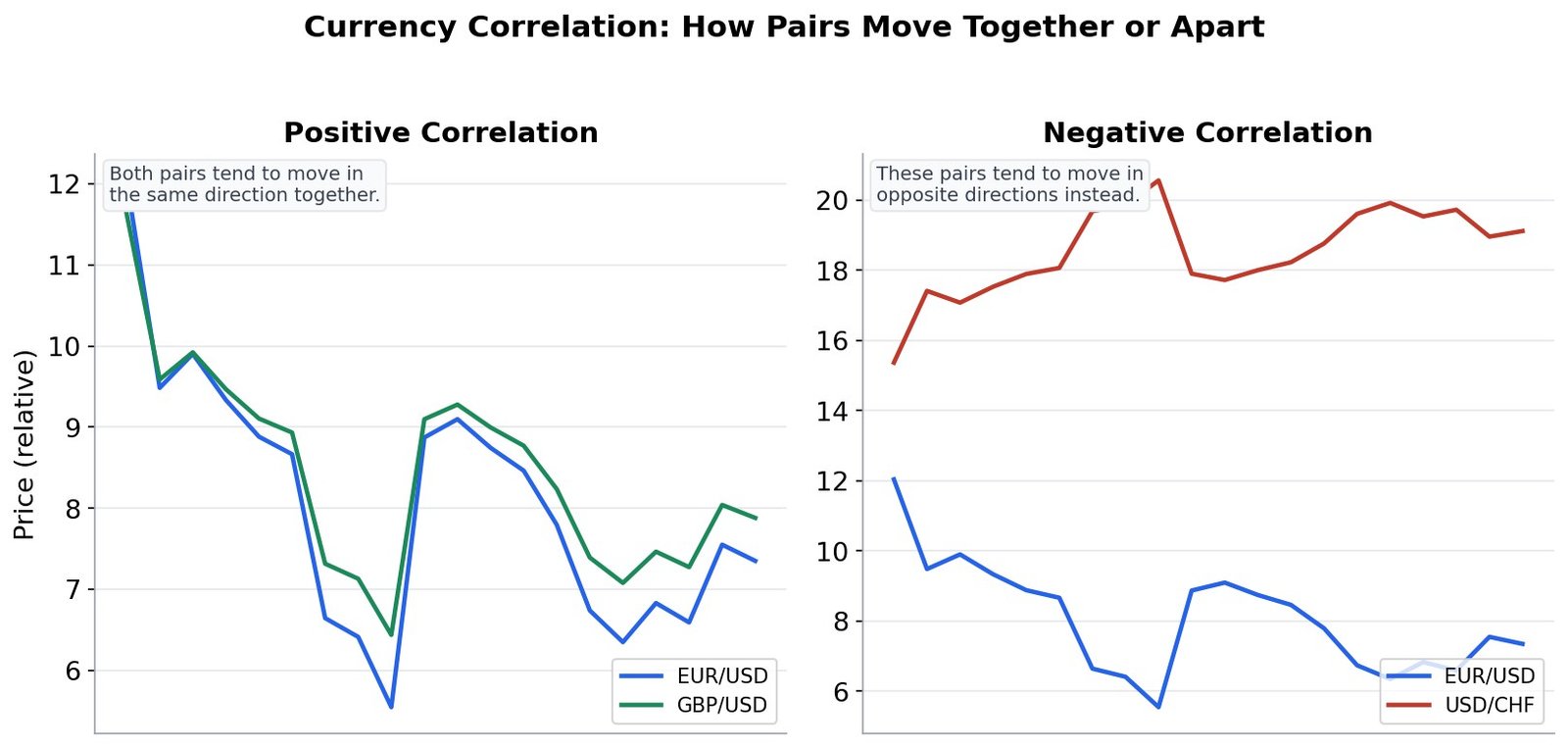
EUR/USD and GBP/USD, for example, often show positive correlation, tending to rise and fall together, since both are being measured against the same US Dollar and the Euro and British Pound often react similarly to broader market sentiment. EUR/USD and USD/CHF often show negative correlation instead, tending to move in opposite directions. Understanding correlation matters most for risk management: opening several positions that are all strongly positively correlated is, in practice, very similar to placing one much larger position, even though it might not feel that way.
Step 18: The Carry Trade Explained
The carry trade is a well known forex strategy built directly on the interest rate differential idea from Step 13. It involves buying a currency from a country with a relatively high interest rate while simultaneously selling a currency from a country with a relatively low interest rate.
The idea is to earn the difference between the two interest rates over time, sometimes called the “carry,” in addition to any profit or loss from the exchange rate itself moving. It is generally considered a longer term, more advanced strategy, since it depends heavily on interest rate differentials staying favorable and can still lose money if the exchange rate itself moves sharply against the position, sometimes losing far more than the interest differential ever earned.
Step 19: Common Forex Trading Strategies
A few broad strategy styles are commonly used in forex, each suited to different market conditions and different amounts of time available to watch the charts.
- Trend Following: Identifying an established uptrend or downtrend (using the structure ideas from the Price Action Trading course) and trading in that same direction.
- Range Trading: Trading the bounces inside a sideways, range-bound market, buying near support and selling near resistance.
- Breakout Trading: Entering as price moves firmly past a key support or resistance level, expecting the move to continue.
- Scalping: Taking many very short, small trades throughout a session, aiming to capture small pip movements repeatedly. This generally needs tight spreads and a lot of focused screen time.
- Swing Trading: Holding positions for several days to a few weeks, aiming to capture a larger move without needing to watch the screen constantly.
None of these is universally “the best.” The right style depends heavily on your available time, temperament, and the market condition you are actually in, the same honest point made throughout this site’s other courses.
Step 20: Risk Management and Position Sizing in Forex
Because of the high leverage covered in Step 9, risk management is arguably more important in forex than in almost any other market. The same position sizing math from this site’s Option Trading course applies directly here too.
A simple worked example: say you decide to risk only 1% of a Rs 2,00,000 account on a single trade, which is Rs 2,000. If your stop loss is 20 pips away, and you are trading a pair where 1 pip on a standard lot is worth about $10 (roughly Rs 830, using an example rate of Rs 83 per Dollar), your risk per standard lot would be about Rs 16,600 for that 20 pip stop, far more than your Rs 2,000 risk budget. This tells you plainly that a full standard lot is too large for this trade, and you would need to trade a much smaller lot size, a mini or micro lot, to keep your actual risk at your planned Rs 2,000. This is exactly why Step 7’s lot sizes matter so much: they are the real lever you adjust to make your position size match your risk plan, not your gut feeling.
Step 21: Is Forex Trading Legal in India? The Rules You Must Know
This is one of the most important sections in this entire course, and one most forex content online either skips or gets wrong. Please read this step carefully before going anywhere near a real forex account.
Trading currency pairs like EUR/USD or GBP/USD directly with an overseas, offshore broker (through platforms like MT4 or MT5) is not a legal channel for Indian residents. Under the Foreign Exchange Management Act (FEMA), a resident individual can only transact in foreign exchange through authorised persons and for permitted purposes. The Reserve Bank of India (RBI) has repeatedly and publicly stated that electronic forex trading is only legal through RBI-authorised Electronic Trading Platforms or on recognised Indian exchanges, not through overseas retail forex brokers.
The RBI actively maintains and regularly updates a public “Alert List” of forex trading platforms it considers unauthorised for Indian residents, which has grown to include dozens of well known international broker names. Importantly, the RBI itself states this list is not exhaustive, meaning a platform’s absence from the list does not mean it is authorised or safe to use. You also cannot use the Liberalised Remittance Scheme (LRS), the normal channel for Indian residents sending money abroad, to fund an overseas forex trading account, since the RBI has stated this is not a permitted purpose under that scheme.
What is actually legal: Indian residents can trade currency futures and options on recognised Indian exchanges, specifically the NSE, BSE, and MSEI, through a SEBI-registered broker. However, there is a significant and fairly recent change worth understanding clearly: as of an RBI circular effective April 2024, anyone taking a position in these exchange-traded currency derivatives must now have a genuine, underlying contracted or anticipated foreign currency exposure behind that position. Before this change, retail and proprietary traders could take purely speculative positions on these exchanges up to a certain aggregate limit without proving any real underlying exposure. This change has been widely reported as having significantly reduced purely speculative retail currency derivatives trading, even through this legal, exchange-based channel.
In practical terms, for most individual retail traders without a genuine business reason to hedge foreign currency exposure, legal options for speculative forex trading in India are now quite limited. Trading through an unauthorised offshore broker carries real risk: the RBI has stated that residents transacting for non-permitted purposes or through unauthorised platforms are liable for penal action under FEMA, and separately, you would have no SEBI or RBI investor protection at all if an unregulated offshore broker misused your funds, manipulated prices, or simply disappeared. This course explains forex mechanics for genuine educational understanding. Before funding any forex account with real money, verify your own specific situation with a SEBI-registered advisor or a qualified professional, since this is a genuinely evolving regulatory area and the details matter.
Step 22: How to Choose a Forex Broker
If, after understanding Step 21 fully, you are evaluating brokers for a legally permitted use case, a few factors matter most.
- Regulation: Confirm which financial regulator actually licenses the broker, and in which country, since this determines what real protection you have if something goes wrong.
- Spreads and Commissions: Compare the typical spread (Step 8) on the pairs you actually plan to trade, since this is a real, recurring cost.
- Leverage Offered: Higher is not automatically better, given the risks covered in Step 9.
- Platform Quality: A stable, reliable trading platform matters more than flashy features once real money is involved.
- Deposit and Withdrawal Process: A broker that makes withdrawals slow, confusing, or difficult is a meaningful warning sign, covered further in Step 25.
Step 23: Broker Types, Market Maker vs ECN/STP
Brokers generally fall into two broad models, based on where your order actually goes once you place it.
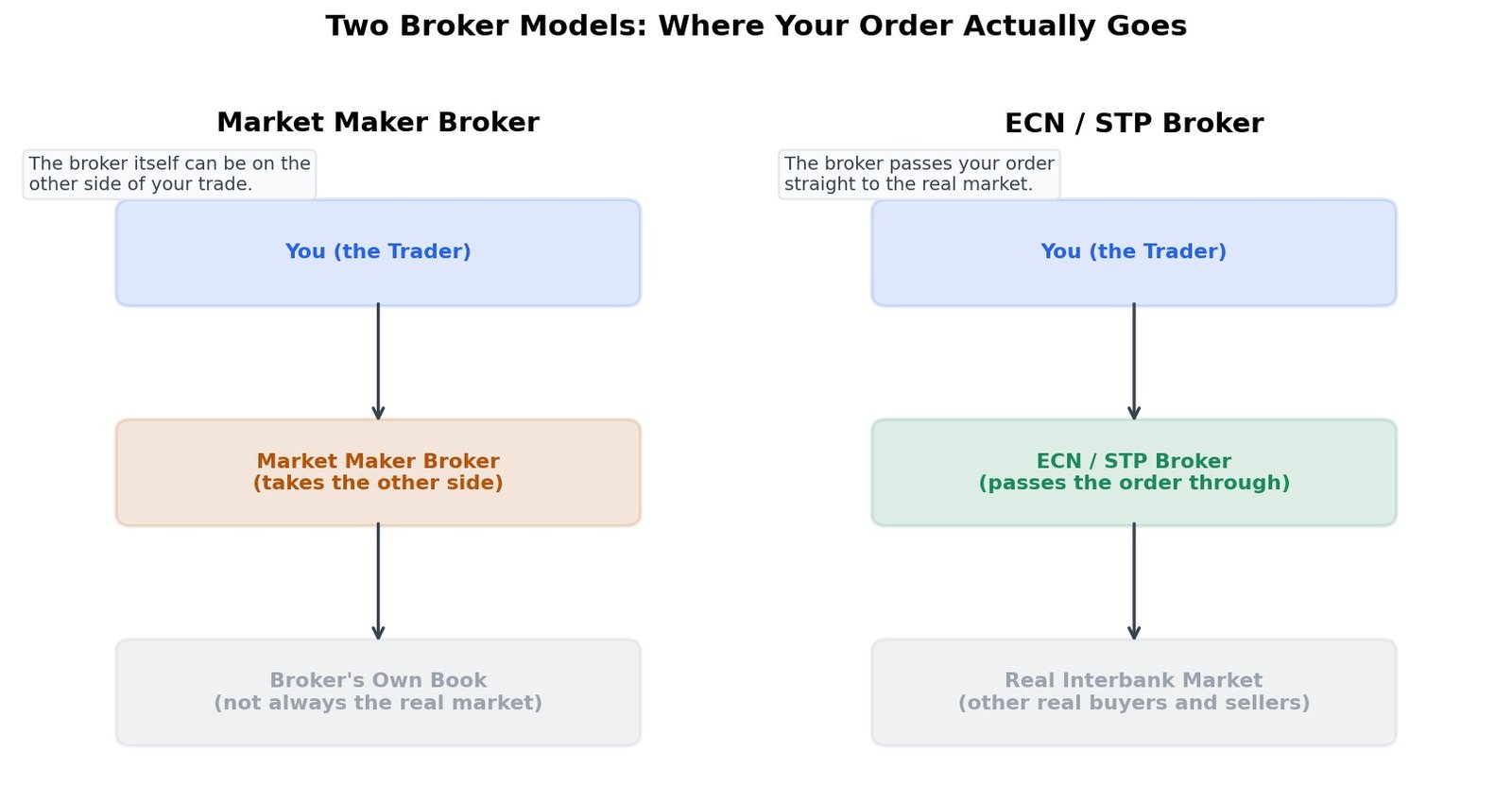
A Market Maker broker can take the other side of your trade itself, essentially creating its own internal market for you to trade against, rather than always sending your order out to the real market. An ECN (Electronic Communication Network) or STP (Straight Through Processing) broker instead passes your order directly through to the real interbank market, matching you with other real buyers and sellers. Neither model is automatically dishonest, both are common and widely used, but understanding which one you are using helps you understand exactly who is on the other side of your trade, directly connecting back to Step 2’s point about who actually participates in this market.
Step 24: Funded Trading Accounts (Prop Firms) Explained
A funded trading account, offered by companies often called proprietary trading firms or “prop firms,” is an arrangement where a firm allows a trader to trade its capital instead of their own, keeping an agreed share of any profit generated.
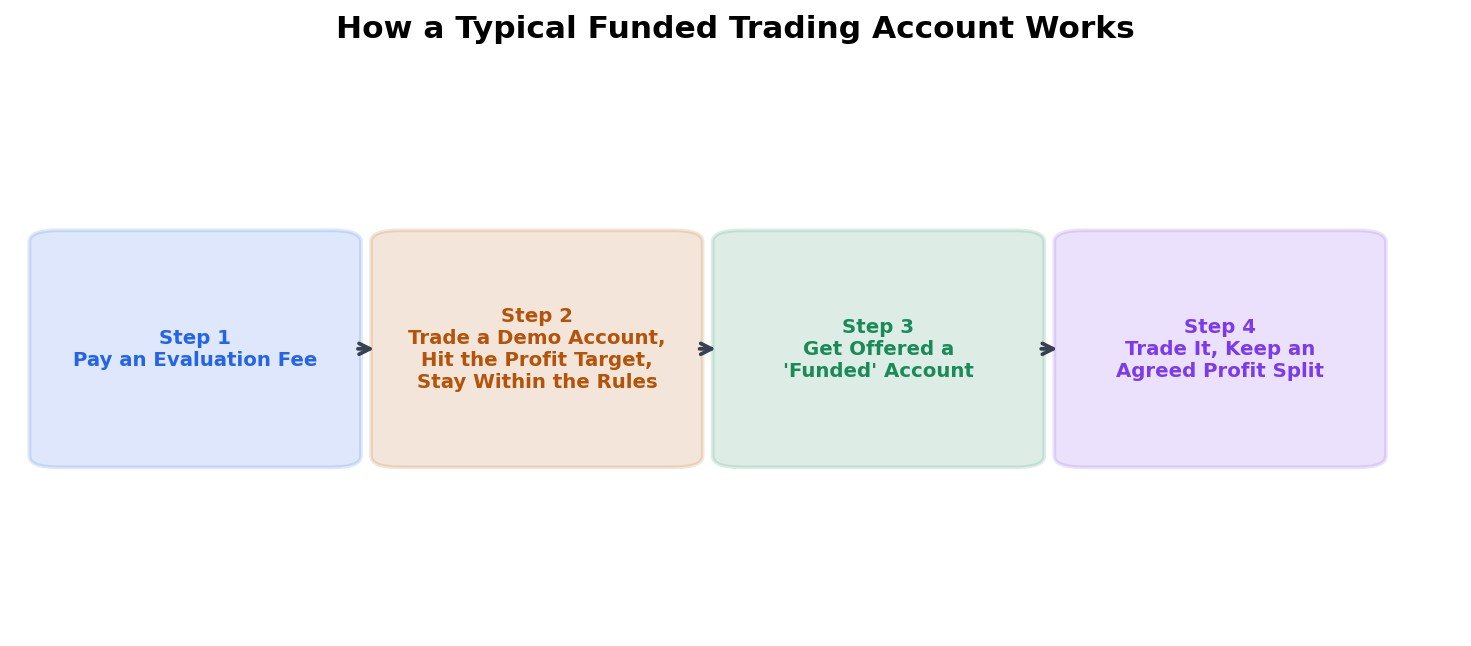
The typical path works like this: a trader pays an upfront evaluation fee to attempt a challenge, trading a demo account while trying to hit a specific profit target within a set time period, while also staying within strict rules on maximum daily loss and maximum overall loss. Traders who pass are then offered a “funded” account, sometimes still a demo account mirrored by the firm’s real capital elsewhere, and keep an agreed percentage of the profits they generate going forward, commonly somewhere between 70% and 90%, though this varies significantly by firm.
The appeal is obvious: potentially trading with far more capital than you personally have, without directly risking your own trading capital beyond the evaluation fee. But it is worth understanding clearly that the evaluation fee itself is a real, guaranteed cost to the firm regardless of whether you pass, and the strict daily and overall loss rules mean even a skilled trader can fail an evaluation due to one bad day, not necessarily poor long term skill.
Step 25: How to Evaluate a Prop Firm, Red Flags to Watch
The funded account industry includes both genuinely well run firms and some that are poorly run or outright predatory. A few honest things worth checking before paying any evaluation fee:
- Track record of actually paying out funded traders. Search specifically for real trader reviews about the withdrawal process, not just marketing claims on the firm’s own website.
- Clear, specific rules, not vague ones. A legitimate firm states its maximum daily loss, maximum overall loss, and profit target in precise, unambiguous numbers.
- Reasonable profit split and fee structure. Compare the evaluation fee and profit split against other established firms, extremely cheap evaluations alongside extremely generous promises are worth extra scrutiny.
- How failures are handled. Understand exactly what happens, and what you are charged, if you fail an evaluation and want to retry.
- Realistic marketing. Be cautious of firms promising guaranteed income or downplaying the real, significant failure rate most traders experience in evaluations.
None of this should be read as a blanket endorsement or rejection of funded accounts as a category, only as the same honest due diligence you would apply before trusting any company with real money.
Step 26: Common Beginner Mistakes in Forex
- Using maximum leverage immediately instead of understanding how dramatically it amplifies both gains and losses, as covered in Step 9.
- Trading with an unregulated, offshore broker without understanding the real legal and financial risk explained in Step 21.
- Ignoring the spread as a real, ongoing cost that quietly eats into frequent, small trades.
- Trading news events without a plan, when spreads often widen sharply and price can move extremely fast and unpredictably.
- Opening several highly correlated positions without realizing they add up to one much larger, concentrated risk, as explained in Step 17.
- Chasing funded account evaluations repeatedly without first building real, demonstrated skill on a genuine demo account.
Step 27: A Simple Checklist Before You Trade Forex
Save this list, bookmark it, or share it with a friend who is learning alongside you.
- Do I fully understand the legal position explained in Step 21 for my specific situation?
- Do I know exactly how my chosen lot size translates into real risk per pip, as covered in Step 10?
- Have I checked whether my broker is a Market Maker or an ECN/STP broker, and what that means for me?
- Do I have both a stop loss and a take profit level decided before I place the trade?
- Have I checked whether any other open positions are highly correlated with this new one?
- Am I aware of any major economic data releases scheduled soon that could cause a sharp, fast move?
- Am I trading with money I can genuinely afford to lose, under leverage I actually understand?
Step 28: Quick Glossary, Every Term in One Place
A fast reference for every term used across this course. Bookmark this page and jump here any time a word slips your memory.
- Forex / FX: Foreign exchange, trading one currency against another.
- Currency Pair: Two currencies quoted together, such as EUR/USD.
- Base Currency / Quote Currency: The first currency in a pair, and the second currency it is priced against.
- Major / Minor / Exotic Pairs: Categories of currency pairs based on how heavily they are traded.
- Pip / Pipette: The standard unit measuring price movement, and a smaller, more precise fraction of it.
- Lot (Standard, Mini, Micro, Nano): The fixed bundle sizes forex trades in.
- Bid / Ask / Spread: The sell price, the buy price, and the gap between them.
- Leverage / Margin: Controlling a larger position by borrowing, and the portion of money you put in yourself.
- Trading Session: A major financial center’s active trading hours, such as London or New York.
- Interest Rate Differential: The gap between two countries’ interest rates.
- Carry Trade: Buying a higher interest rate currency against a lower interest rate one, to earn the rate difference over time.
- Currency Correlation: How closely two currency pairs tend to move together or apart.
- Market Maker Broker: A broker that can take the other side of your trade itself.
- ECN / STP Broker: A broker that passes your order directly to the real market.
- FEMA: The Foreign Exchange Management Act, India’s core law governing foreign exchange transactions.
- RBI Alert List: A public, non-exhaustive list of forex platforms the RBI considers unauthorised for Indian residents.
- Prop Firm / Funded Account: A firm that lets a trader trade its capital after passing an evaluation, for a share of the profits.
Step 29: What to Do Next
Everything you just read about reading charts applies directly from this site’s Candlestick Patterns, Chart Patterns, and Price Action Trading courses, since the same candles, levels, and patterns work identically on a forex chart. If options interest you too, this site’s Option Trading course covers that market in full depth.
But understanding forex mechanics, and even the legal landscape, is still only one half of becoming a consistent trader. The other half is the decision-making that happens once real money and real emotion are involved, especially given how fast leveraged forex positions can move. Samir Dash’s ACE framework (Aware, Control, Execute) at Mindful Trading Hub focuses specifically on that second half, for traders who understand the mechanics but still struggle to execute consistently under pressure.
Frequently Asked Questions
Can I legally trade EUR/USD or GBP/USD as an Indian resident?
Trading these pairs directly with an offshore broker is not a legal channel under FEMA, as explained in full in Step 21. Exchange-traded currency derivatives on Indian exchanges are legal, but since April 2024 require genuine underlying currency exposure, which significantly limits purely speculative use of even this legal channel. Please verify your specific situation with a qualified professional.
How much money do I need to start trading forex?
Because of micro and nano lots (Step 7) and high leverage (Step 9), the technical minimum can be very small. The more important question, as with any trading, is whether that money is genuinely surplus capital you can afford to lose, not a fixed minimum amount.
What is the safest leverage to use as a beginner?
There is no universally “safe” leverage level, since risk ultimately depends on your position size and stop loss distance, not the leverage number alone, as explained in Step 20. Many beginners choose lower leverage specifically because it forces more deliberate position sizing.
Are funded trading accounts worth it?
This depends entirely on the specific firm, its track record, and your own trading skill level. Step 25’s checklist covers the real due diligence worth doing, and it is worth understanding clearly that most evaluation attempts across the industry are not passed on the first try.
What is the difference between forex and trading currency futures on NSE?
Forex, as commonly advertised online, usually refers to trading directly with an offshore broker via platforms like MT4 or MT5, which is not a legal channel for Indian residents. Currency futures and options on the NSE, BSE, or MSEI are a separate, legal, exchange-traded product, though now requiring genuine underlying exposure since April 2024, as explained fully in Step 21.
How much is one pip actually worth in rupees?
It depends on the pair, your lot size, and the current exchange rate, as covered in Step 10. As a rough example, one pip on a standard lot of a pair quoted against the US Dollar is often close to $10, which converts to roughly Rs 800 to Rs 850 depending on the current USD to INR rate, though this varies by pair and by broker.
What is a margin call, and how can it happen?
A margin call happens when your account’s margin falls below the minimum level your broker requires to keep your open positions running, usually after a losing trade has moved significantly against you under leverage (Step 9). Your broker will typically ask you to add more funds, or will automatically close some or all of your positions to protect itself, which is exactly why the position sizing math in Step 20 matters so much.
What is slippage, and why does it happen?
Slippage is the difference between the price you expected a trade to execute at and the price it actually executed at. It happens most often during fast moving markets, such as around a major economic data release (Step 12), when prices can move faster than an order can be filled at the exact requested price.
Should I practice on a demo account before using real money?
Many experienced traders recommend it, specifically to get comfortable with order types (Step 15), lot sizes (Step 7), and your chosen platform before any real money is at risk. A demo account cannot fully recreate the emotional pressure of real money, but it is a genuinely useful, low cost way to build familiarity with the mechanics first.
Can I trade forex part time alongside a full time job?
Yes, this is common, particularly for swing style approaches that do not require constantly watching the screen. The 24 hour market and overlapping sessions covered in Step 11 mean there is often some window of active trading time outside normal working hours, depending on which pairs you focus on.
What is the best time of day to trade forex?
There is no single universally best time, but the London and New York session overlap, covered in Step 11, is generally considered the most active and liquid stretch of the day, since the largest number of participants are trading at the same time.
How is forex trading different from stock trading?
The core mechanics of reading charts, placing orders, and managing risk are similar, and in fact the same price action skills from this site’s other courses apply directly. The biggest practical differences are forex’s much higher typical leverage (Step 9), its 24 hour trading schedule (Step 11), and, specifically for Indian residents, the legal restrictions explained fully in Step 21, which do not apply to ordinary equity trading.
Why did my broker’s spread suddenly widen?
Spreads (Step 8) often widen temporarily around major news events, low liquidity periods like late in the day or around holidays, or during unusually high volatility, since market makers and liquidity providers charge more to take on risk during uncertain conditions. This is exactly why Step 26 warns against trading major news events without a clear plan.
Is this investment advice?
No. Samir Dash is not SEBI-registered, and nothing in this course is a trading recommendation or promise of returns. The regulatory information in Step 21 is a general summary for educational purposes, not legal advice, and rules can change, so please verify your specific situation with a SEBI-registered advisor or a qualified professional before acting on anything here. Please also read the Disclaimer.
Related Reading on This Site
If you want to go deeper on specific ideas from this course, Samir Dash has written these on blog.samirdash.in:
- How Forex Trading Works: A Beginner’s Guide
- Pips, Lots, and Leverage in Forex Trading Explained
- Currency Pairs Explained: Majors, Minors, and Exotics
- Forex Trading in India: What Is Actually Allowed
- Forex Risk Management Basics Every Trader Should Know
Continue Your Learning Path
You understand forex. Here is what most readers explore next.
- Swing Trading: hold positions for days to weeks instead of hours.
- Intraday Trading: open and close every position within the same day.
- Trading Psychology: the inner game every strategy eventually runs into.
You can also see every course on this site, in order, and pick your own path.
Want to trade with more clarity and less emotional reactivity? Samir Dash’s ACE framework (Aware, Control, Execute) helps traders build the decision-making discipline that market knowledge alone can’t teach. Learn more at Mindful Trading Hub.