

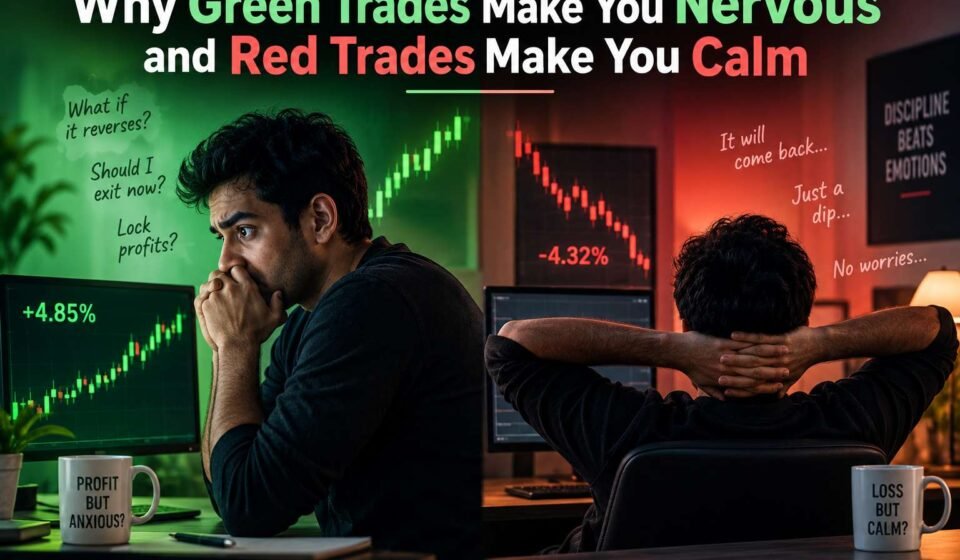

Your trade is up 6,000 rupees. It should feel like the best part of your trading day. Instead you are refreshing the P&L every twenty seconds, your shoulders are tight, and part of you just wants to close it and be done. Meanwhile, an hour earlier, when the same trade was down 3,000 rupees, you were oddly calm, telling yourself it was still within your plan.
If this sounds backwards, that is because most explanations of trading psychology are backwards. Fear of loss is not the only force at work here. Fear of losing a gain you already have is a separate, and often stronger, force.
What is actually happening when a green trade makes you nervous
Once a trade is in profit, your brain starts treating that unrealised profit as something you already own, even though it is not locked in until you close the trade. This is a subtle but important shift. Before the trade turned green, there was nothing to lose except the risk you had already accepted. After it turns green, there is now something new to lose: the gain itself.
From this point forward, every tick against you does not just feel like normal price movement. It feels like your money being taken away, even if the trade is still comfortably above your entry and nowhere near your stop.
Why this feels worse than a red trade in some ways
A red trade has a clear boundary. You know your stop loss, you know the maximum you can lose, and once price is between entry and stop, the range of outcomes is defined and limited.
A green trade has no such natural ceiling on how much you could lose back. If a trade is up 6,000 rupees and your stop is still at your original entry level, you are mentally tracking a much wider range: it could close at 8,000 profit, or it could reverse all the way back to zero. That range of uncertainty, on money you already feel you own, is what produces the nervous energy.
This is closely tied to the twice-as-strong nature of losses compared to gains. Giving back 3,000 rupees of an existing 6,000 rupee profit does not feel like “still up 3,000.” It feels like a loss of 3,000, on top of an average trade.
The moment it flips: from excitement to guarding
Watch your own reaction closely the next time a trade moves in your favour, and you will likely notice a specific turning point.
- Initial excitement. The trade moves in your favour and you feel genuinely good, briefly.
- Ownership sets in. Within a few minutes, the profit stops feeling like a possibility and starts feeling like yours.
- Guarding begins. Attention shifts from “how much more could this make” to “how do I make sure I don’t lose what I have.”
- Every small pullback feels threatening. Even a normal, minor retracement inside an uptrend gets read as the start of a reversal.
- The urge to close early takes over. Locking in the gain becomes more important than following the original plan.
Step 2 is where the shift happens, and it usually happens faster than traders realise, often within the first few minutes of a trade turning green.
Why red trades can feel calmer than they should
There is a strange comfort in a red trade that has not yet hit its stop. Nothing has to be decided yet. The rule is already written: if it hits the stop, it closes automatically or you close it. Until then, there is technically nothing to do but wait.
A green trade, by contrast, constantly presents a choice. Should you take the profit now? Should you move your stop up? Should you let it run? Every single tick reopens the question. This constant decision-making is mentally tiring in a way that simply waiting for a stop is not, and tired attention often reaches for the easiest option, which is to close the trade and remove the decision entirely.
“I don’t want to be the guy who watched this go from 8,000 profit back to breakeven.”
That specific fear, of watching a gain evaporate and feeling foolish for not taking it, is often stronger than the fear of the original loss ever was. It is also, notably, not about money. It is about not wanting to feel regret later.
How this shows up in your actual exits
The practical result of green-trade nervousness is a pattern most traders will recognise immediately: winners get closed well before target, while losers, protected by the calm of “the stop hasn’t hit yet,” sometimes get held slightly too long waiting for a bounce that never confirms.
Over many trades, this produces the classic shape of a losing system built on a winning strategy: small, early wins and full-sized losses. The setups were correct. The exits, driven by which emotional state the trade happened to trigger, were not.
The role of position size in how strong this feels
This nervousness scales with position size, often faster than traders expect. A 6,000 rupee open profit on a small position might barely register. The same 6,000 rupee profit on a position twice your usual size can feel disproportionately urgent to protect, even though the price move producing it is identical.
This is worth checking honestly. If your green-trade nervousness only shows up strongly on your larger positions, the issue may not be about profit and loss psychology in general. It may be a sign your position sizing on those trades is larger than what you can actually hold calmly, regardless of what your risk rules on paper allow.
What actually helps
- Decide your target and partial-booking rules before the trade turns green, not after. Once you are up money, you are the wrong person to be designing the exit rule from scratch.
- Use a trailing stop instead of a mental “just in case” exit. A trailing stop lets the guarding instinct express itself as a rule, rather than as a live, moment-to-moment decision.
- Reduce how often you check a winning trade, the same way you would with a losing one. Fewer checks means fewer chances for the ownership feeling to build.
- Separate “this feels risky” from “this has broken my plan.” A normal pullback inside a trend is not the same as a trend reversal, even though both feel identical in the moment.
The goal is not to feel neutral about profit. The goal is to make sure the decision to take it or let it run was made by your plan, not by how uncomfortable the guarding feeling had become.
A quick way to check if this applies to you
Think back to your last five trades that moved meaningfully in your favour before you closed them. For each one, ask a simple question: in the final few minutes before you exited, was your attention on your original target, or was it on not wanting to give back what you already had?
If the honest answer is mostly the second one, this pattern is active in your trading, even if you have never labelled it before. Most traders assume their exits are driven by chart analysis in the moment. Looking back at what you were actually thinking about, rather than what the chart showed, usually tells a different story.
Frequently asked questions
Why do I feel more stressed when I’m winning than when I’m losing?
Because once a trade is in profit, your brain starts treating the unrealised gain as something you already own. Losing it back then registers as an actual loss, which triggers the same strong loss-avoidance response as a real losing trade.
Is it wrong to want to protect a profit?
No, protecting profit is a completely reasonable instinct. The problem is only when that instinct overrides a written plan and causes an early exit on a trade that was still working exactly as intended.
Why does a losing trade sometimes feel easier to sit through than a winning one?
A losing trade has a fixed, known outcome range defined by your stop, and nothing needs to be decided until the stop is hit. A winning trade constantly presents a live choice about whether to exit, which is mentally tiring and often resolved by closing early.
How do I stop closing winners too early?
Set your target and any partial-booking rule before the trade turns green, and use a trailing stop instead of relying on a live decision once you are in profit. Removing the in-the-moment choice is more effective than trying to feel calmer.
Does this get easier with more trading experience?
It improves once you have rules that remove the need to decide in the moment. Experience alone, without a written exit process, does not reliably fix it, since the underlying feeling of ownership over an open gain does not go away on its own.
The real point
A winning trade is not automatically a comfortable trade. Once there is a profit to protect, your brain treats the situation as something to guard, and guarding does not feel like winning. It feels like a new kind of pressure.
The fix is the same one that works for losing trades: decide the exit before the feeling arrives, so the feeling has nothing left to negotiate.
The market does not reward better predictions. It rewards better decisions.
Profit ko sambhalna bhi utna hi mushkil hai jitna loss ko sehna.
Related reading:
- Fear of Loss in Trading: Why You Cannot Pull the Trigger
- Greed in Trading: What It Actually Feels Like in a Live Trade
- How to Make Calm Decisions While a Trade Is Still Open
Want to break this loop properly? I run a free live session twice a week for traders with two or more years of experience who know the setups but still cannot execute under pressure. Register for the next free session here.
I am Samir Dash, founder of Mindful Trading Hub. I work with experienced traders on live market decision-making. More about my story here.