
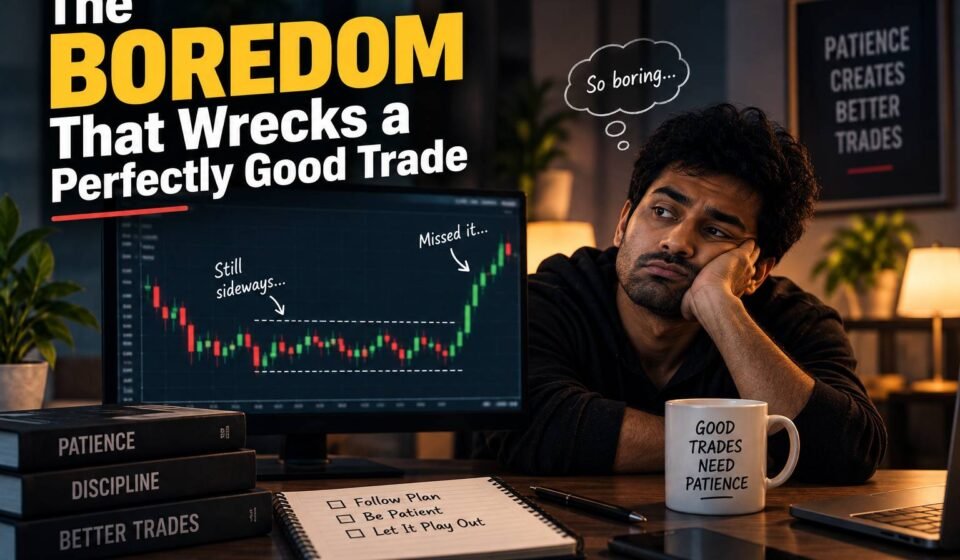

Nifty has traded in a 20-point range for the last forty minutes. Your trade is up 400 rupees, down 200, up 300, down 100, back and forth, going nowhere. Nothing has changed. Your stop is untouched, your target is untouched, and your original reason for the trade is still completely valid.
And yet you are more likely to make a bad decision right now than you were when the trade first went slightly red an hour ago.
Why a flat trade is more dangerous than it looks
Fear and hope both give you something to react to. A trade moving sharply against you produces a clear feeling and a clear countdown to your stop. A trade moving sharply in your favour produces excitement and the question of whether to book. Both states, uncomfortable as they are, at least keep your attention anchored to the trade itself.
A flat, sideways trade gives you nothing to hold onto. There is no information to react to, no story developing, no signal to interpret. Your attention, which is built to seek out something interesting, starts looking elsewhere. And “elsewhere” is where the bad decisions live.
What boredom actually does to your behaviour
Boredom during a live trade rarely feels like boredom. It usually feels like restlessness, or a vague sense that you should be doing something. The common patterns:
- Opening a second chart, on an instrument you have no plan for, “just to see what’s moving.”
- Zooming into the one-minute chart of your existing trade, looking for noise to interpret as signal.
- Checking news, Twitter, or a trading group, searching for something to justify an early action.
- Adding to the position without a plan, simply because sitting still feels unproductive.
- Closing the trade early with the explanation “it’s not going anywhere anyway,” even though nothing about the setup has actually failed.
None of these come from analysis. They come from an itch to do something, applied to a situation that currently calls for doing nothing.
Why doing nothing feels like failure
Trading, unlike most work, rewards effort at the entry and exit, and rewards patience everywhere in between. Most traders, especially experienced ones, associate being good at their job with being active. Sitting still while a trade goes sideways can feel like you are not doing your job, even when doing nothing is precisely what the job requires at that moment.
This mismatch, between what feels productive and what is actually correct, is the real engine behind boredom-driven mistakes. You are not undisciplined. You are applying a work ethic built for other parts of life to a phase of trading where it does not belong.
“This is just sitting here. I might as well close it and find something better to do with my capital.”
Notice that thought does not mention your stop, your target, or your original setup reasoning at all. It is entirely about the discomfort of stillness, wearing the language of capital efficiency.
The sequence boredom follows
- The trade stalls. Price moves into a tight range with no clear direction.
- Attention drifts. You start looking at other charts or checking unrelated information.
- A new “opportunity” appears. Something else on the screen looks more exciting than the trade that is just sitting there.
- You either exit the original trade early, or add a second uncalculated position to feel active again.
- Now you are managing two problems instead of one plan, often with less discipline applied to the new position than the original.
Step 3 is the most avoidable point in the whole sequence. The “new opportunity” almost always looks more exciting specifically because you have no position in it yet, and no history of watching it disappoint you the way your current stalled trade has.
Why sideways price action is often exactly what it should look like
Here is the part that gets missed. Many valid setups spend a meaningful part of their life sideways. A breakout that needs to build a base first. A trend that needs to digest a move before continuing. A support level that needs several touches before it either holds or breaks. Sideways movement is not usually a sign the trade has failed. It is often just what a working trade looks like at that particular stage.
The mistake is treating “nothing is happening” as new information about the trade, when it is usually just the absence of information, which your original plan should already have accounted for.
A note on multiple screens and multiple charts
Many traders keep four or five charts open at once, arguing it helps them “stay aware of the market.” In practice, once one of your open trades goes flat, those extra screens usually stop being awareness and start being bait. Your eyes drift to whichever chart is moving the most, and the one that is moving the most is, by definition, not the one you have a plan for.
A simple test: notice how often the chart that pulls your attention during a flat period turns into an actual, planned trade versus how often it turns into a distraction you eventually close without acting on. For most traders running multiple screens, the second outcome happens far more often, which is a useful thing to know about your own setup.
What to do instead of watching
- Set a specific check-in interval before the trade even goes flat, for example every fifteen minutes, and close the chart in between.
- Write your invalidation and target levels somewhere visible so a quick glance confirms nothing has changed, without needing to study the chart.
- Give yourself a separate, small task during flat periods that is not another trade. Reviewing your journal, prepping the next day’s watchlist, or simply stepping away from the desk.
- Treat the urge to open a second, unplanned position as a signal about your state, not about the market. It usually means you are bored, not that a genuine opportunity has appeared.
The goal is to separate “the trade needs my attention” from “I want something to do.” Only the first one is actually your job right now.
Why this hits experienced traders harder
Newer traders often have the opposite problem, over-managing every position out of nervousness. But traders with a few years of screen time behind them have usually already been through that phase and built some patience for red trades. What they have not always built is patience for boring ones, because boredom was never framed as a real risk to guard against.
Most trading education spends its time on fear and greed. Almost none of it spends time on the specific danger of a trade that is simply uneventful. This gap is exactly why experienced traders, who have already fixed their obvious emotional leaks, often find that boredom-driven decisions are the last habit still quietly costing them money.
Frequently asked questions
Why do I want to close a trade just because it’s not moving?
Stillness feels unproductive, and most people associate good trading with being active. A flat trade that has not hit your stop or target has not actually failed, but the lack of movement creates restlessness that gets mistaken for a signal to act.
Is it a bad sign if my trade goes sideways for a long time?
Not necessarily. Many valid setups move sideways before continuing, especially breakouts building a base or trends digesting a prior move. Sideways price only matters if it actually breaks your invalidation level.
Why do I keep opening new trades while I already have one open?
This is often boredom looking for something to do, not a genuine new opportunity. The new position usually gets less planning and discipline than the original one did, since it was born from restlessness rather than analysis.
How often should I actually check a trade that isn’t moving?
A fixed interval, such as every fifteen to twenty minutes, works better than constant checking. Constant checking during a flat period increases the temptation to act on boredom rather than on any real change in the trade.
Is boredom really as dangerous as fear or greed in trading?
Often more dangerous, because fear and greed at least keep your attention on the actual trade. Boredom pushes your attention away from the trade entirely, which is how unplanned second positions and early exits on valid setups tend to happen.
How this connects to the rest of a live trade
Boredom, fear, hope, and nervous excitement are not separate problems that need separate fixes. They are all versions of the same underlying issue: a live trade puts you in a state your written plan did not fully anticipate, and your attention fills the gap with whatever feeling is loudest at that moment. See What Happens in Your Brain While a Trade Is Open for how these states connect across an entire session, not just during the quiet stretches.
The real point
A trade sitting still is not a trade doing nothing. It is a trade waiting for its plan to play out, exactly as designed. The danger is not the stillness. It is your discomfort with it, and what you do to make that discomfort go away.
The market does not reward better predictions. It rewards better decisions.
Chup trade bhi ek trade hai, bas usse chhedna nahi hai.
Related reading:
- Fear of Loss in Trading: Why You Cannot Pull the Trigger
- Greed in Trading: What It Actually Feels Like in a Live Trade
- How to Make Calm Decisions While a Trade Is Still Open
Want to break this loop properly? I run a free live session twice a week for traders with two or more years of experience who know the setups but still cannot execute under pressure. Register for the next free session here.
I am Samir Dash, founder of Mindful Trading Hub. I work with experienced traders on live market decision-making. More about my story here.