

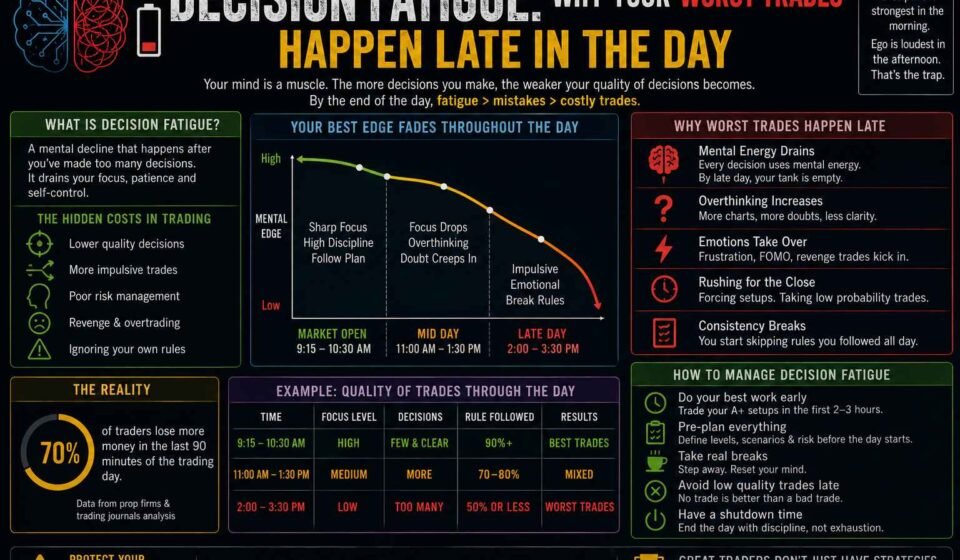

If you pulled up your last 100 trades and sorted them by time of day, most traders would find a pattern they have never actually looked for: the trades taken after 1pm lose more often and lose bigger than the trades taken before noon, using the exact same strategy and the exact same rules.
This is not because afternoon setups are worse. It is because the trader making the decision by 1pm is not the same decision-maker who started the day at 9:15am, and the gap between the two is called decision fatigue.
What decision fatigue actually is
Decision-making draws on a limited mental resource that depletes with use across the day. This is not specific to trading. It shows up in any job that requires repeated judgment calls: doctors make different prescribing decisions later in their shift than earlier, judges hand down different rulings later in a session than earlier. Trading is an unusually concentrated version of this problem, because a single trading session can involve dozens of small judgment calls: whether to enter, how much size, whether to hold through a pullback, whether to exit early, whether that alert is worth checking.
Each of these draws from the same limited reserve. By early afternoon, a trader who has made forty small decisions since the open has less capacity left for the forty-first than they had for the first.
What it looks like in a trading account, specifically
- Rules get applied more loosely as the day goes on. A trader who checks every box on their entry checklist at 9:45am starts skipping a box or two by 2pm, not from carelessness, but because holding a full checklist in mind takes energy that is running low.
- Position sizing drifts, usually upward. Afternoon trades are more likely to be oversized, often justified in the moment as “making up for a slow morning” or “this one looks too good to size normally.”
- Setups get lowered. A setup that would have been rejected at 10am as marginal gets accepted at 3pm, because the mental effort required to say no to a marginal setup is itself a depleting resource.
- Exits get delayed. Deciding to cut a loser requires an active judgment call. A fatigued trader is more likely to default to holding, which is the passive option, even when holding is not what the rules call for.
Why this gets misdiagnosed as a discipline problem
“I know better than this, I just got lazy with my rules today.”
That is usually the wrong diagnosis. Laziness implies the capacity was there and simply not used. Decision fatigue means the capacity was genuinely lower by that point in the day, in a way that has nothing to do with character. Treating it as a discipline failure leads to the wrong fix, trying harder tomorrow, which does not address the actual mechanism: a limited resource that depletes with use regardless of how much a trader wants to stay disciplined.
This is why the ACE framework‘s Aware stage matters as much at 2pm as it does at 9:15am. Checking your state before a trade is not a one-time morning ritual. A trader who checks in at 9:15am and never again has no way of noticing that their capacity for Control has quietly dropped by early afternoon.
What actually reduces decision fatigue’s damage
1. Cap the number of trades before the day starts, not during it
Deciding “I will take at most 4 trades today” at 9:00am is a decision made with full capacity. Deciding whether to take a 9th trade at 2:30pm is a decision made with depleted capacity. A pre-set cap moves the hardest decision to the point in the day when you are best equipped to make it.
2. Build in a real break, not a screen break
Scrolling a phone during a lunch break does not restore decision-making capacity the way stepping away from screens entirely does. A 20-30 minute break with no screens between the morning and afternoon session measurably helps traders return with more capacity for the second half of the day.
3. Front-load the checklist so it requires less active effort later
A written, physical checklist that gets checked off mechanically requires less mental energy than a mental checklist held in memory. By afternoon, a mental-only checklist is far more likely to get skipped than a written one sitting next to the screen.
4. Treat a shrinking win rate across the day as a data point, not bad luck
If your journal shows a consistent pattern of afternoon trades performing worse, the fix is not to try harder in the afternoon. It is to trade less, or trade smaller, in that specific window, treating the data the same way you would treat any other statistical pattern in your own results.
How to actually check if this applies to you
Pull your last 60-100 trades. Split them into before 12pm and after 12pm. Compare win rate and average R multiple between the two groups. Most traders who do this for the first time are surprised by the size of the gap, because it is invisible day to day and only shows up when the data is actually separated and compared.
If the gap is small, decision fatigue may not be a major factor for you specifically. If the gap is large, this single pattern is likely costing more than any individual bad trade, because it is happening quietly across dozens of trades rather than showing up as one dramatic loss.
What this looks like across a full trading week, not just one day
Decision fatigue does not fully reset overnight for every trader. Sleep restores much of the daily depletion, but a demanding week, several high-decision trading days back to back, can leave a residual fatigue that builds across days, not just within one session.
This shows up as a pattern where Thursday and Friday trades, late in the trading week, underperform Monday and Tuesday trades in the same way afternoon trades underperform morning ones. If your journal shows this weekly pattern in addition to the daily one, it is worth treating the same way: fewer trades, smaller size, or a defined cutoff point later in the week, rather than assuming each day starts from a fully identical baseline.
A simple structural fix that works for most traders
Rather than trying to will yourself into better afternoon decisions, the more reliable fix is structural: build a rule that reduces the number of decisions you have to make when capacity is lowest.
One version of this: define your highest-conviction setups as morning-only, and treat any afternoon signal as requiring a stricter checklist, smaller size by default, or a second confirmation before entry. This does not eliminate afternoon trading, it simply raises the bar at exactly the point in the day where your own capacity to hold a high bar has naturally dropped. The rule does the holding for you, which is the entire point of building structure around a resource that predictably depletes.
Frequently asked questions
Does decision fatigue affect all traders equally?
No. Traders who take fewer, higher-conviction trades per day are less exposed than traders who watch every candle and make dozens of micro-decisions. The number of decisions matters more than the number of hours spent watching the screen.
Can caffeine or breaks fully reverse decision fatigue during the day?
Breaks help meaningfully, particularly screen-free breaks. Caffeine can help alertness but does not fully restore the specific capacity used for weighing tradeoffs and holding to rules, which is a different function from simple alertness.
Is it better to trade only in the morning, then?
For many traders, yes, if their data shows a consistent afternoon drop-off. This is not universal, some traders’ setups genuinely occur more often in the afternoon, but the decision should be based on their own tracked data, not a general rule.
How is this different from trading burnout?
Decision fatigue is a daily, resetting pattern tied to the number of decisions made within a single session. Burnout is a longer-term accumulation across weeks or months that does not reset overnight. See The Trader’s Burnout: Signs and What to Do About It for the longer-term version of this same underlying mechanism.
Does reducing the number of trades per day actually improve results?
For traders whose data shows a fatigue-related decline, yes, because it removes the lowest-quality decisions of the day, the ones made with the least capacity remaining, rather than removing decisions at random.
The real point
The trader who enters a position at 9:30am and the trader who enters one at 2:30pm are, functionally, not equally equipped for the decision, even though they are the same person with the same rules. Recognizing that is not an excuse. It is the input that tells you exactly where to add structure.
The market does not reward better predictions. It rewards better decisions, made by a trader who still has the capacity left to make them well.
Din dhalte dhalte dimaag bhi thak jaata hai, isiliye rules likhe hote hain.
Related reading:
- Trading Psychology: The Complete Guide for Indian Traders
- How to Make Calm Decisions While a Trade Is Still Open
- You Know the Strategy. Why Can You Not Follow It?
Want to break this loop properly? I run a free live session twice a week for traders with two or more years of experience who know the setups but still cannot execute under pressure. Register for the next free session here.
I am Samir Dash, founder of Mindful Trading Hub. I work with experienced traders on live market decision-making. More about my story here.