

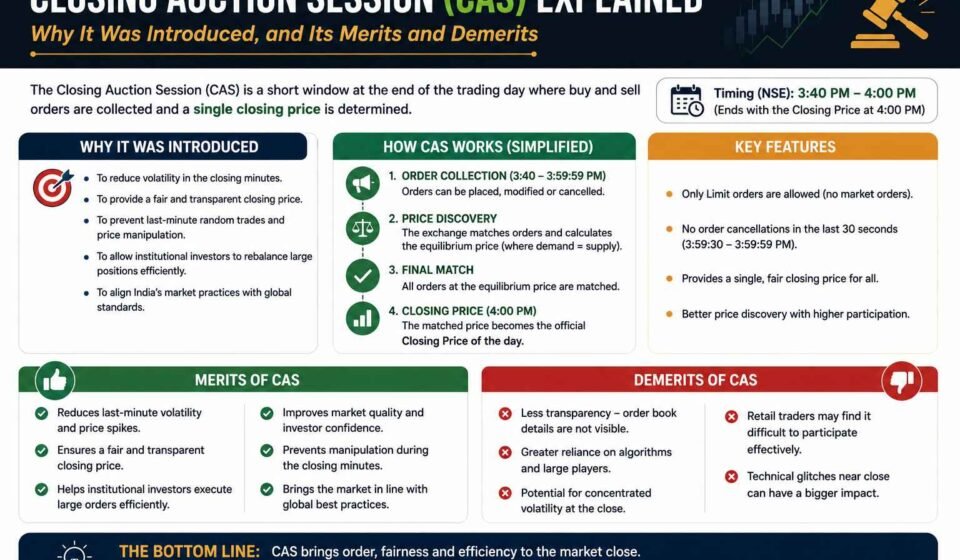
Closing Auction Session (CAS) Explained: Why It Was Introduced, and Its Merits and Demerits

If you trade Nifty stocks or Nifty-linked derivatives, you have probably noticed something new happening in the last few minutes of the trading day. Since August 2026, India’s stock exchanges no longer calculate a stock’s official closing price the old way. Instead, for stocks that have Futures and Options contracts, the close is now decided through a dedicated Closing Auction Session, usually shortened to CAS. This post explains what CAS actually is, why SEBI introduced it, and an honest look at its merits and demerits based on how it has actually performed since launch.
What CAS Actually Is
Closing Auction Session is a twenty minute window at the end of the trading day, running from 3:15 pm to 3:35 pm, used to determine the official closing price of eligible stocks. It applies, in this first phase, only to stocks that have active Futures and Options contracts, which includes the stocks that make up the Nifty and Bank Nifty. Stocks without F&O contracts continue to use the older method for now.
The mechanism works in stages. First, the exchange calculates a reference price using the volume weighted average price of trades between 3:00 pm and 3:15 pm. If a stock did not trade during that window, its last traded price is used instead. From 3:15 pm, instead of continuous trading, the exchange begins collecting buy and sell orders within a price band set around that reference price, without immediately matching them. This is different from normal trading, where an order can execute the instant a matching order exists.
Order entry does not close at a fixed, predictable second. Somewhere between roughly 3:28 pm and 3:30 pm, the system randomly stops accepting new orders. This randomness is deliberate. It exists specifically so that no one can time an order to land in the very last available moment and try to influence the outcome.
Once order entry closes, the exchange runs an algorithm to find a single equilibrium price, the price at which the largest quantity of shares can actually be matched between buyers and sellers. If more than one price allows that same maximum quantity, the exchange picks whichever of those prices leaves the smallest imbalance between buy and sell orders. If there is still a tie after that, it picks the price closest to the earlier reference price. That final number becomes the stock’s official closing price for the day.
Why SEBI Introduced This
Under the earlier method, the closing price was simply the volume weighted average of all trades in roughly the final half hour of the trading day. This meant a relatively small number of trades placed right near the close could meaningfully shift the official closing price, even if those trades did not reflect the broader supply and demand for the stock. This created an opening for what is commonly called marking the close, where someone deliberately places trades near the end of the day specifically to push the closing price in a direction that benefits a position elsewhere, such as an options contract expiring that day.
SEBI’s stated aim in mandating CAS, through a circular issued in January 2026, was to reduce exactly this kind of end of day manipulation, while also improving how fairly the closing price reflects genuine buying and selling interest at that moment. An auction mechanism, where all interest is gathered together and matched at one equilibrium price, is structurally harder to move with a small number of trades than a simple average of recent transactions.
There was also a broader alignment argument. Many major global markets, including large exchanges in the United States and Europe, already use a closing auction of some kind to set official closing prices, particularly for their most liquid, index-linked stocks. Moving India’s F&O stocks toward a similar structure was framed as bringing local market practice closer to global norms, especially since the closing price of these stocks feeds directly into the settlement value of derivatives contracts and the reported value of index funds and ETFs that track the Nifty and Bank Nifty.
The Merits of CAS
The core argument in favour of CAS is that it is structurally harder to manipulate than a simple trailing average. Because the closing price comes from matching a full order book at one point in time, rather than averaging whatever trades happened to occur in a window, a single large order or a short burst of coordinated trades has less power to move the final number on its own. The random order entry cutoff adds another layer of protection, since no one can reliably time a last second order to land in the exact final moment.
A second merit is more accurate price discovery at the moment that matters most for many market participants. Since the auction pulls together buy and sell interest from across the market into a single matching process, the resulting price is meant to better reflect genuine, aggregated demand and supply rather than the sequence of a handful of individual trades.
A third merit is the downstream effect on derivatives and index products. Since F&O contracts settle based on the closing price of the underlying stock, and index funds and ETFs report their value based on the closing prices of the stocks they hold, a closing price that is harder to manipulate and more representative of real demand should, in theory, produce fairer settlement values and more trustworthy fund valuations for anyone holding these products, including people who are not actively trading at all.
The Demerits and Real Problems Seen So Far
An honest look at CAS also has to include what has actually happened since it launched, not just the theory behind it. Media reporting on the first week after the August 2026 rollout described a genuinely turbulent start. Several reports noted sharp, unusual price swings during the auction window on the very first trading day, along with visible confusion among traders about how the new closing prices were being arrived at. Reports also described a noticeable divergence between the Sensex and Nifty during this early period, which added to the confusion, since the two benchmarks are usually closely aligned.
Reports also flagged a liquidity problem specific to the auction window itself. In the initial period, trading volume within the CAS window reportedly dropped sharply compared to what the same minutes used to see under the old system, as many retail participants appeared to step back from actively placing orders during the auction, at least until they better understood how it worked. This is a real, practical demerit, since a thinner auction with fewer participants can, ironically, make the equilibrium price more sensitive to whichever orders are actually present, at least in the early period before participation normalises.
By most accounts, the sharpest volatility did ease within the first week, as participants adjusted to the new mechanism and understood how the reference price and price band worked. But some reporting continued to raise questions around transparency, specifically whether market participants get enough visibility into the buy and sell order flow building up during the auction window itself, since that information gap can make it harder for an ordinary trader to understand why a particular closing price was reached on a given day.
There is also a simple, practical demerit that applies to anyone new to the markets or new to F&O stocks specifically: CAS adds a genuinely new layer of mechanics to learn. A trader who understood how closing prices worked under the old system now has to understand the reference price window, the price band, the random cutoff, and the equilibrium matching logic, all of which did not exist before August 2026.
What This Means If You Trade Nifty Stocks or Options
If you trade F&O stocks, or hold positions that settle based on their closing price, CAS is now simply part of how the market works and is not something to react to emotionally in the moment. This is educational information about how the mechanism functions, not a recommendation about how to trade around it. If you are unsure how a specific stock’s closing price on a specific day was determined, exchange circulars and your broker’s own explainer materials are the most reliable place to check the exact numbers, since specific price bands and timings can be revised by SEBI or the exchanges over time.
Frequently asked questions
Which stocks does CAS currently apply to?
In its initial phase from August 2026, CAS applies only to stocks in the cash market that have active Futures and Options contracts, which includes the stocks that make up indices like Nifty and Bank Nifty. Stocks without F&O contracts continue to use the older closing price method for now, though this could expand over time.
What time does the Closing Auction Session run?
CAS runs for twenty minutes, from 3:15 pm to 3:35 pm. Order entry during this window closes at a randomly determined time, typically between roughly 3:28 pm and 3:30 pm, specifically to prevent traders from timing a last moment order to influence the outcome.
Why did SEBI introduce CAS instead of keeping the older method?
The older method calculated the closing price as a volume weighted average of trades in the final half hour, which made it possible for a small number of trades to meaningfully shift the official close. CAS was introduced to make the closing price harder to manipulate and more reflective of genuine, aggregated buying and selling interest.
Did CAS work smoothly from the very first day?
No. Media reporting described real volatility and confusion during the first week after launch, including sharp swings on the first trading day and a noticeable drop in trading activity within the auction window itself. Much of this reportedly eased as participants adjusted, but it is a fair demerit to be aware of.
Does CAS affect stocks I hold that are not part of Nifty or Bank Nifty?
Only if that specific stock has active Futures and Options contracts, since that is what determines whether it falls under CAS in this initial phase. Stocks without F&O contracts are not currently affected and continue under the earlier closing price method.
Naya system samajhna zaroori hai, sirf reaction dena kaafi nahi hai.
Related reading:
- Trading vs Investing: What Is the Real Difference?
- Position Sizing: The Fix for Most of Your Emotional Trades
- Trading Psychology: The Complete Guide for Indian Traders
Want to learn this from the source? I run a free live session twice a week for traders with two or more years of experience who know the setups but still cannot execute under pressure. Register for the next free session here.
I am Samir Dash, founder of Mindful Trading Hub. I work with experienced traders on live market decision-making. More about my story here.