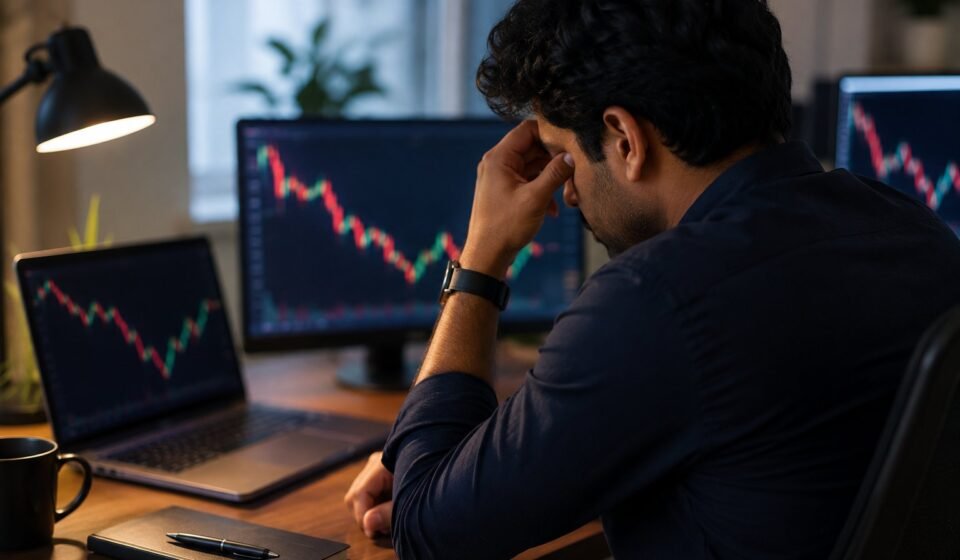

You check the position every thirty seconds. Your chest is tight when the market opens. You did not sleep properly the night before expiry. You are irritable with your family on red days.
Most advice for this recommends breathing exercises. Breathing helps, and it is not the main lever.
The main lever is that trading anxiety is usually a proportionate response to something specific in how you are trading. Find the cause and the anxiety drops without needing to be managed.
The four causes, in order of how common they are
1. Position size (the overwhelming majority)
If the amount at risk matters to your actual life, you will feel it. That is not a psychological problem, it is accurate perception.
Here is the test. Take your current per-trade risk. Halve it. Do you still check the position every thirty seconds?
If the anxiety drops noticeably, you have your answer, and it was never a mindset issue. Most traders reading this are trading above the size their nervous system currently supports, and the fix is arithmetic rather than meditation.
2. Undefined risk
Anxiety needs uncertainty. A position with a live stop-loss order has a known worst case, and known worst cases are much easier to tolerate than open-ended ones.
A position without a stop has no floor. You are not holding a trade with a defined risk, you are holding an open question, and your mind will keep returning to it because there is nothing to settle.
This is why traders who use mental stops report far more anxiety than those with resting orders, even at identical size. The money at risk is the same. The uncertainty is not.
3. Trading money you need
If the capital is required for rent, school fees, or a loan payment, no technique will make that comfortable, and it should not.
The anxiety is doing its job. It is telling you the exposure is inappropriate. The answer is not to reduce the feeling, it is to reduce the exposure.
4. No process, only outcomes
If the only measure of your day is the P&L, then every tick is a verdict on you. That is an exhausting way to spend six hours, and it is entirely self-imposed.
Traders with a written process have something else to attend to: did I follow the plan? That question is answerable and stays under your control, and having it available changes the texture of the session considerably.
What actually reduces it
1. Cut size until the trade is boring
The primary intervention, and the one people skip because it feels like going backwards.
Halve your position size. If the anxiety persists, halve it again. Continue until a full stop-out produces no real reaction.
Trade at that size for a month. You are not giving up on returns, you are establishing the level at which you can execute correctly, which is the only level that produces returns anyway.
2. Use resting orders for everything
Entry as a limit order at your level. Stop as a live order at entry. Target as a live order.
Once all three are placed, the trade requires nothing further from you. The anxiety of monitoring is largely the anxiety of an unmade decision, and there is no longer a decision to make.
3. Reduce how often you look
Define checkpoints in advance. You look at the position at the 15-minute candle close and at no other time.
Constant monitoring does not improve outcomes. It generates the sensation that something should be done, which is the raw material for both anxiety and interference.
If you cannot stop looking, physically leave. Set alerts and close the platform.
4. Build a pre-market routine
Twenty minutes, same sequence every day: review levels, write your setups, note your size, run a three-question state check on sleep, outside pressure, and yesterday’s result.
Routine reduces anxiety by removing decisions from the live session. Most of what feels stressful during market hours is unmade decisions accumulating.
5. Score the process daily
One line at the close: did I follow my rules? Yes or no.
This gives you a measure of a good day that is independent of the P&L. A red day where you followed every rule is a good day. Having that available takes a surprising amount of weight off individual trades.
6. Then use the breathing
Once the structural causes are addressed, physiological tools genuinely work for the residual.
The most useful during market hours is a long exhale. Breathe in for four, out for eight, for about a minute. The extended exhale engages the parasympathetic system and lowers heart rate measurably. It is short enough to do at your desk without ceremony.
This is a real tool. It is fourth on the list because using it while trading at three times your appropriate size is treating a symptom.
Anxiety outside market hours
If trading is affecting your sleep, your mood at home, or your ability to be present with family, treat that as its own problem rather than a side effect.
Some practical boundaries that work:
- No positions held overnight while you are working on this. Overnight risk is the largest single contributor to sleep disruption, and gap risk is real risk.
- A hard finish time. The terminal closes at a set hour, and analysis stops with it.
- No charts on the phone after market hours. Delete the app if necessary. Checking a closed market provides no information and keeps the loop active.
- One non-trading commitment daily that is not optional. Exercise, a walk, time with your family, scheduled rather than fitted in.
There is also a feedback loop worth knowing about. Poor sleep degrades decision quality, which produces worse trades, which produces more anxiety, which further degrades sleep. Warning signs like poor sleep and increased screen time typically precede losing periods rather than following them. Protecting sleep is not self-care advice here, it is risk management.
When it is more than trading
Worth saying plainly and without drama.
If anxiety persists on days you do not trade, if it affects appetite or sleep independently of the market, or if you notice panic symptoms, that is outside what a trading article can address. Speak to a doctor or a mental health professional.
Trading can amplify an existing anxiety condition considerably, and it is a genuinely poor environment in which to manage one untreated. Getting help is not a detour from becoming a better trader.
Frequently asked questions
Is some anxiety normal?
Yes. Money is at risk and a response to that is appropriate. The distinction is whether it changes your behaviour. Feeling tension while your stop holds is fine. Closing a valid position because the tension became unbearable is the problem.
Will anxiety go away as I become more experienced?
Partly. It reduces with evidence that you can execute and survive drawdowns. It does not disappear, and traders who feel nothing are usually either at a very small size or have stopped taking the risk seriously. The goal is that the rules hold regardless.
I only feel anxious on expiry day. Is that a problem?
That is your nervous system giving you accurate information. Expiry involves faster moves and sharper decay, so the same size carries considerably more risk. Reduce size on expiry day or do not trade it. The anxiety is proportionate.
Does meditation help with trading?
It improves your baseline state, which improves decision quality generally. It will not stop you moving a stop at 11:40 if there is no rule preventing it. Use it as a foundation, not as the mechanism.
How do I stop checking my phone constantly?
Remove the ability rather than exercising restraint. Delete the trading app from your phone during the working-on-it period. Set price alerts instead so information reaches you rather than you going to look for it.
The bottom line
Trading anxiety is usually proportionate. It is your system correctly reporting that the size is too large, the risk is undefined, or the money is needed elsewhere.
Fix the cause and the feeling drops on its own. Breathing exercises are for what is left over, not for what is structural.
Anxiety galat nahi hai. Woh bata rahi hai ki size ya risk galat hai.
Related reading:
- Revenge Trading: Why You Keep Trying to Win It Back
- How to Make Calm Decisions While a Trade Is Still Open
- Mindfulness for Traders: What It Actually Means (Not Just Sitting Still)
Want to trade without the tightness in your chest? I run a free live session twice a week for traders with two or more years of experience who know the setups but still cannot execute under pressure. Register for the next free session here.
I am Samir Dash, founder of Mindful Trading Hub. I work with experienced traders on live market decision-making. More about my story here.