
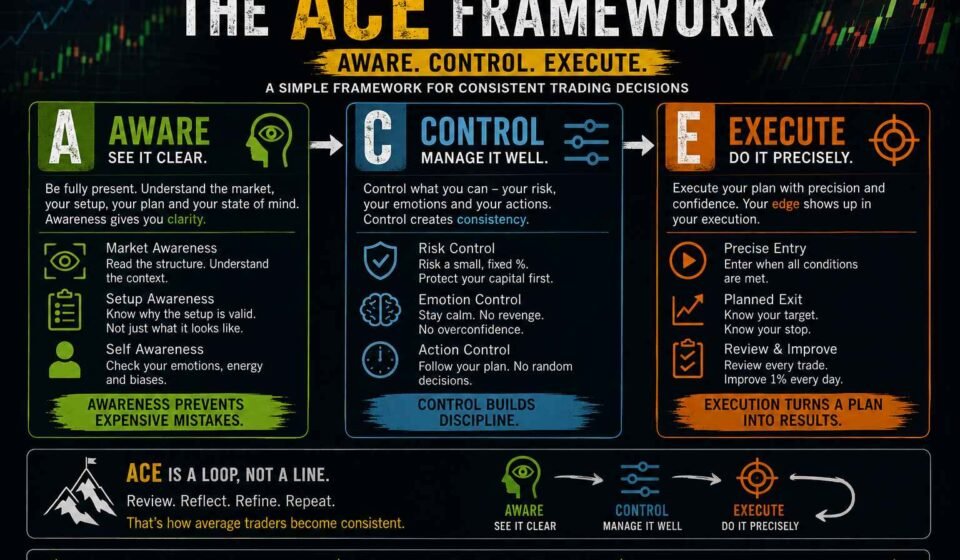

ACE stands for Aware, Control, Execute. It is a three-stage sequence for making a trading decision, in that order, every single time, whether the decision is to enter, to hold, to exit, or to stay out entirely.
Most trading advice jumps straight to the third stage. Execute better. Follow your stop. Stick to the plan. That advice is not wrong, but it arrives too late to work, because by the time a trader is at the execute stage, the decision has usually already been shaped by whatever state they were in and whatever impulse they did not catch. ACE works because it puts two steps in front of execution, and those two steps are where most trading mistakes actually originate.
The three stages, one at a time
Aware
Aware means noticing your own state and the market’s state before you act, not after.
This has two parts. The first is self-awareness: what condition are you in right now. Tired, anxious, overconfident from yesterday’s win, distracted by something outside trading, calm and rested. The second is market awareness: what is actually happening on the chart in front of you, separate from what you want or expect to happen.
Most traders skip this stage entirely and move straight to reading the chart, without ever checking their own state first. This is the mistake, because your state changes how you read the chart. A tired, anxious trader and a calm, rested trader can look at the exact same candle and see two different setups. Awareness is not a mood check for its own sake. It is the step that tells you how much to trust your own read of the market in this specific moment.
In practice, Aware takes the form of a short, honest check before the session starts, and again before any trade that feels urgent: What is my state right now. What did I do differently today, sleep, stress, size, screen time. What is the market actually doing, trending, ranging, choppy, versus what I expect it to do.
Control
Control means managing the impulse between noticing a setup and acting on it, using rules that were decided in advance rather than a judgment made in the moment.
This is the stage most traders think they are already good at, and it is the stage that fails most often, because control is not about willpower in the moment. Willpower is unreliable exactly when you need it most, during a fast market or right after a loss. Control that actually works is control that was pre-decided: a position size cap written down that morning, a daily loss limit in rupees, a rule about how many losses in a row end the trading day. Control is the act of checking your live impulse against that pre-decided rule and letting the rule win, even when the impulse feels urgent and reasonable.
The reason Control sits between Aware and Execute, rather than being folded into Execute, is that they are genuinely different skills. Awareness tells you something is off. Control is the specific act of pausing there instead of proceeding straight to action. A trader can be fully aware that they are anxious after a loss and still skip Control, moving straight into a revenge trade anyway. Naming the state is not the same as managing what you do next with it. That gap is exactly what Control closes.
Execute
Execute means carrying out the plan exactly as written, with size, entry, and stop decided before the trade, not adjusted mid-trade based on how it feels.
Execute is the stage everyone focuses on because it is the visible one, the actual click of the button. But by the time you reach Execute inside the ACE sequence, most of the work is already done. If Aware correctly identified your state and the market condition, and Control correctly held the line against any impulse that did not match the plan, Execute becomes almost mechanical. This is by design. Execute should feel boring. When execution feels dramatic, exciting, or urgent, that is usually a sign that Aware or Control were skipped upstream, not that Execute itself is the problem.
One trade, all three stages
Here is a single realistic trade walked through the full sequence, to make the framework concrete rather than abstract.
It is 9:20am. Nifty futures gapped up and a trader, call her Priya, has a breakout setup on her watchlist that just triggered.
Aware: Priya checks her own state first. She slept only five hours because of a late call the night before. She also had a losing trade yesterday afternoon that she has not fully reviewed yet. Both of these are true before she looks at the chart. She then looks at the market: Nifty gapped up 0.6%, the breakout setup triggered on volume, but the first five minutes after market open are historically the most volatile and least reliable window of the day for her strategy. Two pieces of information now sit side by side: her own state is degraded, and the market condition is a low-reliability window for this specific setup.
Control: Priya’s pre-decided rule, written the week before, says no new entries in the first five minutes after open, and no full-size entries on any day she has slept under six hours. Both rules apply right now. The impulse says the setup looks strong and she does not want to miss it. Control is the act of checking that impulse against the two written rules instead of against how confident the setup feels. She waits. At 9:26am, the setup is still valid, five minutes have passed, and her sleep rule still caps her size at half of normal.
Execute: Priya enters at half her normal size, with her stop placed exactly where her plan defines it for this setup, not adjusted for the gap. The trade is managed afterward using the same pre-decided exit rules, not by watching the P&L number and deciding in the moment. Whether this specific trade wins or loses, the decision that produced it was sound, because every stage was followed in order.
Notice what did not happen. Priya did not skip the trade entirely out of excess caution, and she did not take it at full size out of excitement about the gap. Aware surfaced the real conditions, Control applied the rules that mattered given those conditions, and Execute carried out a plan that had already been adjusted correctly before the entry even happened.
Why the order matters
Aware, Control, Execute has to run in that order, because each stage depends on the one before it.
- Control without Aware is blind. You cannot apply the right rule if you have not first noticed which condition you are actually in.
- Execute without Control is just impulse with a chart attached. The chart reason makes it feel legitimate, but the decision was never actually filtered through a rule.
- Skipping straight to Execute, which is what most trading advice implicitly asks you to do, means trying to fix discipline at the exact moment discipline is hardest to access.
“I know I should follow my rules, I just don’t in the moment.”
That sentence describes a trader who has skill at Execute but no functioning Aware or Control stage in front of it. ACE exists specifically to fix that gap, by building the two steps that come before the moment everyone focuses on.
How to start using ACE this week
- Before market open, write one line for Aware: your state, and the market condition you are walking into.
- Write your Control rules in advance, on paper, before the session, not while a trade is open. Size caps, loss limits, and any no-trade windows specific to your patterns.
- Let Execute be the boring, mechanical last step. If it does not feel boring, go back and check whether Aware or Control were actually followed.
Frequently asked questions
Is ACE a trading strategy?
No. ACE does not tell you what setups to trade or what indicators to use. It is a decision-making sequence that sits on top of whatever strategy you already have, governing how you enter, hold, and exit using that strategy.
How long does the Aware step take in practice?
A genuine check takes two to three minutes before the session, and a few seconds before any trade that feels urgent. It is short by design. The value is in doing it every time, not in how long it takes.
What if I am aware of my state but still act on impulse anyway?
That is a Control failure, not an Aware failure, and it is the most common breakdown point. It usually means the rules were not written down clearly enough in advance, or the rule was written but not treated as non-negotiable. Strengthening Control means making the rule more specific and deciding in advance what happens when it is broken.
Can ACE be applied to exits, not just entries?
Yes, and it should be. Awareness of your state applies just as much to a trade that has moved against you as to a new entry. Control at the exit stage means following your stop as written rather than moving it based on hope. Execute at the exit stage means closing the trade as planned.
Why does ACE work better than just “trying to be more disciplined”?
Because it breaks discipline into three separate, checkable steps instead of treating it as one vague trait you either have or do not have in the moment. A trader can be weak at Control but strong at Aware, or vice versa, and knowing which stage is actually failing tells you exactly what to fix.
The real point
Most trading problems that look like a strategy issue are actually a sequencing issue. The trader has skill, has a plan, and still gets a different result live than on paper, because Aware and Control were never built as deliberate steps, only assumed to happen automatically.
The market does not reward better predictions. It rewards better decisions, and ACE is the sequence that produces them, one stage at a time, in order.
Pehle dekho, phir sambhalo, tab jaake karo.
Related reading:
- Trading Psychology: The Complete Guide for Indian Traders
- How to Make Calm Decisions While a Trade Is Still Open
- You Know the Strategy. Why Can You Not Follow It?
Want to build this into your own trading? I run a free live session twice a week for traders with two or more years of experience who know the setups but still cannot execute under pressure. Register for the next free session here.
I am Samir Dash, founder of Mindful Trading Hub. I work with experienced traders on live market decision-making. More about my story here.