

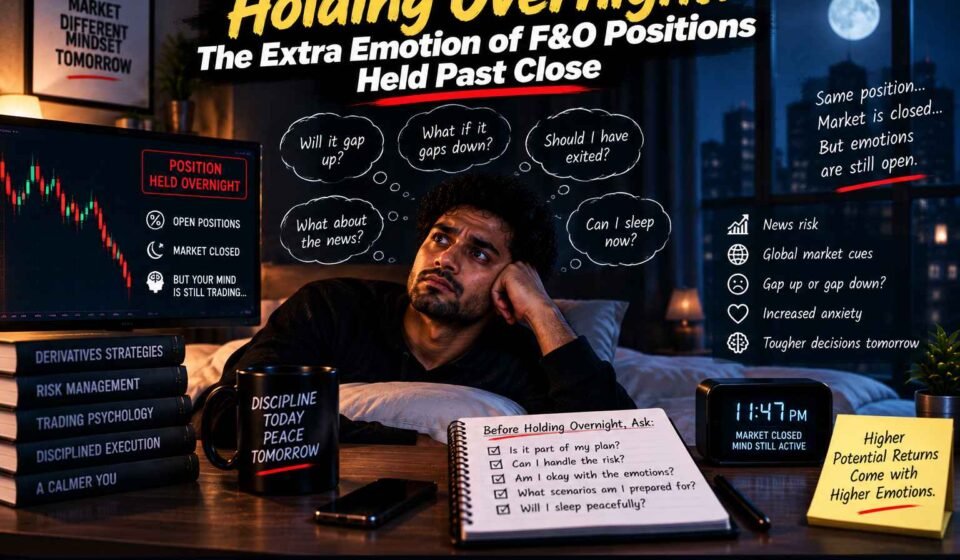

It is 3:25 PM. The market closes in five minutes. You have a position open, a swing trade in a stock, or a futures position, and you have a choice: close it now, or carry it into tomorrow.
The setup is still valid. Your plan always intended to hold this for two or three days. But there is a specific pull at 3:25 PM that does not exist at 11 AM on the same trade, a pull to just close it and start fresh tomorrow, even though nothing about the chart has changed.
This post covers why holding a position overnight feels different from holding it during market hours, what actually creates that extra weight, and how to manage a genuinely valid overnight position without letting the discomfort of the close talk you out of a good trade.
Why overnight feels heavier than intraday, even at the same risk
During market hours, if a trade moves against you, you can see it happen and, if your invalidation condition is hit, you can act immediately. There is a continuous feedback loop between the market and your ability to respond.
The moment the market closes, that loop breaks. The position is still open, but you cannot do anything about it until the next session, roughly 18 hours later on a normal day, longer over a weekend. This gap between “the position exists” and “I can act on it” is what creates the specific discomfort of holding overnight. It is not really about the position being riskier in a mathematical sense. It is about losing the ability to respond during a long stretch of time.
The mechanism: uncertainty without the ability to act
Humans generally tolerate risk better when they feel some sense of control over the outcome, even when that control is limited. During market hours, watching a live chart gives you the feeling of some control, even in moments where your best action is genuinely to do nothing. Overnight, that feeling of control is removed entirely, replaced by pure uncertainty until the market reopens.
This is why the same 3% stop distance feels different depending on when it will be tested. A 3% move during market hours feels manageable because you are watching it unfold and know you can act at any point. The same 3% move happening while you sleep feels like something that occurred without your knowledge or consent, even though the actual risk you accepted was identical.
What actually changes overnight, and what does not
It helps to separate what is genuinely different about overnight risk from what only feels different.
- Genuinely different: gap risk. The price can open the next day beyond your stop loss level, particularly around scheduled events, results, or global news that occurs while Indian markets are closed. This is covered fully in What to Do When a Trade Gaps Against You. This is a real, quantifiable difference and worth planning for.
- Genuinely different: reduced ability to react quickly. You cannot exit at 2 AM if something happens overseas. Your stop loss order, if it is a proper stop order rather than just a mental level, is the only thing working on your behalf while you are asleep.
- Not genuinely different: the underlying probability of your setup working. If your setup was valid at 3:25 PM, it does not become less valid at 3:31 PM just because the market closed. The chart pattern, the trend, the level you are trading around, none of that changes because trading hours ended.
The discomfort of the close often gets attached to the second category, the setup itself, when it actually belongs to the first two, gap risk and reduced control. Separating these clearly is most of the work in managing overnight positions well.
The urge to close everything before the bell
“I’ll just get out now and look for a fresh entry tomorrow if it still looks good.”
This sounds sensible and disciplined. Often it is the opposite. If the setup genuinely called for a multi-day hold, for example a swing trade based on a weekly trend, closing it at 3:25 PM purely to avoid overnight discomfort is not risk management, it is letting a scheduling artifact, the market closing bell, override a plan that had nothing to do with intraday timing.
The test that separates a valid close from an anxiety-driven one is the same test used elsewhere in trade management: has your invalidation condition occurred, or has your target or stop been hit? If none of those apply, the only thing that changed is that the market is about to close, which is not, on its own, a reason your plan was wrong.
What genuinely justifies closing before the close
There are legitimate reasons to close a position before the session ends that are not simply about discomfort:
- Your original plan was intraday only, meaning holding overnight was never part of the setup, and closing is simply following the original plan, not reacting to fear.
- A known high-impact event is scheduled before the next session, like company results or a major policy announcement, and your position size was not calculated with that specific gap risk in mind.
- The position is already sized appropriately for overnight gap risk but you are holding a larger number of overnight positions simultaneously than your total portfolio risk plan allows for.
In each of these cases, the decision to close is coming from a rule, not from the discomfort of not being able to watch the trade for 18 hours.
How to size for overnight risk properly
If your setup genuinely calls for a multi-day hold, the fix for overnight discomfort is rarely to avoid holding overnight altogether. It is to size the position so that a gap beyond your normal stop, not just a move to your normal stop, is still within a loss you can accept. This usually means sizing smaller for an overnight F&O position than you would for a pure intraday trade with the same stop distance, precisely because the stop cannot protect you from a gap the way it can during live market hours.
Once the size is set correctly for this reality, a lot of the emotional weight of holding overnight reduces, because the worst realistic case has already been accounted for in the position size, not left as an open question you carry to bed.
What to do the night the position is open
A few practical habits help here:
- Check global cues once, at a set time, such as US market close or early morning before the Indian open, rather than repeatedly through the evening.
- Write down what you will do at the open in three scenarios: gap in your favour, flat open, gap against you. Deciding this the night before removes the need to think clearly in the first chaotic minutes of the next session.
- Avoid checking the position during hours when you can do nothing about it anyway, like late at night. Checking without the ability to act simply adds anxiety without adding control.
Frequently asked questions
Is it wrong to hold F&O positions overnight at all?
Not inherently. Many valid swing setups require holding past the close. What matters is that the position is sized with gap risk in mind and that the decision to hold came from the original plan, not from ignoring genuine risk.
Why do I feel fine holding a position during the day but anxious about the same position overnight?
Because you lose the ability to react quickly once the market closes, even though the underlying setup has not changed. This is a normal response to reduced control, not a sign the trade itself has become worse.
Should I use a wider stop for overnight positions to account for gaps?
Not necessarily a wider stop, but a smaller position size that accounts for the possibility of a gap beyond your normal stop level. A wider stop alone does not protect against a gap that jumps past it entirely.
How do I stop checking global markets every hour the night before?
Set one or two fixed check times, and treat any check outside those times as an unplanned one, similar to the approach in The One-Trade Rule. Checking without the ability to act rarely reduces anxiety, it usually increases it.
What should I do if I wake up to a large gap against my position?
Follow the process in What to Do When a Trade Gaps Against You, which covers exactly this situation. The short version is to assess against your plan calmly rather than reacting to the size of the number on first glance.
The real point
Overnight risk is real, but most of the discomfort around it is about losing the feeling of control, not about the setup being wrong. The market does not reward better predictions. It rewards better decisions, and a position sized correctly for the night ahead lets you actually sleep instead of just lying there watching a number you cannot change.
Raat ko trade khula rehna theek hai, agar size sahi ho.
Related reading:
- How to Make Calm Decisions While a Trade Is Still Open
- How to Read a Nifty Chart Before the Market Opens
- What Happens in Your Brain While a Trade Is Open
Want to break this loop properly? I run a free live session twice a week for traders with two or more years of experience who know the setups but still cannot execute under pressure. Register for the next free session here.
I am Samir Dash, founder of Mindful Trading Hub. I work with experienced traders on live market decision-making. More about my story here.