

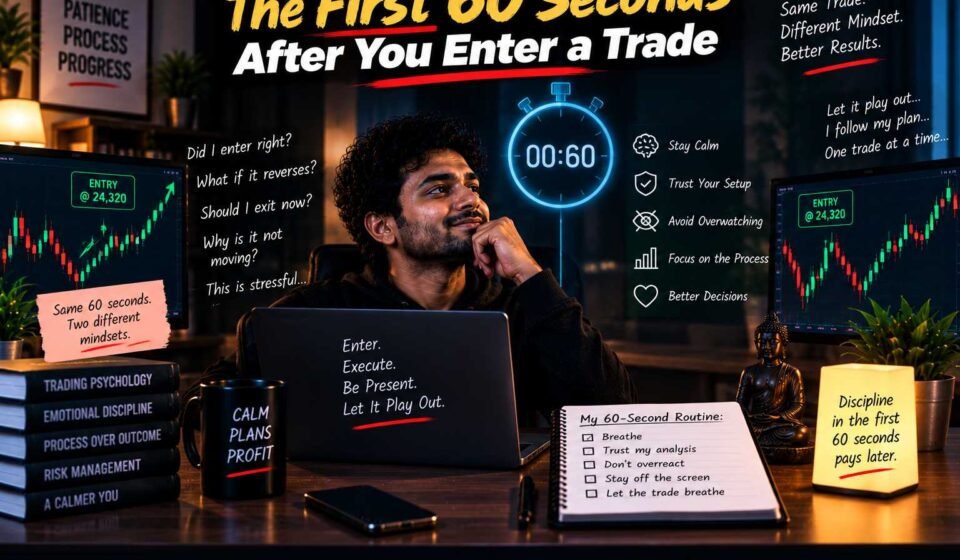

You click buy. The order fills. For about two seconds, nothing has happened yet, the price is exactly where you entered, and there is a strange stillness.
Then the price ticks down by 4 points. Your stomach drops slightly, even though 4 points is nothing against your 40-point stop. Ten seconds later it ticks up by 6 points and the drop in your stomach turns into a small lift. By the thirty-second mark you have already felt three or four emotional swings, and the trade has not done anything unusual at all.
This is the pillar post on the first 60 seconds after entry. It is a specific, short window, and it deserves its own attention because it is where a large number of trades get quietly damaged before the real trade even begins.
Why the first minute feels different from every minute after it
Before you enter, you are watching a chart with no consequence attached to it. The instant your order fills, the same chart is now attached to real money, and your brain updates its relationship to that chart immediately, even though nothing about the price action itself has changed.
This shift happens faster than most traders expect. Researchers who study decision-making under risk have repeatedly found that people evaluate identical information differently depending on whether they currently hold a stake in the outcome. You are not imagining that the trade “feels different” the second it fills. It does, to your brain, even though the chart in front of you is unchanged.
The first 60 seconds are the rawest version of this shift, because it has not had time to settle yet. This is why the first minute often produces the strongest urge to check, adjust, or second-guess, stronger than minute 20 of the same trade.
What is actually happening, second by second
Broken down, the first minute usually follows a recognisable pattern:
- 0 to 5 seconds: A brief neutral window. The order confirmation is still on screen. Most traders feel calm here, almost detached, because the reality of the position has not registered yet.
- 5 to 20 seconds: The price starts moving normally, and your attention locks onto the P&L number for the first time. Small moves that would be invisible on a static chart now register as meaningful, because you are watching them happen live and they are attached to your money.
- 20 to 40 seconds: The urge to check something appears, whether that is refreshing the chart, checking the option chain, or glancing at a related index. This urge is rarely about needing new information. It is about the discomfort of having just given up control by clicking the order button.
- 40 to 60 seconds: Either the feeling starts to settle as the trade starts to feel “normal,” or it escalates if the price has moved noticeably in either direction, setting the tone for how you will treat the rest of the trade.
None of these seconds contain new information about whether your setup was good. They are almost entirely about your relationship to the position, not the position itself.
The most common mistake in this window
“That doesn’t look right, let me get out and re-enter better.”
This thought, arriving somewhere around the 15 to 30 second mark, is one of the most expensive habits in live trading. The price has usually moved a handful of points, well inside normal noise, and the trader interprets ordinary movement as proof the entry was wrong. Exiting here and re-entering a few points later, sometimes repeatedly, quietly stacks up costs, both in actual rupees from spread and slippage, and in the mental fatigue of restarting the first-60-seconds cycle multiple times in a row.
If your stop and target were set properly before entry, a normal price fluctuation in the first minute is not new information. It is exactly what a live chart looks like, regardless of whether the trade eventually wins or loses.
Why this window matters more than it seems
The way you handle the first 60 seconds tends to set the emotional tone for the rest of the trade. If you check compulsively and react to noise in minute one, you are more likely to keep doing that in minute twenty. If you can get through the first minute without reacting to noise, the rest of the trade is generally easier to manage, because you have proven to yourself, in a small and immediate way, that you can hold the plan under live pressure.
This connects directly to The One-Trade Rule: Why You Should Not Watch Every Tick. The first minute is the hardest place to apply that rule, because the urge to watch is at its strongest right after entry. It is also the most valuable place to apply it, because a calm first minute makes the rest of the trade easier to hold to.
What to do in the first 60 seconds instead
You cannot skip this window, but you can decide in advance what to do with it, which removes most of its power.
- Say your plan out loud or write it down again, even though you already wrote it before entering. Repeating “stop at 24,780, target at 24,920” in the first ten seconds reinforces the plan while your attention is most reactive.
- Do not touch the chart for the first 60 seconds if at all possible. Look away, check a different screen, or start a small unrelated task. This is a short enough window that most traders can manage it even if longer no-check periods feel hard.
- Notice the urge to check without acting on it. The urge itself is not a problem. Acting on it every time is what causes damage.
- Expect the stomach-drop or chest-tightness feeling and treat it as normal rather than as a signal that something is wrong. Feeling it and ignoring it is a skill that improves with repetition.
By the time the minute is over, the trade has usually settled into a more normal rhythm, and your job shifts to the longer-term management covered in the main pillar post, How to Make Calm Decisions While a Trade Is Still Open.
What experienced traders do differently in this window
The difference between a trader with ten years of screen time and one with two is rarely that the first-minute feeling has vanished for the experienced trader. Ask most veteran traders directly and they will admit the stomach still reacts, even now. What has changed is what happens immediately after the feeling shows up. A newer trader treats the feeling as a signal to act. A more experienced trader treats it as a familiar, expected sensation that passes on its own within a minute or two, and simply waits it out rather than responding to it.
This is a learnable skill, not a personality trait some traders happen to have and others do not. It is built the same way any skill is built, through repetition, specifically the repetition of noticing the urge in the first sixty seconds and choosing not to act on it, trade after trade, until it stops requiring conscious effort.
How position size shows up in this window
The intensity of the first-minute feeling is strongly tied to position size. A trade sized comfortably tends to produce a mild version of the sequence above. A trade sized above your comfort threshold, explored fully in How Position Size Changes the Way You Feel About a Live Trade, can turn the first 60 seconds into something closer to genuine alarm, even on a setup that is objectively fine. If your first minute regularly feels intense regardless of the setup, size is worth checking before technique.
Frequently asked questions
Is it normal to feel anxious right after entering every trade?
Yes, some version of this is common even among experienced traders, because the shift from observer to participant happens instantly at entry. What matters is whether the feeling changes your actions or whether you can let it pass without reacting.
Should I avoid looking at the chart at all for the first minute?
Where practical, yes. If your platform requires you to confirm the order filled correctly, a single check for that purpose is fine. Repeated checking during this window is where the habit tends to cause problems, not a single confirmation glance.
Why does a 4-point move feel so much bigger right after I enter than it would an hour into the trade?
Because your attention is at its most reactive immediately after entry, before the position has had time to feel “normal.” The same move later in the trade usually registers as far less significant, even though the number itself has not changed in size.
I keep exiting within the first minute and re-entering later at a worse price. How do I stop this?
Treat any exit inside the first 60 seconds as against your rules unless your invalidation condition, decided before entry, has actually occurred. If it has not, the exit was reactive, not planned, regardless of how it is justified afterward.
Does the first-minute feeling ever go away completely with experience?
For most traders it softens noticeably but rarely disappears completely, particularly at new size levels or unfamiliar setups. The goal is not to eliminate the feeling, it is to stop it from making decisions on your behalf.
The real point
The first 60 seconds are not a preview of how the trade will go. They are a preview of how you will handle pressure, and that is worth paying attention to on its own. The market does not reward better predictions. It rewards better decisions, and the best trades are usually the ones where the first minute passed quietly, exactly as planned.
Pehla minute shant rakho, baaki trade khud sambhal jayegi.
Related reading:
- How to Make Calm Decisions While a Trade Is Still Open
- How to Read a Nifty Chart Before the Market Opens
- What Happens in Your Brain While a Trade Is Open
Want to break this loop properly? I run a free live session twice a week for traders with two or more years of experience who know the setups but still cannot execute under pressure. Register for the next free session here.
I am Samir Dash, founder of Mindful Trading Hub. I work with experienced traders on live market decision-making. More about my story here.