

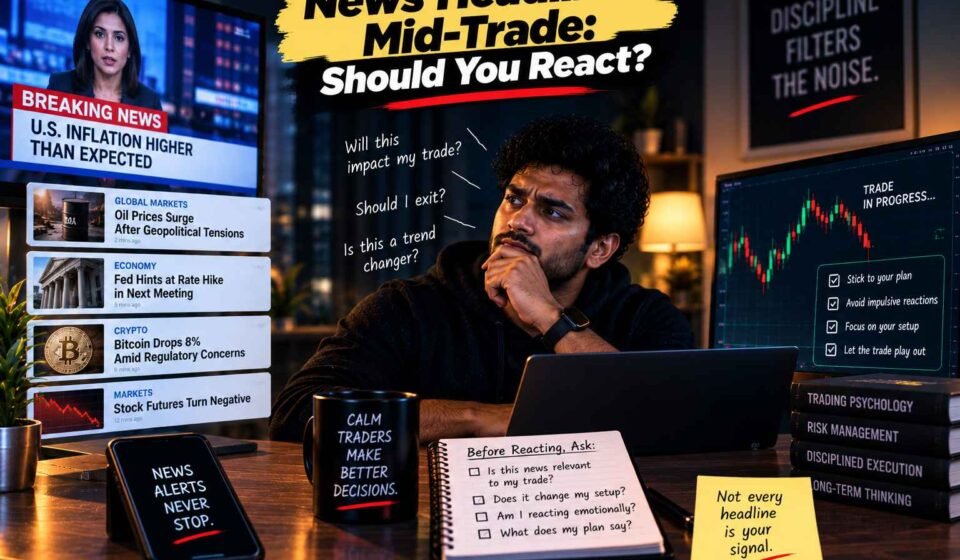

You are 20 minutes into a trade. Nifty is sitting quietly near your entry. Then a headline flashes across a news app on your second monitor: “RBI Governor comments on rate outlook.” Within four seconds, Nifty moves 30 points. Your P&L, which was flat a moment ago, is now down ₹3,000.
Your thumb is already moving toward the exit button before you have read the second half of the headline. This is the moment this post is about. Not the news itself, but the four seconds between seeing it and acting on it, and what usually goes wrong inside those four seconds.
Why a headline feels more urgent than a price move
A price move by itself is just a number. A headline attached to that price move gives your brain a story, and stories feel more real and more urgent than numbers alone. “RBI comments on rates” sounds like a reason. “Price moved 30 points” does not, even though the price move is the only part that actually affects your position.
This matters because your brain is far more comfortable acting on a story than acting on a number. A number needs interpretation. A story, especially one delivered in an urgent tone with words like “breaking” or “just in,” triggers a much faster, less careful response. News apps and financial channels know this, which is part of why headlines are written the way they are.
What actually happens in the four seconds after a headline
Here is the honest sequence, broken into its real steps:
- You see the headline before you understand it. The word “RBI” or “Fed” or “war” registers before the actual content does.
- Your attention narrows onto the P&L number, which has usually already started moving by the time you notice the headline, because algorithmic trading reacts to news faster than any person can read it.
- You feel the urge to do something, specifically to exit, because exiting feels like taking back control of a situation that suddenly feels unpredictable.
- You act, often before finishing the headline, let alone understanding whether it is actually relevant to your specific trade.
The exit itself is rarely based on the content of the news. It is based on the feeling of urgency the news created. This is why two traders reading the same headline in the same trade often make opposite decisions, neither of which was really based on analysis.
The question that matters: does this news change your invalidation condition?
In Why You Should Decide Your Exit Before You Enter, the invalidation condition is defined as the one thing that would tell you your original reason for the trade was wrong, separate from price alone. This is the exact tool that answers the news question.
Before reacting to any headline, ask one question: does this specific piece of news change the invalidation condition I wrote down before I entered? If your trade was a technical breakout on Nifty and the headline is about a mid-cap company’s quarterly results, the answer is almost always no, regardless of how dramatic the headline sounds. If your trade was specifically a rate-sensitive banking stock and the headline is an unscheduled RBI statement, the answer might genuinely be yes.
Most headlines that appear mid-trade fail this test. They are dramatic, but they are not relevant to the specific setup you took.
Why “just in case” reactions are usually the expensive ones
“I don’t know what this means yet, but I’d rather be safe and get out.”
This sounds cautious, and caution is generally a good instinct in trading. The problem is what “safe” actually means in this sentence. Exiting a well-planned trade because of an unread, unprocessed headline is not the same as respecting your stop loss. Your stop loss represents a level you calculated in advance, based on where your idea would actually be wrong. A news-driven exit represents a level determined by how fast a headline scrolled across your screen.
Across many trades, the “just in case” exits tend to cost more than they save, because most headlines that trigger them turn out to be noise, priced in within minutes, or unrelated to the actual position. The exits that would have saved money, the ones tied to genuinely relevant news, are rare enough that a general “exit on any headline” rule loses more than it protects.
When reacting to news is actually correct
This is not a rule to ignore all news forever. Some situations genuinely call for an immediate exit or size reduction:
- Scheduled high-impact events you forgot about, like an RBI policy announcement or a major US Fed decision, where you should not have been holding a large position through the event in the first place. In this case the fix is better pre-trade planning, not a faster reaction now.
- News that directly and specifically hits your instrument, for example a stock-specific regulatory action or an unexpected corporate announcement on a stock you are holding.
- A gap-triggering event outside market hours, which is a related but separate situation covered in What to Do When a Trade Gaps Against You.
In these genuine cases, the right response is still not a panicked click. It is a fast but deliberate check against your invalidation condition, followed by an exit if it applies.
A simple filter for headlines while you are in a trade
- Read the whole headline before doing anything, not just the first few words.
- Ask if it is specific to your instrument or sector, or general market noise.
- Ask if it changes your invalidation condition, not just your P&L.
- If both answers point to “not relevant,” return to your stop and target and do nothing.
- If it is genuinely relevant, exit or reduce size according to your risk rules, calmly, not as fast as possible.
This filter takes maybe fifteen seconds to run through once it becomes a habit, which is slower than the panic reaction but far more accurate.
Why algorithms react before you can read the headline
It is worth understanding one more piece of this, because it changes how you should think about your own reaction speed. A large share of the price move you see the instant a headline appears has already been driven by automated systems reading the same news feed faster than any human can read a sentence. By the time your eyes finish the headline, the “first reaction” in price has often already happened.
This means that when you react within a few seconds of seeing a headline, you are not front-running the market, you are reacting after the fastest part of the move is already over, often at a worse price than if you had simply waited for your invalidation check to run its course. Trying to beat the algorithms to the exit is not a fair fight, and it is not one you need to enter. Your edge as a retail trader was never speed. It was a plan, made in advance, that does not depend on being first.
Reducing exposure to headlines in the first place
If you are following The One-Trade Rule, you are already less exposed to this problem, because you are not watching a live feed continuously while a trade is open. Consider keeping news apps and financial Twitter closed during your checkpoint windows, and only opening them if an alert on your actual position fires. Most headlines that feel urgent in the moment are not urgent at all by the time your next scheduled check comes around.
Frequently asked questions
Should I close all my trades before a scheduled news event like RBI policy?
For most retail intraday and short-swing setups, yes, reducing size or closing out ahead of known high-impact scheduled events is a reasonable risk rule, decided in advance rather than reacted to in the moment.
How do I know if a headline is actually relevant to my trade?
Check it against the invalidation condition you wrote before entering. If the headline does not touch the specific reason you took the trade, it is very likely noise for your position, even if it is significant for the broader market.
What if the news turns out to be true and the market keeps moving against me?
Your stop loss is still there for exactly this situation. A relevant piece of news does not require you to abandon your risk plan, it just means the market may reach your stop faster than expected, which your stop is already designed to handle.
Why do I feel calmer after reacting immediately, even when it was the wrong call?
Acting removes the discomfort of uncertainty in the short term, which feels like relief. That relief is not the same as the reaction being correct. Judge the decision against your invalidation condition, not against how it felt in the moment.
Should I mute financial news apps completely while trading?
Muting notifications during checkpoint windows is a reasonable middle ground. You do not need to be unaware of major events, you just do not need every headline pushed to you the instant it appears.
The real point
A headline is not a decision. It is an input that may or may not be relevant to a decision you already made carefully before you entered. The market does not reward better predictions of what a headline means. It rewards better decisions about whether that headline actually changes anything for your specific trade.
Khabar aayi, iska matlab yeh nahi ki turant react karo.
Related reading:
- The ACE Framework: Aware, Control, Execute Explained
- Mindfulness for Traders: What It Actually Means (Not Just Sitting Still)
- What Happens in Your Brain While a Trade Is Open
Want to break this loop properly? I run a free live session twice a week for traders with two or more years of experience who know the setups but still cannot execute under pressure. Register for the next free session here.
I am Samir Dash, founder of Mindful Trading Hub. I work with experienced traders on live market decision-making. More about my story here.