

You place the trade. Then you watch the chart. Not for a reason, just because it is there, updating every second, and closing the tab feels like losing control of something you are supposed to be controlling.
Twelve minutes later you have watched roughly 700 individual price ticks. Maybe five of them were meaningfully close to your stop or your target. The other 695 were noise your eyes tracked anyway, and every single one of them gave your brain a small chance to second-guess a plan that was already written down.
This post explains why watching every tick feels like discipline but actually works against it, what happens in your attention system when you stare at a live number, and the one-trade rule that fixes it without asking you to develop superhuman patience.
What watching every tick actually costs you
The instinct to watch closely comes from a reasonable place. You care about the outcome, so you pay attention. The problem is that a live price chart does not reward attention the way most things in life do. Watching a pot does not make it boil faster, but at least watching a pot gives you no false signals along the way. A live chart gives you hundreds of false signals an hour, and your brain cannot tell in advance which ones are real.
Each tick that moves against your entry produces a tiny stress response, even inside a trade that is well within your planned risk. Multiply that by hundreds of ticks and the cumulative fatigue is real, even if no single tick felt dramatic. By the time an actual decision point arrives, near your stop or your target, you are often already worn down from a hundred decisions you never needed to make.
The mechanism: why your brain cannot ignore a moving number
Human attention is built to notice change and movement more than stillness. This is not a trading flaw, it is a general feature of how attention works, and it is normally useful, it helps you notice a car pulling out or a child running toward a road. Applied to a live P&L number, the same system fires constantly, because the number is always changing.
The result is that your brain treats every tick as if it might be new information, even though a 3-point move inside a 60-point stop range carries almost no information at all. You end up reacting to noise with the same intensity you would react to a real signal, because your attention system was never built to tell the difference on its own. That distinction has to be made deliberately, with a rule, not left to instinct.
The one-trade rule
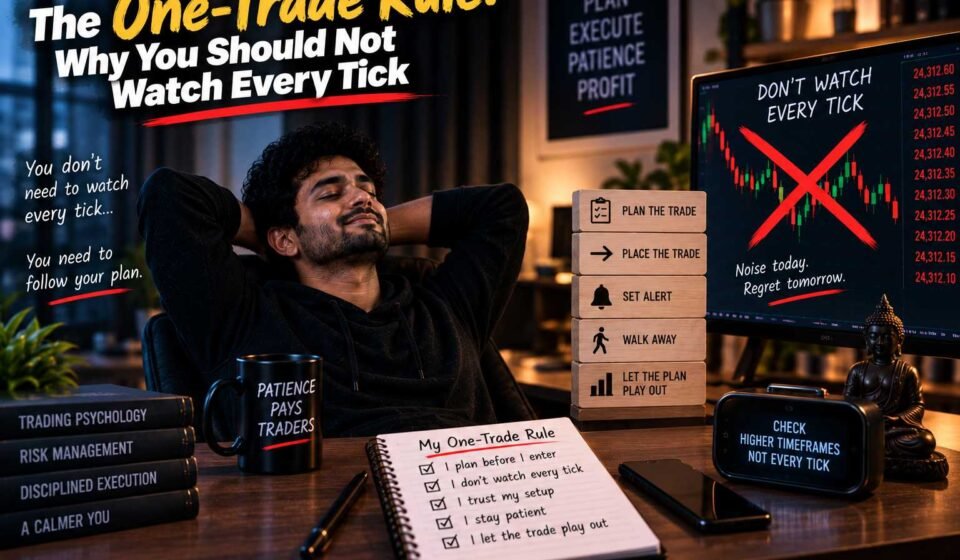
The rule is simple to state and hard to follow the first few times you try it: once a trade is live, you are allowed to look at it in response to an alert, not on your own initiative.
In practice, this means:
- Set two price alerts before you enter, one at your stop loss level and one at your target. Most trading apps and even basic charting tools support this.
- Close the chart, or at minimum close the live P&L column, after you enter. If you are trading from a laptop, switch to a different application. If you are on your phone, lock the screen.
- Only open the chart again when an alert fires, or at a small number of pre-decided checkpoints, for example once every 15 or 30 minutes depending on your timeframe.
- Treat every unplanned check as data, not a failure. If you catch yourself opening the chart out of habit, note it. Over a week you will usually find the checks cluster around specific triggers, like a notification sound or a certain time of day.
The name “one-trade rule” comes from the idea that you should be managing one trade at a time, based on its actual levels, rather than running a continuous commentary on every tick it produces.
Why this is harder than it sounds
“What if something happens and I miss it?”
This is the thought that pulls people back to the chart every ninety seconds. It feels protective. In practice, the only two things that need your action are your stop and your target, and both of those are covered by an alert. Everything else that “happens” on the chart between those two points does not require you to do anything, by definition, because you already decided what to do at every meaningful level before you entered.
If you notice this thought coming up often, it is usually less about the trade and more about a general discomfort with not being in control of something in real time. That discomfort is worth noticing on its own, separate from whether checking the chart actually helps the trade.
What to do with your attention instead
Removing the chart creates a gap, and that gap needs to go somewhere or you will simply refill it by reopening the chart. A few options that work for most traders:
- Do a different, focused task for the checkpoint window, something that needs enough attention to occupy you but not so much that you cannot step away when an alert fires.
- Journal the trade rationale while you wait, writing out why you took it and what you expect, which reinforces the plan rather than second-guessing it.
- Physically leave the desk if you are trading from a laptop. Distance from the screen is one of the most reliable ways to reduce compulsive checking, more reliable than willpower alone.
How this connects to interruptions and news
Interestingly, traders who follow the one-trade rule often report that when a real interruption does happen, like someone talking to them or a phone call, they handle the trade better, not worse. This is explored fully in Why You Exit the Moment Someone Talks to You While Trading. A trade that is being watched constantly makes any interruption feel dangerous, because the interruption breaks a habit loop you had built around checking. A trade that is only checked at alerts does not have that fragile loop to break.
The same logic applies to news headlines appearing mid-trade, covered in News Headlines Mid-Trade: Should You React?. If you are not watching continuously, you are less likely to see a headline the instant it drops and react to it before you have had a chance to think.
What experienced traders report after a few weeks
Traders who commit to the one-trade rule for even two or three weeks tend to describe a similar shift. In the first few days it feels uncomfortable, almost like ignoring something you are supposed to be responsible for. By the second week, most report that their trade journal notes get cleaner, because there are fewer entries like “exited early, felt nervous” and more entries like “hit target as planned.” The quality of the notes is often a better sign of progress than the P&L in any single week, because it reflects whether the plan is actually being followed, not just whether the market happened to move favourably.
This does not mean the urge to check disappears completely. It means the urge stops automatically translating into action, which is the actual goal of the rule.
A realistic version for your first attempt
Do not try to go from checking every ten seconds to checking only at alerts on your very first attempt, that swing is too large and usually fails within a day. Instead, set a checkpoint interval, for example every 10 minutes, and extend it gradually as it gets easier. The goal over a few weeks is to get to a place where alerts do almost all the work and checkpoints are rare.
Frequently asked questions
Isn’t it risky to not watch my trade at all?
Your stop loss and target alerts are doing the watching for you, based on the exact levels you decided in advance. What you are removing is not risk management, it is the habit of watching ticks that carry no decision-relevant information.
What if my broker’s platform does not support price alerts?
Most major Indian broker apps support basic price alerts. If yours genuinely does not, set a timer for fixed checkpoints instead, and treat any check outside those checkpoints as an unplanned one worth noting.
I trade intraday on a 5-minute chart. Doesn’t that mean I have to watch closely?
A shorter timeframe changes how often your checkpoints should be, not whether you should watch every tick. A scalper checking every 2 minutes is still following the one-trade rule if those checks are scheduled rather than constant and compulsive.
Why do I feel anxious the moment I stop watching, even for a few minutes?
This is a withdrawal-like response to breaking a checking habit, not a sign that something is actually wrong with the trade. It usually fades within a few sessions of practising scheduled checks instead of continuous ones.
Does watching less mean I care less about my trading?
No. It means you are trusting the plan you built while you were thinking clearly, instead of re-deciding it every few seconds while you are not.
The real point
Watching every tick feels like control, but it is closer to giving 700 small decisions to a version of you that is under pressure and has no new information to work with. The market does not reward better predictions. It rewards better decisions, and most of those decisions were already correct the moment you set your stop and your target.
Har tick dekhna zaroori nahi, plan sahi hona zaroori hai.
Related reading:
- The ACE Framework: Aware, Control, Execute Explained
- Mindfulness for Traders: What It Actually Means (Not Just Sitting Still)
- What Happens in Your Brain While a Trade Is Open
Want to break this loop properly? I run a free live session twice a week for traders with two or more years of experience who know the setups but still cannot execute under pressure. Register for the next free session here.
I am Samir Dash, founder of Mindful Trading Hub. I work with experienced traders on live market decision-making. More about my story here.