
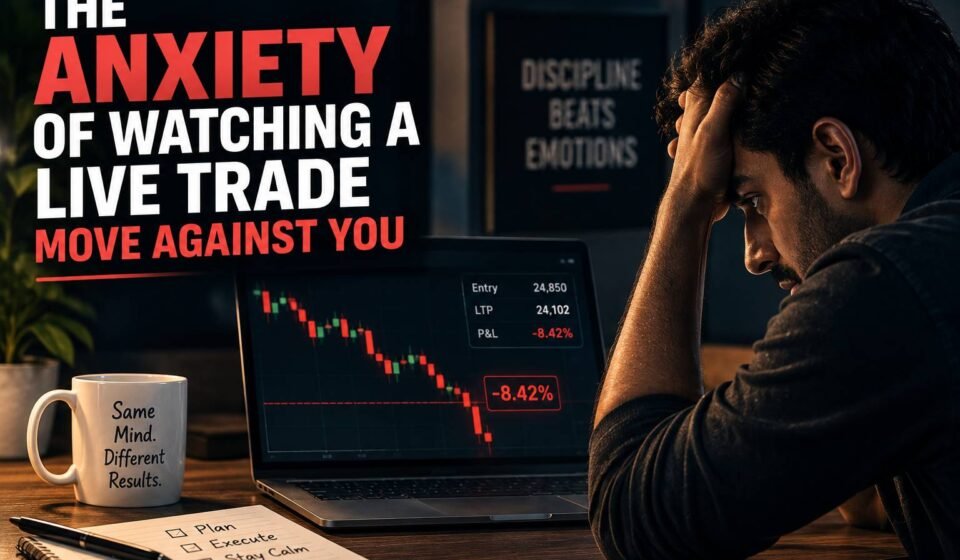

The candle prints red. Your P&L drops from minus 2,000 to minus 4,500 in the space of one five-minute bar. Your stop is still 3,000 rupees away, which means the trade has not actually broken your plan. But your chest feels tight, your scroll finger keeps opening the P&L screen, and a single thought is looping: get out now.
This is trading anxiety in its most common form. It is not about the account being at risk of ruin. It is a live, physical reaction to a number moving in the wrong direction, happening well before any actual rule has been broken.
What anxiety does to your attention while a trade is open
Anxiety has one main job. It narrows your attention onto the source of the threat and away from almost everything else. This is useful if you are avoiding an actual physical danger. It is a serious problem when the “danger” is a price on a screen and the thing you need to be paying attention to is your original plan.
Once anxiety takes over, here is what typically disappears from view:
- The distance between the current price and your actual stop loss.
- The higher timeframe trend that originally justified the trade.
- The size of the loss relative to your monthly risk budget, which is usually much smaller than it feels.
- Any memory of similar trades that recovered after looking exactly this bad.
What replaces all of that is a single, oversized question: how do I make this feeling stop right now. And the fastest way to make it stop is to close the trade, whether or not closing it is the correct decision.
Why the loss feels bigger than it is
A loss that is still open and moving feels considerably worse than the same loss once it is closed and final, purely because of the uncertainty. Your brain does not just react to the size of a potential loss. It reacts strongly to not knowing how big the loss will end up being.
An open, moving trade against you carries this uncertainty at every single second. The 4,500 rupee loss might become 3,000, or it might become 9,000. Your brain treats that unresolved range as more threatening than a fixed 6,000 rupee loss would be, even though the fixed number is larger. This is why closing a losing trade early, even a small one, so often brings instant relief. You have removed the uncertainty, not just the loss.
The physical side, and why it matters
This kind of anxiety is not only mental. Your heart rate rises. Your breathing gets shorter and higher in your chest. Some traders notice their hand on the mouse gets slightly unsteady. None of this is dramatic or visible to anyone else, but it is real, and it directly affects the quality of your decisions.
A body in this state is optimised for one thing: fast action to remove the threat. It is not optimised for checking a chart calmly against a written rule. This is why traders who are normally careful and analytical can make a snap exit decision during a live losing trade that they would never make if you showed them the same setup on a screenshot the next day.
“I just need this to stop moving against me. I’ll figure out if it was right or wrong later.”
That thought is the anxiety talking, not your trading plan. Your plan does not care about the feeling stopping. It cares about whether your stop has actually been hit.
The gap between “uncomfortable” and “invalidated”
This is the single most useful distinction to build into your trading. A trade being uncomfortable to watch is not the same as a trade being invalidated by your rules.
- Uncomfortable means the price is moving against you, inside the range your stop already accounts for, and your original setup reasoning has not changed.
- Invalidated means price has actually broken your stop level, or the specific condition you wrote down before entry that would prove the trade wrong.
Anxiety makes uncomfortable feel exactly like invalidated. They are not the same thing, and confusing them is what turns a normal, planned-for drawdown into an early exit that abandons a trade before it ever had a real chance to work.
Three things to do in the moment, not after
These are not long-term fixes. They are actions you can take while the anxious feeling is happening, without needing to feel calm first.
- Say the actual distance to your stop out loud or write it down. “Price is at 24,735, my stop is 24,720. That is 15 points away.” This forces you to check reality instead of the feeling.
- Take one slow breath out longer than the breath in. This is a simple, physical signal that directly reduces the body’s alarm response. It takes ten seconds and does not require any trading skill.
- Step away from the screen for sixty seconds. Not to ignore the trade, but to break the loop of constant checking, which is what keeps refreshing the anxiety.
None of these are about becoming fearless. They are about buying yourself the few seconds needed to check your plan instead of your feelings. This is the Control step of ACE in practice, not in theory.
Why avoiding red trades entirely is not the answer
Some traders respond to this anxiety by trying to avoid ever seeing a trade go red, closing positions the instant they dip even slightly. This feels like solving the problem, but it usually just moves the cost elsewhere. You start cutting valid trades before they have room to work, which quietly drags down your win rate and your average gain over time.
The goal is not a trading style with no red candles. Every real trading edge involves some open losses along the way, most of which recover inside a well-placed stop. The goal is separating the discomfort of watching red from the actual decision of whether to exit.
What this looks like across a full trading day
Anxiety while watching a losing trade rarely stays contained to that one trade. A bad twenty minutes on your first position of the day often changes how you trade everything after it. You take the next setup slightly early, because waiting for full confirmation now feels unbearable. You size the next trade slightly smaller than your plan calls for, not because your rules changed, but because you are still carrying tension from the last one.
This is worth naming, because it means the cost of unmanaged trade anxiety is rarely limited to the trade that caused it. It shows up as a subtle drag on every decision for the rest of the session, usually without you noticing the connection. If your second and third trades of the day tend to be worse quality than your first, this carried-over anxiety is a common, underrated reason why.
Frequently asked questions
Is it normal to feel anxious every time a trade goes red?
Yes. This is one of the most universal experiences in trading, regardless of experience level. What separates consistent traders is not the absence of this feeling, but a rule for what to do while feeling it.
How do I stop myself from exiting early out of anxiety?
Write your stop level and invalidation condition down before you enter. When anxiety hits, check current price against those written numbers instead of asking yourself how you feel. If the numbers have not been hit, the plan says hold.
Why does a small loss sometimes feel worse than a big one?
Because an open, moving loss carries uncertainty about how large it will get, and uncertainty itself is uncomfortable, separate from the size of the loss. A closed, fixed loss, even a larger one, often feels calmer simply because the uncertainty is gone.
Should I stop watching the trade completely to avoid the anxiety?
Reducing how often you check helps. Never checking at all is risky, since you still need to see if your stop or target has actually been hit. A middle ground, like checking every fifteen or twenty minutes instead of every fifteen seconds, works better than either extreme.
Does this anxiety ever go away with experience?
It reduces in intensity for most traders over years, but rarely disappears completely, especially on larger size or important trades. Experienced traders manage it with rules and process, not by no longer feeling it.
The real point
The anxiety you feel watching a trade move against you is not evidence that something is wrong with your trading. It is evidence that your body treats a moving loss as an unresolved threat, which is exactly what it is designed to do.
Your job is not to switch that system off. It is to build a small, repeatable gap between the alarm going off and your hand moving to close the trade.
The market does not reward better predictions. It rewards better decisions.
Ghabrahat sach hai, lekin faisla plan se hoga, dar se nahi.
Related reading:
- Fear of Loss in Trading: Why You Cannot Pull the Trigger
- Greed in Trading: What It Actually Feels Like in a Live Trade
- How to Make Calm Decisions While a Trade Is Still Open
Want to break this loop properly? I run a free live session twice a week for traders with two or more years of experience who know the setups but still cannot execute under pressure. Register for the next free session here.
I am Samir Dash, founder of Mindful Trading Hub. I work with experienced traders on live market decision-making. More about my story here.