

Before you enter a trade, you are a calm, rational person looking at a chart. Three seconds after your order fills, you become someone else.
This is not a character flaw. It is a predictable, mechanical shift that happens to every trader, every time, without exception. This is the pillar post on that shift. It covers what actually changes in your body and attention the moment a trade goes live, why the feeling is so different from planning the same trade on paper, and what you can do about it that does not depend on willpower.
The moment the order fills
Picture it exactly. You click buy on Nifty futures at 24,850. The order confirms. For the next few seconds, nothing about the market has changed. The candle is the same candle. The setup is the same setup you studied for twenty minutes before entering.
But something in you has changed completely. Before the fill, the trade was a hypothesis. After the fill, it is money. Your money, moving in real time, in front of your eyes, with a number attached to it that updates every second.
That single shift, from hypothesis to live money, is the entire reason planning a trade and living through a trade feel like two different activities done by two different people.
Why planning-you and holding-you disagree
When you plan a trade the night before or in the morning before the market opens, you are using a slow, careful part of your thinking. You compare scenarios. You check your rules. You are not under time pressure and nothing is currently costing you money.
The moment a trade is open and the price is moving, a faster and older part of your brain takes over. This system does not compare scenarios. It reacts to threat and reward right now, in the current second. It does not care what you decided at 9 AM. It cares what the P&L number says at 11:42 AM.
This is why a rule that felt completely obvious on paper, like “I will hold to my target no matter what,” can feel impossible to follow twenty minutes into a live trade. The person who wrote the rule and the person trying to follow it are running on different systems in your brain, and the second system is louder when money is actually moving.
The P&L number is doing more than you think
Every time your account balance updates, your attention gets pulled toward it. This is not weakness. A number that keeps changing and represents your money is one of the strongest attention magnets that exists. You did not choose to keep checking it. Your attention is built to track things that move and things that matter, and a live P&L is both.
The problem is what constant checking does to your decisions. Each time you look, you get a fresh emotional hit, either relief or worry. String together forty checks in an hour and you have had forty small emotional events, each one nudging you slightly toward acting. Most bad exits do not come from one big decision. They come from the fortieth check, when you are tired of feeling the number move.
“I’ll just check it one more time, then I’ll leave it alone.”
You have probably said a version of that sentence to yourself in the last month. It is rarely true, and it is not really about the trade. It is about wanting the checking itself to stop.
Three emotional states you cycle through
Almost every live trade puts you through some mix of three states, often within the same ten minutes.
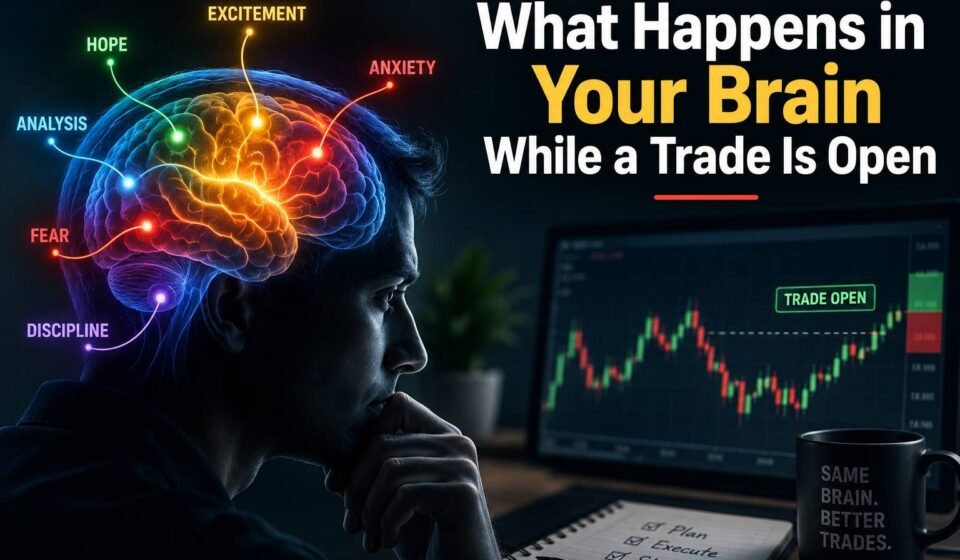
- Hope. The trade is flat or slightly against you, and you find reasons it will still work. Covered in full in Hope Is Not a Trading Plan.
- Fear. The trade moves against you fast, and your attention narrows to the loss, not the plan. This is covered in The Anxiety of Watching a Live Trade Move Against You.
- Relief-turned-fear. The trade moves in your favour, and instead of feeling good, you feel a new kind of pressure to protect what you have. Covered in Why Green Trades Make You Nervous and Red Trades Make You Calm.
Notice that none of these three states is neutral. There is no default calm setting once a trade is open. Calm is something you build with rules, not something that happens naturally.
Why your body is involved, not just your mind
A live trade against you produces a real physical response. Your heart rate goes up slightly. Your breathing gets shorter. Your shoulders tighten. This happens even when the loss, in rupee terms, is small compared to your monthly income.
Your body cannot tell the difference between a market threat and a physical one. It reacts to the possibility of loss with the same basic alarm system used for anything else that feels dangerous. This is why traders who are otherwise calm, successful, rational people in every other part of their life can feel their hands shake slightly while watching a red position.
Once you know this is physical and not just mental, it becomes something you can manage directly. A slower exhale, a few seconds away from the screen, a glass of water. These sound too simple to matter, but they work on the actual mechanism, not on willpower.
The three-second rule that separates good traders from the rest
The traders who execute well under pressure are not traders who feel less. They feel the same pull toward checking, hoping, and panicking as everyone else. What they have built is a three-second gap between the feeling and the action.
The gap looks like this:
- Notice the urge. “I want to close this right now.”
- Name it without acting on it. “This is fear, not my plan talking.”
- Check the plan you wrote before entry. Does the current price action actually break your stop or target, or does it just feel uncomfortable?
- Act on the plan, not the feeling.
This is the Control step in the ACE framework. Awareness alone does not stop the bad exit. You need a specific, repeatable pause between noticing the feeling and moving your hand to the mouse.
What a written plan actually protects you from
A written entry plan, done before the trade, is not really there to help you enter. Entering is the easy part. It is there to give holding-you something to check against when planning-you is no longer running the show.
Without it, every decision while the trade is open gets made from scratch, in real time, under pressure, by the faster and less careful part of your brain. With it, you are not deciding whether to exit. You are just checking whether the exit conditions you already wrote down have been met.
This single shift, from deciding to checking, removes most of the emotional weight from a live trade. See When to Exit a Trade: The Decision Framework Most Traders Skip for the full framework.
Frequently asked questions
Why do I feel calm before entering a trade but anxious once it is live?
Before entry, nothing is at risk yet, so the slower, careful part of your thinking is in charge. Once the trade is live and money is moving, a faster threat-reward system takes over. The shift is automatic and happens to every trader.
Is it normal to check my P&L constantly during a trade?
It is common, but it is not harmless. Each check delivers a small emotional hit that nudges you toward acting early. Reducing check frequency, not eliminating it completely, is usually the realistic fix.
Can I train myself to feel less during a live trade?
Not reliably, and it is the wrong goal. Traders who execute well still feel fear and hope. What changes is the gap they build between the feeling and the action, not the feeling itself.
Why does my trading plan feel useless once the trade is open?
Because the plan was written by a calmer version of you, and the person holding the trade is running on a faster, more reactive system. The plan is not useless, it just needs to be checked against, not relied on to appear from memory under pressure.
What is the single biggest fix for emotional trading while a position is open?
A written exit plan created before entry, specific enough that you only need to check current price against it rather than make a fresh decision. This removes most of the in-the-moment guesswork.
The real point
You will never trade from a position of feeling nothing. That is not the goal, and traders who claim to feel nothing are usually not being honest about it.
The goal is a three-second gap, built in advance, that stands between what you feel and what you do.
The market does not reward better predictions. It rewards better decisions.
Jo trade se pehle decide hota hai, wahi trade ke andar bhi kaam aata hai.
Related reading:
- Fear of Loss in Trading: Why You Cannot Pull the Trigger
- Greed in Trading: What It Actually Feels Like in a Live Trade
- How to Make Calm Decisions While a Trade Is Still Open
Want to break this loop properly? I run a free live session twice a week for traders with two or more years of experience who know the setups but still cannot execute under pressure. Register for the next free session here.
I am Samir Dash, founder of Mindful Trading Hub. I work with experienced traders on live market decision-making. More about my story here.