

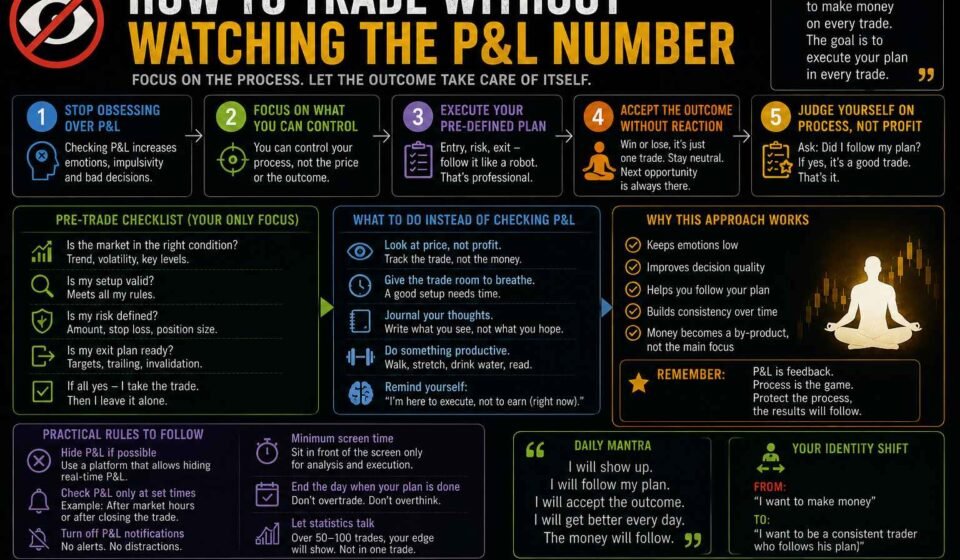

Two traders take the identical setup, identical entry, identical stop, identical target. One watches the live P&L number tick every second the trade is open. The other watches the chart and checks the account balance only at defined intervals. Across enough trades, the second trader keeps more of the gains their strategy was actually designed to produce.
This post is about why watching the number changes the outcome even when the plan is exactly the same, and what to look at instead.
Why the number itself is the problem
A price chart shows you information about the market. A live P&L number shows you information about your own money, converted into a constantly updating figure that goes up and down in front of your eyes. Those are two very different things to stare at, and they produce two very different mental states.
The chart invites analysis: where is price relative to support, is the trend intact, has volume confirmed the move. The P&L number invites something else entirely: a rolling, second-by-second verdict on whether this specific decision was right or wrong, delivered before the trade has had time to actually play out. That verdict arrives dozens of times a minute, and each flicker pulls attention away from the market and onto the emotional reaction to the number itself.
What watching the number actually does to decisions
- Winners get cut early. Once a trade shows a green number, closing it locks in a concrete, certain gain. Watching that number sit there creates pressure to protect it, even when the chart itself has given no signal to exit. The trader is reacting to the number, not the setup.
- Losers get held too long. A red number creates the opposite pull: closing it makes the loss official and final. Watching it tempts a trader to wait for the number to turn green again, even past the point where the chart has clearly invalidated the original setup.
- Stops get moved reactively. A stop that is about to be hit, watched live as a shrinking number, creates urgency to “give it a bit more room,” which is a decision driven by not wanting to see the number get worse, not by any new information about the chart.
- Position sizing on the next trade gets distorted. A large unrealized gain sitting on screen for an hour creates a felt sense of house money, which often leads to the next trade being oversized, because losing “some of today’s gain” feels less costly than it actually is.
Why this happens even to experienced traders
“I’m just checking it to stay informed, that’s responsible risk management.”
That is the justification, and it sounds reasonable, which is exactly why the habit persists. But there is a difference between checking a number at defined points to make a planned decision, and watching it continuously while it has no new information to offer beyond what the chart already shows. The chart tells you whether the setup is still valid. The live number mostly tells you how you feel about the setup, updated every second. Confusing the two is the actual mechanism behind the mistake.
This connects directly to the Control stage of the ACE framework. The rule that matters here is not about the trade’s entry or exit levels. It is a rule about what you are allowed to look at, and when, while the trade is open.
What to do instead
1. Hide the live P&L column, if your platform allows it
Many trading platforms let you display positions without the running profit and loss figure visible, showing only entry price, current price, and stop level. This single change removes the second-by-second emotional feed without removing any actual information needed to manage the trade.
2. Manage the trade by price levels, not by rupee amount
Write the plan in terms of price: “exit if price closes below 24,850” rather than “exit if I’m down ₹8,000.” Price-based rules keep attention on the chart, which is where the actual information about the setup lives. Rupee-based thinking keeps attention on the number, which mostly reflects your relationship to the outcome rather than the setup’s validity.
3. Check the account balance at defined intervals, not continuously
Some traders find a middle ground: checking overall P&L once per hour, or at the close of each position, rather than leaving it visible throughout. This preserves genuine awareness of risk without the constant emotional pull of a live-updating figure.
4. Journal the urge, not just the trade
When the urge to check the number shows up strongly during an open trade, note it. Over time, this reveals whether the urge clusters around specific conditions, larger position sizes, trades close to a round-number gain, trades near the stop, which tells you exactly where to add a specific rule.
A concrete comparison
Trader A takes a trade, watches the live P&L the entire time it is open. The trade moves 1.5R in their favor within twenty minutes. Watching the green number climb, they close it manually at 1.5R, well short of their planned 3R target, because the number sitting there in green felt like enough certainty to protect.
Trader B takes the identical trade, with the P&L column hidden, watching only price relative to their planned target and stop on the chart. Price continues toward the original 3R target over the next ninety minutes. Trader B exits at the planned level, because there was no live number pulling attention toward an early, emotionally-driven exit.
Same setup, same entry, same stop. The only difference was what was visible on screen while the trade was open, and it changed the outcome by half the total trade.
Why this is harder for traders who came from a spreadsheet-heavy background
Traders who built strong analytical habits elsewhere, in finance, accounting, or any numbers-heavy field, often find this specific change harder than traders without that background. The instinct to monitor a live figure closely feels like diligence, not a mistake, because in most other numerical contexts, closer monitoring genuinely does produce better outcomes.
Trading is one of the few numerical activities where this instinct works against you, because the number being monitored, unlike a spreadsheet formula, changes in response to market noise that has nothing to do with the quality of the underlying decision. A live P&L figure moving up and down within a single minute is mostly reflecting bid-ask bounce and small order flow, not new information about whether the trade thesis is still valid. Recognizing that the live number is mostly noise, not signal, is the specific belief shift that makes hiding it feel less like negligence and more like precision.
What to replace the habit with, not just remove
Simply removing the number from view without replacing the habit often leaves a gap that gets filled with something equally distracting, refreshing news headlines, checking other open positions, or scrolling social media during the trade. The goal is not an empty screen, it is a screen filled with the right information.
A useful replacement is a simple, static checklist visible during the trade: the original setup reason, the planned stop level, and the planned target, written once at entry and left untouched. Checking this list periodically gives the same sense of active engagement that watching the P&L number provided, without the second-by-second emotional pull, because the checklist does not move, it only gets compared against where price actually is.
Frequently asked questions
Is it dangerous to hide the P&L number entirely, in case something goes badly wrong?
No, as long as the stop-loss order itself is placed and active in the market. The stop is what actually protects capital, not the visual number. Hiding the P&L column does not remove any real protection, it removes a distraction from the number that has no bearing on whether the stop will do its job.
What if my platform does not allow hiding the P&L column?
Some traders use a second monitor or a simplified chart-only view during the trade, and only pull up the full account screen at the point they planned to check it. The specific method matters less than removing the continuous number from view.
Does checking P&L less often mean I am ignoring risk?
No, as long as the stop is in place and the position size was decided before entry. Checking less often removes emotional noise, not actual risk controls, which were already set before the number-watching would have started.
Why does a winning number create pressure to exit early, when that seems like good sense?
Because a visible, certain gain feels safer to lock in than an uncertain, larger future gain, even when the plan already accounted for that uncertainty at the time it was written. This is a well-established pattern in how people weigh certain versus uncertain outcomes, and it applies just as strongly to a live green number as to any other financial decision.
How long does it take to break the habit of watching the number?
Most traders notice a real difference within 2-3 weeks of deliberately hiding or ignoring the live figure, though the underlying pull to check it can persist longer, particularly on larger or more volatile trades.
The real point
The chart tells you about the market. The live number mostly tells you how you feel about your own money. Managing a trade well means paying attention to the first one and building a rule that keeps the second one out of view until it is actually time to look.
The market does not reward better predictions. It rewards better decisions, and those are easier to make when you are looking at the chart instead of the number.
Number dekhoge toh dar badhega, chart dekhoge toh samajh badhegi.
Related reading:
- Trading Psychology: The Complete Guide for Indian Traders
- How to Make Calm Decisions While a Trade Is Still Open
- You Know the Strategy. Why Can You Not Follow It?
Want to break this loop properly? I run a free live session twice a week for traders with two or more years of experience who know the setups but still cannot execute under pressure. Register for the next free session here.
I am Samir Dash, founder of Mindful Trading Hub. I work with experienced traders on live market decision-making. More about my story here.