
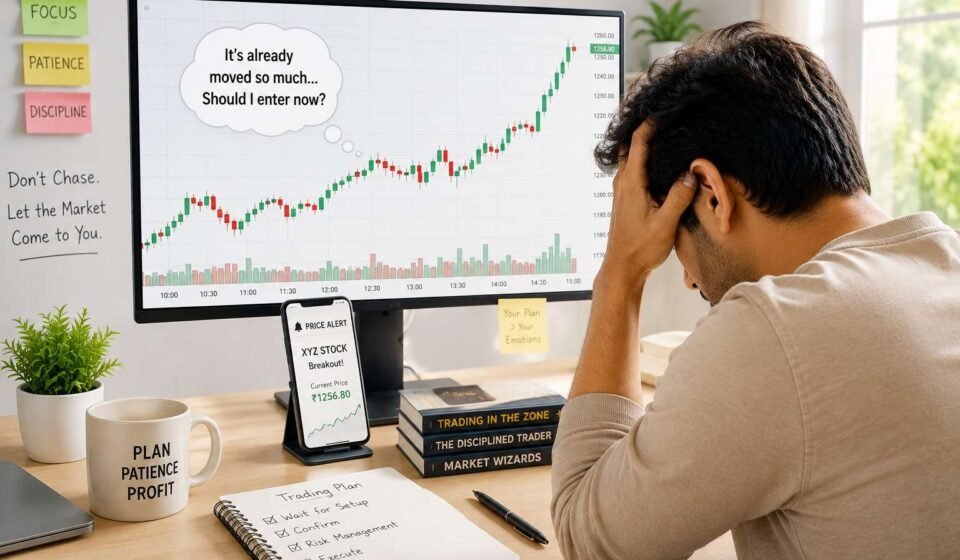

Nifty broke out at 9:35 and you were not in it.
By 9:50 it was 120 points higher. You entered at 9:52, near the top of the move, with a stop that had to be wide because you were nowhere near a structural level. It pulled back at 10:05 and took you out.
The move continued afterwards. You were right about the direction and you still lost money.
That is FOMO, and the reason it is so expensive is structural rather than emotional. Let us start there.
Why a FOMO entry is mathematically bad
Forget the psychology for a moment. A chased entry is a worse trade on the numbers, every time, for reasons that have nothing to do with how you feel.
Your entry price is worse. You are buying after the move, which means you have less distance to your target and more distance to any level that would support the position.
Your stop has to be wider. Structural stops sit below structure. Enter 120 points above it and your stop is either 120 points away, which is a large risk, or somewhere arbitrary in mid-air, which will get hit by noise.
Your risk-reward inverts. A planned entry might risk 1R for 3R. The same idea chased might risk 1R for 0.8R. Same direction, same analysis, completely different trade.
The pullback that stops you out is normal. Moves retrace. When you enter at the extreme, an ordinary retracement passes straight through your position.
This is the important part: a FOMO trade can be right about direction and still lose. That is why it does not teach you anything. You conclude your read was wrong when your read was fine and your entry was the problem.
What is actually driving it
FOMO is usually described as greed. It is closer to a loss.
When you watch a move you identified go without you, it does not register as a neutral non-event. It registers as something taken from you. You had it, in the sense that you saw it, and now it is gone.
And losses weigh about twice what equivalent gains do. So a missed 120-point move produces roughly double the pressure that capturing it would have produced pleasure.
That is why the response is so urgent and so oversized. You are not chasing profit. You are trying to close a loop that opened when the move left without you.
There is a second driver worth naming, particularly in India: social proof. Screenshots of winning trades circulate constantly on Telegram, Twitter, and Instagram. What you never see is the same account’s losing weeks. The feed is a highlight reel with survivorship built in, and it creates a permanent sense of being behind.
The three chase patterns
1. The breakout chase
Price breaks a level you were watching, you hesitate, then enter three candles later, well above the level. Most common and most expensive, because the stop distance grows with every candle you wait.
2. The other-instrument chase
Your instrument is quiet. Something else is moving. You switch, with no plan and no data on that instrument.
This one is worth watching for specifically, because it wears a disguise. It feels like flexibility and adapting to conditions. It is entering an unfamiliar market at a random point.
3. The social chase
Someone posts a winning position. You take the same trade twenty minutes later without knowing their entry, their stop, their size, or their timeframe. You have copied the direction and none of the risk management.
Six rules that work
1. Define your entry zone with a price, before the move
Not “I will buy the breakout.” Write: “I will buy between 24,980 and 25,010, and not above 25,010.”
The upper bound is the rule. Without it, “buy the breakout” has no expiry and stays valid at any price, which is exactly what a chase is.
2. Use limit orders at your level
A resting limit order at your zone either fills or does not. This removes the decision from the live moment entirely, which is the whole objective.
It also means you get your price or no trade, and no trade is a perfectly good outcome.
3. Apply the one-candle rule
If you did not enter within one candle of your signal on your trading timeframe, the trade is gone. Not reduced size, not a wider stop. Gone.
Simple, mechanical, and it kills the breakout chase entirely.
4. Measure the distance before entering
One calculation, ten seconds. How far is price from where my stop belongs?
If that distance is more than 1.5 times your normal stop, you have already missed it. This converts “am I chasing?” from a judgment call into arithmetic.
5. Wait for the retest, or accept nothing
Moves that continue usually retest. Make the retest your only permitted late entry, with a defined level and a defined invalidation.
If it never retests, you miss the trade. That is the cost, and it is small.
6. Remove the feed during market hours
The social chase has a mechanical fix. Close Telegram, Twitter, and Instagram while the market is open.
You are not missing information. Nothing actionable arrives in a screenshot of somebody’s open position. What arrives is pressure.
The reframe that helps most
The belief underneath FOMO is that opportunities are scarce.
They are not. Nifty and Bank Nifty produce setups every single week, indefinitely. There is no finite supply, and there is no last train.
The scarce resource is your capital. Every rupee spent on a chased entry with inverted risk-reward is a rupee unavailable for the clean setup two days later.
Missing a move costs you nothing. It is a zero. Chasing it costs you real money and, worse, it costs you the clarity to see the next one properly, because you are now down and pressured.
Say it directly when it happens: “I missed that one. There will be another.” Because there will be, and there is nothing else true to say about it.
Frequently asked questions
How do I know if I am chasing or entering a strong move?
Use the distance test. Measure from current price to where your stop would structurally belong. If that is significantly more than your normal stop distance, you are chasing regardless of how strong the move looks. Strength is not the variable, position relative to structure is.
What if the move never pulls back?
Then you miss it, and you have lost nothing. This happens and it is survivable. The alternative, entering at any price to avoid missing it, is what actually costs money.
Is FOMO the same as overtrading?
FOMO is one of the causes of overtrading, alongside boredom, capital anxiety, and recovery pressure. It is the one that produces the worst individual entries, because it specifically drives you in at the extreme of a move.
I get FOMO from my trading group. Should I leave?
Mute it during market hours at minimum. Groups that post live positions create constant pressure and provide almost nothing usable, since you do not know the poster’s size, stop, timeframe, or their losing trades. Discussion after the close is a different thing and can be genuinely useful.
How long does it take to stop chasing?
The mechanical rules work immediately, particularly the limit order and the one-candle rule, because they remove the decision rather than requiring you to win it. The feeling of missing out takes a few months to quieten, and it does not have to disappear for the rules to hold.
The bottom line
A chased entry is a worse trade at a worse price with a worse stop, and it can be right about direction and still lose. That is why chasing does not teach you anything.
Define the price you will pay before the move starts, and let the ones outside that range go.
Jo move chala gaya, woh aapka nahi tha. Agla aapka ho sakta hai.
Related reading:
- Averaging Down: Why It Feels Smart and Rarely Is
- Greed in Trading: What It Actually Feels Like in a Live Trade
- How to Build Habits That Actually Stick as a Trader
Want to fix your entries? I run a free live session twice a week for traders with two or more years of experience who know the setups but still cannot execute under pressure. Register for the next free session here.
I am Samir Dash, founder of Mindful Trading Hub. I work with experienced traders on live market decision-making. More about my story here.