

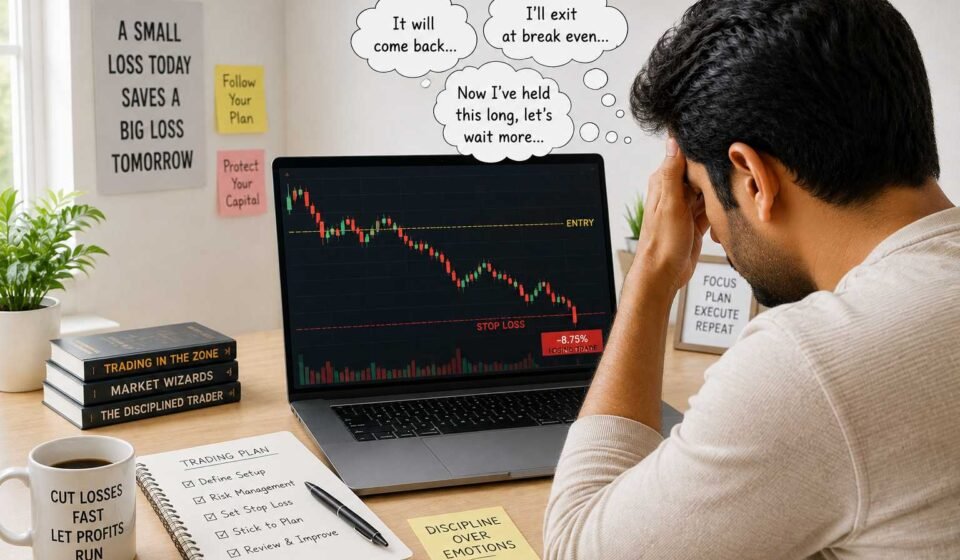

You have a position that is down 4%. You have another that is up 4%.
You need to free up capital, so you close one. Almost certainly you closed the winner.
This is the disposition effect, and it is one of the most reliably documented findings in all of investor psychology. Traders sell winners too early and hold losers too long, consistently, across markets, across countries, across decades of data.
Here is the problem with that instinct. It is the exact opposite of what produces profitability.
Why holding losers feels correct in the moment
The reasoning always sounds like analysis. That is the whole difficulty.
- “It is a good company, it will come back.”
- “Selling now locks in the loss.”
- “It is only a loss if I sell.”
- “I will exit at breakeven.”
- “Everyone is panicking, this is where you are supposed to hold.”
The second and third are the load-bearing ones, and they are both false in the same way.
The loss already happened. It happened when price moved against you. Your account value reflects it right now, whether or not you have clicked anything. Holding does not preserve the money, it preserves your ability to avoid acknowledging that the money is gone.
That is what the position is actually doing for you. It is not a trade any more, it is a way of keeping the outcome undecided.
The mechanism
Two things stack.
Losses weigh roughly twice what equivalent gains do. Realising a ₹10,000 loss hurts about twice as much as realising a ₹10,000 gain feels good. So the pressure to avoid the first is double the pull toward the second.
An unrealised loss is psychologically not yet a loss. While it is open, the story is undecided and recovery remains possible. The moment you close it, it becomes a fact with a number attached.
Put them together and the behaviour becomes predictable. You take small gains quickly to bank certainty. You let losses run to postpone certainty. The result is small winners and large losers, which is the only reliable formula for losing money with a system that should work.
What it costs
Concrete numbers, because this is the part that changes behaviour.
Baseline system: 40% win rate, 3R winners, 1R losers. Over 100 trades that is +60R.
Now apply the disposition effect to both sides, which is how it actually shows up. Winners get cut at 1.5R. Losers get held to an average of 2R instead of 1R.
- 40 wins × 1.5R = +60R
- 60 losses × 2R = -120R
- Net: -60R
Same entries. Same analysis. Same win rate. From +60R to -60R purely through exit behaviour.
This is why traders become convinced their strategy is broken and go shopping for a new one. The strategy was fine. Both exits were inverted.
The breakeven trap
Worth isolating, because it is the most common form this takes.
“I will exit at breakeven” sounds disciplined. It is not a plan, it is a wish with a price attached, and the price has no relationship to anything in the market.
Your entry price is meaningful to exactly one participant: you. The market does not know it, does not care, and will not return there because you need it to. Waiting for breakeven means holding a position for reasons entirely disconnected from whether the trade is still valid.
It also produces a specific pattern worth recognising. Price recovers to just below your entry. You do not sell, because you are so close. It reverses. Now you are waiting again, further away, with more invested in the outcome.
Averaging down
The escalated version. If it was worth buying at 100, it is better at 90.
Sometimes true for a long-term investor with a thesis, a time horizon, and no leverage. Almost never true for a trader, for three reasons:
- It increases size on a position that is already proving you wrong. Your risk grows precisely as the evidence against you accumulates.
- It resets your justification. The new lower average makes recovery feel closer, which makes holding easier, which is the opposite of useful.
- In F&O it can end the account. With leverage and expiry, “it will come back” has a deadline, and the position can go to zero before the deadline arrives.
The test is the same as always: was this addition planned before entry, with total risk inside your limit? If you decided while the position was against you, it is this article’s behaviour with extra steps.
Five fixes
1. A live stop-loss order at entry
The complete solution to this problem, and it takes one click.
A resting stop order closes the position without you making a decision in the moment when you are least equipped to make one. Everything else in this list is support for people who cannot yet do this consistently.
2. The re-entry test
Ask, honestly: if I were flat right now, would I enter this position at this price?
If no, you are not holding a trade. You are avoiding a click.
This works because it strips out your entry price, which is the irrelevant number driving the decision. It reframes holding as a fresh buy, which is what it actually is.
3. Define the exit in market terms, never in your terms
“I exit if price closes below 24,900” is a market condition. “I exit at breakeven” and “I exit when I am down ₹5,000” are conditions about you.
Only the first kind can tell you whether your idea is still valid.
4. Time stops
“If this has not moved in my favour within 45 minutes, I close it regardless of price.”
Underused and effective. It targets the specific case where the position is not dramatically wrong but is doing nothing, which is where dead positions accumulate and attention gets consumed.
5. Log the loser’s full path
For every losing trade, record two numbers: the loss at your original stop, and the loss you actually took.
Sum the difference over a month. That figure is what this habit costs you, and it is generally the single most persuasive thing a trader can look at, because it is not an opinion.
Frequently asked questions
Is it not true that most positions eventually recover?
Many do, and that is exactly what sustains the habit. But “eventually” is doing enormous work in that sentence. Capital tied up in a recovering position for three weeks is capital unavailable for setups you can see right now. And in F&O, eventually may be after expiry, at which point recovery is not available at any price.
What is the difference between holding a loser and giving a trade room?
Giving room was decided before entry, with a defined stop at a level that invalidates the idea. Holding a loser is deciding during the trade, with the exit moving as price moves. Same behaviour on the surface, opposite in every way that matters.
I hold losers but I do cut them eventually. Is that not the same thing?
The question is what triggers the eventual exit. If it is a price level you defined, you are fine. If it is that the discomfort became unbearable, your exit is being set by your tolerance rather than by the market, and that threshold is usually reached near maximum pain, which is frequently close to the reversal.
Does this apply to long-term investing?
Less so. Investing has a thesis, a multi-year horizon, and no leverage, so holding through drawdown is often correct. The disposition effect still applies, but the appropriate response differs. This post is about trading.
How do I stop feeling the pull to hold?
You mostly do not, and that is fine. The pull remains and the stop order fires anyway. Reducing size helps considerably, because the pull scales with the rupee amount at stake. If holding losers is a persistent pattern, halve your size for a month and watch what happens to the behaviour.
The bottom line
Selling winners feels like discipline and holding losers feels like conviction. Both are the same instinct: avoid the certainty of a loss, capture the certainty of a gain.
It is backwards, and it will turn a profitable system into a losing one without changing a single thing about your analysis.
Place the stop at entry. Let it do the deciding.
Loss tab hua jab price gira. Click karne se nahi hota.
Related reading:
- Averaging Down: Why It Feels Smart and Rarely Is
- Greed in Trading: What It Actually Feels Like in a Live Trade
- How to Build Habits That Actually Stick as a Trader
- Why You Exit Winning Trades Too Early
Want to fix both sides of your exits? I run a free live session twice a week for traders with two or more years of experience who know the setups but still cannot execute under pressure. Register for the next free session here.
I am Samir Dash, founder of Mindful Trading Hub. I work with experienced traders on live market decision-making. More about my story here.