
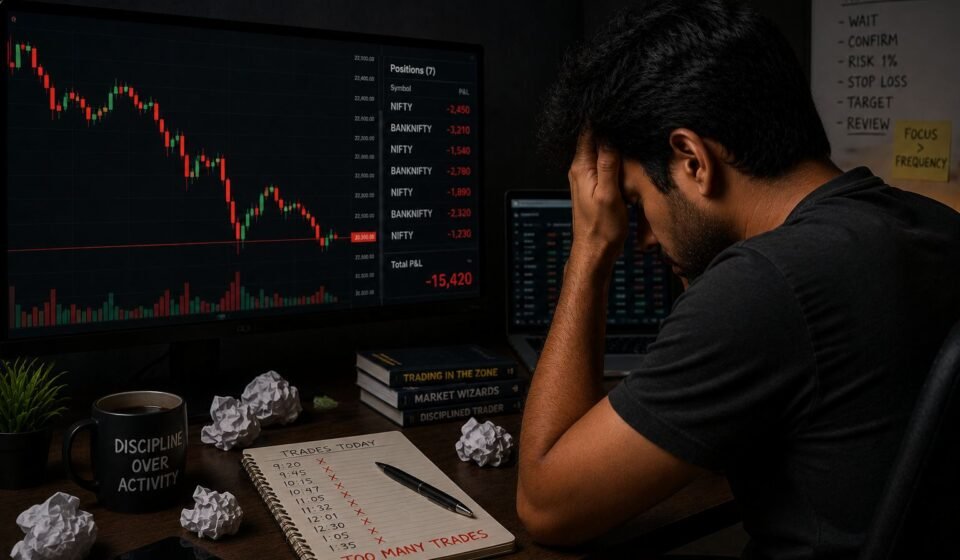

Overtrading is taking trades that do not meet your own criteria.
Notice what that definition does not say. It says nothing about a number. Twelve trades a day is not overtrading if all twelve met your rules. Two trades a day is overtrading if neither did.
This matters because most advice on the topic tells you to trade less, which misses the mechanism. The problem is not frequency. Frequency is the symptom.
Why it is the hardest habit to see
Revenge trading announces itself. You know the trade was emotional roughly ten minutes afterwards.
Overtrading does not. Each individual trade looks reasonable. You had a chart reason. You had a stop. The size was normal. Nothing about trade number seven feels like a mistake while you are taking it.
The damage only becomes visible when you aggregate, which most traders never do. And there is a second reason it hides: overtrading rarely produces the one big loss that forces a review. It produces a slow drift down through many small losses and brokerage, which never triggers the alarm that a single large loss would.
You end the month down ₹18,000 with no single trade you can point to as the problem.
The cost, made concrete
Take a trader with a real edge. 40% win rate, 3R winners, 1R losers, giving +0.6R per trade. Two quality setups per day, twenty trading days: 40 trades, +24R for the month.
Now that trader takes six trades a day instead of two. The two quality setups are still there. The extra four are marginal, and marginal setups do not carry the same edge. Assume they break even before costs, which is generous.
- 40 quality trades: +24R
- 80 marginal trades: 0R before costs
Looks harmless. Now add costs. Brokerage, STT, exchange charges, GST, plus slippage. Call it 0.15R per trade round trip, which is conservative for Indian F&O.
- 120 trades × 0.15R = -18R
- Net: +6R instead of +24R
Three quarters of the month’s profit, gone. Not to bad trades. To trades that did nothing, plus the cost of taking them.
And that assumed the marginal trades broke even. They usually do not, because attention degrades across a session. Trade eleven is not analysed as carefully as trade two.
The four sources
Overtrading is one behaviour with four different causes, and they need different fixes.
1. Boredom
The market is slow. You have blocked out four hours. Sitting and doing nothing feels like wasting the time you set aside.
The unstated belief: my job is to trade. It is not. Your job is to take your setups when they appear, which sometimes means doing nothing for three hours.
2. FOMO
Something is moving and you are not in it. Someone posted a screenshot. The fear is not of losing money, it is of missing money, and it produces entries at the worst possible point, after the move has already happened.
3. Capital anxiety
The belief that idle capital is wasted capital. This one usually comes from people who arrived at trading from business, where deployed capital does generate return.
In trading, cash is a position. Being flat during conditions that do not suit your system is the correct trade, and it has a positive expected value compared to forcing setups.
4. Recovery pressure
Down for the day, week, or month, and increasing frequency to catch up. This overlaps with revenge trading and is the most expensive of the four, because it usually arrives with increased size as well.
Twelve signs
Score yourself. Six or more means this is your primary leak.
- You cannot state your setup criteria in one sentence without looking them up.
- Your trade count varies a lot day to day with no matching change in market conditions.
- You take trades on instruments you did not plan to trade that morning.
- You have entered within two minutes of closing a position, more than once this week.
- Your brokerage for the month is more than 10% of your gross profit.
- You cannot remember why you took at least one trade from yesterday.
- You trade more on slow days than on active ones.
- You have lowered your criteria at least once because “nothing was setting up.”
- You feel restless rather than relieved when you have no position on.
- Your best trades are in the first hour and your worst are after 1pm.
- You check other timeframes after your primary one gives no signal.
- You have said “let me just take a small position” this week.
Number 8 is the definitional one. The moment criteria get lowered because nothing qualified, you have stopped running a system.
Why “just trade less” fails
Because it targets the number rather than the cause.
Tell a bored trader to take fewer trades and they will still be bored, sitting at the same screen, watching the same market. Willpower gets spent holding back rather than on execution quality, and it runs out around 1pm.
The fixes that work do one of two things: they remove you from the screen when there is nothing to do, or they make the criteria explicit enough that a marginal setup fails visibly rather than being quietly promoted.
The detailed rule set is in How to Stop Overtrading: 7 Rules That Actually Work. The short version:
- Write your setup criteria as a checklist with a specific number of conditions. A setup either meets all of them or it is not a setup.
- Set alerts and leave the screen. You cannot force a trade on a chart you are not watching.
- Log every trade against the checklist so your compliance rate becomes a visible number.
- Track your cost-to-profit ratio monthly. It is the earliest measurable signal.
The uncomfortable diagnosis
One question, and it is worth sitting with.
If you could only take three trades this week, would your results improve or get worse?
Most traders who consider this honestly say improve. Three trades would force them to wait for the best setups, the ones they already know work.
If your answer is improve, then you already know your marginal trades are costing you. The remaining question is not what to do. It is why you keep taking them.
The answer is usually that trading has become the activity you are attached to, rather than the outcome. That is not a moral failing and it is extremely common. But it is worth naming, because you cannot fix a frequency problem with rules if what you actually want is screen time.
Frequently asked questions
How many trades per day is too many?
There is no universal number, and any answer that gives you one is guessing about your system. A scalper may legitimately take thirty. A swing trader taking three in a day is probably overtrading. The test is whether each trade met your written criteria, not the count.
Is overtrading the same as revenge trading?
They overlap. Revenge trading is triggered specifically by a loss and aimed at recovery, usually with larger size. Overtrading is broader and often has no emotional trigger at all, just boredom or restlessness. Revenge trading is more expensive per instance. Overtrading is more expensive per month.
My broker charges are low, so does frequency really matter?
Brokerage is the smallest part of the cost. Slippage, the bid-ask spread, and the quality degradation of setups you would not normally take dominate. Even at zero brokerage, marginal setups do not carry your edge.
How do I handle slow market days?
Plan for them explicitly. Decide in the morning what you will do if no setup appears by a certain time, and make that plan something other than staying at the screen. Review past trades, do nothing, or close the terminal. An undefined plan for a slow day defaults to trading.
I only overtrade on some days. Is that still a problem?
Look for the pattern rather than the frequency. Most traders find their overtrading clusters in a specific window: after a loss, after 1pm, or on days that started slow. Once you can name your window, you can put a rule around it.
The bottom line
Overtrading does not blow up accounts. It drains them, slowly enough that no single day forces you to look at it.
The fix is not fewer trades as a target. It is criteria explicit enough that a marginal setup fails the test visibly, instead of getting quietly promoted at 2pm on a slow Tuesday.
Trading aapka kaam nahi hai. Apne setups ka intezaar karna aapka kaam hai.
Related reading:
- Averaging Down: Why It Feels Smart and Rarely Is
- Greed in Trading: What It Actually Feels Like in a Live Trade
- How to Build Habits That Actually Stick as a Trader
Want to find your own pattern? I run a free live session twice a week for traders with two or more years of experience who know the setups but still cannot execute under pressure. Register for the next free session here.
I am Samir Dash, founder of Mindful Trading Hub. I work with experienced traders on live market decision-making. More about my story here.