

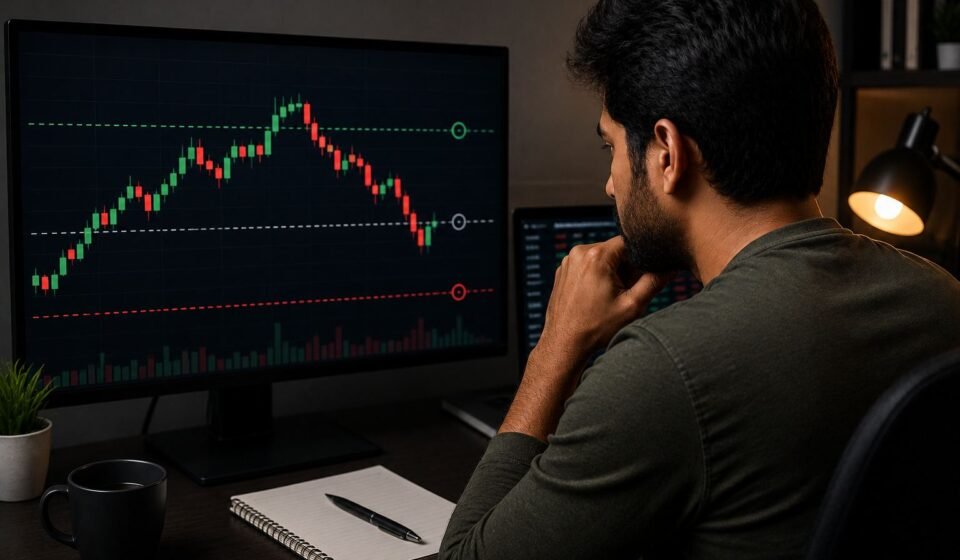

Everything written about stop losses assumes the thing you are trading moves like the thing you are analysing.
In options, it does not. You analyse the Nifty chart and you hold a premium that responds to the Nifty, plus volatility, plus time. That gap is why traders who are perfectly disciplined about stops in equity find themselves confused in F&O.
This post is about setting stops when the instrument and the analysis are two different things.
The core problem
You buy a 25,000 CE because Nifty looks bullish above 24,950. Your invalidation is a close below 24,900.
That level is on the Nifty chart. Your position is in the option premium. Nifty can sit exactly where it is for an hour and your premium will still fall, because time passed and implied volatility softened.
So you face a choice most traders never make consciously:
- Stop on the underlying, exiting when Nifty breaks your level.
- Stop on the premium, exiting when the option loses a set amount.
Choosing without deciding, which is the default, produces the worst outcome. You watch the premium, panic at decay, and exit a position whose actual thesis is still intact.
Rule one: stop on the underlying, size on the premium
For directional option buying, this is the approach that holds up.
Your stop level lives on the underlying chart. That is where your analysis lives, so that is where invalidation lives. Nifty closing below 24,900 means the idea was wrong. That is the exit trigger.
Your position size is calculated from the premium at risk. Before entering, estimate what the option will be worth if the underlying reaches your stop level. The difference between the current premium and that estimate is your risk per lot.
Worked example:
- Daily loss limit: ₹6,000. Maximum single-trade risk: ₹2,000.
- 25,000 CE currently at ₹120.
- Nifty at your stop level, allowing for decay, puts the option near ₹80.
- Risk per unit: ₹40. Nifty lot size 75, so ₹3,000 per lot.
- ₹3,000 exceeds your ₹2,000 limit, so this trade is not available at one lot.
That last line is the entire point of the exercise, and it is the step almost nobody performs. Most traders decide to buy one lot and then find out what it cost them.
Rule two: cap the premium loss as a backstop
The underlying stop handles direction. It does not handle the case where you are directionally right but the position bleeds out through volatility and time.
So add a second exit, a hard premium stop. If the option loses 30 to 40% of the premium you paid, you are out, regardless of where the underlying is.
This is not a substitute for the underlying stop. It is a backstop for the specific F&O failure mode: being right about direction, wrong about timing, and watching the position decay to nothing while the thesis technically remains valid.
Whichever triggers first, you exit.
Rule three: never average down on a long option
A long option has a defined maximum loss, the premium paid. That is genuinely a useful property, and it is the one thing options give you for free.
Averaging down destroys it. Each addition increases the amount that can go to zero, and because the position is decaying, you are adding to something whose value is falling on its own.
The Indian pattern is well documented enough to have a shape. Loss on a BankNifty option, then bigger lots to recover, then a large weekly loss. The ₹45,000-in-two-weeks story is this exact sequence.
One line: the premium you paid at entry is the most you will ever have in this trade.
Selling options is a different problem
Everything above assumes you are buying. Selling inverts the risk profile completely, and it needs saying because option selling is heavily promoted in India on the strength of its win rate.
Selling options gives you a high win rate and an undefined loss. That is the exact shape that produces long comfortable stretches followed by one event that removes them.
If you sell options, the stop is not optional and it cannot be mental:
- Use a stop on the premium. If the premium you sold doubles, you are out. Fixed, mechanical, no judgment.
- Prefer defined-risk spreads. A hedge bought at entry caps the loss structurally, which is worth more than any stop order.
- Size for a gap. Your stop does not protect you against an overnight gap. Size assuming your stop does not fill where you want it to.
The high win rate is not evidence the strategy is safe. It is a property of the payoff shape, and it is exactly what makes the eventual loss surprising.
Practical placement notes for Indian F&O
Expiry day changes everything
Decay accelerates sharply and premiums move violently on small underlying moves. A percentage-based premium stop that works on Monday is meaningless on expiry day. Either widen it substantially or reduce size, and be honest that expiry-day trading is a different activity with different parameters.
Use the underlying’s ATR, not the option’s
Set your invalidation buffer using the Average True Range of Nifty or Bank Nifty, not of the option premium. The option’s range is contaminated by volatility and decay, so it will not tell you what a meaningful move looks like.
Watch liquidity in your strike
Far out-of-the-money strikes have wide spreads. A stop order there can fill well away from your intended level. Trade strikes near the money where the book is deep, and accept that a wide spread is a real cost of the strike you chose.
Account for the auto square-off
Intraday positions get squared off by your broker near the close at whatever price exists then. That is not risk management. Have your own exit before it arrives.
A pre-trade checklist
- What level on the underlying proves this idea wrong?
- What will my option be worth if the underlying reaches that level?
- What is my risk per lot in rupees?
- Does that fit inside a third of my daily loss limit? If not, do not take it.
- What is my premium backstop, as a percentage of what I paid?
- Are both exits entered or alerted, not just remembered?
Six questions, about a minute. The trades this checklist prevents are worth considerably more than the minute.
Frequently asked questions
Should my stop loss be on the option price or the index?
Both, with different jobs. The index level is your real invalidation, because that is where your analysis lives. The premium stop is a backstop for decay and volatility. Exit on whichever comes first.
What percentage stop loss is right for options?
As a backstop, 30 to 40% of premium paid is a reasonable starting range for intraday directional buying. It is not a universal answer. On expiry day it is far too tight, and for positional trades it may be too loose.
Should I use a stop-loss order or exit manually?
A resting order, always. Options move fast enough that manual exits during a sharp move happen several points worse than intended, and that is before accounting for hesitation.
My stop keeps hitting because of decay even when Nifty is fine. What do I do?
Your premium stop is too tight relative to your holding period, or you are buying too far out of the money. Either buy closer to the money where the position is less decay-sensitive, or accept a wider premium stop with a smaller size.
Is a stop loss needed if I only buy options with money I can afford to lose?
If the entire premium is genuinely inside your per-trade risk limit and you will not average down, then your risk is capped structurally and a stop is optional rather than essential. Both conditions have to hold. In practice the second one is where people fail.
The bottom line
The reason F&O stop losses feel harder is that you are analysing one instrument and holding another. Once you separate the two jobs, stop level from the underlying, position size from the premium, most of the confusion disappears.
Decide both before you enter. In options, the decisions you make after entry are the expensive ones.
Analysis index par hota hai. Risk premium mein lagta hai. Dono alag decide karo.
Related reading:
- Risk Management Rules That Actually Get Followed
- When to Exit a Trade: The Decision Framework Most Traders Skip
- The ACE Framework: Aware, Control, Execute Explained
Want help applying this to your own trades? I run a free live session twice a week for traders with two or more years of experience who know the setups but still cannot execute under pressure. Register for the next free session here.
I am Samir Dash, founder of Mindful Trading Hub. I work with experienced traders on live market decision-making. More about my story here.