
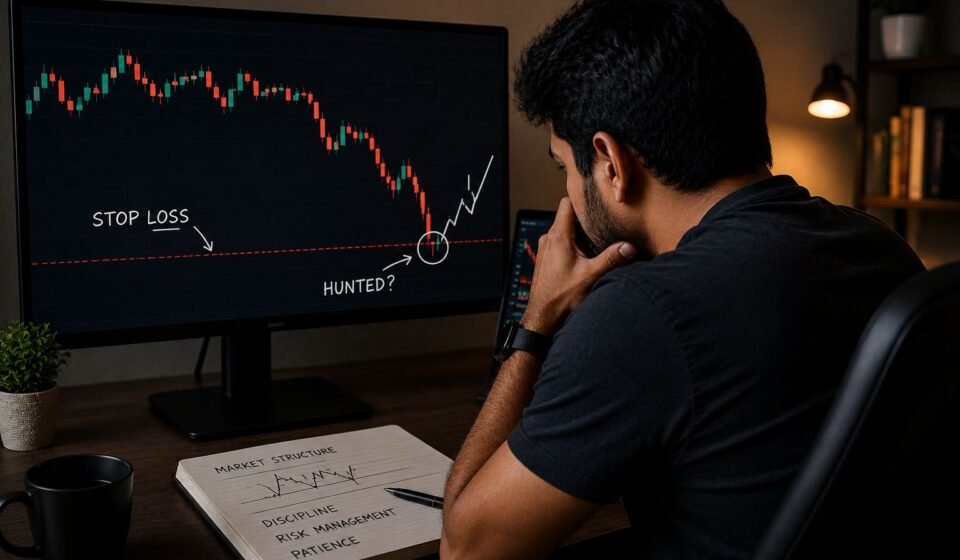

Price came down, took your stop by four points, reversed, and ran to your original target without you.
It has happened enough times that it does not feel random any more. It feels aimed.
This post is about what is actually happening, because the honest answer sits between the two popular ones. It is not paranoia, and it is also not personal. And the distinction matters, because one version of the story leads to better stop placement and the other leads to trading without stops at all.
What is actually true
Stop runs are real. Price does reach into areas of concentrated stop orders and reverse. This is well documented and you are not imagining it.
Nobody is looking at your stop. Your individual order is not visible to anyone as a target, and it is not large enough to be worth pursuing.
Both statements are true at once, and reconciling them is the useful part.
Why it happens: orders cluster
Large participants need liquidity. To fill a large buy order, someone must be selling in size at that moment.
Now think about where sell orders sit in a cluster. Below an obvious support level, below a recent swing low, below a round number. Every retail trader long from that support has a stop underneath it, and every one of those stops is a sell order waiting to trigger.
So a move down into that zone does two things at once. It triggers those sells, and it gives a large buyer the volume needed to fill. Once filled, the selling pressure is exhausted and price moves back up.
From your seat this looks like your stop was targeted, then the market reversed. What actually happened is that your stop was in a pool of similar orders, and the pool was the destination.
The insight worth taking: the market is not hunting your stop. It is going where the orders are, and your stop is standing in the crowd.
The version that is not stop hunting
Be careful here, because this explanation is comforting and it gets over-applied.
Most stops that get hit are not hit by liquidity sweeps. They are hit by ordinary movement, because they were placed inside the range of normal noise.
Here is the test. Measure the Average True Range on your trading timeframe, then compare it to your typical stop distance.
If your stop is smaller than one ATR, you are not being hunted. Your stop is inside the instrument’s routine breathing range, and it is being hit by the market doing nothing in particular.
Most traders who believe they are being hunted are in this category. That is good news, because it is a placement problem and placement problems have solutions.
How to tell which one is happening
Go back through your last twenty stopped-out trades and mark each one.
Signs of a genuine liquidity sweep:
- Price moved sharply beyond an obvious level and reversed quickly, often within one or two candles.
- The move left a long wick rather than a body close beyond the level.
- Your stop was at or just beyond a highly visible point: a round number, an exact swing low, the session low.
- It reversed and reached your original target.
Signs it was ordinary noise:
- Your stop was less than one ATR from entry.
- Price drifted through it rather than spiking.
- Price continued in that direction afterwards rather than reversing.
- It happens on most of your trades rather than at specific levels.
That last one is the clearest signal. If it happens on nearly every trade, it is not a market conspiracy. Sweeps happen at particular locations, not everywhere.
Four fixes
1. Place stops beyond the pool, not inside it
If everyone’s stop is below the swing low, that is exactly where liquidity sits. Put yours further out, past the obvious point rather than at it.
This costs you a wider stop, which is the trade you are making: you accept a larger distance in exchange for not being in the crowd.
2. Size down to keep the rupee risk constant
A wider stop does not have to mean more risk. Position size is risk divided by stop distance. Double the distance, halve the size, same rupee exposure.
This is the step that makes fix one usable. Most traders reject wider stops because they think in lots instead of rupees.
3. Use a buffer measured in ATR
Find your invalidation level and place the stop half an ATR beyond it. This scales with conditions automatically, so your stop widens on volatile days without you deciding anything.
4. Consider a candle-close stop
Exit only if a candle closes beyond your level, rather than on any touch. Sweeps are usually wicks. A close beyond the level is much stronger evidence that your idea was actually wrong.
The cost is a worse fill on genuine breaks. The benefit is not being removed by spikes. For traders who are frequently swept and then vindicated, this is often the single highest-value change.
The mistake this belief usually leads to
Here is why this topic matters more than it looks.
“I keep getting hunted” is the single most common justification for trading without a stop loss. The reasoning feels sound: if the stop is what is getting hit, remove the stop.
That swaps a bounded, solvable problem for an unbounded one. Your losses stop being 1R and start being however far price runs before you cannot watch any more. A 90% win rate with a handful of enormous losses is a losing system, and it takes months to reveal itself.
The correct response to being swept is better placement, not no placement.
The psychological trap
One more thing worth naming, because it is where this belief does quiet damage.
“Stop hunting” is an attractive explanation because it moves responsibility outward. The loss becomes something done to you rather than something to review.
That feels better and it costs you the lesson. A trader who believes stops get hunted stops examining stop placement, because there is nothing to examine. The problem is external.
Sweeps are real. They are also, for most retail traders, a much smaller fraction of stopped-out trades than the belief suggests. Check the ATR before reaching for the explanation.
Frequently asked questions
Do brokers see my stop loss and trigger it?
Your broker can see resting orders on their book, and in regulated Indian markets there are rules against acting on that. But the more useful answer is that your individual order is far too small to be worth anyone’s attention. The clustering explanation accounts for what you are seeing without requiring anyone to look at you specifically.
Does this happen more in F&O than in equity?
It tends to be more visible in leveraged, high-participation instruments like index options and futures, where stop clusters are dense and moves are amplified. The mechanism is identical, the effect is just easier to see.
Should I place stops at odd numbers to avoid clusters?
Marginally helpful, and much less important than distance. Being four points past a level and being at it are nearly the same location. The meaningful variable is whether you are beyond the pool or inside it.
If I widen my stop, my risk per trade goes up. How do I manage that?
Reduce position size proportionally. Risk in rupees is size multiplied by distance. Keep the rupee number fixed and let the other two adjust. This is the mechanism that makes wide stops affordable.
What if I widen my stop and still get hit?
Then the idea was probably wrong, which is what the stop is for. A stop that never gets hit is not protecting you from anything. The goal is not to avoid being stopped out, it is to be stopped out only when your reason for entering has actually failed.
The bottom line
Price goes where the orders are. Your stop sitting in an obvious cluster is not persecution, it is placement.
Measure your stop against ATR before you reach for the hunting explanation. Most of the time the fix is a wider stop, a smaller size, and a buffer beyond the crowd.
Market aapko target nahi kar raha. Aapka stop bheed mein khada hai.
Related reading:
- Risk Management Rules That Actually Get Followed
- When to Exit a Trade: The Decision Framework Most Traders Skip
- The ACE Framework: Aware, Control, Execute Explained
Want to review your own stop placement? I run a free live session twice a week for traders with two or more years of experience who know the setups but still cannot execute under pressure. Register for the next free session here.
I am Samir Dash, founder of Mindful Trading Hub. I work with experienced traders on live market decision-making. More about my story here.