

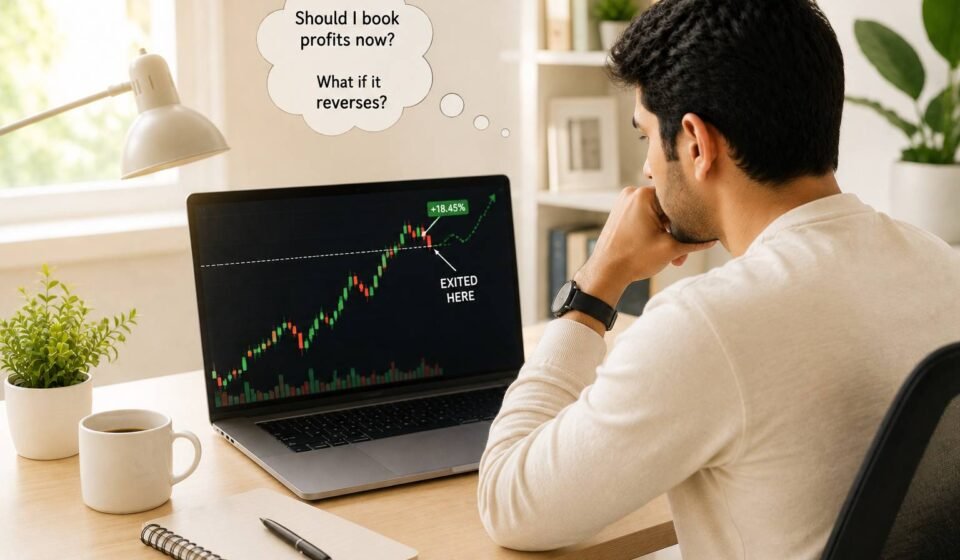

You were up 1.2R. Your target was 3R. The candle stalled for four minutes, it looked like it was pulling back, and you closed it.
Forty minutes later it hit your original target without you.
You did not break a rule that anyone would notice. You booked a profit. Your P&L was green. If you told this story to most traders they would say you did the right thing, because “profit is profit” and “nobody went broke booking a profit.”
Both of those sentences are wrong, and this post is about exactly how wrong, in numbers.
This is fear wearing a sensible costume
Cutting a winner short is usually described as a discipline problem. It is not. It is the same fear of loss that stops people entering trades, just showing up at a different point in the trade.
Once a position goes green, the unrealised profit starts to feel like something you own. Giving it back does not feel like a smaller win. It feels like a loss. So your brain does the thing it always does with a potential loss, which is close it out and make it stop.
This is why the impulse is so hard to argue with. You are not being greedy or lazy. You are protecting something. The instinct is genuinely a good one. It is just pointed at the wrong number.
The other reason it survives is that it works, briefly. Every single time you cut a winner early you get immediate, guaranteed, positive feedback: a green trade, a closed loop, relief. The cost arrives later and quietly, spread across a hundred trades where you never see the counterfactual. Behaviour that pays instantly and charges you later is the hardest kind to break.
The four exits that are all the same exit
Traders rarely say “I got scared.” They say one of these instead:
- “I moved my stop to breakeven.” Reasonable in principle. In practice, done at 0.8R on a trade that needs room, you have converted a 3R trade into a coin flip on noise.
- “I booked partial profits.” Sometimes valid. But check your log: do you take partials on every winner, or only the ones that feel uncomfortable? If it is only the uncomfortable ones, this is not trade management, it is anxiety management.
- “It looked weak.” Almost always a story written after the decision. If weakness was a real exit signal, it would be defined in your plan with a price attached.
- “I was protecting my profit.” The most respectable-sounding one. Ask yourself what you were protecting it from. Usually the answer is the feeling of watching it shrink, not a market event.
All four produce the same outcome. Your average winner shrinks. Your average loser does not.
What this actually costs you
Here is the part that makes people uncomfortable, and it is just arithmetic.
Say you have a decent system. You win 40% of the time. Your winners run to 3R and your losers stop out at 1R. Over 100 trades:
- 40 wins × 3R = +120R
- 60 losses × 1R = -60R
- Net: +60R, or +0.6R per trade
That is a genuinely good system. Now change one thing. You keep the exact same entries, the exact same stops, the exact same win rate. You just cut your winners at 1.2R instead of letting them run to 3R.
- 40 wins × 1.2R = +48R
- 60 losses × 1R = -60R
- Net: -12R
Same strategy. Same setups. Same discipline on the downside. You have turned a profitable system into a losing one, without changing a single thing about your analysis.
This is why so many traders are convinced their strategy is broken and go looking for a new one. The strategy was never the problem. The exits were.
Why your win rate hides it
Here is the trap that keeps this invisible for years.
When you cut winners early, your win rate goes up. Of course it does. A trade only needs to move a little in your favour to count as a win. So the number most traders check first, the one that feels like a report card, actually improves while the account gets worse.
You end up in a strange position: 65% of your trades are winners and you are still down for the month. And because the win rate looks healthy, you conclude the problem must be somewhere else. Usually you conclude it is the strategy, and you go and buy another one.
Track average R won versus average R lost. If your average win is smaller than your average loss, nothing else in your stats matters yet.
Why it gets worse after a good run
Counterintuitive, but consistent: most traders cut winners hardest right after a winning streak, not after a losing one.
Three green days in a row and there is suddenly something to protect. The account is at a recent high. A red day now would not just be a loss, it would be giving back progress. So sizing stays the same but exits get twitchy, and the best trades of the month get closed at a third of their potential.
If your journal shows your biggest missed runners clustered right after your best days, that is this. It is worth knowing, because it means the fix has to be applied when things are going well, which is exactly when nobody thinks they need it.
Five things that fix it
1. Decide the exit before the entry, and write it down
Target price, stop price, both written before the order is placed. Not a rough idea. A number. An exit you invent mid-trade is an exit made by the least reliable version of you.
2. Size down until 3R feels boring
This is the real fix and almost nobody wants to hear it.
If watching ₹6,000 of unrealised profit fluctuate makes you close the trade, the problem is not your patience, it is that ₹6,000 is too much money for your current state. Cut your size in half. The same trade in half size produces the same R-multiple and a fraction of the emotional pressure. Hold to target three times at half size and you have proof, not just intent.
Traders resist this because smaller size feels like going backwards. It is the fastest route forward available.
3. Only manage the trade at defined checkpoints
Pick your moments in advance. For example: you look at the position at the 15-minute candle close, and at nothing else. Between checkpoints, the trade runs.
Constant screen-watching is what generates the “it looks weak” feeling. Reduce the number of times you look and you reduce the number of chances to interfere.
4. Make partials a rule, not a mood
If you want to scale out, fine. But define it once: “I take 50% off at 2R and let the rest run to 4R with the stop at 1R.” Then it applies to every trade, including the ones that feel great and the ones that feel shaky.
A partial exit rule that applies only when you are nervous is not a rule.
5. Log what the trade did after you left
This is the single highest-return journalling habit for this specific problem. One extra column: where did it go after my exit?
For one month, record the maximum favourable move after every exit. It is uncomfortable reading. It is also the only feedback loop that makes the cost real, because normally the cost is invisible by design. You never see the 3R you did not get. This makes you see it.
Frequently asked questions
Is it always wrong to book profit early?
No. Exiting early is correct when your plan said to, or when the actual reason you entered has been invalidated. The test is simple: could you have written down that exit condition before you entered? If yes, it is trade management. If you only found the reason once you were in profit, it is fear.
My mentor says “book profit, nobody went broke taking a profit.” Is that wrong?
As a general rule, yes. Plenty of traders have gone broke taking profits, because they took small ones and full-sized losses. The saying survives because it sounds prudent, not because the maths supports it. What actually matters is the relationship between your average win and your average loss.
What if I hold to target and it reverses to a full loss?
It will happen, regularly. Roughly speaking, if your winners are 3R, you can afford to be wrong about most of them. That is the whole point of the ratio. A system is judged across a hundred trades, not one. The trade that reverses on you is priced in already.
How do I know if this is actually my problem?
Pull your last 50 trades and calculate two numbers: average R on winners, average R on losers. If your average winner is under 1.5 times your average loser, this is your biggest single leak. Fix this before you change anything else about how you trade.
The bigger picture
Every fix above works by moving the decision out of the live moment. Written targets, fixed checkpoints, pre-set partials, reduced size. None of them require you to feel calmer while the position is open. They just make sure the version of you that is calm is the one who decided.
That is the whole game. You will not out-discipline the feeling. You can absolutely out-plan it.
Aap market ko control nahi kar sakte. Apne decisions ko kar sakte hain.
Related reading:
- Revenge Trading: Why You Keep Trying to Win It Back
- How to Make Calm Decisions While a Trade Is Still Open
- Mindfulness for Traders: What It Actually Means (Not Just Sitting Still)
Want to fix this properly? I run a free live session twice a week for traders with two or more years of experience who know the setups but still cannot execute under pressure. Exits are one of the first things we work on. Register for the next free session here.
I am Samir Dash, founder of Mindful Trading Hub. I work with experienced traders on live market decision-making. More about my story here.