

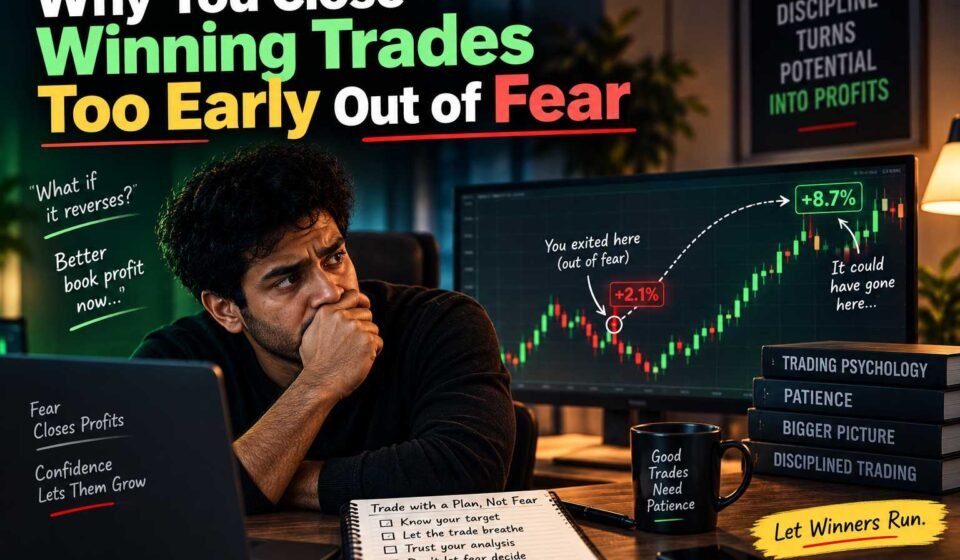

Your target was 25,050. You entered at 24,850. At 24,950, exactly 100 points in, halfway to target, you closed the trade. Two hours later, Nifty is trading at 25,060. You would have hit your full target and then some. Instead you locked in less than half of what your own plan said this trade was worth.
This is not a one-time mistake. For most traders, it is the single most repeated pattern in their entire trading history, and it happens for a very specific reason that has nothing to do with the chart.
The moment the fear shows up
The fear of giving back a gain does not arrive when a trade is deeply in profit and starting to reverse. It arrives much earlier than that, usually the moment a trade first turns green and keeps moving. At 100 points in, with 100 more to go, you are not thinking about your target anymore. You are thinking about the version of today where this trade goes back to zero and you did nothing about it.
That imagined version of today, where you had a gain and gave it all back, feels more real and more urgent than the actual plan you wrote a few hours earlier.
Why this fear is stronger than it should be, statistically
Once a position is in profit, your brain begins treating the current unrealised gain as belonging to you already, even though nothing is locked in until the trade closes. This means the trade going back down does not feel like “still ending up fine.” It feels like an actual loss of money you already had, and that kind of loss registers roughly twice as strongly as an equivalent gain would have felt good.
So the trade-off in your head is badly skewed. Staying in for another 100 points offers a gain that would feel good. Giving back the 100 points you already have would feel roughly twice as bad. Closing early, even at less than half your planned target, resolves that lopsided bet immediately.
Why a small, certain win feels better than a bigger, uncertain one
There is a second layer to this. A certain 100-point win, locked in right now, feels more comfortable than a probable 200-point win that is not yet locked in, even when the probable win is objectively the better outcome most of the time.
This preference for certainty over a better expected outcome is one of the most consistent patterns in how people make decisions involving risk, and trading puts you in front of it dozens of times a week. Every open winning trade is, in effect, offering you a choice between a smaller sure thing and a larger uncertain thing, and the sure thing has a strong natural pull.
“I could lock this in right now. Why risk giving it back for another hundred points?”
Notice this thought does not reference your target, your setup, or any chart-based reason to exit. It is purely about converting an uncertain gain into a certain one, as fast as possible.
The pattern this creates across your trading history
Look at a full month of your closed trades, not one trade at a time. Traders who close winners early out of this fear usually show a specific shape: many small wins clustered well below their stated targets, and losses that, while capped by a stop, are close to full size because the same fear does not apply on the way down. The losses stay losses. The wins get cut short.
Over enough trades, this shape can make an otherwise good setup unprofitable, even though the win rate looks fine on paper. The problem is never really the setup. It is that the average win is a fraction of the average loss, purely because of when the exit decision actually gets made.
Why this often gets worse after a string of losses
This fear is rarely constant. It tends to spike after a losing streak, even a small one. If your last two trades were stopped out, the next trade that turns green carries extra emotional weight, because you are not just protecting this gain, you are trying to prove to yourself that you can still win.
This makes the early exit even more tempting than usual, because closing the trade now confirms, immediately, that the losing streak is over. Waiting for the full target keeps that confirmation uncertain for longer, which feels unbearable after a run of losses. Recognising this pattern, that the urge to close early gets stronger right after a drawdown, is often enough on its own to slow the decision down.
How to tell the difference between smart profit protection and fear
Not every early exit is fear-driven. Sometimes new information genuinely justifies taking profit before your original target. The test is whether the reason existed before the trade turned green.
- Fear-driven exit: The only thing that changed is that you now have a gain to protect. The chart, the trend, and the setup are all still intact.
- Legitimate early exit: Something concrete has changed, a key level has been reached, volume has genuinely dried up, or a specific condition you wrote into your plan has triggered.
If you cannot point to a concrete, pre-decided reason, the exit came from fear of losing the gain, not from analysis.
What actually fixes this
- Use a partial exit rule instead of an all-or-nothing decision. Booking a third or half of the position at a set level satisfies the urge to lock something in, while leaving the rest to run toward the real target. Full detail in Should I Book Partial Profits or Let It Run?.
- Set your target before entry and treat it as the default, not a suggestion. The default action is to hold to target. Closing early requires a specific, written reason, not a feeling.
- Use a trailing stop once price crosses a certain point, so protecting the gain is handled by a rule rather than a live decision you have to make while feeling the pull to lock it in.
- Track your average win versus average loss in rupees, monthly. If wins are consistently a fraction of your stated targets, this is happening whether you have noticed it or not.
A test you can run this week
For your next ten trades, before you enter, write your target on a sticky note or in a notes app, somewhere separate from your trading screen. When you close a winning trade, check it against that written number before you log the trade as done.
Most traders who try this are surprised by the gap. Not because they did not know their target in theory, but because seeing the actual written number next to the actual exit price, side by side, makes the pattern impossible to explain away as “reading the market.” It is a small exercise, but it turns a vague feeling of “I probably exit early sometimes” into a specific, countable habit you can then work on directly.
Frequently asked questions
Why do I always close winning trades before they hit my target?
Once a trade is in profit, your brain treats that gain as already yours. Giving it back feels like an actual loss, which registers more strongly than the equivalent additional gain would feel good, creating pressure to lock in a smaller, certain win.
Is closing a trade early ever the right call?
Yes, when a specific, pre-decided condition has actually changed, such as a key level being reached or a factor you built into your original plan. The problem is only when the only thing that changed is that you now have a profit to protect.
How do partial exits help with this fear?
Booking part of the position lets you satisfy the urge to lock in a gain immediately, while the remaining portion stays open toward your original target. This reduces the pressure to make an all-or-nothing decision under the pull of the fear.
Should I just always hold to my full target no matter what?
Not necessarily, since market conditions can genuinely change. The goal is making sure any early exit is based on a specific, pre-written reason rather than the discomfort of having an open gain that could shrink.
How do I know if this is actually costing me money?
Compare your average winning trade size to your stated target size over a month of trades. If your wins consistently land well below target while your losses run close to full stop size, this pattern is present in your trading.
The real point
Closing a winner early does not feel like fear. It feels like being smart, taking what the market gave you, protecting your gains. But if the only thing that changed is that you now have money on the table, the decision came from fear, not from your plan.
The market does not reward better predictions. It rewards better decisions.
Jo mila hai use bachana samajhdaari hai, lekin plan se pehle nahi.
Related reading:
- Adding to a Winning Position: When It Is a Plan and When It Is Greed
- Averaging Down: Why It Feels Smart and Rarely Is
- Why You Move Your Stop Loss, and the Rule That Fixes It
Want to break this loop properly? I run a free live session twice a week for traders with two or more years of experience who know the setups but still cannot execute under pressure. Register for the next free session here.
I am Samir Dash, founder of Mindful Trading Hub. I work with experienced traders on live market decision-making. More about my story here.