
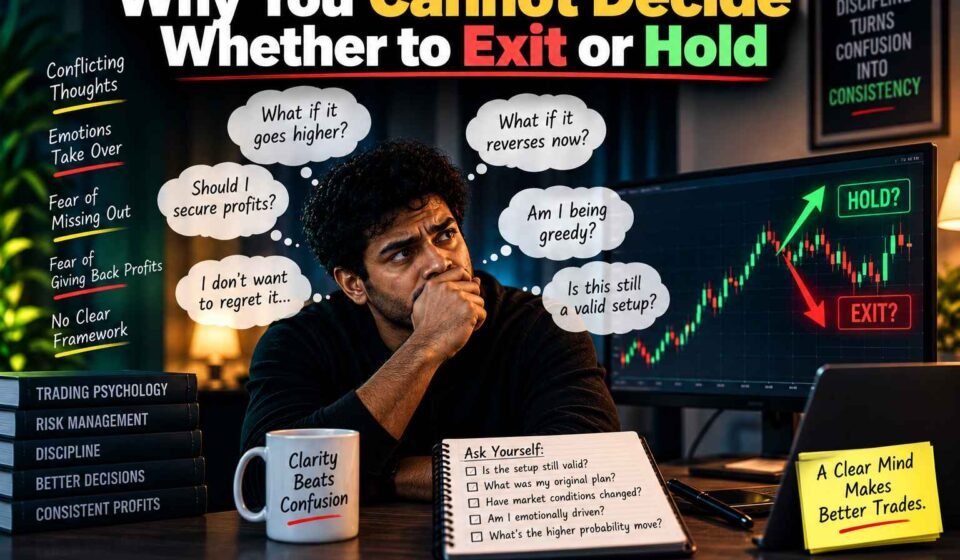

Your cursor is hovering over the exit button. Price is at 24,910, your entry was 24,850, your stop is 24,800 and your target is 25,050. Nothing has actually gone wrong. But you have been sitting here for four minutes, thumb tapping the desk, unable to click either the exit button or simply close the laptop and walk away.
This is not indecision about the market. The chart is not confusing. This is indecision about which version of regret you are willing to accept, and that is a much harder thing to resolve than reading a candle.
What is actually happening when you freeze
Freezing on a live trade almost never happens because you lack information. You usually have everything you need: your entry, your stop, your target, and current price, all visible on the same screen. What you are missing is not information. It is certainty about which outcome you will regret less.
If you exit now and the trade keeps running to target, you will regret leaving money on the table. If you hold and the trade reverses back through your entry, you will regret not taking the gain while you had it. Both outcomes are visible to you at the same time, which is exactly why neither choice feels obviously correct. Your mind is trying to solve for the answer that produces the least regret, and there often isn’t one, because regret is being generated by the situation itself, not by any specific choice.
Why this feels worse than a clear loss or a clear win
A trade that has clearly hit your stop does not require a decision. It requires an action, closing it, but no real choice is involved. A trade that has clearly hit your target is the same. The decision only becomes agonising in the space between those two points, where the trade is neither failing nor succeeding, just existing, and any action you take is a genuine choice rather than a rule being followed.
This is why indecision tends to cluster in trades sitting in the middle of their range, up somewhat but not at target, or down somewhat but not at stop. The clearer the outcome, the less decision paralysis you feel. The more ambiguous the current position, the worse it gets.
Why more analysis does not fix this
The instinct when frozen is to look for more information. Check a different timeframe. Check volume. Check a second indicator. This feels productive, but it rarely resolves the freeze, because the freeze was never about missing information in the first place.
Adding more inputs while indecisive usually just adds more conflicting signals to weigh, which extends the freeze rather than ending it. Five more minutes of analysis on a trade that already has a clear stop and target is five more minutes of decision fatigue, not five more minutes of useful clarity.
“Let me just check one more thing before I decide.”
If you have said this more than once about the same trade, the additional check is not going to produce the answer. It is going to produce another version of the same uncertainty, dressed up as new information.
The cost of staying frozen
Freezing is not a neutral outcome. While you are stuck deciding, the market is still moving, and the trade is still exposed to whatever happens next, with or without your decision. Two common results:
- The freeze resolves itself when price finally hits your stop or target, meaning the market made the decision for you, after you spent several minutes of stress not making it.
- The freeze breaks under pressure, usually at the worst possible moment, a sudden spike that panics you into an exit that has nothing to do with either your stop or your target.
Both outcomes cost you something the plan was supposed to prevent: a decision made by circumstance or panic, rather than by your own written rule.
Why this connects to your exit framework, not your willpower
Indecision during a live trade is rarely a willpower problem. It is usually a sign that the trade currently sits inside a gap your exit plan did not cover. If your only two rules are “exit at stop” and “exit at target,” every point in between is undefined, and undefined territory is exactly where freezing happens.
The fix is not trying harder to decide. It is closing the gap in advance, the same way described in When to Exit a Trade: The Decision Framework Most Traders Skip. A time exit and a partial exit rule, decided before the trade, cover most of the middle ground where freezing tends to happen, because they give you a defined action for the ambiguous zone instead of leaving it as an open question.
Why this feels different from normal decision making
In most areas of life, more time to think produces a better decision. A live trade breaks that pattern. The longer you sit frozen between exit and hold, the more anxious and tired you become, and tired decisions are rarely better than quick, rule-based ones. This is counterintuitive if you are used to thinking of careful deliberation as a strength. In a live trade, past a certain point, deliberation stops being careful and starts being avoidance dressed up as thoroughness.
What to do in the moment, while already frozen
If you are already stuck on a live trade right now, these steps work faster than trying to analyse your way out:
- State your actual numbers out loud. Entry, stop, target, current price. This grounds you in the plan rather than the feeling.
- Ask one question only: has my stop or target been hit? Not “does this feel risky.” Just the literal, written condition.
- If neither has been hit, the default action is hold. Freezing usually happens because you are searching for a reason to act. Remind yourself that “no new information” is itself an answer: the plan says wait.
- If you genuinely have no rule for this situation, write one down right now for next time, even mid-trade. You cannot fix this trade’s plan retroactively, but you can make sure this exact gap does not repeat.
Why some traders never seem to freeze
Watch a trader who executes calmly, and it can look like they simply do not experience this pull between exiting and holding. That is rarely the truth. What they usually have is a complete enough exit plan that very few trades ever land in genuinely undefined territory.
Their stop covers the downside. Their target covers the upside. Their time exit covers the trade that goes nowhere. Their partial exit covers the trade that is in profit but not yet at target. Between those four rules, almost every situation a live trade can present has an assigned action. There is very little room left for the kind of ambiguous middle ground where freezing happens, not because they feel less, but because their plan leaves fewer open questions for the feeling to attach to.
Frequently asked questions
Why do I freeze on some trades and not others?
Freezing tends to happen when a trade is in the ambiguous middle ground, neither at your stop nor your target, where no clear rule tells you what to do. Trades that are clearly at stop or target rarely produce this same paralysis.
Does checking more indicators help me decide?
Usually not. The freeze is rarely caused by missing information, so adding more signals to analyse tends to extend the indecision rather than resolve it.
What should I default to when I genuinely can’t decide?
If your stop has not been hit and your target has not been reached, the default action under your original plan is to hold. Indecision is often a search for a reason to act, and “no new condition has triggered” is itself a valid answer.
Is freezing on a trade a sign I’m not cut out for trading?
No. It is a sign your exit plan has a gap in the middle ground between stop and target. Most traders experience this until they build a time exit and partial exit rule that cover that space explicitly.
How do I stop this from happening on future trades?
Build a complete exit framework before entry, covering invalidation, target, time, and partial exits, so there is a defined action for the ambiguous middle ground instead of an open question you have to resolve live.
How this connects to the anxiety of a losing trade
Freezing is not limited to trades that are ambiguous in direction. It also shows up on trades that are clearly moving against you, where the freeze is less about which choice to make and more about not wanting to make either one. See The Anxiety of Watching a Live Trade Move Against You for how that specific version plays out and what to do while it is happening.
The real point
Freezing between exit and hold is not a lack of courage. It is what happens when a trade sits in territory your plan never defined. The fix is not deciding harder in the moment. It is going back and closing the gap before the next trade ever opens.
The market does not reward better predictions. It rewards better decisions.
Jab plan poora hota hai, dimaag khaali reh jaata hai faisle ke liye.
Related reading:
- Adding to a Winning Position: When It Is a Plan and When It Is Greed
- Averaging Down: Why It Feels Smart and Rarely Is
- Why You Move Your Stop Loss, and the Rule That Fixes It
Want to break this loop properly? I run a free live session twice a week for traders with two or more years of experience who know the setups but still cannot execute under pressure. Register for the next free session here.
I am Samir Dash, founder of Mindful Trading Hub. I work with experienced traders on live market decision-making. More about my story here.