

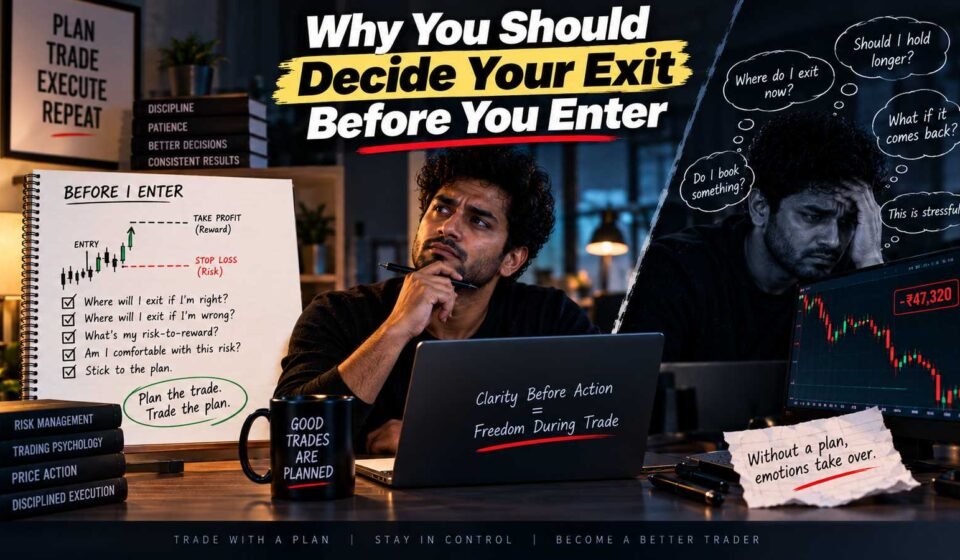

Here is a question worth asking yourself honestly. When you entered your last five trades, did you know the exact price where you would exit for a loss, and the exact price where you would exit for a profit, before you clicked buy or sell?
Most experienced traders say yes when asked this in general. Then, when they check their last five actual trades, the honest answer is closer to “I had a rough idea.” A rough idea is not a plan. A rough idea is a decision you postponed until the moment you are least equipped to make it well.
This post covers why deciding your exit after entry is so much harder than deciding it before, what changes in your thinking once money is at risk, and exactly how to write an exit plan that actually holds up when the price starts moving.
The moment everything changes: before entry versus after
Before you enter a trade, you are a neutral observer. The chart in front of you is information. You can look at it, compare it to other setups, and walk away from it with no cost.
The second the order fills, you are no longer neutral. You now have a position that will make or lose money depending on what the chart does next. This single change, from observer to participant, is the biggest shift in how your brain processes the same information.
Studies on decision-making consistently show that people evaluate the same numbers differently depending on whether they currently hold a position in the outcome. A trader with no position looks at a 40-point pullback and calls it normal. The same trader, five minutes after entering, looks at the same 40-point pullback and calls it a warning sign. The chart has not changed. The trader’s relationship to the chart has.
Why “I will decide when I see how it moves” fails
This is the plan that feels flexible and reasonable in the morning, and it is the plan that causes the most damage once the trade is live. Here is why.
- You are no longer thinking clearly by the time you need to decide. The moment you most need to decide your exit is exactly the moment your attention is narrowed on the moving number, which is the worst possible state for a careful decision.
- Every price level starts to look meaningful. Without a pre-set stop, every small dip becomes a candidate for “maybe I should get out here,” and every small bounce becomes a candidate for “maybe I should hold for more.” You end up deciding fifteen times instead of zero times.
- Loss aversion kicks in and shifts your stop in real time. Once a trade is red, the pain of confirming the loss by exiting is sharper than the pain of a slightly bigger loss later. So the exit point keeps moving further away, not because the setup changed, but because deciding to exit now hurts more than deciding to exit later.
None of this is about weak willpower. It is what happens to almost anyone who tries to make a precise decision under live pressure without having made it already.
What a real exit plan contains
A usable exit plan is short. It does not need paragraphs. It needs four specific things, written down before you enter, in a place you can look at while the trade is open.
- Stop loss price. An exact number, for example “24,780 on Nifty spot” or “8 points below the low of the entry candle.” Not “if it starts looking bad.”
- Target price, or partial profit levels. For example “book half at 24,920, trail the rest.” Vague targets like “ride it as long as possible” turn into guessing games later.
- Invalidation condition. The one thing, separate from price, that tells you your original reason for the trade was wrong. For example, “if Nifty closes back inside the range I was expecting a breakout from.”
- Time limit, if relevant. Some setups are only valid for a certain window, for example an opening range trade that should resolve within the first hour. If it has not moved by then, that itself can be an exit signal.
Write these four things down every single time, even for trades that feel obvious. The trades that feel most obvious at entry are often the ones where you skip the plan, and skipped plans are where the biggest losses tend to hide.
The blank stop loss field is where discipline actually breaks
“I will just watch it closely and get out if it feels wrong.”
This sentence sounds responsible. It is actually the sentence that removes your stop loss entirely and replaces it with a feeling that has no fixed price attached to it. A feeling cannot be back-tested. A feeling does not trigger automatically at 2 AM when you are asleep and the position is still open. A number does.
If you find yourself thinking a version of this sentence right before entry, treat it as a stop sign, not a plan. Go back and write the actual number.
Why this matters more the closer price gets to your levels
The pull to abandon a written plan is not constant. It grows sharply as price approaches your stop or your target. This is covered in detail in Watching a Trade Near Your Target: Why the Last 10 Points Feel Hardest, but the short version is important here too.
When price is far from your stop, the plan feels easy to follow because there is nothing at stake yet. When price is 5 points from your stop, every part of your attention narrows onto that number, and the temptation to give it “just a bit more room” is strongest exactly when giving it more room is most costly. A written, specific stop is what survives that moment. A rough idea does not.
What to do when the market gaps past your plan
Sometimes the price will gap straight through your stop or your target without letting you exit at the exact number, particularly overnight in F&O positions. This is a real limitation of any plan and it is covered fully in What to Do When a Trade Gaps Against You. The short answer is that a written plan still wins in this situation, because it tells you what to do the moment the market opens, rather than leaving you to decide under the added shock of a gap.
A simple test to check if your plan is real
Before your next trade, try this test. Write your stop, target, and invalidation condition on paper or in a notes app. Then ask yourself: could someone else execute this exact trade using only what I wrote, without asking me anything? If the answer is no, the plan is not finished. If the answer is yes, you are ready to enter.
Frequently asked questions
Is it okay to adjust my stop loss after entering a trade?
Yes, but only in the direction of reducing risk, for example moving it to breakeven once a certain level is reached, and only if that adjustment rule was part of your original plan. Moving a stop further away from price to give a losing trade more room is not an adjustment, it is abandoning the plan.
What if my setup genuinely does not have a clear stop level?
Then it is not ready to trade yet. Every setup that is precise enough to trade is precise enough to have a stop. If you cannot define where you are wrong, you have not finished analysing the trade, regardless of how confident you feel about the direction.
How specific does my target need to be?
Specific enough that you would recognise it on the chart without checking your notes. A round number like “25,000” is fine. “Somewhere near the recent high” is not, because “near” will keep moving as the price gets closer.
Should my exit plan change based on how the trade is performing?
Only through pre-decided rules, like trailing a stop after a certain move in your favour. Changing the plan reactively, based on how you feel about the current price, is exactly what a written plan is meant to prevent.
I keep writing a plan and then ignoring it mid-trade. What now?
This usually means the plan is written but not visible while the trade is live, or the position size is large enough that fear is overriding the plan regardless of how clear it is. Check How Position Size Changes the Way You Feel About a Live Trade for the second possibility, it is more common than people expect.
The real point
Your exit is not a reaction to the market. It is a decision you already made, that the market simply confirms later. Every minute you spend deciding your exit before you enter is a minute you buy back from the version of you that will be under pressure later. The market does not reward better predictions. It rewards better decisions, made at the right time.
Exit pehle decide karo, market ke bharose mat chhodo.
Related reading:
- The ACE Framework: Aware, Control, Execute Explained
- Mindfulness for Traders: What It Actually Means (Not Just Sitting Still)
- What Happens in Your Brain While a Trade Is Open
Want to break this loop properly? I run a free live session twice a week for traders with two or more years of experience who know the setups but still cannot execute under pressure. Register for the next free session here.
I am Samir Dash, founder of Mindful Trading Hub. I work with experienced traders on live market decision-making. More about my story here.